
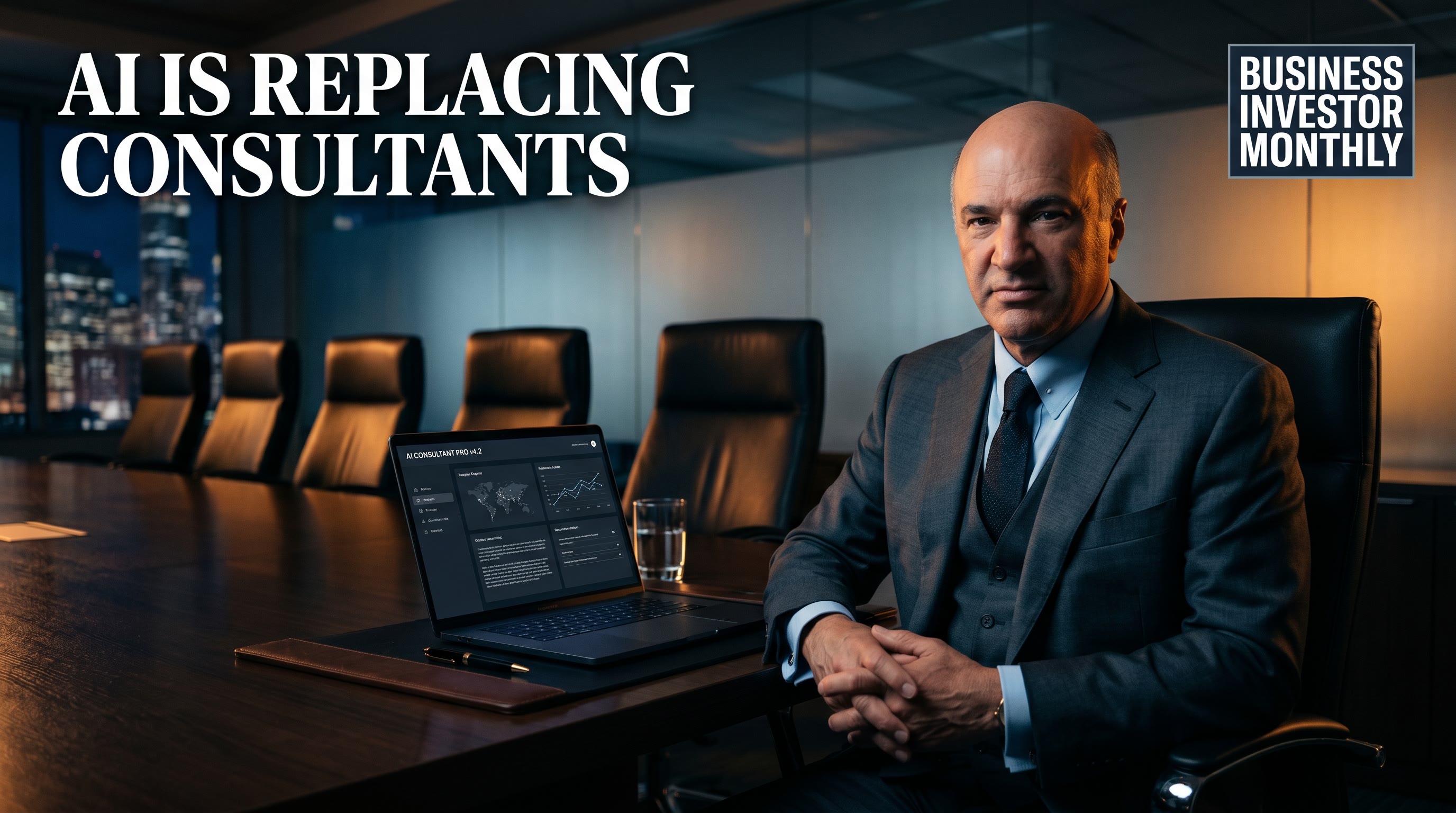
Kevin O'Leary Is Half Right About AI Replacing Consultants
Kevin O'Leary went on record this month saying his portfolio companies are ditching consultants for AI. His exact words: "Even the companies that I invest in that used to use a lot of consultants for very specific vertical situations are first going to AI, which they can do for a lot cheaper." He's right about the diagnosis. He's wrong about the prescription. The death isn't coming for consultants. It's coming for a specific type of consultant: the one who sells hours and deliverables instead of systems and IP.
That distinction is everything. And most consultants still don't see it.
The Model That's Actually Dying
Here's what O'Leary is really describing. A company hires a strategy firm to produce a market analysis. The firm bills 400 hours. A senior partner reviews the slides. The client gets a PDF. Three months later, the engagement ends. The client still doesn't know how to do the analysis themselves. They call the firm again next quarter.
That is the model that's dying. And it deserves to die.
Sakana AI launched Marlin in June 2026, an autonomous research agent that runs 8-hour unattended sessions and produces 100-page reports and executive slide decks with no human intervention. Three hundred enterprise beta users across financial institutions, operating companies, and consulting firms are already testing it. Sakana positions Marlin explicitly as "the reason those customers question whether they need McKinsey in the first place."
McKinsey itself reports that roughly 40% of its current work involves AI-related projects. BCG said about 20% of its 2024 workload was tied to AI initiatives. The big firms are pivoting because they can read the room. The solo consultant billing $300 an hour for research and analysis cannot survive the same tool that runs overnight for $40.
That is O'Leary's point. And he's right.
But here is where his analysis breaks down. He's describing what AI replaces. He's not describing what it can't replace.
What AI Can't Buy You
AI produces output. It does not produce judgment about which output matters.
AI synthesizes research. It does not tell you which finding to stake your reputation on.
AI generates slide decks. It does not walk into a board meeting and hold the room when the CFO pushes back.
More specifically: AI does not build a repeatable client system that delivers consistent outcomes across different engagements. It does not encode your specific methodology. It does not carry the relationship. It does not own the IP.
You do. Or you should.
The consultants who are getting fired right now built their business on four things: access to information, synthesis of information, presentation of information, and hours billed doing all three. AI collapsed the value of all four. If your entire practice is research, analysis, and decks, you are not a consultant. You are a human API. And humans make worse APIs than actual APIs.
The consultants who survive built something different. They built a process that produces a specific outcome. They productized it. They made it teachable, repeatable, and scalable. Their IP lives in a framework, not in their billable hours.
Systems beat deliverables. Every time. In every market condition. And especially in this one.
The Hartford Lesson
I was one of 15 innovation scouts in a 55,000-person organization. My job was to find the thing that replaced the old thing before the old thing broke.
We were embedded in a massive insurance operation. The directive was simple: identify emerging threats and opportunities before they become crises. What I learned in that role wasn't about innovation. It was about timing. The companies that survived disruption weren't the ones that saw it coming. They were the ones who had already built the internal capability to respond. They didn't need to call anyone. They had the system.
The consultants who sold us point-in-time analysis? We stopped calling them. Not because the analysis was bad. Because we had internalized the methodology. We owned the framework. We didn't need to rent someone else's thinking anymore.
That is exactly what is happening now at scale. AI lets companies internalize the methodology faster. The consultants who only sold the output are redundant. The consultants who transferred the system are not. They're already gone, because their clients no longer need them. That's the goal. That's the exit.
The Owner-Operator Frame
Every consultant should run what I call the Owner-Operator Frame on their practice. The question is simple: if you stepped out of your business for 90 days, would it still produce value for your clients?
For most consultants, the answer is no. Because the value is them. Their expertise, their relationships, their hours. That's not a business. That's a job with a complicated invoicing system.
The Owner-Operator Frame forces a different question: what is the repeatable system that delivers the outcome? Not the person who delivers it. The system.
The 90-Day Bottleneck Audit starts there. Map every function in your practice. Identify which ones require your specific judgment. Identify which ones are process. Anything that is process should be documented, templatized, and eventually systematized with AI. What's left is your actual IP: the judgment layer that AI cannot replicate.
Most consultants who do this audit discover that about 70% of what they do is process. That's not a failure. That's an opportunity. Systematize the 70%. Charge a premium on the 30%. Use AI to generate scope documents and SOWs in 24 hours instead of 3 days. Convert project engagements into retained relationships with recurring revenue by delivering ongoing insight from systematized workflows.
That is the pivot. Not from consulting to AI. From deliverables to systems.
The Adoption Numbers Don't Lie
Seventeen percent of US businesses used AI as of December 2025. Among firms with 250 or more employees, that number jumps to 30%. McKinsey reports 88% of large companies use AI in at least one business function. Generative AI adoption went from 33% in 2023 to 79% in 2025.
Those numbers mean that your clients are using AI right now to do things they used to hire you to do. They are not waiting for your permission. They are not asking if AI is ready. They are already inside the tool.
The question is not whether AI is replacing consultants. It already is, in specific functions. The question is which consultants have positioned themselves in a way that AI makes more valuable, not less.
The answer is the ones who sell systems.
A consultant who builds a proprietary intake scoring methodology and licenses it across 50 client organizations is not threatened by AI. AI makes that system faster to deploy and easier to iterate. The consultant who spent last quarter manually building 50 slide decks is in serious trouble.
The Multiple Conversation
O'Leary talks about investing. So let's use his language.
A consulting practice that sells deliverables trades at zero multiple on exit. There is nothing to buy. The value walks out when the consultant does. A PE firm or strategic acquirer has no interest in a book of business that evaporates when the principal leaves.
A consulting practice that sells a proprietary system, a documented methodology, a training program, a software tool, or a licensed IP framework trades at a real multiple. There is something to acquire. The value persists beyond the founder.
AI did not create this distinction. It accelerated the penalty for ignoring it.
The consultants who built transferable processes are walking away with multiples. The consultants who sold hours are getting fired. Both groups are responding to the same market pressure. The outcomes are completely different.
Competence beats credentials. Always has. The credential was the consulting brand. The competence is the system. AI is stripping the credential premium faster than any prior disruption. What it cannot strip is a genuinely differentiated methodology backed by proof of outcomes.
If you have that, O'Leary's warning is an opportunity. If you don't, it's a termination notice.
What the Smart Move Looks Like
Step one: audit your practice against the Owner-Operator Frame. What do you actually do? How much of it is process?
Step two: document the process. Every step. Every decision point. Every output format. Build it so someone else, or something else, could execute 70% of it.
Step three: use AI to run the 70%. Research, synthesis, first-draft deliverables, client updates, intake scoring, scheduling, reporting. Let the tools handle the workflow.
Step four: price the 30% at a serious premium. That 30% is your judgment, your relationships, your domain authority, your outcome guarantee. It should be the most expensive thing in your market.
Step five: package the system as a licensable asset. A training program. A SaaS product. A certification. A white-label methodology. Something that another firm or individual can buy and deploy without you.
That fifth step is what most consultants never take. It's also what separates the ones who build wealth from the ones who build workload.
O'Leary is right that AI is replacing consultants who sell analysis. He's wrong that AI is replacing consulting. The category doesn't disappear. It upgrades. The practitioners who don't upgrade are the ones he's describing. The rest will be fine.
FAQ
Q: Is Kevin O'Leary right that AI is replacing consultants?
He's right that AI is replacing a specific type of consultant: one who sells research, analysis, and deliverables at an hourly rate. Tools like Sakana AI's Marlin can now run 8-hour autonomous research sessions and produce 100-page reports with executive slide decks at a fraction of the cost. If your practice is built on producing output, you are directly exposed. If it's built on a proprietary methodology that produces specific client outcomes, you are far less exposed and potentially more valuable because of AI.
Q: What kind of consulting survives the AI wave?
Systems-based consulting survives. This means practices built on four pillars: a documented, repeatable methodology, a proprietary intake or diagnostic framework, clear outcome guarantees tied to that framework, and the ability to transfer or license the IP independent of the founder's hours. The 90-Day Bottleneck Audit is a useful starting point to identify which parts of your practice are genuinely differentiated and which are exposed.
Q: How do I convert my practice from deliverables to systems?
Start by documenting every step of your current engagements. Map what is process and what is judgment. Use AI to systematize the process layer: scope documents and signed SOWs in 24 hours, automated intake scoring, AI-assisted research and first drafts. Then price the judgment layer at a premium and begin packaging the full system as a licensable asset. The goal is a practice where the methodology works without you present.
Q: Should consultants be worried about tools like Marlin from Sakana AI?
Consultants who sell research synthesis and slide production should be very concerned. Sakana's Marlin is positioned as a direct alternative to strategy team outputs, and 300 enterprise clients are already testing it. Consultants who sell a repeatable outcome system backed by deep domain expertise have a different situation. Their risk is being commoditized on the output layer. The protection is ensuring that the output layer is not where their premium is priced.
Q: What does "competence beats credentials" mean for consultants right now?
It means the McKinsey brand is a declining asset, and your specific methodology is an appreciating one. For decades, the consulting credential carried significant premium: the brand, the pedigree, the Rolodex. AI is accelerating the erosion of credential-based pricing across the board. What it cannot erode is a genuine system that delivers proven results. Clients do not need a credential. They need an outcome. The consultant who can guarantee the outcome with a documented, repeatable system wins. The consultant who was selling access to a prestigious brand is losing ground every quarter.