
TL;DR
On June 24, 2026, MoEngage bought Aampe for tens of millions in cash. Aampe's whole product is a dedicated AI agent for every single customer, not a segment, not a cohort, one agent per person, running on reinforcement learning. Aampe already processes over 200 billion of these individual decisions a week. This is not a feature announcement. It's a signal that the entire CRM category is rebuilding itself around the individual instead of the audience. Klaviyo is already moving the same direction with its Composer agent. If your email and SMS program still runs on 12 tidy segments, you have roughly one buying cycle to change that before it becomes the price of admission, not the differentiator.
MoEngage, the customer engagement platform used by more than 1,350 brands including Flipkart, Domino's, and Deutsche Telekom, announced it acquired Aampe in an all-cash deal that TechCrunch reported was worth tens of millions of dollars. Aampe's technology assigns a dedicated, autonomous AI agent to every individual end user of a brand. Not a segment model. Not a lookalike audience. One agent, one person, learning continuously from that one person's behavior. The company has deployed millions of these agents across brands like Swiggy, Grab, Zalora, and Taxfix, and its systems make more than 200 billion decisions every week about what to send, when to send it, and through which channel.
This matters even if you have never heard of MoEngage or Aampe. The buyer is a direct competitor to Klaviyo, Braze, and Salesforce Marketing Cloud, and it just spent real money to make "one agent per customer" a standard feature instead of a startup's pitch deck. When one player in a category buys the capability, the rest follow within 12 to 18 months. You saw this with AI copy generation in 2023. You are about to see it with individual-level decisioning in 2026 and 2027.
Segments Are Dead, Agents Are Alive
Segmentation was never really about your customers. It was about your tooling's limits. You could not personalize for 50,000 people individually with a human team, so you built buckets. VIPs. Lapsed. New. Cart abandoners. High AOV. Each bucket got a flow. Each flow got a few branches. You called that personalization, and for 20 years, it was the best available option.
Aampe's own documentation names the core problem. Traditional systems train one model on all users, find patterns that work "on average" across segments, then apply that logic to everyone in the bucket. The result is messages optimized for an average customer who does not exist. Your VIP segment holds a customer who buys weekly and opens every email, and a customer who buys twice a year and only opens SMS. Same bucket. Same message. Different human.
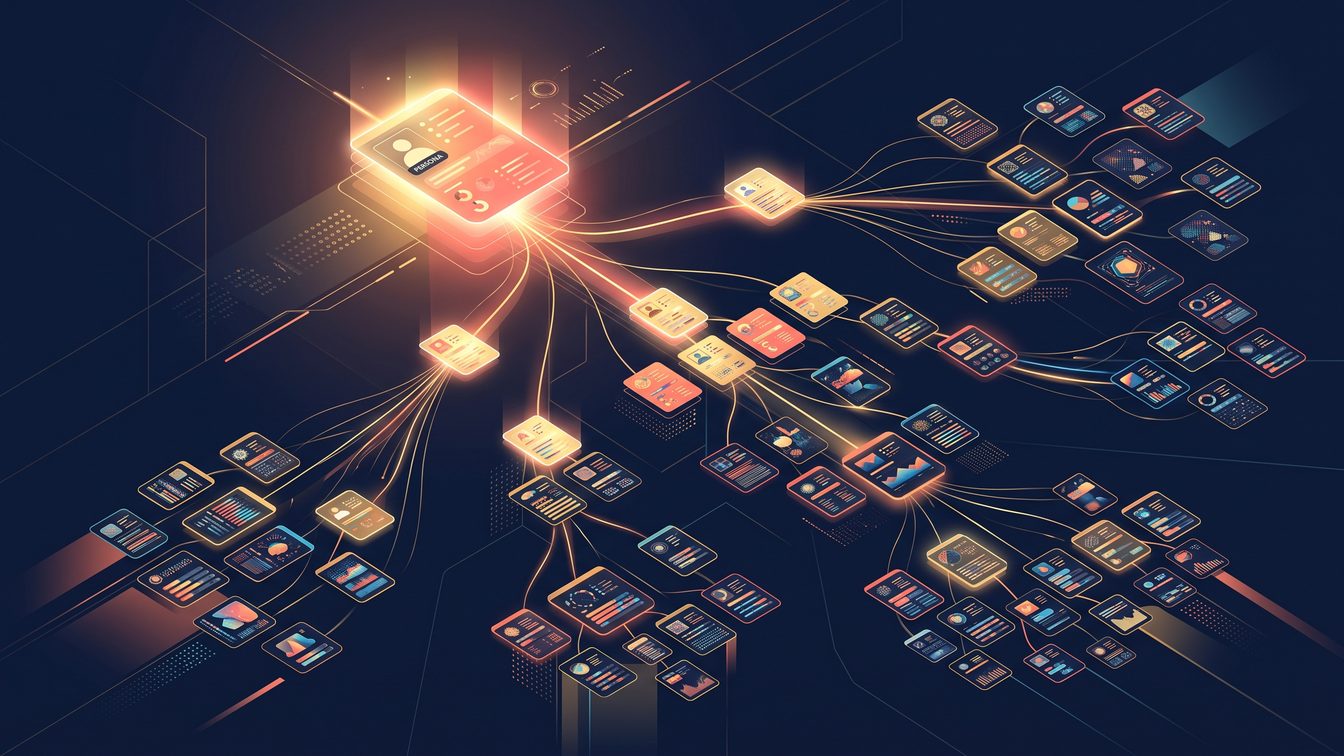
The agent model flips this. Each customer gets a dedicated agent that learns exclusively from that person's clicks, purchases, timing patterns, and channel preferences, then decides content, timing, frequency, and channel independently for that one person. No manual segment management. The agent runs a loop: observe, learn, decide, deliver, measure, repeat, for every customer, every day.
The results are already public. Zalora, the Southeast Asian ecommerce platform, deployed Aampe into its push notification pipeline and saw targeted users add items to wishlists and start checkouts 21% more often within two weeks of training, according to Aampe's case study. Fy!, a UK-based home goods marketplace shipping products from 3,500 emerging brands, drove a 7% compound monthly growth rate in order rate during its first 30 days, with a 30% jump in first-month purchases from new users. TheCut, a barber-booking platform serving nearly a million monthly users, integrated Aampe in about 8 hours and watched its agents immediately map 396 distinct behavioral micro-groups among its user base, groups no human segmentation exercise would have found or maintained.
That last number is the one to sit with. 396 groups, generated automatically, on day one, versus the 5 to 12 buckets a marketing team can realistically manage by hand. The math of segmentation was always a headcount constraint dressed up as a strategy. Remove the constraint, and the buckets stop making sense.
What 'One Agent Per Customer' Actually Means
Strip away the vendor language and the mechanism is specific. Aampe's agents use a form of reinforcement learning called Thompson sampling, paired with multi-armed bandit algorithms, to run a continuous, personalized experiment on every customer.
Four dimensions, optimized per person. Each agent decides content, timing, frequency, and channel independently for its one assigned customer. Zalora's data showed customer timing preferences held steady across consecutive days less than 30% of the time. A static send-time feature, the kind bolted onto most ESPs today, cannot keep up with that. A per-user learning agent can, because it re-evaluates constantly instead of on a quarterly cadence.
Every message is a controlled experiment. Instead of running one A/B test and picking a winner for the whole list, the agent treats each send as a data point specific to that customer, measuring impact through interrupted time series analysis, then updating its belief about what works for that person. There is no winning variant applied to everyone. There is a running, individual-level belief that keeps updating.
New customers borrow from similar ones, not averages. When a customer has little history, the agent imputes preferences from customers with similar behavioral signatures, then refines that guess as real data arrives. This is why "agent per customer" is not the same as "1,000 tiny segments." A segment is static. An agent updates its model after every interaction.
Marketers set the guardrails, not the message. You are not writing 50,000 individual emails. You define content options, offers, brand voice, and business rules. The agent decides which combination goes to which person and when. Your job moves from campaign builder to policy setter. That is a real shift in what the marketing seat does day to day.
Klaviyo is not standing still. Its March 2026 Composer release lets marketers describe a campaign in plain language, and the system determines audience, message, timing, and channel using data from more than 193,000 brands. The platform decides more, the human decides less, and static segmentation stops being the default. When the two largest players in customer engagement software both race toward individual-level decisioning in the same window, that is a category shift, not a trend piece.
The 90-Day Ecom Operator Playbook
You do not need to rip out your ESP tomorrow. You need to stop building your program in a way that makes the eventual switch expensive and slow.
Days 1-15: Audit your data exhaust. List every signal your store captures and every signal it throws away. Browse behavior beyond page views. Time-of-day open patterns per customer. Product category dwell time. Return behavior. Support ticket sentiment. Most Shopify and WooCommerce stores capture 10% of what an agent-based system needs. Fix your event tracking before you fix your messaging.
Days 16-30: Kill your zombie segments. Pull the last 90 days of performance for every segment in your ESP. Any segment with fewer than 200 active members, or a send frequency that has not changed in six months, is dead weight, not a personalization strategy. Consolidate or delete. This cleanup makes migration to any agent-based layer faster later, because you are not dragging 40 legacy flows into a new architecture.
Days 31-50: Pilot one high-value flow with adaptive 1:1 timing. Pick your highest-revenue automated flow, usually post-purchase or cart abandonment, and test send-time and channel optimization at the individual level rather than the segment level. Run it against your current static flow for three weeks. Measure lift above baseline, not raw open rate, because a rising tide across your whole list will hide a flat-performing flow.
Days 51-70: Reframe your team's job description. Rewrite what "campaign manager" means at your company. Less time in the drag-and-drop builder. More time writing offer logic, defining brand guardrails, and auditing agent decisions for brand safety. A skill set limited to building flows by hand has a shrinking shelf life.
Days 71-90: Pilot one agent-based platform, not a replatform. Aampe, and now MoEngage by extension, are built to plug into existing CRM and CDP pipelines without a rebuild, the way theCut connected through Customer.io and Snowflake in about 8 hours. Run a 30-day side-by-side test on one channel. Compare revenue per recipient above baseline, not vanity opens. Decide with data, not hype.
None of this requires a six-figure martech budget. It requires treating your segment list as a temporary scaffold, not a finished asset.
Jeff's Take: The Math Changed
At Angel Investors Network, we segmented our 50,000-plus investors into 12 buckets. Accredited versus non-accredited. Early-stage versus growth. Geography. Deal size preference. Twelve clean buckets, twelve email templates, one CRM admin managing it part time. Worked great in 2005.
Today those 12 buckets would be 50,000 individual conversations. Every investor has a different risk appetite, a different check size they actually write versus the one they claim, a different response pattern to follow-up cadence. Back then, we could not build 50,000 individual relationships by hand. Nobody could. So we approximated with buckets and called it strategy.
The math changed. Compute got cheap enough that an agent per person costs less than a junior CRM hire, and it never sleeps, never forgets a customer's last three purchases, and never applies yesterday's rule to today's behavior. Your tools need to change with it. Segments were not wrong. They were the correct answer under the old constraints. The constraint that made them necessary is gone now. Holding onto 12 buckets in 2026 is like insisting on a paper ledger because the abacus worked fine in 1995.
Framework Reference: Data's DNA
This shift is the clearest proof yet of a principle I call Data's DNA. Every signal a customer leaves behind, a click, a dwell time, a return, a support message, a skipped email, carries information about who that person is and what they will do next. Segment-based marketing reads three or four strands of that DNA and averages the rest away. Agent-based systems read all of it, continuously, for one person at a time. The operators who win the next five years stopped throwing away behavioral signal in 2026, not in 2028 after competitors already have years of individual-level data compounding in their favor.
Doctrine Connection: Capitalism Creates Value
Capitalism creates value, and value here is measurable in dollars, not sentiment. Zalora generated real, attributable revenue within a single week of deploying per-customer agents. Fy! posted a 7% compound monthly growth rate in order rate that a spreadsheet, not a press release, can verify. A tax platform in Europe cut unsubscribes by 21% while processing 15 million-plus events in two off-season weeks. None of that is theoretical. It is capital allocated toward a system that produces more revenue per customer than the one before it, the only test that has ever mattered in a P&L. Early adopters are not chasing a trend. They are capturing value sitting on the table while competitors debate whether AI marketing is real.
FAQ
Do I need to switch off Klaviyo or my current ESP to do this? No. Aampe and similar agent-based layers plug into your existing CRM, CDP, and messaging pipeline. TheCut integrated in about 8 hours without touching its existing Customer.io and Snowflake setup. Start with a pilot on one flow before considering a full replatform.
Is this just fancier A/B testing? No. A/B testing picks one winning message and applies it to everyone. Agent-based systems run a continuous, individual-level experiment for every customer and update that customer's model after every interaction. The unit of learning is the person, not the campaign.
What size ecom business actually needs this right now? Under 5,000 active customers, your existing segmentation probably still works fine and the ROI on a pilot will be thin. Above 20,000 active customers, especially with repeat purchase behavior, the gap between segment-based and agent-based performance shows up in your revenue-per-recipient numbers within weeks.
What happens to my email and SMS team's jobs? The work shifts from building flows by hand to setting content options, offers, and brand guardrails, then auditing what the agents decide. Teams that only know flow-building without understanding offer strategy will need to develop those skills. This is a skill shift, not a headcount elimination event, at least not yet.
How do I know if my current ESP is moving toward this or getting left behind? Ask your vendor directly whether they optimize at the individual level or the segment level, and ask for a customer reference with real, verifiable lift numbers, not a demo video. Klaviyo's Composer and MoEngage's Aampe integration are the two most concrete public answers in the market as of mid-2026. If your vendor has no roadmap answer, that is your answer.
Disclosure
This article was researched and drafted with AI assistance and reviewed for accuracy and voice before publication. Data points on the MoEngage-Aampe acquisition, case study results, and product mechanics are drawn from public company announcements, press coverage, and vendor-published case studies cited by hyperlink throughout. demg.ai has no financial relationship with MoEngage, Aampe, or Klaviyo.