
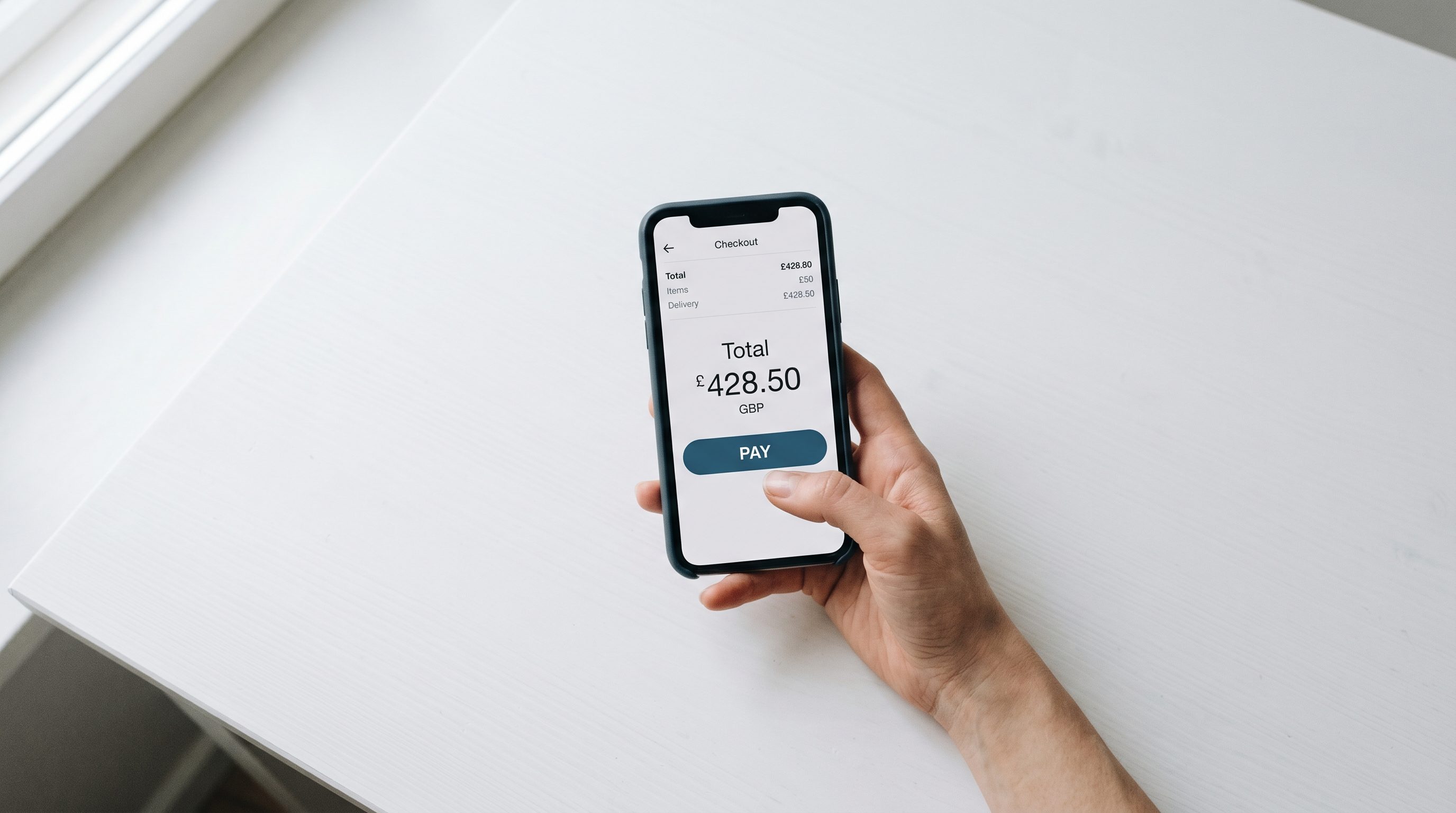
Mobile is already 70% of your traffic. It converts at roughly half the rate of desktop. That gap is your biggest revenue leak — and AI-powered checkout optimization is the fix. This article gives you the system, the numbers, and the exact steps to close it.
The Math Most Store Owners Get Wrong
You are pouring budget into ads. You are optimizing product pages. You are A/B testing hero images.
Meanwhile, mobile cart abandonment sits at 85%. Desktop? Around 69%.
That 16-point spread is not a minor inefficiency. It is a structural revenue failure hiding in plain sight.
Here is how the math shakes out. Say your store does $1M in annual revenue. Mobile drives 70% of sessions but converts at 1.8% versus desktop's 3.9%. If you close even half that gap on mobile, you are looking at $200K–$400K in incremental revenue from traffic you already paid to acquire.
The payback period on fixing mobile checkout is measured in weeks, not quarters.
Why Mobile Underperforms (It Is Not What You Think)
Most owners blame screen size. Screen size is a red herring.
The real culprits are friction and distrust — both fixable with the right systems.
Friction means: 12-field checkout forms. Three-page flows. Forced account creation. Manual card entry on a 5-inch screen.
Distrust means: no visible security signals at the payment step. Unfamiliar payment options. Checkout pages that look different from the brand the shopper just spent 8 minutes browsing.
Neither of these is a design problem. Both are a systems problem. And both are exactly what AI-powered checkout tools are built to solve.
The FOCUS Strategy for Mobile Checkout
Before touching any tool, use this framework to sequence your work. FOCUS stands for:
- F . Find the drop point. Use session recording and funnel analytics to identify which step bleeds mobile users. Cart? Shipping? Payment? You cannot fix what you have not measured.
- O . Offer one-tap options first. One-tap payments are the highest-ROI single change you can make. Deploy them before anything else.
- C . Compress the form. Every field you remove increases mobile conversion. AI smart-fill eliminates the rest.
- U . Use dynamic recovery. AI cart abandonment tools recapture 15–30% of lost sessions. Set them up as a system, not a one-off campaign.
- S . Score and personalize. Once the basics are solid, AI checkout personalization adapts the experience per customer . saved preferences, relevant upsells, predicted payment method.
This is the sequence that matters. Most owners skip to step five before fixing step one. That is why they see weak ROI.
Tool 1: One-Tap Payments . Your Fastest Win
Shop Pay, Apple Pay, and Google Pay are not just conveniences. They are conversion infrastructure.
The receipts are hard to argue with. Businesses integrating Apple Pay see up to a 58% lift in mobile conversion versus traditional card forms, per Stripe data. Shop Pay delivers an average 9% lift across all checkouts . and up to 50% lift versus guest checkout for returning customers. Google Pay adds another 2–3% conversion improvement where adopted.
The mechanism is simple. One-tap payments remove the single biggest mobile friction point: manual text entry. Autofilling email, shipping address, billing information, and payment method in under one second changes the buyer psychology entirely.
Verification beats optimism here. Do not assume your customers will complete a 10-field form on mobile because your product is good enough. The data says they will not.
Implementation checklist:
- Enable Shop Pay if on Shopify (takes 15 minutes)
- Add Apple Pay and Google Pay via your payment processor's express checkout element
- Place one-tap buttons *above* the fold on the cart page, not just at the final step
- Test display on actual mobile devices, not browser emulators
Tool 2: AI Smart Form Fill and Checkout Compression
For shoppers who do not have a saved digital wallet, AI-assisted form completion is the next best thing.
Stripe's Optimized Checkout Suite uses Link . an accelerated checkout layer . to recognize returning users across the Stripe network and pre-fill their details. The result is checkout in seconds for repeat buyers, even on new stores.
Beyond pre-fill, checkout compression matters. Moving from a three-page to a one-page checkout has shown a 37% increase in conversion rates and a 26% increase in average order value in documented tests. That is not a minor UX tweak. That is a structural change to your funnel.
AI also plays a role in dynamic field ordering . surfacing the most-completed fields first for a given device type, geography, or user profile. Braze's AI decisioning layer does this in the context of journey orchestration, timing checkout reminders and adapting the flow based on each shopper's mobile behavior history.
Tool 3: AI-Powered Cart Recovery
Eighty-five percent of mobile carts are abandoned. You will never get all of them back. But 15–30% recovery is achievable . and that is a number that changes your revenue model.
The system has three components:
- Exit-intent detection. AI models trained on scroll behavior, tap patterns, and session time predict abandonment 10–30 seconds before it happens. That window allows real-time intervention: a discount prompt, a one-tap checkout shortcut, a trust signal.
- SMS and push sequencing. Mobile shoppers respond to mobile channels. A well-timed SMS with a direct cart link . sent within 15 minutes of abandonment . outperforms email recovery by a wide margin for mobile-originated carts. AI sequences test timing, copy, and offer dynamically.
- Dynamic retargeting. Paid retargeting that shows the exact item abandoned, with a mobile-optimized landing page that drops the user directly into checkout, not back to the product page.
The critical configuration detail: your recovery flow should land the user in a single-tap-to-purchase experience. Sending them back to a full browse session resets the friction counter to zero.
Tool 4: AI-Personalized Checkout Flows
This is the layer most owner-operators skip because it feels complex. It is not.
At its core, AI checkout personalization means: show different checkout experiences to different customers based on what the data says they are most likely to respond to.
For a first-time mobile visitor: emphasize trust signals, show guest checkout prominently, display social proof near the payment step.
For a returning customer: skip the noise, pre-fill everything, surface a loyalty point redemption if applicable, offer a one-click reorder on the thank-you page.
McKinsey's data shows that fast-growing ecommerce companies derive 40% more revenue from personalization than their slower-growing peers. The mechanism is not magic. It is reducing decision fatigue at the moment of maximum purchase intent.
Platforms like Braze and Klaviyo now offer AI decisioning at the checkout touchpoint . not just in email. The setup investment is real, but the payback period, in documented cases, averages 9 months across AI personalization implementations.
The AIN Lesson: Funnel Drops Are Solvable
At AIN, we track every step of the investor onboarding funnel. The biggest drop? The mobile application form.
We had a multi-field form that worked fine on desktop. On mobile, it was a conversion disaster. Applicants were starting it, getting frustrated with the text entry, and abandoning.
We rebuilt it . compressed the fields, added smart-fill, mobile-optimized the layout. Conversions jumped 40%.
The same principle applies to your checkout. The problem is almost never the product. The problem is the friction between "I want to buy this" and "purchase confirmed." AI removes that friction systematically.
Due diligence on your own funnel will reveal the same pattern. Pull your mobile session recordings. Watch where the taps stop. The answer is usually obvious . and fixable in a week.
What the Numbers Tell You to Do First
Prioritize by ROI, not by complexity:
| Action | Effort | Conversion Lift | |---|---|---| | Enable Shop Pay / Apple Pay / Google Pay | Low | 9–58% | | Compress to one-page checkout | Medium | 37% | | Add AI cart recovery (SMS + exit intent) | Medium | 15–30% recovery | | AI smart form fill (Stripe Link) | Low | 20–30% | | AI checkout personalization | High | 18–28% |
Start at the top. The first two actions require less than a day of implementation and generate the highest ROI per hour invested.
Every week you wait, you are paying to acquire mobile traffic you are systematically failing to convert.
Doctrine Connection: Verification Beats Optimism
The single biggest mistake in mobile checkout optimization is assuming your customers have more patience than they do.
Owner-operators often say, "Our customers love our brand . they will fill out the form." The data says otherwise. Mobile cart abandonment at 85% is not a customer loyalty problem. It is a friction problem.
Verification beats optimism. Pull your funnel data before drawing any conclusions. Measure mobile conversion versus desktop separately. Run session recordings on actual mobile devices. The gap will be larger than you expect . and the fix will be more straightforward than you fear.
The math on mobile checkout AI is simple: you already paid for the traffic. The question is whether you are willing to do the work to convert it.
FAQ
Q: What is the fastest way to improve mobile checkout conversion today? Enable one-tap payments . Shop Pay, Apple Pay, Google Pay . on your cart page and product pages. This is the single highest-ROI action with the lowest implementation barrier. Documented lifts range from 9% to 58% depending on platform and customer base.
Q: How much does AI checkout personalization cost? Entry-level tools like Klaviyo's AI flows start under $100/month. Braze and full-stack personalization platforms scale with revenue. The documented average payback period across implementations is 9 months. For most stores doing $500K+ annually, the ROI math clears easily.
Q: My store is on Shopify. Where do I start? Enable Shop Pay immediately . it is free and takes minutes. Then install Shopify's one-page checkout if you have not already. Third, activate Shop Pay Installments if your AOV is above $100. These three steps address the top friction points with no custom development required.
Q: Is AI cart recovery better than standard email abandonment flows? For mobile-originated abandonment, yes. AI recovery tools predict the abandonment event before it completes, enabling real-time intervention. They also sequence SMS and push channels . which have higher open rates on mobile than email . and dynamically test offer amounts and timing. Standard email flows miss the first 15-minute recovery window, which is when re-engagement rates are highest.
Q: How do I measure whether mobile checkout improvements are working? Track three numbers separately for mobile and desktop: checkout initiation rate (cart-to-checkout), checkout completion rate (checkout-to-purchase), and cart abandonment rate. Most analytics platforms report these as blended averages. Segmenting by device reveals the true gap . and gives you a clean before/after metric when you make changes.
*Jeff Barnes is the founder of DEMG.ai and has been building marketing systems for owner-operators since 2023. He has no commercial relationship with any tool or platform named in this article unless explicitly stated. This content is educational, not professional advice. Your results depend on your execution.*