
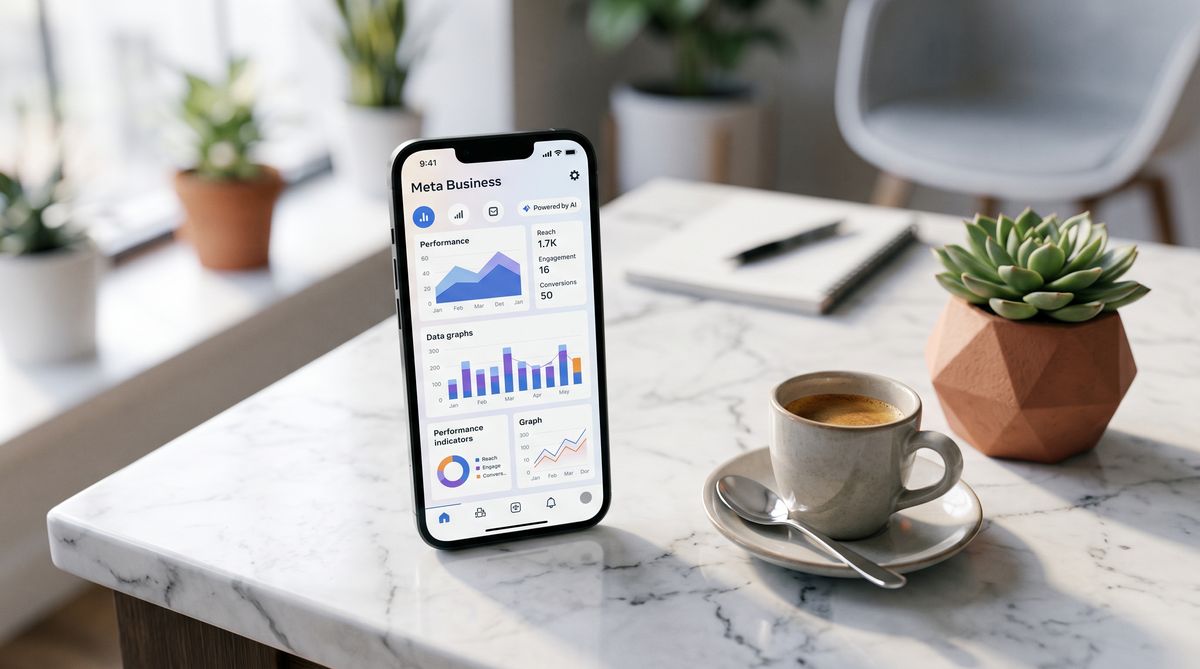
Meta just turned on five AI tools most DTC operators haven't touched yet
Meta rolled out a set of AI upgrades in August 2026 that plug Meta AI directly into your Facebook, Instagram, ad account, and Google Workspace data. Five of these matter for a DTC operator running under $5M in revenue: AI-driven performance analysis, competitor benchmarking, automated report generation, the Meta Business Agent for DMs, and the Advantage+ AI layer underneath it all. Activate them this week. The operators who wait for a case study will be reading about the ones who didn't.
I have run over seven figures in Meta ad spend across multiple businesses. The operators who win are not the ones with the biggest budgets. They are the ones who activate new features within 72 hours of release. Speed compounds in paid media the same way it compounds in capital markets. A feature sitting unused in your ad account is capital sitting idle in a checking account. It's not doing anything for you, and your competitor's version of it is already working.
The doctrine: competence beats credentials
Nobody is going to hand you a permission slip to use these tools well. There's no certification for reading a Meta AI report correctly or knowing which of the five tools below actually moves your numbers. The operators who win here are the ones who open the tool, test it against their own account, and learn what it does by running it, not by waiting for an agency to explain it to them. That's the whole doctrine. Competence beats credentials, every time, in every channel.
The framework: FOCUS
I use a five-step framework for evaluating any new ad platform feature before I roll it out past a test budget. I call it FOCUS: Find the feature, Observe it on a small budget, Compare against your control, Understand the mechanism, Scale what works. Skip a step and you're gambling. Run all five and you're operating. Apply FOCUS to each of the five tools below before you hand them your full budget.
The 5 tools to activate this week
1. Meta AI performance analysis inside Ads Manager and Meta AI apps
Meta is rolling out features that let Meta AI connect directly to your Facebook and Instagram accounts, your ad campaigns, and your Google Workspace files. Once connected, you can ask it to review 90 days of ad performance, find what your top-performing ad sets have in common, and recommend changes for the next 30 days. Meta says the assistant can examine which audiences are producing results, identify patterns among better-performing ads, flag creative that may no longer be resonating, and suggest where advertising budgets could work harder.
For an operator without a dedicated analyst, this collapses a task that used to take an agency a week into a conversation that takes ten minutes. Connect your ad account this week. Ask it the same question you'd ask a media buyer: what's working, what isn't, and what should change in the next 30 days.
2. Competitor benchmarking against comparable brands
Meta AI can now examine publicly available content and engagement patterns from brands you name and tell you where you're ahead or behind, and why. According to coverage of the rollout, a business can ask Meta AI to benchmark its organic performance against five comparable brands and get back the factors behind any gap.
This is competitive intelligence that used to require a subscription to a social listening tool. Now it's built into the assistant you already have open. Name your three closest competitors and run the benchmark before your next content calendar meeting.
3. Automated recurring reports and presentations
Instead of pulling the same weekly report by hand, Meta AI can now generate decks, documents, and spreadsheets from your business data and set them to recur automatically. Meta gave the example of a business asking for an updated report on Instagram content performance every Monday, delivered without anyone running the analysis again.
Set this up once and it runs without you. That's an hour a week back on your calendar, every week, forever. Compounding, the same way a recurring dividend compounds if you leave it alone instead of spending it.
4. Meta Business Agent for Instagram DMs, Messenger, and WhatsApp
Meta Business Agent went global on June 3, 2026, and by August it's the customer-facing layer sitting under every one of your click-to-message ads. It answers product questions, recommends items from your catalog, qualifies leads, and can close a sale directly inside the DM thread, in the customer's own language, around the clock. More than one million businesses were already using it on WhatsApp and Messenger before the global expansion to Instagram.
This is the conversion layer your click-to-DM ads have been missing. Every ad that drove a click into your Instagram DMs before this had a leaky bottom of funnel: slow replies, missed messages at 11pm, abandoned threads. An agent that answers in seconds changes the economics of that entire ad objective. Start it in answer-only mode this week: shipping times, sizing, order status. Consumer research still shows most people prefer a human for anything complex, so climb the trust ladder before you let it close sales unsupervised.
5. Advantage+ AI optimization layer
Advantage+ has been the engine room running underneath Meta's ad products for a few years now, and Meta continues stacking new AI optimizations into it: streamlined campaign setup, an expanded Opportunity Score in Ads Manager offering one-click recommendations, and Advantage+ leads campaigns tuned for lead quality rather than volume. Meta reported a median 5% reduction in cost per result when advertisers followed Opportunity Score recommendations, and roughly 10% lower cost per qualified lead when Advantage+ optimization was applied to leads campaigns.
If your campaigns are still running on manual bid strategies and hand-built audiences from two years ago, you are leaving margin on the table every single day the campaign runs. Check your Opportunity Score this week. Apply the recommendations Meta is already testing against your account.
Why speed is the actual moat here
None of these five tools require a technical team, a developer, or a budget increase to test. That's the point, and it's also why waiting costs you more than it costs a nine-figure brand with an in-house growth team. They were going to test this anyway, on day one, with a team dedicated to nothing else. You're testing it with the same tool, for free, on your own account, this week. The gap between you and them isn't resources. It's whether you open the app.
Common Thread Collective's analysis of the Meta Business Agent rollout makes the structural point directly: Meta has long dominated the top of the funnel for ecommerce, and these tools extend that dominance into the post-click and post-purchase customer journey. Brands that configure this well will convert cold traffic at a lower cost. Brands that ignore it are handing that advantage to whoever configures it first. There is no neutral option. Someone activates these tools inside your customer's DMs this week, either you or the next brand competing for that same attention.
There's also a data signal worth understanding before you jump in. DTC.live reported that Messenger and WhatsApp bot messages see 70 to 80% open rates and 15 to 30% response rates, compared to 20 to 30% open rates and 2 to 4% response rates on email. That's not a marginal improvement. That's a different channel entirely, and most DTC operators under $5M revenue haven't built anything on it yet.
The 72-hour activation checklist
Here's the sequence I'd run this week if I were operating a DTC brand under $5M in revenue right now. Treat it like a watchstanding rotation: someone owns each step, and nobody moves to the next one without confirming the last.
Day one. Connect Meta AI to your ad account and your Instagram and Facebook pages. Ask it for a 90-day performance review before you touch anything else. Don't act on the output yet. Just read it against what you already believe about your account. Where it disagrees with your gut, that's the place to dig first.
Day one, second pass. Turn on Meta Business Agent in answer-only mode across Instagram DMs and Messenger. Load your shipping policy, sizing chart, and return window into it directly. Do not connect it to your catalog for recommendations yet. Just let it answer the questions your support inbox gets forty times a day.
Day two. Run the competitor benchmark against your three closest brands. Write down what it flags as the gap. Cross-check one claim manually before you trust the rest. This is not blind faith in a black box. It's verification, same as you'd verify any report from a junior analyst.
Day two, second pass. Check your Opportunity Score in Ads Manager. Apply the recommendations that touch creative and audience expansion first. Hold off on anything that touches your core evergreen campaigns until you've watched the test campaigns for a few days.
Day three. Set up your first recurring report. Pick the one metric you check most often by hand right now, weekly revenue by channel, ROAS by campaign, whatever it is, and have Meta AI deliver it to you automatically starting the following Monday. Stop pulling it manually the moment the automated version proves accurate.
By the end of day three you've touched all five tools, verified the outputs you can verify, and built one automation that saves you time every week going into the fall. That's not a transformation. That's a watch cycle, run correctly, three days in a row.
Doctrine Connection: Competence beats credentials
Nobody certifies you to run Meta Business Agent well. Nobody grades your Opportunity Score homework. The operators who win this cycle are the ones who opened the tool on release day, ran it against a small test budget, watched what happened, and adjusted. That is the entire skill. It is not proprietary. It is available to anyone willing to do the work instead of waiting for someone else to explain it first.
FAQ
Q: Do I need a developer to activate any of these five tools? No. All five sit inside Meta Business Suite, Ads Manager, or the Meta AI app, and connect through account permissions rather than code. The Meta Business Agent Platform, which links the agent to Shopify or Zendesk, is the one exception that benefits from technical setup, but the standard agent runs without it.
Q: Is Meta AI's business analysis actually free right now? Yes, as of the August 2026 rollout. Meta has said businesses that want heavier usage will eventually move to a paid tier called Meta One, but standard use is free to start. Activate now while the meter's off.
Q: Should I let Meta Business Agent close sales automatically on day one? No. Start in answer-only mode: shipping, sizing, order status. Watch the transcripts for a few weeks. Move to product recommendations next, then lead qualification, and only let it close sales once you trust what it says to a paying customer. Most consumers still want a visible option to reach a human, and the agent is built to hand off when a conversation needs one.
Q: How is Advantage+ different from Meta Business Agent? Advantage+ optimizes your campaigns: targeting, budget, and creative delivery on the ad side. Meta Business Agent is customer-facing: it talks directly to shoppers in your DMs after they click. One runs your media buying. The other runs your customer conversation. Both compound in your favor if you activate them, and both sit idle if you don't.
Q: What's the single biggest risk in activating these tools too fast? Letting an AI system speak for your brand on policy details it doesn't fully understand, like return windows or warranty terms, before you've checked its accuracy. Test on low-stakes questions first. Confirm it's giving correct answers before you expand its scope.