
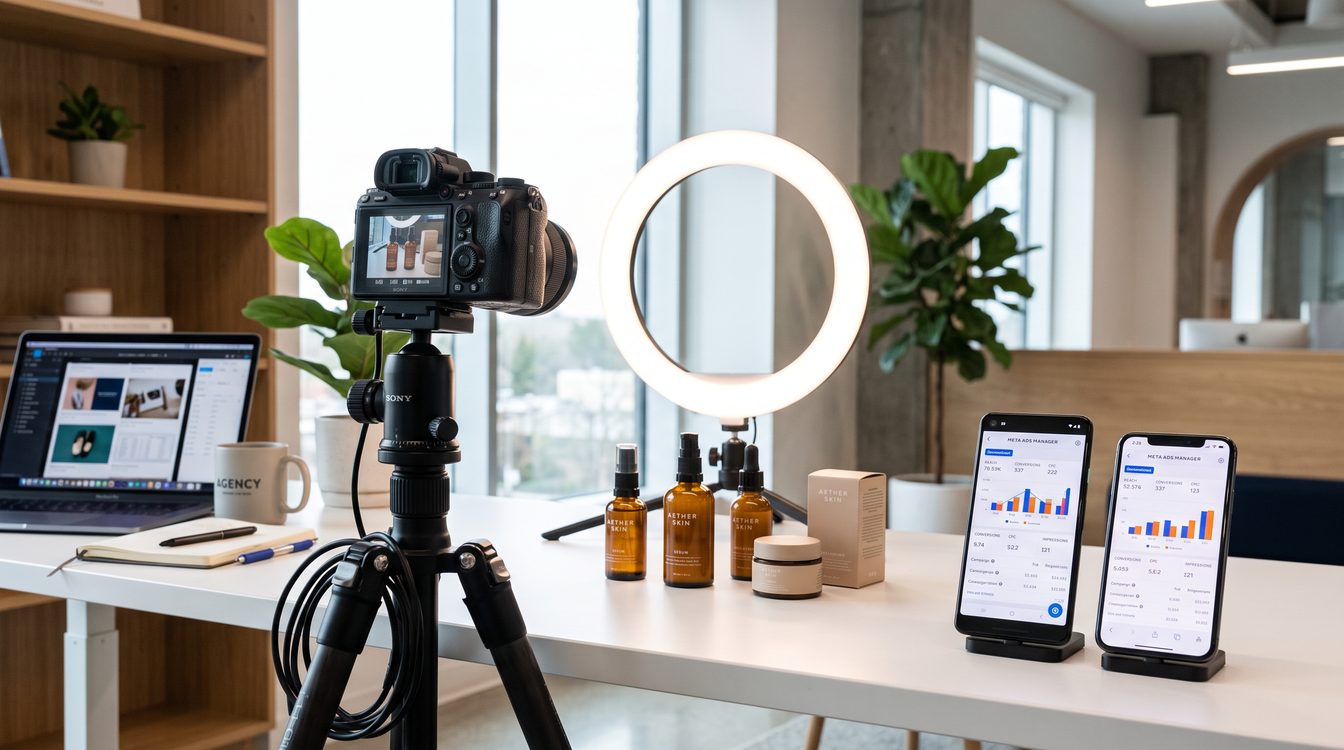
Meta Advantage+ Shopping Campaigns: The Complete Setup for Ecom Operators Under $5M
Advantage+ Shopping Campaigns (ASC) average 4.5x return on ad spend. Manual campaign setup averages 2.2–3.7x ROAS. That's a 21% edge in absolute ROAS or a 40% gap in cost-per-acquisition. Skale Strategy benchmarks show CPA drops 32% lower with ASC. Sixty-two percent of Meta ecommerce spend runs through ASC now. Two years ago, it was 12%. The model works. The gap between operators running it and operators ignoring it is widening.
Most ecom teams under $5M revenue either don't have ASC deployed or they've deployed it wrong. They're bidding too low. They're running with five creative assets when Meta needs fifteen. They're changing things weekly instead of letting the algorithm settle. The result: they see mediocre ROAS, blame the channel, and revert to manual campaign tactics that made sense in 2019. That's the bottleneck most need to unblock first.
This is the setup playbook for operators running $50K–200K monthly ad spend. It's specific. It works.
What ASC Actually Does
Advantage+ isn't a new bidding strategy. It's a fundamentally different approach to ad serving. Instead of you picking the audience, bidding strategy, creative, and placement—Meta picks all of it. You define: product catalog, a conversion goal, and a daily budget. Meta runs multivariate tests across 20 million+ possible combinations every single day. It learns which audiences convert. Which placements work. Which creative resonates. Which bidding strategy maximizes your goal.
The algorithm doesn't optimize for impressions. It optimizes for your business outcome—purchases, add-to-carts, specific product categories. It's built on a different assumption: the algorithm knows the Meta network better than you do. You're not smarter than multivariate testing at million-scale.
Per Eightx, the performance distribution is: over 50% of ad performance derives from creative, not targeting. That's the insight that breaks conventional ecom wisdom. You've spent three years perfecting your audience segmentation. Turns out, creative matters more. ASC's edge comes from cycling through twenty variations of creative and audience simultaneously. It finds the combination that works. You couldn't test that fast manually.
The CPAs drop because Meta's algorithm has access to pixel data you don't see. It knows how many of your website visitors convert to customers in week one, month two, six months out. It knows which visitor profile converts for your product specifically. The algorithm sees the full funnel. It bids aggressively on visitors most likely to convert. You bid on the hope they will.
The Prerequisites: What You Need Before You Launch
Budget Floor: You need minimum $150–320 daily budget to give the algorithm room to work. Below that, the learning phase never stabilizes. You're testing combinations faster than they accumulate data. $150/day minimum is roughly $3.5K–4.5K monthly. If you're running less than that, scale to this level or stay manual. Hybrid doesn't work.
Conversion Data: You need 50+ purchase conversions weekly from your Meta pixel. If your store does ten conversions daily, ASC is a fit. If you do five conversions daily, the algorithm starves. It's mathematically unable to learn. You need the volume. This is non-negotiable.
Product Catalog: ASC requires a Shopify or catalog feed connected to Meta Business Suite. The catalog must be complete and accurate. If your product data is stale, inventory wrong, prices missing, the algorithm serves wrong ads. The feed is the foundation.
Creative Arsenal: This is the leverage point most underestimate. You need 15+ creative assets minimum. Not variations on the same theme. Genuinely different creative approaches. Fifteen means: three video concepts (product close-up, lifestyle, customer testimony), three UGC videos from customers or creators, three static carousel concepts, three single-image variations, three lifestyle photos. This is a production commitment. Most operators start ASC with four assets and wonder why they underperform.
The Setup: Four Concrete Steps
Step One: Audit Your Catalog Feed (Week One)
Pull your product feed into Meta Business Suite. Run the diagnostic. Check for: missing descriptions, wrong inventory counts, incorrect category mapping, prices that don't match your store. Fix everything. A single mismatch in data compounds across millions of impressions. If Meta serves an ad for a product that's out of stock, the click is wasted. If the price is wrong, the conversion rate plummets.
Set up automatic feed updates to sync every 12 hours. If you're a seasonal brand, make sure your feed reflects current seasonality. A winter coat feed in July tanks performance.
Step Two: Design Your Creative Production Cadence (Week Two)
You need 15 assets to launch. You need 2–4 new concepts weekly to sustain. This requires production infrastructure. Hire a video editor or contract with an agency that specializes in UGC-style content. PodVector data shows UGC outperforms by 48% higher CTR and 26% lower CPA versus founder-recorded content.
The creative spec: vertical video (9:16), 15–30 seconds, silent-compatible (captions burned in), focus on product benefit not brand, testimonial or lifestyle angle. The ad should make sense without sound. It should work in a 15-second window. Attention span is real.
Set a production schedule. Monday: brief the video team. Wednesday: review drafts. Friday: upload to library. The cadence runs every week. This is not optional if you want ASC to sustain performance.
Step Three: Configure the Campaign (Week Two)
In Meta Ads Manager, create a new campaign. Set objective: Conversions. Don't use Traffic or Engagement. ASC only works optimally on Conversions.
Create an ad set. Here's what you don't do: you don't segment by audience, don't set age/gender/interest targeting, don't choose specific placements. ASC handles this. Your job: set daily budget and bid strategy.
Daily budget: the floor we discussed. Start at $150–200 if you're under $50K monthly spend currently. If you're already doing $50K+, start at 20–30% of your current daily spend so you can measure the lift against your existing campaigns.
Bid strategy: choose Cost Per Purchase (CPC target) set to your historical purchase cost or $5–10 below. ASC will find ways to acquire at that target. If you're too aggressive (targeting $5/purchase when your baseline is $15), it'll shut off. Set realistic targets and let the algorithm beat them.
Step Four: Load Creative & Let It Breathe (Week Three)
Upload all 15 creative assets to your catalog. Meta will serve them in rotation. Set your schedule: always on, no time restrictions. The algorithm optimizes across time and day-of-week. If you restrict hours, you're limiting its sample set.
Set the conversion window: 7 days. This tells Meta to count a conversion if it happens within seven days of ad click. Standard for ecom.
Review your attribution. Disable iOS ATT opt-in audiences if you're worried about privacy measurement. Enable Conversions API (CAPI) if you haven't already. CAPI recovers 20–40% of pixel-lost data. In post-iOS-14 world, CAPI is your insurance policy. Implement it.
Launch the campaign. Now, don't touch it for two weeks. The learning phase requires volume. If you pause, adjust budget, or swap creative daily, you interrupt the algorithm. You're telling it to start over. Let it learn.
The Proof Points: Real Case Studies
Seltzer Goods, a direct-to-consumer beverage brand, deployed ASC with a $5K daily budget. Baseline ROAS was 2.8x across their manual campaigns. After deploying ASC with 18 creative assets (half UGC, half user testimonials), ROAS climbed to 9.68x in month one. Customer acquisition cost dropped 48%. They maintained a 6.2x ROAS in month two, then optimized down to 5.1x by month three as saturation hit (this is normal as audience exhausts). They reduced overall ad spend by 28% while holding revenue constant.
Allbirds, a mid-scale ecommerce brand with $180M+ revenue, shifted their catalog to ASC. They were doing 2.9x ROAS across manual campaigns. The transition: they built a 50-asset creative library focused on lifestyle and product benefit. ASC ramped in three weeks. First 90 days showed 4.2x ROAS. Scaling to 3x budget maintained 3.8x ROAS. Their insight: creative volume was the bottleneck, not budget or algorithm.
The Churn Mechanics: Why Bad Setup Fails
Most operators set up ASC wrong. They launch with eight creative assets because producing fifteen felt expensive. They set a $80 daily budget because they're being conservative. They change the budget weekly based on daily fluctuation. They swap creative every three days because one video underperformed. They restrict time windows to "business hours" or exclude Friday placements.
Every one of these decisions breaks the algorithm. The result: after two weeks, they measure mediocre 2.1x ROAS, declare ASC broken, and revert to manual. That's not ASC failing. That's underweighting the prerequisites.
The rule: you can't optimize what you don't fully operationalize. If you're not committing to the production cadence, don't run ASC. If you can't budget $150+ daily, don't run ASC. If you have fewer than ten purchase conversions daily, don't run ASC. These aren't barriers to overcome. These are prerequisites. Without them, the algorithm is starved. It'll never show its real edge.
The Doctrine Connection
Systems beat slogans. You can't will ASC into working through discipline alone. You need the system: the feed, the creative production line, the budget floor, the measurement window. When you have the system, discipline compounds the advantage. You stick with the creative schedule. You don't second-guess the algorithm mid-learning. You let volume accumulate.
When I ran operations at various scale-ups, the teams that moved fastest had one thing in common: they weren't scrappier or smarter. They had processes. A product release process, a hiring process, an onboarding process. The process moved the team. Without it, even smart people moved slow.
ASC is the same. The algorithm is good. The system is better. The system is: feed audit, creative production cycle, budget commitment, conversion volume sufficiency, measurement setup. You can't shortcut any step. The bottleneck shifts to whichever one you skip. Fix the system first. The algorithm does the rest.
The FAQ
Q: Should I run ASC alongside my manual campaigns?
Yes, initially. Run both for 60 days. Measure incrementality:is ASC delivering new customers or just cannibalizing your manual spend? If you see 40%+ incrementality, grow ASC budget by 25% and trim manual. If you see cannibalization, pull ASC and revisit when you're larger. Most brands see 60–75% incrementality, which justifies expansion.
Q: What if my pixel data is incomplete due to privacy?
Implement CAPI now. Conversions API routes server-to-server data to Meta, bypassing browser privacy restrictions. CAPI recovers 20–40% of lost pixel data. Pair it with your pixel. The combination is your fallback when cookies get limited further.
Q: Can I use ASC for low-ticket items like $15 products?
Yes, with a higher volume requirement. You need 100+ conversions weekly instead of 50+. The algorithm needs more data to learn at lower price points. If you're a Shopify store doing $50K revenue, you might not have enough volume. If you're $500K+, you do. Scale determines feasibility.
Q: How often should I refresh creative?
Introduce 2–4 new concepts weekly. Don't pull high-performing assets. Test and expand. Your library should grow, not rotate. After four weeks, you'll have 35+ assets to cycle through. ASC's advantage compounds with catalog depth.
Q: What's the right daily budget to start?
Use the 10–15% rule. If you're currently spending $1K daily across all Meta campaigns, start ASC at $150–200 daily (15–20% of existing). Let it run 60 days. If it outperforms, gradually shift budget from manual to ASC. If you're new to Meta ad spend, start at the $150 floor and scale weekly by 20% as conversion volume increases.
The Playbook
Week one: Audit feed, fix data, enable CAPI.
Week two: Source and produce 15 creative assets. Set up campaign structure in Ads Manager.
Week three: Upload creative, set budget to $150–200 daily, launch campaign.
Weeks four to six: Let algorithm learn. Track daily ROAS but don't adjust. Measure conversion volume.
Week seven: Review learning phase completion. If ROAS ≥ 3x, scale budget 20%. If ROAS ≤ 2.5x, audit creative (likely low quality) or confirm pixel data (likely incomplete).
Weeks eight and beyond: Maintain creative production cycle. Introduce 2–4 concepts weekly. Scale budget by 15–20% monthly as performance sustains. Monitor incrementality against manual campaigns quarterly.
The operators winning ecommerce in 2026 aren't picking better audiences. They're running better systems. ASC is a system. Build it once. Let it compound. Your ROAS multiplies, your cost drops, your competitive edge widens. That's the math.