
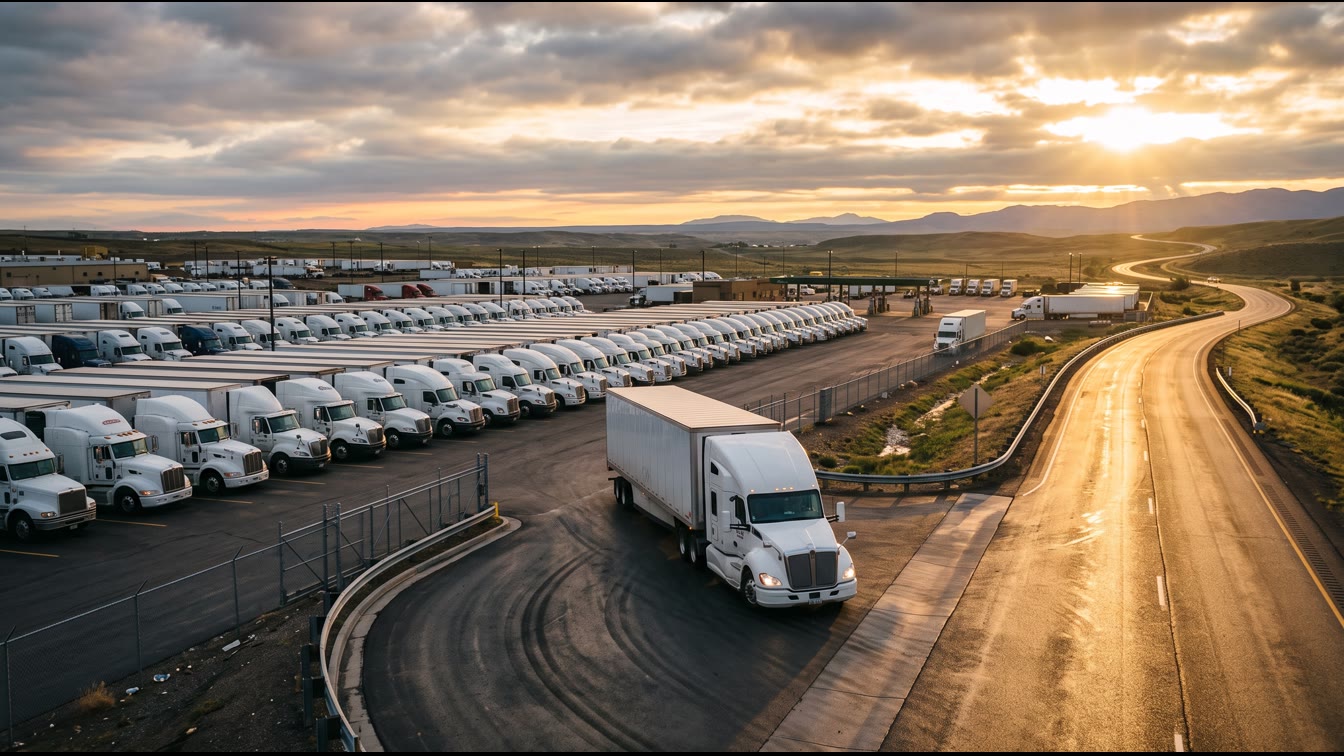
TL;DR: Trucking M&A froze for three years during the freight recession. As Truck News reported, deal-makers say the market is shifting into a higher gear as rates recover and aging owners run out of runway to wait. Tenney Group's 2026 Mid-Year M&A Report calls for record-breaking transaction volume in 2027. Buyers aren't chasing distressed inventory. They want management depth, businesses that operate without the owner standing at the helm every hour. That test isn't unique to trucking. It's coming for every service business in the $500K-$5M range. Build the management bench now, or watch the exit window close on you.
The freight recession ran from mid-2022 through most of 2025, per Truck News reporting on the M&A restart. Three years. Rates cratered. Capacity that shouldn't have existed kept limping along because owners couldn't afford to sell into a down market and buyers weren't paying up for it either. Everybody held their breath and waited.
Now the tide's turning. Rates have been climbing since the start of 2026. Bad capacity finally exited through bankruptcies, shutdowns, and tighter enforcement on non-compliant carriers. Peter Stefanovich, president of Left Lane Associates, told Truck News that interest from buyers and sellers "picked up noticeably" after Easter this year, following nine to twelve months of people sitting on their hands. Tenney Group's 2026 Mid-Year M&A Report backs him up: reduced capacity, improving rates, aging owners, available capital, and technology change are converging into what the report calls conditions for record-breaking deal activity in 2027.
I spent six years running a nuclear reactor plant on a submarine before I built DEMG. I've watched enough casualty drills to recognize a pattern when the pressure finally releases. Freight just went through a controlled casualty. What happens next in trucking is the same thing that's about to happen in HVAC, plumbing, landscaping, dental, and every other owner-operator business north of half a million in revenue. Pay attention. This is a preview, not a niche story.
Three Years of Pent-Up Demand Doesn't Disappear. It Compounds.
Stefanovich's read on the seller side is blunt: "You don't want to sell when the market's down. It's great for a buyer, but not for a seller that's looking at exiting. People have been holding back." That holding pattern didn't make the underlying problem go away. It made it worse. Owners who wanted to sell in 2023 are three years older now. Age doesn't negotiate. "The thing you can't change is people's age and time," Stefanovich said. "A lot of people wanted to sell two years ago or three years ago or last year that have been waiting. It's less about a want and it becomes more of a need."
That's not a trucking problem. It's an American ownership problem. Boomer owners represent a huge share of the roughly 2.9 million employer firms owned by people 55 and older, according to Project Equity data, and the Exit Planning Institute has found that a majority of them lack a formal succession plan. This isn't abstract. Run the math on your own balance sheet. If your exit plan is "I'll figure it out when I'm ready to slow down," you're not planning an exit. You're planning a fire sale, and fire sales happen on the buyer's terms, not yours. I've written before about what a real exit planning timeline looks like, and seven years out is not too early to start. Three years of denial doesn't compound in your favor. It compounds against you.
Buyers Never Left the Table. They Just Got Pickier.
Here's the part owners miss when they assume a slow market means slow buyers. Mark Seymour, CEO of Kriska Transportation Group and chairman of the Truckload Carriers Association, told Truck News that acquisition strategy was never purely about freight conditions. "Buyers are buyers," he said. "We're always looking at ways to make our business better." Kriska's acquisition of Sharp Transportation earlier this year wasn't a distressed bargain hunt. It was a network play: Sharp brought pre-existing customer relationships and complementary geography, and Kriska already had space to absorb it without paying for duplicate facilities.
That's the buyer mindset in every consolidating industry right now. Capital doesn't sit on the sidelines forever. Tenney Group's report notes that buyers and investment firms are facing real urgency to deploy capital after three flat years. They can't stay parked. But urgency doesn't mean sloppy. Stefanovich was direct about what today's acquirers are actually screening for: "they're looking for businesses that can stand on their own while being integrated." Distressed turnarounds are out of favor. Management depth is in favor. If the business can't survive the owner walking away for thirty days, it's not an asset. It's a job wearing a balance sheet.
The Watch Officer Test
On a submarine, the watch officer stands at the conn and runs the ship for a set period, then hands off to the next officer and walks away. The ship doesn't slow down. The reactor doesn't hiccup. Nobody radios the captain in a panic because the watch officer went to get coffee. That's not an accident. It's the entire point of the system. Every procedure is written down. Every casualty response is drilled until it's muscle memory. Every watchstander is trained to run the plant the same way, whether the guy who trained them is in the room or asleep in his rack three decks down.
Compare that to how most owner-operators run their business. The owner is the watch officer who never leaves the conn. Sales goes through the owner. Pricing decisions go through the owner. The best technician quits and the owner has to jump on the truck. Nothing is written down because it's all in the owner's head, which means the business has exactly one point of failure and it's the person trying to sell it.
Buyers can smell that in under an hour of due diligence. Ask them to show you the org chart below the owner and they show you an empty box. Ask for the standard operating procedures and they show you their own memory. That's not a business. That's a very well-compensated job, and jobs don't sell for a multiple. Owner-operators who build the manual, cross-train the crew, and let a manager run operations for a week without a phone call are the ones commanding the premium when the buyers show up. I laid out the full test buyers actually apply in the six dimensions PE buyers score before they write a check. Management depth is dimension one for a reason.
Specialization Commands the Premium. Commoditization Gets the Squeeze.
Stefanovich's phrase for it was blunt: "the riches are in the niches." Companies operating in specialized, higher-margin lanes are pulling stronger valuations than carriers stuck competing in commoditized freight where margins get ground down every quarter. Tenney Group's report echoes the same theme: cross-border operators with deep compliance capability and specialized 3PLs are becoming premium acquisition targets as nearshoring accelerates, while generic capacity fights over scraps.
That maps directly onto services. An HVAC shop that only does emergency repair calls is a commodity. An HVAC shop with a recurring maintenance contract book, a niche in commercial refrigeration, and documented processes for onboarding new technicians is a specialized asset. Same trade, completely different valuation. I've watched this play out in real roll-ups, and I broke down how HVAC roll-ups price equity-light acquisitions based on exactly this kind of specialization and operational independence. The buyers doing roll-ups in home services right now are running the identical playbook Kriska ran on Sharp: look for complementary capability, absorb it without duplicating cost, pay for the parts that make the whole network stronger.
Diversification Isn't Optional Anymore
Stefanovich pointed to carriers like Challenger Motor Freight and Canada Cartage, which expanded beyond core trucking into customs brokerage, freight forwarding, dedicated transportation, and final-mile delivery. The logic: don't let your entire balance sheet ride on one commoditized revenue line. Give customers more reasons to consolidate spend with you, and give yourself more than one lever if one segment softens.
Service business owners should read that as a direct instruction. If your entire revenue depends on one service line, one big customer, or one referral source, you don't have a business. You have a bet. Diversify the revenue streams and diversify the customer base before a buyer forces the conversation, because customer concentration is one of the first things due diligence flags, and it's one of the fastest ways to get your multiple cut in the room.
Preparation Beats Timing
Stefanovich's advice to owners heading toward a sale is the same advice I give operators every week: start now, not when you're ready to leave. Monthly financial statements you can actually stand behind. Reduced customer concentration. A management team that can run the show. A tax and succession plan drafted before anyone's forcing your hand. None of that happens the month before a term sheet. It happens over years of deliberate work, the same way a crew doesn't become qualified watchstanders overnight. You drill it. You document it. You test it under pressure before the real casualty hits.
Trucking spent three years finding out what happens when an entire industry defers that work simultaneously. The lesson isn't confined to freight lanes. It applies to every service business waiting for "someday" to become a plan.
FAQ
Is this M&A rebound specific to trucking, or does it apply to other service businesses?
The mechanics are universal. Reduced competitive capacity, aging owners running out of time, and available buyer capital are the same three forces driving consolidation in HVAC, plumbing, dental, landscaping, and agency services. Trucking is just the most visible current example because the freight recession made the freeze and the thaw easy to measure.
What does "management depth" actually mean to a buyer?
It means the business generates the same results whether the owner is in the building or not. Documented processes, a second-tier leader who can make decisions, and financial reporting that doesn't require the owner to explain it line by line. Buyers test this directly, often by asking what happens if the owner is unreachable for two weeks.
If I'm not planning to sell for five years, does any of this matter yet?
It matters more now than it will in year four. Building management depth, documenting procedures, and cleaning up customer concentration take years to show results, not months. The owners caught flat-footed in every downturn are the ones who started this work the year they decided to sell.
How do I know if my business is too commoditized to command a premium?
Ask whether a customer could replace you with a competitor over a phone call and a slightly lower price. If yes, you're commoditized. Specialization, recurring contracts, and a defensible niche are what separate an acquirable asset from a race to the bottom.
Disclosure: DEMG works with owner-operators on marketing systems that build enterprise value, including the documentation, lead-generation infrastructure, and brand assets buyers evaluate during due diligence. This article reflects our operating view of the market and is not financial, legal, or M&A advisory advice. Consult a qualified M&A advisor, CPA, and attorney before making transaction decisions.
Jeff Barnes is the founder of Digital Evolution Marketing Group (DEMG). This article reflects operational experience, not investment advice. Results vary by market, execution, and business model. Do your own due diligence.