
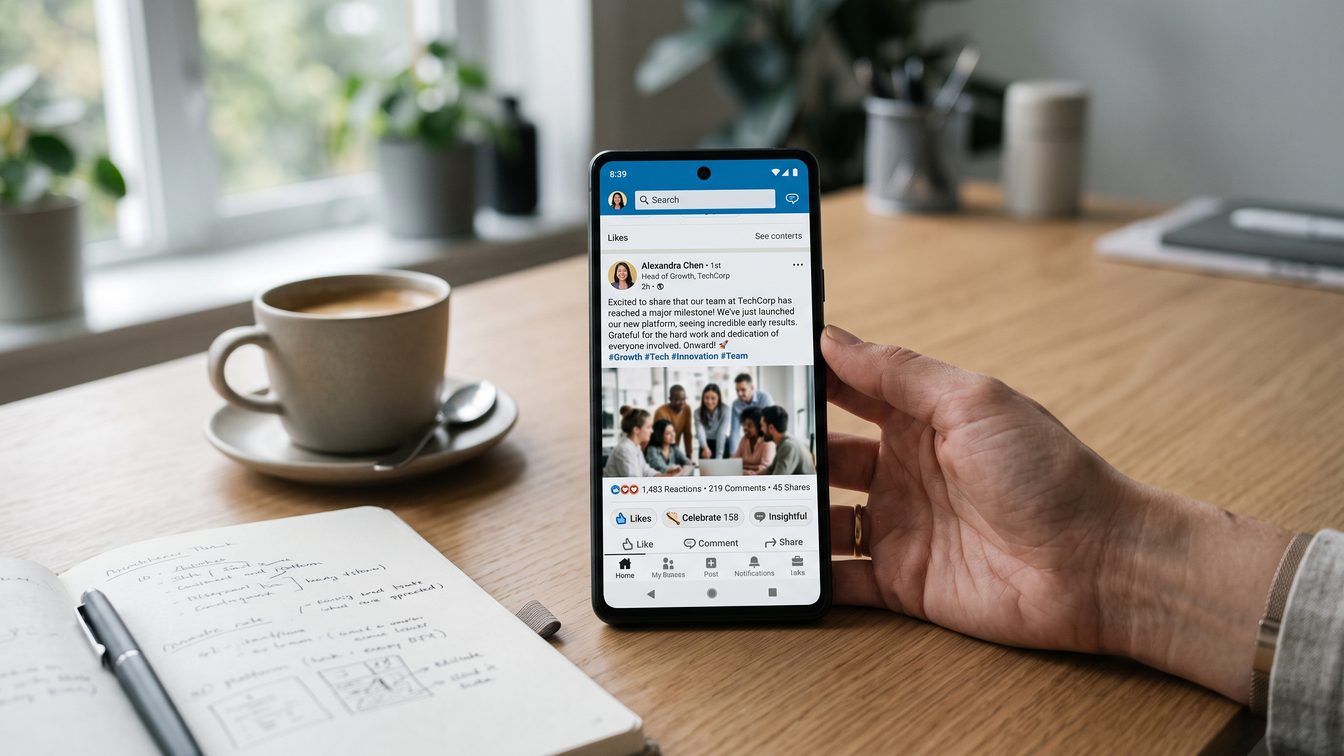
TL;DR: LinkedIn just flipped its algorithm. Dwell time and comment depth now outweigh vanity metrics. Your consultant positioning strategy needs a rewrite.
Your last post got 50 likes. It reached maybe 2,000 people. A competitor down the street posted something rougher, with three real comments, and it reached 11,000. You checked the numbers twice because it did not make sense under the old rules. It makes perfect sense under the new ones.
LinkedIn replaced its entire ranking system with a model called 360Brew, a 150-billion-parameter engine that reads what industry analysts are calling your Topic DNA, the cumulative signal of what you write about, who dwells on your posts, and what gets saved instead of liked. Median reach across the platform dropped roughly 47 percent year over year. If your content and your profile do not point at the same thing, you are getting suppressed and your dashboard will not tell you why.
This is not a minor tweak. This is the biggest shift in consultant marketing on LinkedIn since the platform existed. Owner-operators running $500K to $5M consultancies need to understand what changed, why the old playbook is dead, and what to do about it before Q3 ends.
What Changed
LinkedIn's engineering team has been public about this for longer than most marketers noticed. Back in 2024 they published research on "dwell time," the amount of time a reader spends on your post before scrolling past. In 2026 that research became the backbone of the entire feed.
Here is the mechanic. When you post, LinkedIn shows it to a small test slice of your audience, usually 50 to 200 people, for the first 60 to 90 minutes. This is the golden hour. During that window, the algorithm measures four things.
Dwell time is the strongest signal. LinkedIn's own classifier, called Long Dwell, predicts whether your reader's time on the post crosses a percentile threshold for that post type and audience. Scroll past in under 3 seconds and the post registers as skipped, a negative outcome. Read for 11 to 30 seconds and you are in real-reading territory. Cross 31 to 60 seconds and you have a strong signal. Cross 61 seconds and you are in the top percentile for extended distribution.
Comment quality is the second signal, and it is scored, not counted. A comment under 5 to 10 words carries almost no weight. "Great post!" earns close to zero. A comment over 12 words that relates directly to your content, especially one that sparks a reply and builds a thread, carries several times the weight of a single like. Thread depth, meaning comments that generate replies, count roughly 3x more than standalone comments according to Gromming's analysis of the March 2026 update.
Saves are the quiet third signal. A save means someone found your content worth keeping. LinkedIn treats this as stronger evidence of value than a like, because a like takes one click and no thought.
Format matters more than it used to. Document carousels, the PDF-style posts you swipe through, generate an average 55 seconds of dwell time compared to roughly 15 seconds for a standard text post. That gap alone explains why carousels now post a 6.6 percent engagement rate against roughly 2 percent for plain text.
Hashtags and external links got penalized hard. Posts with 3 or more hashtags lost up to 70 percent of their reach in some tracked samples. Links placed in the body of a post, rather than the first comment, cost you somewhere between 45 and 68 percent of your reach, because LinkedIn treats an outbound click as an exit signal, not an engagement signal.
The Old Playbook Is Dead
For three years the consultant playbook on LinkedIn was simple. Post daily. Use 5 hashtags. Ask "agree?" at the end so people would smash the like button. Chase virality with hot takes. Track vanity numbers like follower count and total likes. Treat every comment the same, whether it was a paragraph or an emoji.
That playbook is now actively working against you.
Daily posting with no strategy dilutes your Topic DNA signal, because the algorithm cannot tell what you are actually an authority on. Hashtag stuffing reads as spam and gets suppressed. Engagement bait like "comment YES below" gets algorithmically detected and demoted, part of what LinkedIn called its Authenticity Update in March and April 2026. Chasing likes optimizes for exactly the metric the algorithm now weighs least. And ignoring your own comment section, which used to cost you nothing, now costs you the single most important 90 minutes of your post's life.
Here is the part that stings most for consultants specifically. The old playbook rewarded the loudest voice in the room. The new playbook rewards the most useful voice in the room, and usefulness is measured by whether people stop scrolling, not by whether they click a thumb.
The New Playbook for Consultants
1. Comment before you post, every single day. The highest-ROI activity on LinkedIn in 2026 is not publishing. It is leaving 5 to 10 substantive comments daily on posts from your target buyers, 15 to 20 minutes before you publish your own content. A 200-word comment on a post with 50,000 views can be seen by 5,000 to 10,000 people who look exactly like your ideal client. This warms your Topic DNA signal before your own post ever goes live.
2. Rebuild your posts around the first two lines. LinkedIn truncates your post after roughly three lines on mobile. If the first two sentences do not earn the "see more" tap, your dwell time drops to under one second and the post is functionally dead. Open with a specific claim, a number, or a named situation. Never open with a generic observation.
3. Switch your primary format to document carousels. If you are still publishing only plain text, you are leaving 2 to 3x dwell time on the table. Build a 6 to 10 slide carousel breaking down a framework you already use with clients. This is not busywork. It is the single most important format change available to a consultant right now.
4. Reply to every comment inside the first 90 minutes, and make the reply count. A one-word "thanks!" does not extend the thread. A 2 to 3 sentence reply that adds something and invites a follow-up does. Each reply generates a fresh notification, pulls the commenter back, and extends the golden hour window your post is being scored inside.
5. Kill the hashtags, kill the body links. Cut your hashtag use to zero or one relevant tag. Move every external link to the first comment, or better, stop using them and let your post stand on its own. Neither of these choices costs you anything you actually needed.
None of these five tactics are complicated. What they require is discipline, the same discipline that separates an operator who runs their business from an operator whose business runs them.
The Dan Kennedy Line That Explains All of This
I trained under Dan Kennedy early in my career. He said one thing about direct response that applies perfectly to LinkedIn today. "Attention is step one. Engagement is step two. Conversion is step three. Most people skip to step three."
For years, LinkedIn's own algorithm let people skip step two and get away with it. A like was cheap attention dressed up as engagement, and the platform rewarded it anyway. Consultants built entire content strategies around collecting cheap attention and calling it traction.
The new algorithm finally rewards operators who do step two properly. It cannot be gamed with a hashtag trick or an engagement pod, not for long, because it is measuring whether a human being actually stopped and read your words. That is the same discipline direct response marketers have preached for fifty years, now enforced by a 150-billion-parameter model instead of a media buyer's gut instinct.
The Owner-Operator Frame
Every tactic above works better when it sits inside a positioning frame, and the frame that matters here is what I call the Owner-Operator Frame. Most consultant content speaks to a title. It says "for CFOs" or "for marketing directors." The Owner-Operator Frame speaks to a bottleneck instead of a title.
The bottleneck founder running a $1M to $5M business does not read LinkedIn looking for generic thought leadership. They read it looking for someone who understands the specific place where their business is stuck right now, whether that is cash flow, hiring, or handing off decisions they should have delegated a year ago. A post that names that bottleneck precisely, in the first two lines, earns the dwell time the algorithm now demands, because the reader recognizes their own problem before they finish the first sentence.
This is not a coincidence. The algorithm change and the Owner-Operator Frame reward the exact same behavior: specificity over generality, and depth over breadth. Write for the bottleneck, not the job title, and dwell time follows naturally.
Doctrine Connection: Freedom Beats Comfort
It is more comfortable to post a safe, generic update and collect a pile of easy likes. It is less comfortable to write something specific enough that only 200 people fully qualify to read it, comment on it, and act on it.
Freedom beats comfort. The consultant who chases comfortable engagement stays stuck at the same follower count and the same client roster for years. The consultant who accepts the discomfort of narrow, specific, opinionated content earns the algorithmic distribution, the inbound conversation, and eventually the freedom to choose which clients they take. The algorithm did not create this tradeoff. It just started measuring it.
FAQ
Does this mean I should stop posting and only comment? No. Comment daily to warm your signal, but keep publishing 2 to 3 times per week. The two activities compound. Comments build the algorithm's understanding of your topic authority. Posts convert that authority into inbound conversations.
How many comments actually move the needle on my own post's reach? Volume matters less than quality. Six to twelve substantive comments in the first hour, especially ones that generate replies, will outperform fifty quick likes by a wide margin. Focus your energy on getting a handful of the right people to engage deeply rather than chasing a large number of shallow reactions.
Is it still worth using hashtags at all? Use zero to one relevant hashtag. Tracked samples show posts with three or more hashtags losing up to 70 percent of their reach, likely because the pattern now reads as a spam signal to the model.
What if my niche audience is small? Can this still work? Yes. The 360Brew model distributes based on topic relevance, not follower count. A specific post that generates deep engagement from a small, correct audience gets pushed to second and third degree connections who match that topic. Consultants with a few hundred well-targeted connections can outperform accounts with ten times the following.
How long before I see results from this new approach? Plan on 8 to 12 weeks of consistent comment-first activity and reformatted posting before you see a meaningful shift in inbound conversations. The algorithm rewards consistency over time, not a single viral post.
Disclosure
This article reflects publicly available research on LinkedIn's 2026 algorithm changes, including LinkedIn's own engineering publications on dwell time and third-party analyses of the 360Brew ranking model. Specific engagement percentages and benchmarks cited come from third-party tracking studies and should be treated as directional rather than officially published LinkedIn statistics. Demg.ai has no paid or affiliate relationship with LinkedIn.