
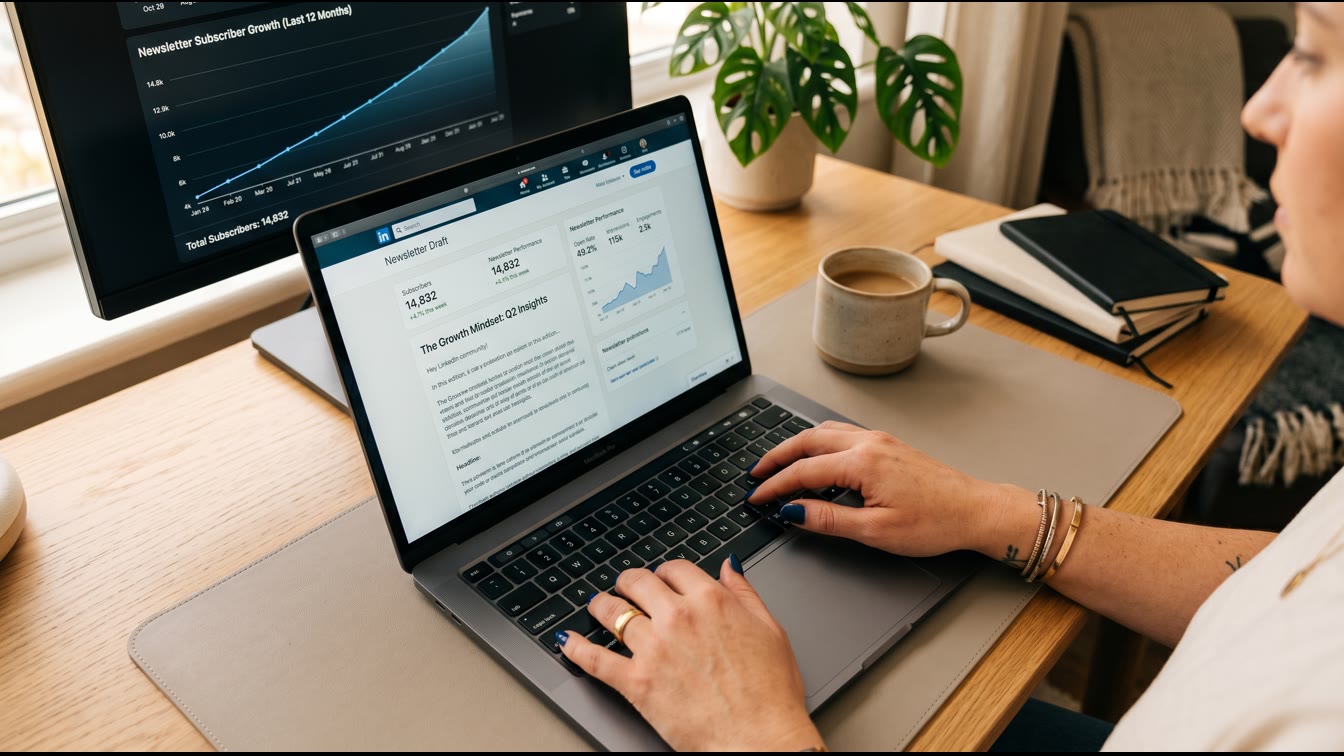
LinkedIn newsletters bypass the feed algorithm entirely. Every edition hits subscribers via email, push notification, and in-app alert — triple delivery, zero algorithmic filtering. That is the single most important fact an owner-operator needs to know in 2026. Standard posts reach 5–7% of your followers. Your newsletter reaches 100% of your subscribers. The growth play here is not complicated. Build subscribers, run an AI content system behind the scenes, and you compound an owned publishing asset that no platform update can take away from you.
The Asset Most Professionals Are Ignoring
LinkedIn overall is in contraction. Views are down 50% year-over-year. Engagement is down 25%. Follower growth dropped 59%. The algorithm punishes external links with 60% less reach. While most creators are suffering, newsletter publishers are insulated. They already have direct delivery locked in.
There are roughly 146,000 active LinkedIn newsletters serving over 1 billion members — approximately one newsletter per 6,800 users. That market is not saturated. The average subscriber follows 17 newsletters. Decision-makers are consuming this content: 58% of them read at least one hour of thought leadership per week, and 55% use thought leadership to vet organizations before engaging.
This is not a soft branding play. It is a business development asset. Treat it like one.
Why 500 Connections Is Enough to Launch
Here is the compounding mechanics that most people miss. When you launch a LinkedIn newsletter, the platform automatically invites your existing followers to subscribe. Creators consistently see 10–30% of their network convert immediately. With 500 connections, that means 50–150 warm subscribers on day one . people who already know you and chose to opt in.
Every new follower you gain afterward receives an automatic subscription invitation. Growth is continuous and frictionless. Andy Crestodina of Orbit Media has called the LinkedIn newsletter signup the lowest-friction conversion in all of digital. That frictionless conversion is your compounding engine. Feed it consistently and the subscriber count climbs without paid acquisition.
I built Angel Investors Network's investor community in 1997 with email lists and forums. We scraped together subscribers one by one, manually, with no automated delivery and no platform support. LinkedIn newsletters are the 2026 version of that same play . but with a billion-user platform handling discovery, delivery, and subscriber invitations on your behalf. The structural advantage now versus then is staggering.
The AI Content System: How to Stand Watch Every Week
Consistency is the operating requirement. Nearly 60% of top-performing LinkedIn newsletters publish weekly. Most professionals fail at consistency not because they lack ideas but because content production drains time. That is where an AI content system changes the equation.
The system has three layers.
Layer one: Ideation and drafting. Tools like Taplio ($39–$49/month) connect content drafting with a CRM layer, so you can track which topics resonate and which subscribers are engaging. Supergrow ($19/month and up) ingests PDFs, YouTube videos, and articles and outputs LinkedIn-formatted drafts in your voice. Neither tool produces finished content. Both produce usable starting points in minutes instead of hours.
Layer two: LinkedIn's native AI. LinkedIn's built-in AI Assistant, available to Premium subscribers, handles quick edits and comment replies. Use it for low-stakes tasks. For your newsletter . the asset you're building . use dedicated tools that can actually match your voice.
Layer three: Analytics and iteration. LinkedIn added email send counts and email open rate tracking in early 2025. Use them. The platform also added subscriber demographic data and referral source tracking in April 2026. Your open rate is your report card. The average LinkedIn newsletter hits 25–35% open rates. Top-performing newsletters hit 40–50%. That gap closes with better subject lines and tighter topic focus . both things AI tools can test and refine faster than manual iteration.
One operational note: LinkedIn's algorithm now flags content that reads as generic AI output and deprioritizes it. You are not outsourcing your thinking. You are outsourcing the mechanical work of production. Write the ideas. Write the framework. Let the AI build the scaffold. Edit it back into your voice before you publish.
The ATLAS Scale Phase: Systematize Before You Amplify
The ATLAS Model for Growth identifies the Scale phase as the moment when you stop trading hours for output and start running systems that produce output without you at the center of every task. That is exactly what an AI content system does for a LinkedIn newsletter.
Before you amplify . before you run ads, pursue cross-promotions, or pitch sponsors . you need your publishing system tight. Define your newsletter's single topic lane. Set a publishing cadence you can hold for 12 months. Build a 4-week content calendar before you launch so you are never improvising at deadline. Assign your AI tool stack and set up your template. Then . and only then . amplify.
A $500 LinkedIn ad spend targeting your ideal audience typically generates 300–500 new subscribers. That ROI only makes sense after your open rates prove your content is worth subscribing to. Scale a broken system and you waste capital. Scale a proven system and every dollar compounds.
The Cross-Promotion Play: 50–200 Subscribers Per Exchange
Paid acquisition is not the only growth lever. The collaboration loop is free and often outperforms paid.
Identify 10–20 creators in your topic area with 3,000–10,000 subscribers who are slightly ahead of you. Propose a guest edition exchange: they write a guest issue for your list, you write one for theirs. Each exchange delivers 50–200 new subscribers from an aligned audience. This tactic produced 25% subscriber growth for documented newsletter partnerships on LinkedIn.
Question-based subject lines outperform statement-based ones by 40% with professional audiences. Publishing Tuesday through Thursday, 8–10 AM, produces the highest engagement . one documented case saw a 35% jump in opens after switching from afternoon publishing. Custom cover images increase click-through rates by 20%. These are not opinions. They are operational parameters. Set them and hold them.
Monetization: When the Asset Starts Paying
Most creators see first revenue at months 6–8, typically through affiliate recommendations or light sponsorships. Meaningful income . $500/month or more . arrives around month 12–18 with 2,000+ engaged subscribers. LinkedIn's native paid subscription feature lets creators keep 70% of revenue. Sponsorships price at $50–$100 per thousand engaged subscribers. A 3,000-subscriber newsletter at 40% open rates can charge $150 to $500+ per sponsored edition depending on sponsor tier.
Sponsored content surpassed paid subscriptions as the dominant newsletter revenue model in 2025, with 77% of creators pursuing advertising partnerships versus 2% running hard paywalls. That ratio will hold into 2026. Build your rate card early. It signals seriousness to sponsors and forces you to track the metrics that matter: subscriber count, open rate, click rate.
The 98% figure here is decisive: 98% of LinkedIn's top 100 newsletters are written by individuals, not company pages. The platform rewards personal expertise, not branded content. If you are an owner-operator with genuine domain knowledge, the field is tilted in your favor.
Doctrine Connection: Capitalism Creates Value
Capitalism creates value. That is not a slogan . it is a description of mechanism. A LinkedIn newsletter is a value-creation system. You produce insight, package it consistently, deliver it reliably, and the market responds with attention, trust, and eventually money. The platform handles delivery infrastructure. AI tools handle production efficiency. You supply the irreplaceable input: earned expertise and a documented point of view.
The owner-operator who builds this asset is not dependent on any single client, employer, or algorithm. They hold something that compounds: a direct line to an audience that opted in. That is sovereignty in the attention economy. Attention is the scarce resource. A newsletter subscription is proof of attention, given voluntarily, renewed every open.
Build the system. Publish consistently. Let it compound.
FAQ
Q: How many connections do I need before launching a LinkedIn newsletter? You can launch with zero. LinkedIn auto-invites every follower you gain going forward. With 500 connections, expect 50–150 subscribers on launch day if 10–30% convert. That is enough of a base to start building open rate data and compounding organic growth.
Q: How often should I publish to grow fastest? Weekly publishing correlates with higher performance . 45% of top newsletters publish weekly. That said, consistency beats frequency. A newsletter that runs every Tuesday for 12 months outperforms one that runs daily for 6 weeks and then goes dark. Choose a cadence you can hold and hold it.
Q: Will AI-generated content get penalized by LinkedIn's algorithm? Content that reads as generic, templated AI output is deprioritized by LinkedIn's 360Brew algorithm system as of 2026. Use AI to draft structure and produce first passes. Edit everything into your documented voice before publishing. The standard is whether a reader can tell it came from you specifically . not whether a machine touched it.
Q: When can I realistically start monetizing? Most creators reach first revenue at months 6–8 through affiliate recommendations or small sponsorships. Sponsorships price at $50–$100 per thousand engaged subscribers. At 2,000+ subscribers with 35–40% open rates, you have a rate card worth building. LinkedIn's native paid subscription keeps 70% of revenue for creators who want to gate premium content.
Q: What is the biggest operational mistake professionals make with LinkedIn newsletters? Launching without a topic lane. Newsletters that try to cover everything build a general audience that is hard to monetize. Decision-makers pay for specialized expertise. Pick one topic, own it thoroughly, and let subscriber quality drive revenue rather than chasing raw subscriber volume.