
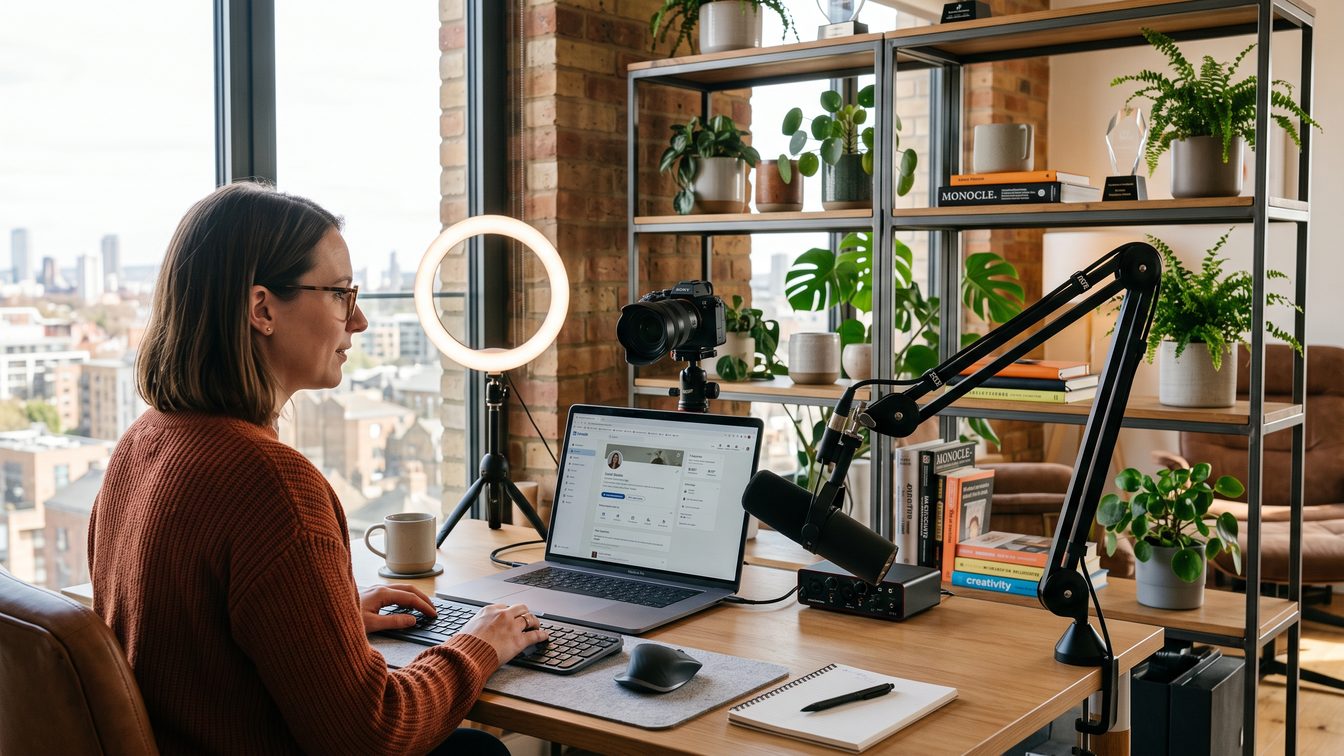
TL;DR: LinkedIn just opened a Creator Marketplace. B2B SaaS operators who set up profiles now will own the first-mover advantage in a creator economy that Goldman Sachs pegs near $250 billion today and $480 billion by 2027. The window is small. It will not stay open.
On June 10, 2026, LinkedIn launched Creator Marketplace and BrandWorks inside Campaign Manager. Two weeks later, at Cannes Lions, it added Collaborative Posts. Both are in alpha. Both are gated by invitation. And according to LinkedIn's own data published alongside the launch, 82% of B2B marketers say creators increase credibility with decision-makers, while 56% of B2B buyers say they lean on creator input at the final stage of a purchase decision [1]. That is not a top-of-funnel statistic. That is a statistic about who closes the deal. According to LinkedIn's official announcement, the Creator Marketplace connects brands with B2B thought leaders at scale.
Most owner-operators running $500K to $5M B2B SaaS shops have never heard of Creator Marketplace. That is not a criticism. It launched quietly, inside a campaign management tool most founders never open, timed to a marketing festival most founders never attend. But the operators who read this article and act on it in the next 30 days will be sitting in the room while everyone else is still reading the press release.
What LinkedIn Just Shipped
Three products launched within a three week window around Cannes Lions 2026, and each one matters for a different reason.
Creator Marketplace. A new section inside Campaign Manager, under Content and Assets, where brands search for creators by topic, expertise, and audience fit instead of scrolling the feed hoping to find the right voice [2]. It is currently live for select brands and creators in the United States and Canada, English language content only. LinkedIn has not published a global timeline, but it confirmed more regions are coming [3]. Eligible creators get a Monetization tab on their profile. Access is invite only, based on content quality, topic expertise, and how closely a creator's audience matches advertiser demand [4].
This part matters most for owner-operators: eligibility is not about follower count. Sam Corrao Clanon, LinkedIn's director of product, put it directly. The goal is not the lowest CPM, it is finding the practitioner who can speak credibly about a specific product to a specific buyer [5]. A SaaS founder with 8,000 followers who are all VPs of RevOps will out-earn a generalist with ten times the audience.
BrandWorks. A team of roughly 60 LinkedIn staffers, led by VP Alex Josephson, who build creative strategy and campaign production for managed advertisers. BrandWorks already runs Top Voices 360, a sponsorship program that paired advertisers with creators and generated more than $20 million in revenue between May 2025 and May 2026, with SAP, IBM, and ServiceNow as clients [6]. LinkedIn is targeting a $100 million annualized run rate for BrandWorks next fiscal year [6]. That is not a pilot budget. That is a business unit.
Collaborative Posts. Announced June 23, 2026, tested first with a small group of creators and brands at Cannes [7]. A single post can now carry up to five co-authors, personal profiles or company pages, all listed at the top, all publishing to every collaborator's network simultaneously [8]. It is the mechanic Instagram has run since 2021, finally on the professional network. On LinkedIn specifically, this matters more than it did on Instagram, because personal profiles already out-reach company pages by a wide margin. Metricool's 2026 LinkedIn study found personal profiles running a 63% higher engagement rate than company pages and pulling in 238% more comments per post [9]. A collaborative post lets a founder's personal reach carry the company page along with it, officially credited, in front of both audiences at once.
Put the three together and the pattern is obvious. LinkedIn is building the infrastructure to make B2B creator partnerships as searchable, payable, and trackable as a paid ad campaign. Stripe powered payouts are part of the Creator Marketplace rollout, cutting the friction that used to make brand creator deals slow and manual [10].
Why B2B SaaS Operators Should Care, Not Just Influencers
Here is the mistake most owner-operators will make. They will read Creator Marketplace and assume it is for full time LinkedIn influencers with agents and media kits. It is not. It is for operators.
Look at Alex Boyd. He founded RevenueZen, a B2B organic growth agency, after a stint as Director of Growth at a B2B accounting startup. He was not an internet celebrity. He started posting on LinkedIn without a content calendar, just sharing what he was learning about B2B marketing. A prospect saw his posts, emailed him, and became a $200,000 client. Boyd started tracking every inbound lead back to its source. The result: over $4.5 million in revenue traced directly to LinkedIn, 34% of the agency's total revenue, built on a following of just 30,000 people [11]. That works out to roughly $13,000 in revenue per post, averaged over years, not from one viral hit. RevenueZen sold to Onfolio Holdings in January 2024 for $1.1 million. LinkedIn presence was the asset that made the deal.
That is the shape of the B2B creator economy that actually pays. LinkedInsider's 2026 market analysis found that the biggest dollars are not in courses or sponsored newsletters. They are in operator creators: founders and senior practitioners who convert an audience into company pipeline, fractional consulting engagements, or board seats. A founder with 50,000 LinkedIn followers and steady inbound rarely sells a course. He converts that audience into pipeline for his own company, priced in the high five to low six figures [12].
The economics back this up at the macro level too. LinkedIn's 2026 Global B2B Marketing Outlook, based on a YouGov survey of 1,299 B2B marketers across five countries, found 77% say buyers need to trust a brand before engaging, 83% say credibility now matters more than traditional brand messaging, and 70% say buyers rely more on peer voices than brand produced content [3]. B2B creator content also runs cheaper than paid media. A separate industry analysis put average B2B creator CPMs on LinkedIn near $10, against $27 for standard LinkedIn ads [13].
For an owner-operator, the math is simple. You already have the credibility. You built the product. You solved the customer problem. What you have been missing is the distribution mechanism that turns that credibility into pipeline without paying for every impression. LinkedIn just built that mechanism and is actively looking for people exactly like you to fill it.
The 30-Day Setup Playbook
You cannot apply to Creator Marketplace directly. Access comes through an invite that appears as a Monetization tab on your profile [14]. That means the strategy is not sign up. It is become the kind of profile LinkedIn wants to invite. Here is how to do that in 30 days.
Week 1: Fix the profile before you touch the algorithm. Your banner, headline, and About section need to answer one question in ten seconds. What do you know that a buyer would pay to hear? A profile that mentions AI, productivity, hiring, and personal reflections in the same week reads as unfocused to both humans and to LinkedIn's own eligibility signals, which weigh topic consistency [15]. Pick one lane. Stay in it.
Week 1: Turn on collaboration notifications now. Go to Me, then Settings, then Notifications, then Collaborations, and switch it on. If you run a company page, make sure a super admin does the same thing on the page side, because a page cannot appear as a collaborator until an admin accepts the invite, and that step alone stalls most company side collaborative posts [16].
Week 2: Publish three posts per week in your lane, every week, no exceptions. LinkedIn's eligibility criteria for Creator Marketplace explicitly include content quality and platform presence over time [4]. There is no shortcut around consistency. Set a schedule you can actually keep for a year, not a month.
Week 2: Build your first collaborator shortlist. Identify three to five people or company pages whose audience is different from yours but relevant to your buyer. A cybersecurity operator partnered with a compliance consultant reaches two distinct, relevant audiences. Two people with 80% audience overlap reach almost nobody new [17]. Write down who you would ask, and why, before the feature reaches your account.
Week 3: Launch a LinkedIn newsletter if you have not already. Newsletters bypass the feed algorithm entirely. Every issue triggers a direct notification to subscribers, and past issues stay visible on your profile indefinitely, unlike posts that vanish after 48 hours [18]. A newsletter with a tight, specific angle, something like RevOps benchmarks for 20 person SaaS teams, builds the kind of durable, owned audience that both proves and compounds your eligibility for monetization tools.
Week 3: Draft three collaborative post scenarios you would run the day access arrives. One announcement post with an executive and a partner. One expert post pairing your company page with a recognized voice in your category. One event recap if you attend an industry conference this quarter. Having the scenarios ready means you publish on day one of access instead of scrambling.
Week 4: Set up attribution before you need it. Boyd's $4.5 million did not happen because he posted well. It happened because he tracked every inbound lead back to LinkedIn as the source [11]. Add a simple UTM structure or a CRM field that flags LinkedIn organic as a lead source now, before the volume arrives. When BrandWorks or a Creator Marketplace opportunity asks what results you can show, you want a number, not a guess.
Week 4: Review and repeat. By day 30, you should have a focused profile, a month of consistent posting, collaboration settings switched on, a newsletter live or in draft, and lead attribution running. That is the full set of signals LinkedIn is watching before it extends an invite. None of it requires a marketing budget. All of it requires discipline.
A Story About Being First
When I launched Angel Investors Network in 1997, everyone told me online capital raising was a niche. Nobody thought founders would find investors through a website instead of a Rolodex. I built it anyway. Twenty seven years later, AIN has facilitated over $1 billion in capital formation. The lesson was never about the technology. It was about being early to a distribution channel before the channel had proven itself, and then staying disciplined long enough for the proof to arrive.
First mover advantage in distribution channels compounds. It compounded for AIN because the founders who trusted an unproven website in 1997 became the network everyone else had to work through by 2005. LinkedIn's Creator Marketplace is the same pattern, just twenty nine years later and on a different platform. The operators who claim a credible, focused profile now, while it is still alpha and most owners have never heard the term, will be the bench that brands and BrandWorks reach for when the marketplace opens wide. The operators who wait for a case study will be competing against a bench that is already full.
The ATLAS Model for Growth
This playbook maps cleanly onto the ATLAS Model for Growth, the repeatable system I use to take a business from obscurity to industry leadership.
Audit your current position. Most owner-operators have a LinkedIn profile that has not been touched since they took the job. Before you post anything, audit what your profile currently signals versus what your ideal buyer needs to see.
Target the narrow lane. Pick one topic. One buyer persona. One recurring angle. Broad content reads as unfocused to both readers and to LinkedIn's own creator eligibility algorithm.
Ladder up consistency. Three posts a week, every week, for a full quarter minimum. Consistency is the signal every platform rewards, because it is the signal competitors quit providing first.
Amplify through collaboration. Collaborative Posts and creator partnerships are amplification tools, not content strategies. They only work once you already have something worth amplifying.
Systematize attribution. Track every lead back to its source. Without that discipline, you cannot prove the channel worked, and you cannot negotiate from strength when a real partnership opportunity appears.
Doctrine Connection: Legacy Matters More Than Lifestyle
Chasing this week's engagement number is lifestyle thinking. It feels productive. It rarely compounds. Building the distribution asset that still works in five years, the newsletter with a real subscriber list, the profile a brand wants to invite into a marketplace, the attribution system that proves the channel, is legacy thinking. Nobody builds a legacy by reacting to whatever LinkedIn's algorithm rewards this month. They build it by claiming position in a channel before the channel has proven itself to everyone else, and then showing up with discipline long after the novelty wears off.
FAQ
Is LinkedIn Creator Marketplace open to everyone right now? No. It is in alpha, limited to select brands and creators in the United States and Canada, English language content only. Access for creators comes through an invite only Monetization tab, not a public application [4].
Do I need a huge following to get invited? No. LinkedIn's stated eligibility criteria include content quality, topic expertise, and audience fit with advertiser demand, not raw follower count [4]. A founder with a few thousand highly relevant followers can qualify ahead of a generalist with a much larger audience.
What is the difference between Collaborative Posts and just tagging someone? A tag credits one author and shows the post mainly to that author's own followers. A collaborative post lists every collaborator at the top and publishes to every collaborator's full network at once, once each invited account accepts [8].
Should I wait until Creator Marketplace is out of alpha before I do anything? No. Access is based on signals LinkedIn is already watching: content consistency, topic focus, and audience quality. Waiting for general availability means starting the eligibility clock later than operators who prepare now.
What is the fastest way to start building attribution today? Add a single CRM field or UTM tag that flags LinkedIn organic as a lead source, and start using it on every inbound conversation this week. You cannot retroactively prove a channel worked once you finally decide to measure it.
*Disclosure: This article discusses LinkedIn's Creator Marketplace, BrandWorks, and Collaborative Posts programs based on publicly available reporting as of July 2026. Demg.ai has no paid partnership or financial relationship with LinkedIn or Microsoft. Program details, availability, and eligibility criteria are controlled by LinkedIn and subject to change without notice. Names and figures cited, including Alex Boyd and RevenueZen, LinkedIn's BrandWorks revenue targets, and the Top Voices 360 client list, are drawn from the cited sources and were accurate as of publication.*