
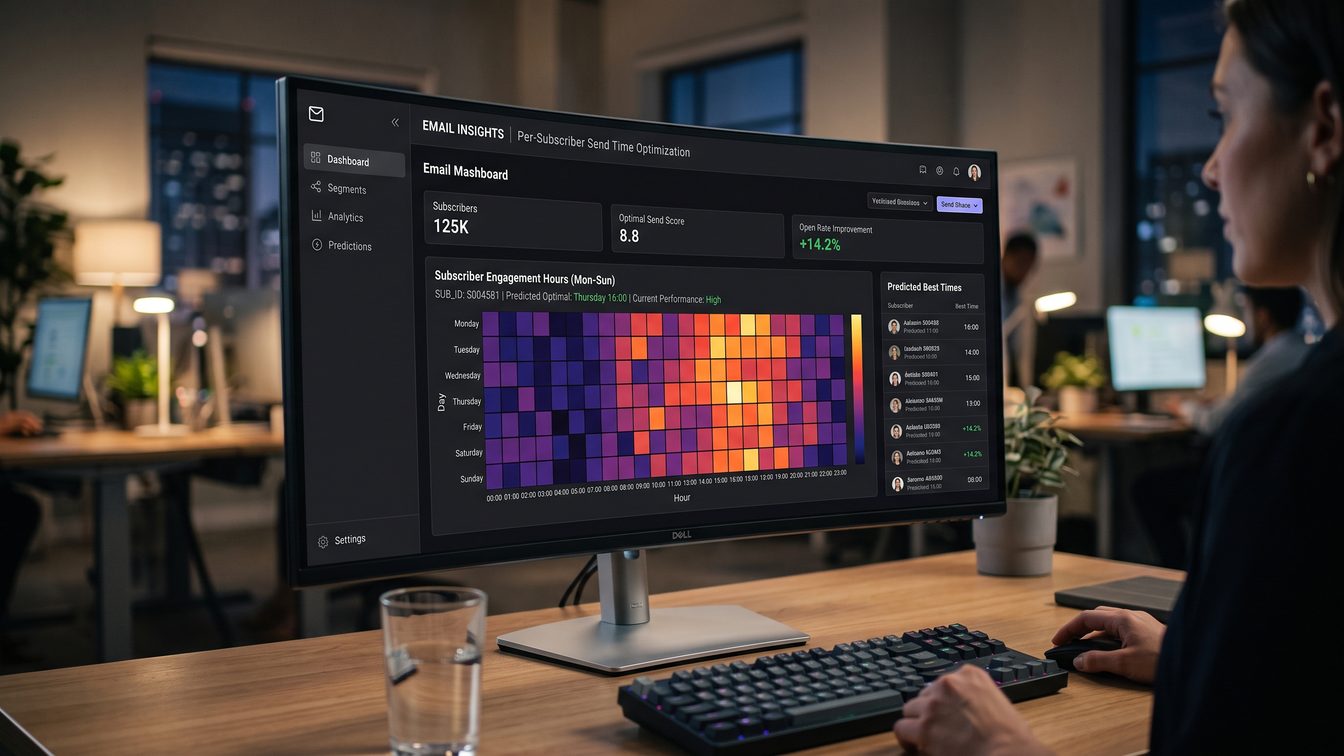
Klaviyo rebuilt its send-time engine. The data says pay attention.
Klaviyo launched a rebuilt predictive send-time optimization engine on June 9, 2026. It replaced cohort-based averages with per-subscriber behavioral modeling. Agency benchmarks from Recur and Pilothouse show revenue-per-recipient lifts of 11-19% on early adopter accounts. That is not a marginal gain. That is a line item.
Meta CPMs are averaging $18.40 across DTC verticals in Q2 2026, up 22% year over year per Varos. Paid acquisition costs more every quarter. Owned channels do not have that problem, but only if you run them like a system.
What actually changed in the new model
The old Klaviyo STO used cohort averages. It grouped subscribers by broad behavior patterns and picked a send window for the group. The new engine models each subscriber individually. It ingests three data streams:
Shopify order timestamps. Browse abandonment events. Klaviyo-tracked session data: opens, clicks, site behavior.
The model predicts, per subscriber, the window where they are most likely to engage. Multiply that across a list of 50,000 and you get thousands of micro-schedules running in parallel.
Here is the part most brands skip: the model is only as good as the event stream feeding it. Brands with fragmented tracking get degraded predictions. This is not a Klaviyo problem. It is a data hygiene problem that Klaviyo's new model just made visible.
The ATLAS Model applied to send-time AI
I evaluate every marketing system through five checks. Attribution clarity. Technical readiness. Learning period tolerance. Automation ceiling. Signal quality.
Send-time AI passes four of five cleanly. The failure point is almost always Signal quality. If your event stream is broken, the other four checks do not matter. Run your account through those five checks before you flip this on.
The submarine lesson on bad sensor data
On the boat, we ran drills where bad sensor data got fed into a control system and nobody caught it for an hour. The system did exactly what it was told. The inputs were wrong, so the output was wrong. Nobody blamed the control system. They fixed the sensor.
I see the same failure in email marketing constantly. A brand turns on an AI feature, gets a mediocre result, and concludes the AI does not work. Nine times out of ten, the event stream is broken. Fix the sensor first. Then judge the system.
Step-by-step setup
Step 1: Audit your event streams. Confirm Shopify connection is active and syncing order timestamps in real time. Confirm browse abandonment tracking is installed on product pages. Check that your Klaviyo tracking snippet fires without ad-blocker interference on at least 90% of sessions.
Step 2: Fix any gaps before proceeding. If Shopify order sync is delayed, resolve it before enabling STO. If browse abandonment is not tracked, turn it on and let it collect data for at least two weeks.
Step 3: Enable STO on broadcast campaigns only, not flows. Find the send time settings in campaign builder and switch to Smart Send Time.
Step 4: Run a learning period. Let the model run on 4-6 consecutive broadcast sends before judging results.
Step 5: Track revenue-per-recipient, not open rate. Pull RPR for each STO-enabled send and compare against your trailing 90-day average.
Step 6: Watch unsubscribe and spam complaint rates. Early data shows both dropping when STO is active, because subscribers get emails at times they are inclined to open.
Step 7: Expand to flows once broadcasts show consistent lift. Extend Smart Send Time to abandoned cart, browse abandonment, post-purchase.
Step 8: Re-audit signal quality quarterly. Shopify apps get added, tracking snippets get overwritten by theme updates. Put a recurring reminder to check your event streams every quarter.
Who should run this now versus wait
If you are on Klaviyo Growth or above, this feature costs nothing extra. There is no reason to wait if your data plumbing is solid. Brands running under 5,000 active subscribers should temper expectations. Per-subscriber modeling needs volume to find real patterns.
The math on ignoring this
A brand sending 200,000 emails per month at $2.50 RPR that gets a 15% lift is looking at an additional $75,000 annually from the same list. No incremental ad spend. No new subscribers. Just better timing.
Doctrine Connection: Competence beats credentials
This feature does not care about your title. It cares whether your Shopify webhook fires on time. That is the whole doctrine in one tool.
The Revenue Math on a 15% Lift
Run the math on a brand sending 200,000 emails per month at a current revenue-per-recipient of $2.50. That is $500,000 per month in email-attributed revenue.
A 15% RPR lift, the midpoint of the agency benchmark range, takes RPR to $2.875 and monthly email revenue to $575,000. That is $75,000 per month in incremental revenue, or $900,000 annually, from a feature that costs nothing to activate on Growth plans and above.
Even if your list is smaller, the proportional math holds. A 50,000-subscriber list at $1.80 RPR generating $90,000 per month in email revenue gains $13,500 per month with a 15% lift, or $162,000 annually.
These are not theoretical projections. They are the range reported by Recur and Pilothouse across their client base through May 2026. The variance depends on list hygiene, event stream quality, and how well the learning period is managed.
The Cost of Broken Event Streams
Klaviyo's product team confirmed that the model ingests Shopify order timestamps, browse abandonment events, and session data to weight predictions. Brands not feeding Klaviyo clean event streams via Shopify's native integration see degraded prediction accuracy.
"Degraded" means the model falls back toward cohort-average timing. You still get some benefit, but the per-subscriber precision that drives the 11-19% lift range gets diluted. The gap between a 5% lift (broken plumbing) and a 17% lift (clean plumbing) on a $500,000 monthly email program is $60,000 per month. That is the cost of a data hygiene problem nobody is watching.
Common event stream failures: Shopify webhooks delayed by a third-party app that processes orders before passing them through. Browse abandonment tracking installed on cart pages but not product pages, missing 70% of browse signals. Klaviyo tracking snippet blocked by ad blockers on mobile Safari, which accounts for 30-40% of DTC traffic.
Each of these is a 15-minute diagnostic. None of them shows up as an error in any dashboard. They just quietly reduce the quality of every predictive model that depends on them.
Beyond Send Time: The Signal Quality Compound Effect
Clean event streams do not just improve send-time predictions. They improve every AI feature Klaviyo offers: predictive churn scoring, customer lifetime value modeling, segment suggestions, and product recommendations.
Fixing your event plumbing once improves every downstream model simultaneously. This is the compound effect of signal quality. It is the same principle that makes a clean engine room run better across every system, not just the one you tuned.
FAQ
Q: Does Klaviyo's predictive send-time AI cost extra?
No. Included on Growth plans and above with no additional fee.
Q: How long is the learning period?
Plan on 4-6 consecutive broadcast sends before predictions stabilize.
Q: Should I turn this on for flows or campaigns first?
Campaigns first. Broadcasts are lower-risk to test.
Q: What happens if my tracking data is incomplete?
Predictions degrade toward cohort-average behavior. You will see a smaller lift, or none, until the event stream is fixed.
Q: Is an 11-19% revenue lift realistic for every brand?
That range comes from agency benchmarks on early adopters with clean data feeds. Brands with fragmented tracking should expect less until inputs improve.
*Jeff Barnes, MBA has no personal position in any company, fund, platform, or tool named in this article. demg.ai has no current commercial relationship with any party mentioned. demg.ai provides marketing education and systems for owner-operators, not investment advice. Past performance does not guarantee future results.*