
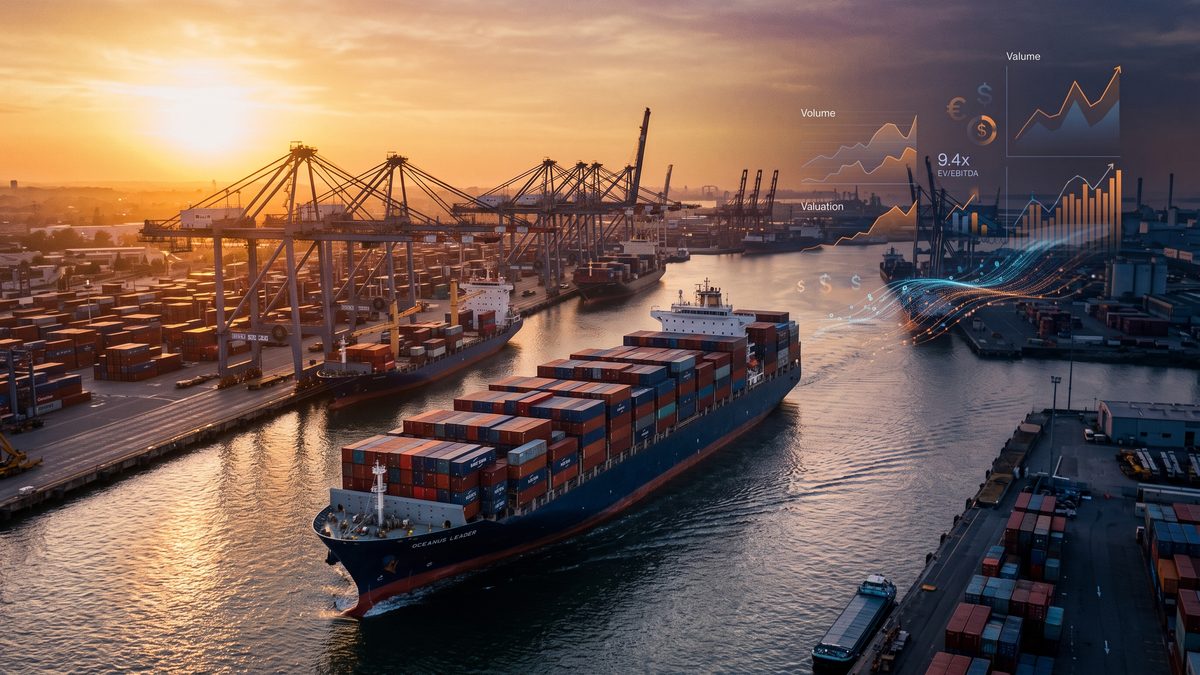
KKR sold Ocean Yield to A.P. Moller Holding on July 2, 2026, closing a five-year hold that started with an $830 million take-private deal in 2021 (KKR, July 2, 2026). KKR invested more than $3 billion, nearly doubled the contracted backlog to over $5 billion, and sold to a strategic buyer that already runs the largest container line on earth. The price wasn't disclosed.
The playbook was: build the recurring revenue, sell to the buyer who needs what you built, keep a stake in the piece that still compounds. That's not a shipping story. That's an exit engine, and it runs the same in any industry.
The Deal, In Plain Numbers
Ocean Yield started as an Aker Capital subsidiary, built from three vessels to sixty-three over nine years on the Oslo exchange. In September 2021, KKR bought a 61.25 percent stake from Aker and took the company private for roughly $830 million (Riviera Maritime Media, July 3, 2026). That was the entry price on an asset with roughly $2 billion in linked assets at the time.
Five years later, the fleet holds interests in more than 70 vessels across gas carriers, container ships, LNG carriers, tankers, and dry bulk. KKR put more than $3 billion into expanding the portfolio and diversifying the customer base toward investment-grade counterparties (Splash247, July 2, 2026). The long-term contracted backlog nearly doubled, from roughly $2.6 billion to more than $5 billion. That backlog is the number that mattered most to the buyer.
A.P. Moller Holding, the Maersk family's investment vehicle, took 100 percent of Ocean Yield through a subsidiary. CFO Martin Larsen called Ocean Yield's stable cash flow model "an excellent complement" to the group's existing maritime portfolio (RTTNews, July 2, 2026). The deal is the latest in a run of maritime consolidation moves by AP Moller Holding, following the 2023 acquisition of Maersk Supply Service, Maersk Tankers' purchase of Penfield Marine in early 2024, and the take-private of tug operator Svitzer last year (Splash247, July 2, 2026).
One detail didn't get sold. KKR retained its joint investment in CapeOmega Gas Transportation AS, the entity that owns 10 LNG carriers chartered to Shell, Engie, and QatarEnergy. KKR Partner Vincent Policard said the firm will "continue to be a strategic partner to Ocean Yield" through that stake (KKR, July 2, 2026).
KKR sold the platform. It kept the piece it liked best.
Why This Is a Textbook Exit, Not a Lucky One
Strip the ships out of the story and you're left with four moves any owner-operator can run.
Move one: build contracted, recurring revenue. Ocean Yield's entire value proposition to AP Moller was visibility. Long-term charters mean the buyer knows what cash comes in and when. A backlog isn't a sales pipeline. It's a promise already signed.
KKR didn't grow Ocean Yield by chasing spot-market shipping rates, which swing hard and often. It grew the company by locking in contracts with investment-grade counterparties, then stacking more of them on top. The backlog nearly doubled to $5 billion because that's the number buyers pay for.
Move two: sell to a strategic who values your position, not just your EBITDA. A financial buyer prices a company on multiples and comparable transactions. A strategic buyer prices it on what the asset does for their existing operation. AP Moller didn't need generic ship-leasing exposure.
It needed to fold Ocean Yield's LNG and diversified vessel exposure into a maritime group that already runs Maersk Line, Maersk Tankers, Svitzer, and Noble Drilling (Maritime Executive, July 2026). Ocean Yield CEO Andreas Røde called AP Moller a "perfect home" specifically because of scale fit, not just price (ShippingWatch, July 2, 2026). That's the difference between selling an asset and selling a fit.
Move three: time the exit when the market wants consolidation. This deal didn't happen in isolation. AP Moller Holding has been buying maritime assets on a steady cadence for three years. Maersk itself upgraded its full-year 2026 guidance by $2 billion to $3 billion around the same window, with pre-tax earnings expected between $8 billion and $10 billion (Riviera Maritime Media, July 3, 2026).
KKR sold into a strategic buyer with cash on hand, an active acquisition thesis, and improving sector fundamentals. That's not luck. That's watching the buyer's balance sheet and moving when it's flush.
Move four: keep skin in the game where it still compounds. KKR didn't walk away clean. It held onto CapeOmega, the LNG piece with contracts to Shell, Engie, and QatarEnergy. That tells you something about conviction.
When a seller retains a slice of the business post-exit, it signals the seller still believes in that specific cash flow, even after cashing out the rest. It also keeps a foot in the room for whatever AP Moller does next in LNG.
The Owner-Operator Translation
I've been involved in $1B+ in capital transactions through Angel Investors Network. The pattern is always the same: build the asset, grow the contracted revenue, then sell to the buyer who needs what you built. Ocean Yield is that pattern at scale, with ships instead of software, and a $5 billion backlog instead of a customer list. The mechanics don't change because the asset is a vessel instead of a service contract.
Here's where owner-operators skip a step. They build a business that generates revenue, then assume revenue alone makes them acquirable. It doesn't. A buyer isn't purchasing last year's number.
A buyer is purchasing next year's certainty. Ocean Yield didn't get bought for what it earned. It got bought for what it had already contracted to earn, years out, from counterparties strong enough to honor the charter.
That's the piece a landscaping company, a dental practice, or a regional HVAC operator can copy without touching a single ship. Recurring service contracts, retainer agreements, subscription revenue, multi-year maintenance deals all function like a charter backlog. Each one converts a business from "trust us, it'll keep growing" into "here's the signed paper." A private equity firm building a platform in your sector, or a larger competitor looking to consolidate share, pays a premium for the signed paper every time.
The Timing Half Nobody Plans For
Building the asset is half the job. Timing the sale is the other half, and it's the half most owner-operators never rehearse. EY's 2026 exit readiness study found that 86 percent of GPs who ran a formal exit-prep process saw improved valuations, with the strongest gains going to firms that started preparing 12 to 24 months before sale (EY Global Private Equity Exit Readiness Study, April 2026). Firms that started less than six months out reported materially weaker outcomes.
KKR didn't wake up in June and decide to sell. It spent five years scaling the backlog, diversifying the customer base, and building the CapeOmega side deal, all while watching for a strategic buyer with the appetite and the balance sheet to pay for what it built. Cherry Bekaert's 2026 outlook describes this as the market's current mode: 2025 reopened the exit window after years of stalled valuations, and 2026 is the year sponsors execute against a backlog of assets that are finally ready, led by strategic and sponsor-to-sponsor sales (Cherry Bekaert Private Equity Report, February 2026).
The lesson for an owner-operator isn't "hire a bank and wait for a call." It's simpler and less comfortable. Exit readiness isn't a project you start when you decide to sell. It's a discipline you run continuously, the same way a ship's engineer logs pressure readings on a schedule instead of waiting for a warning light.
If your books, your contracts, and your customer concentration can't survive a stranger's diligence on 90 days' notice, you're not ready to sell. You're hoping the buyer won't look too closely.
Doctrine Connection: Capitalism Creates Value
Ocean Yield is proof that capitalism, run correctly, doesn't extract value. It creates it. KKR paid $830 million for a company with roughly $2 billion in linked assets. Five years and $3 billion of invested capital later, it sold a platform with a $5 billion contracted backlog to a buyer who valued the fit enough to take the whole thing.
Nobody got poorer in that transaction. Aker got liquidity in 2021. KKR's LPs got a return. AP Moller got a strategic asset that complements a century-long maritime business.
The vessels kept operating the whole time, moving gas and cargo and revenue across every leg of that hold period.
That's the doctrine in one transaction. Value gets created when capital gets deployed toward an asset that produces more, contracts more, and diversifies more than it did on day one. The exit isn't the reward for building value. It's the receipt.
Owner-operators building toward their own exit should read this deal as a checklist, not a headline. Convert revenue into contracted backlog wherever the business model allows it. Identify who the strategic buyer in your category actually is, years before you need them, and understand what they're missing that you have.
Watch the consolidation cycle in your industry the way KKR watched AP Moller's acquisition pace. And when the exit comes, decide deliberately what you keep, not just what you sell.
FAQ
How much did AP Moller Holding pay for Ocean Yield? The financial terms were not disclosed. What's public: KKR invested more than $3 billion during its five-year ownership and grew the long-term contracted backlog to over $5 billion, up from roughly half that figure when KKR took the company private in 2021 for about $830 million (Splash247, July 2, 2026).
Why did KKR keep its stake in CapeOmega instead of selling everything? CapeOmega Gas Transportation AS owns 10 LNG carriers under long-term charter to Shell, Engie, and QatarEnergy. KKR's continued stake signals conviction in that specific contracted cash flow and keeps KKR positioned as a strategic partner to Ocean Yield's next chapter under AP Moller ownership (KKR, July 2, 2026).
What does "contracted backlog" mean for a small business owner, not a shipping company? It means any revenue you can point to on paper before it's earned: signed multi-year service contracts, retainer agreements, subscription commitments, or maintenance deals with defined terms. Buyers pay a premium for backlog because it converts a forecast into a receivable.
Why does a strategic buyer often pay more than a financial buyer? A financial buyer prices you on comparable multiples. A strategic buyer prices you on what your asset does inside their existing operation, including cost savings, market access, or vertical integration they can't easily build themselves. AP Moller wanted maritime scale and LNG exposure it didn't have to build from scratch.
When should an owner-operator start preparing for an exit? Twelve to twenty-four months before you intend to sell, according to EY's 2026 exit readiness research, which found firms on that timeline saw the strongest valuation improvements versus those who started under six months out (EY Global Private Equity Exit Readiness Study, April 2026). Readiness means clean books, documented contracts, and a clear answer to who the natural strategic buyer is.
*Disclosure: Jeff Barnes is the founder of demg.ai and Angel Investors Network. demg.ai provides AI marketing education and systems for owner-operators. This article is for informational purposes only and does not constitute business, legal, or financial advice. Past performance does not guarantee future results.*