
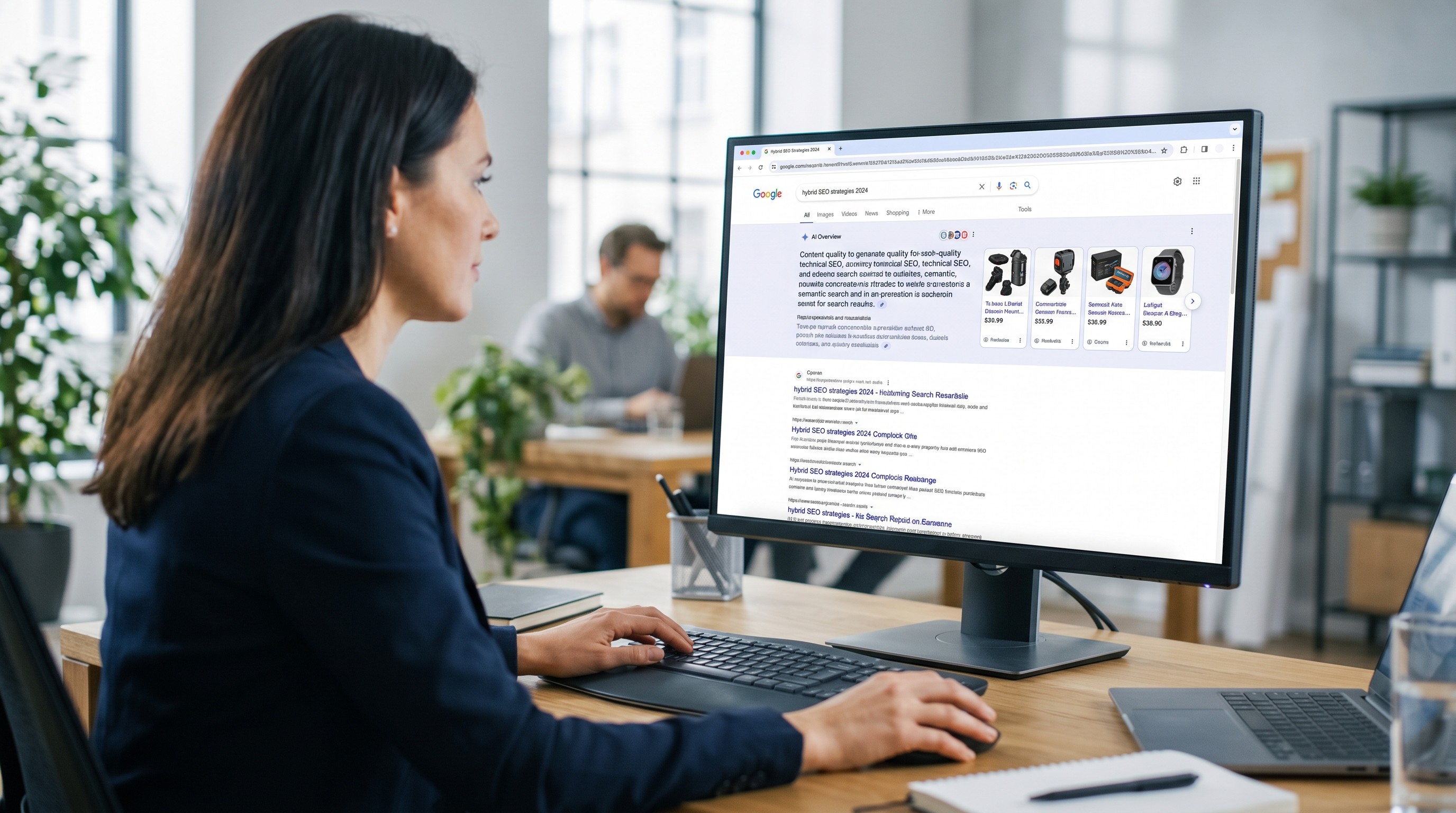
AI Overviews Just Broke Your Category Pages
As of June 2026, Google AI Overviews appear on an estimated 68% of U.S. commercial search queries. For ecommerce merchants, the impact is immediate: organic click-through rates on category and comparison pages have dropped 20% to 35%, with the steepest declines hitting skincare, home goods, supplements, and apparel.
According to Semrush's June 2026 benchmarking data, organic CTR on queries containing "best," "top," and "buy" fell 28% year-over-year for e-commerce domains in the 10,000-to-500,000 monthly organic session range. For competitive categories like skincare, the decline reached 34%.
This is not temporary. The pre-2025 playbook—optimize category pages, build domain authority, harvest informational traffic with listicles—is structurally broken. Google has financial incentive to protect ad revenue (Shopping ads remain core monetization), but for content-driven organic, the math no longer works without a fundamental rebuild.
I learned this lesson the hard way building content authority at AIN: we didn't just publish. We verified every ranking signal, every data point, before scaling budget. Verification beats optimism.
The Hybrid Model: Shopping + PMax + Rebuilt Organic
You now operate in a dual-channel environment. Bottom-funnel conversion runs on paid; mid-to-top-funnel authority runs on organic that feeds AI Overviews. The operators winning are those who compartmentalize budget and strategy accordingly.
Paid: Shopping + Performance Max As Your Demand Engine
Google Shopping now integrates directly with AI Overview panels. When a user asks "best running shoes for flat feet," the AI Overview often renders a Shopping carousel sourced from your Merchant Center feed. Performance Max campaigns, when configured correctly, surface across this entire market.
Here's the capital math: The average CPC in Shopping rose 12-18% in Q1 2026 across competitive categories (Tinuiti Q1 2026 Digital Ads Benchmark). If your blended organic + paid CAC was previously $45, and organic CTR drops 30%, you can't simply shift that $45 into paid, you'll hit $55-65 per acquisition. The fix is scale: Performance Max budgets should grow 25-35% to capture the volume AI Overviews provide, with tighter ROAS targets.
Two-campaign structure:
- PMax Hero SKUs: Top 20% by revenue. High-quality creative assets, lifestyle imagery, video. Conservative Target ROAS (5:1 to 6:1 in 2026 environments). Let automation find scale.
- PMax New Arrivals: Isolated campaign to avoid cannibalizing hero budget during the learning period. Spin-up after 3-5 weeks of hero data.
Feed quality is now your creative strategy. If your product titles are thin, descriptions missing key attributes (size, color, material), and structured shipping data absent, Google's AI optimization has nothing to work with. Your feed must include shippingDetails, hasMerchantReturnPolicy, and priceValidUntil as table stakes, not optional.
Organic: Rebuild for Citations, Not Clicks (Yet)
AI Overviews cite 2-4 sources when forming a recommendation. Brands cited in the Overview see a modest referral bump; everyone else gets less. Your organic strategy shifts from "rank high and capture traffic" to "get cited as a trusted source."
That requires three tactical moves:
1. Implement Complete Product Schema
Product schema is the highest-use SEO work most operators skip. Google's Search Central documentation distinguishes two markup types: Product snippets (for review pages) and Merchant listings (for direct purchase pages).
In 2026, three fields moved from "recommended" to effectively required:
- shippingDetails: Must include shippingRate (MonetaryAmount with value + currency) and shippingDestination (DefinedRegion with addressCountry). Sites with complete shippingDetails win the price snippet ~4x more often than sites without it on competitive retail queries.
- hasMerchantReturnPolicy: Include returnPolicyCategory and returnDays. Non-negotiable.
- priceValidUntil: Essential for promotional pricing visibility.
The GTIN field (gtin8/gtin12/gtin13/gtin14) is massively underused. Google weights GTIN-matched products heavily for merchant listings. If your feed omits GTIN, you're invisible in 40% of Shopping-enabled surfaces.
Sites with complete Product + Offer + AggregateRating schema win price snippets on ~60-75% of commercial queries. Bare-minimum markup wins on ~10-20%. That's the audit: ship complete markup or don't ship schema at all.
2. Audit Third-Party Review Publishers
When AI Overviews synthesize a recommendation, they pull from authority sources: The Wirecutter, RTINGS, Reviewed.com, and industry-vertical specialists. These publications have domain authority signals Google trusts.
You can't buy citations, but you can engineer them. Here's the operator's approach: identify the top 5 review publishers in your category. Reach out with a story: "Your recent article on [product category] missed a critical use case. Here's the data [specific, verifiable claim] that changes the recommendation." Send structured product data, not marketing copy.
AIM: get reviewed by one publisher per quarter. Each citation that lands in an AI Overview is essentially a compounding conversion asset. Reviewers cite you because you provided verifiable data, not hype.
3. Build Mini-Answer Content for AI Overview Inclusion
AI Overviews pull from two types of content: comparison pages and FAQ content that directly answers common questions. You're not building listicles anymore. You're building mini-answers.
Example: Instead of "The 10 Best Running Shoes," build: "What Shoes Do Podiatrists Recommend for Flat Feet? Data from 47 Board-Certified Podiatrists." Include structured data citing the research methodology, expert credentials, and your top 3-4 product picks (yours and competitors equally, to signal you're not just sales-driven).
This does two things: First, it makes AI Overviews more likely to cite your domain. Second, when AI Overviews do cite you, users see your verifiable methodology, not just a product name. That builds brand recall.
4. Build Entity Authority
Google AI engines treat brand + product entities with more weight than loose topical content. Your brand entity should have:
- A Wikipedia or equivalent third-party page (or a Wikipedia-like page on your domain with third-party citations).
- Consistent name, logo, and description across your site and all feeds.
- Organization schema with proper return policies, loyalty programs, and trust signals.
Product entities need: GTIN linkage, accurate brand entity reference, and AggregateRating backed by authentic customer reviews. AI engines use these signals to validate "should we trust this retailer's listing?"
The Data's DNA Framework: Verification → Authority → Distribution
I invoke the Data's DNA framework here because verification is the anchor:
- Verification: Your product data, reviews, and schema are auditable. Third-party sources cite you because your claims are verifiable. Fabricated review counts or inflated ratings get de-indexed by Google's spam detection.
- Authority: Entity authority compounds. A brand cited in 3 AI Overviews builds recognition. Cited in 20, it becomes a trust signal. Your goal: get cited consistently by the same 3-5 authority sources.
- Distribution: Once authority is solid, distribution follows. AI Overviews cite you. Shopping carousels surface your products. Paid campaigns have higher ROAS because your domain is familiar. The math compounds.
FAQ
Q: Should I stop investing in organic SEO content?
No. Stop investing in high-funnel listicle content that competed on CTR. Invest in bottom-funnel, verification-driven mini-answers that position you for AI Overview citation. Organic's role shifted from traffic driver to authority asset. Treat it accordingly.
Q: What's the realistic timeline to see AI Overview citations?
If you already have strong entity authority (3+ years of consistent brand signals, decent domain authority), 6-12 weeks. If you're starting from scratch, build mini-answer content for 8-12 weeks, pitch 2-3 third-party reviewers, and expect 3-6 months before consistent citation. Verification compounds slowly. Plan accordingly.
Q: How do I know if my Product schema is actually complete?
Use Google's Rich Results Tester. Run your 20 highest-revenue product pages. If fewer than 15 trigger the price snippet, your schema is incomplete. Common gaps: missing shippingDetails, hasMerchantReturnPolicy, or GTIN. Audit, fix, and re-test. One page per quarter is the baseline maintenance rhythm.
Q: Is Performance Max a replacement for Standard Shopping campaigns?
No. PMax is top-of-funnel discovery. Standard Shopping gives you keyword control and per-product-group budget allocation. Run both. PMax captures users who haven't searched your brand yet. Standard Shopping captures high-intent, branded and category-head terms where you want tighter spend management.
Q: If AI Overviews reduce organic traffic, why rebuild organic at all?
Because the brands cited in AI Overviews see higher conversion rates on the traffic they do get, plus improved paid ROAS due to brand lift, plus better email list growth from organic authority plays. An AI-cited site with 40% of former organic volume but 20% higher conversion rate and 15% higher ROAS on paid is producing more revenue, not less.
Q: What happens to my domain if my Product schema has fabricated reviews?
Google de-indexes pages with fabricated review data. Competitors will report you. Verification beats optimism. Audit your reviews quarterly. If anything looks inflated or inauthentic, remove it. A 4.2-star rating with 237 authentic reviews beats a 4.8-star rating with 2,400 suspicious ones every time.
The Rebuild Starts Now
Adobe data shows AI-driven retail traffic surged 138% year-over-year in May 2026, a 1,324% increase since October 2024. That growth is real. But it's not available to every operator. It flows to brands Google trusts, brands cited by reviewers, brands with complete entity and product data.
The hybrid model, Shopping + Performance Max for bottom-funnel conversion, rebuilt organic for AI Overview authority, is no longer optional for operators running lean margins. Start with schema audit. Then mini-answer content. Then third-party reviewer outreach. Verification beats optimism. That's the doctrine that compounds.
Jeff Barnes, MBA is the founder of demg.ai. This article reflects independent analysis. AI tools assisted with research. All conclusions are Jeff's own.