
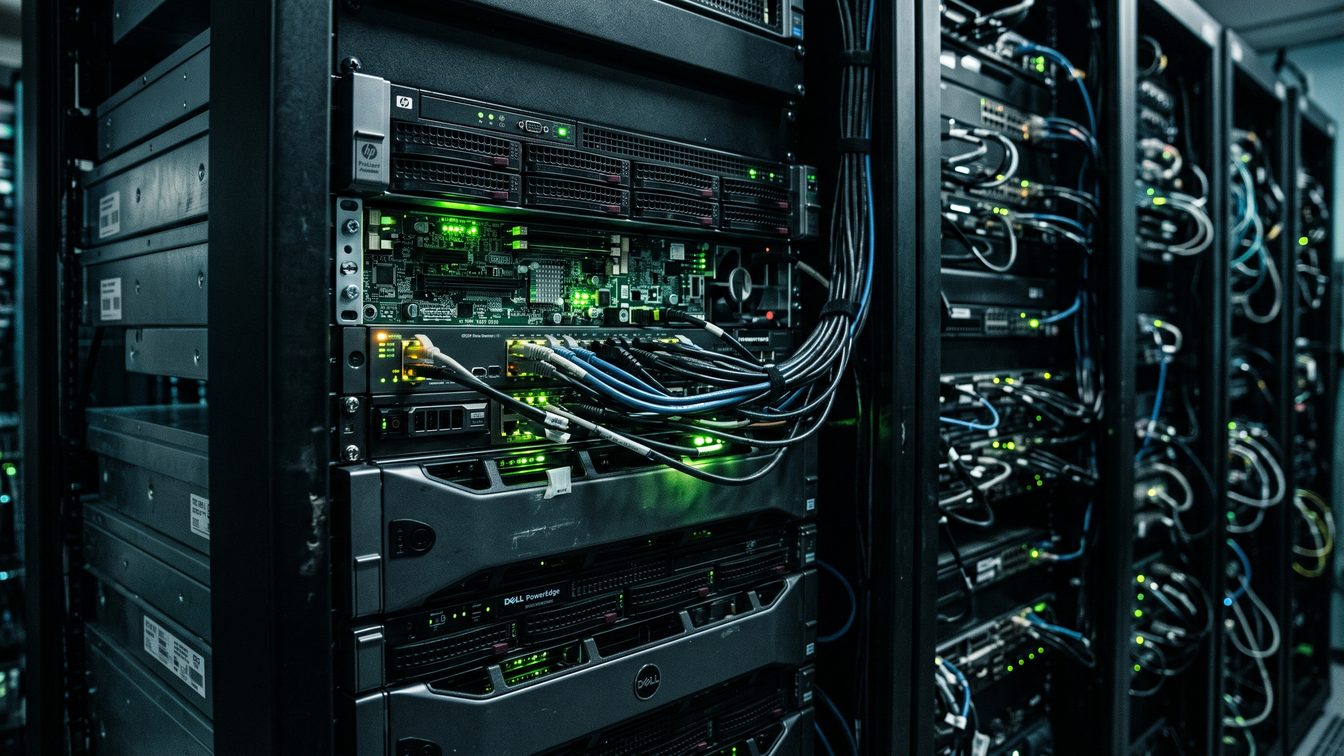
According to TechCrunch, Groq raised $350 million on August 17, 2026, to fund its pivot from AI chipmaker to what the industry calls a neocloud, a company that rents out GPU capacity instead of building the chips underneath it. The round values Groq at $3.5 billion. Eleven months earlier, in September 2025, Groq was worth $6.9 billion. That is a haircut of roughly 50%, and it happened for one reason: Nvidia hired away Groq's founder and most of its engineers.
This is not a story about a company failing. Groq did not go to zero. It raised real money from a real investor and it kept operating. This is a story about a company getting priced correctly after the market found out what it actually was. And for an owner-operator running a $2 million to $50 million business who is being pitched on building proprietary AI infrastructure, this is the most useful data point of the year.
What Actually Happened
Groq was founded in 2016 by Jonathan Ross, a former Google engineer who helped build Google's tensor processing units. Groq's whole premise was building its own chip, the LPU (Language Processing Unit), to compete directly with Nvidia. That is a hard business. Chip design takes years and billions of dollars. Groq raised the billions. It built the chips. It signed customers. By September 2025 investors valued the company at $6.9 billion.
Then Nvidia made a move that had nothing to do with buying a competitor and everything to do with neutralizing one. Nvidia struck a $20 billion licensing deal with Groq and, as part of the arrangement, hired Jonathan Ross and most of Groq's top talent directly onto Nvidia's payroll. According to Dealroom, roughly 90% of Groq's employees joined Nvidia, with vested shares paid out in cash and unvested shares converted into Nvidia stock. Dealroom's assessment is blunt: "The company that remains is a fundamentally different one: no longer primarily a chip designer, but a data centre operator focused on inference."
The founder is gone. Nine out of ten employees are gone. What is left is the brand, the customer contracts, the 13 data centers, and a new business model: rent Nvidia GPUs, sell inference capacity to developers, and call it a neocloud. Nvidia even joined the new funding round as an investor, which tells you exactly how this ends. Groq is not Nvidia's rival anymore. Groq is Nvidia's customer, and Nvidia wants that customer well capitalized.
The Numbers Do Not Lie
Here is the ledger, in full. Groq raised $650 million in June 2026, then another $350 million in August, for $1 billion in fresh capital inside three months. The August round was led by Disruptive, a Dallas-based investment firm run by Alex Davis. Groq says, per its own newsroom announcement, that it now operates 13 data centers across North America, Europe, the Middle East, and Asia Pacific, serves more than six million developers and thousands of AI-native companies, and processes trillions of tokens per week. The new capital funds a buildout from 54 megawatts of capacity today to 200 megawatts or more by the end of 2027.
Those are not small numbers. Six million developers is a real distribution channel. Trillions of tokens a week is real usage. But look at the valuation again: $3.5 billion, down from $6.9 billion. The market is not pricing Groq on its user base. The market is pricing Groq on what it lost: its chip-design independence, its founder, and its claim to be a genuine Nvidia alternative. The Next Web put it better than I can: "At $3.5bn, they are paying for a going concern, not a giant-killer." The same piece calls the arrangement peculiar "even by the standards of the AI-chip boom, where allegiances are fluid and almost everyone is somehow both a customer and a competitor at once."
Bloomberg Law frames the math the same way: $3.5 billion is "roughly half what it was worth nearly a year ago before Nvidia Corp. struck a licensing deal with the startup and hired away much of its talent." Half. In under a year. That is not a market correction. That is a company getting re-underwritten from scratch after its core asset, the ability to out-engineer Nvidia, evaporated.
The Insurance Lesson: Price the Risk, Not the Story
I spent years at Hartford and later at Munich Re pricing risk for a living. Underwriting is not about believing a good story. It is about pricing the probability that the story holds up under stress. A catastrophe model does not care how confident the builder was. It cares about wind speed, soil composition, and distance to the coastline.
Groq's investors in September 2025 were underwriting a story: a well-funded startup with a brilliant founder was going to chip away at Nvidia's monopoly on AI compute. That story had a real chance of being true. It was not a bad bet at the time. But the story had a concentration risk nobody priced correctly: the entire value of the company sat on top of one founder and a small team of specialized engineers, competing against the single most cash-rich company in the history of technology. Nvidia did not need to out-engineer Groq. Nvidia just needed to write a check big enough to hire the team. It did, for $20 billion, and the "giant-killer" story ended in an afternoon.
That is the same mistake I watched underwriters make with catastrophe risk that looked diversified on paper but was actually one earthquake away from wiping out five different policies at once. Concentration risk hides inside a good narrative. You have to price it separately from the story. Groq's investors are re-pricing it now, in public, at half the number.
The Verdict for Owner-Operators
Here is the verdict, stated plainly. If you run a $2 million to $50 million business and someone on your team, or a vendor, is pitching you on building your own AI inference layer, your own model-hosting infrastructure, or your own GPU cluster: do not do it.
Groq had more going for it than you ever will on this front. It had a founder who helped invent the underlying chip category at Google. It had $6.9 billion in perceived value. It had years of engineering runway and a real product with real customers. Nvidia still cut it off at the knees with a licensing deal and a hiring raid. If Nvidia can neutralize a well-funded chip company by writing one check, it can neutralize anything smaller with even less effort. You are not going to out-build Nvidia's economics, its supply chain, or its regulatory position with a $2 million P&L. Nobody in your revenue bracket should be trying.
Buy the infrastructure. Rent the capacity. Groq itself now sells that capacity as a service, and it competes with CoreWeave, Lambda, and Nebius, three other neocloud providers running on the same Nvidia GPU foundation. Pick one, negotiate a per-token or per-hour rate, and put it in a contract with a term you understand. Your job is not to win the infrastructure war. Your job is to build the layer that sits on top of infrastructure: the workflow, the proprietary data, the customer relationship, the thing a customer pays you for that has nothing to do with which chip ran the model. That is where your moat lives. It has never lived in silicon, and after this year, it should be obvious that it does not live in owning your own inference stack either.
The Risk on the Other Side of the Ledger
I am not telling you to close your eyes and sign the first neocloud contract that lands in your inbox. Buy-don't-build has its own risk, and I would be leaving something out if I skipped it.
First, Groq's reinvention could still fail. A company that lost its founder and 90% of its engineers in one transaction is not a settled bet. The $3.5 billion valuation assumes the remaining team can run a data-center operating business competently. That is a different skill set than chip design. Watch their next 12 months before you assume the "going concern" framing from The Next Web holds up.
Second, vendor lock-in is real. The whole pitch of renting compute is that you avoid capital risk. But once your product is built on top of a specific neocloud's API, switching costs climb fast. Pricing that looks attractive at signing can move once you are dependent. Read the contract for price-escalation clauses, minimum commitment terms, and data-portability guarantees before you build your product around any single vendor's endpoint. Verify the unit economics at the volume you expect to run in 18 months, not the discounted rate you get on day one.
Third, do not confuse "buy don't build" with "don't think about infrastructure at all." You still need to underwrite the vendor. Ask about uptime history. Ask what happens to your account if the vendor gets acquired or, like Groq, gets partially absorbed by a bigger player. The point is not to outsource your judgment. The point is to outsource the capital expenditure and keep the judgment.
Doctrine Connection: Verification Beats Optimism
The doctrine here is verification beats optimism. Groq's 2025 investors were optimistic. They believed in the founder, the chip, and the mission to break Nvidia's grip on AI compute. Optimism is not a crime. It is required to fund anything ambitious. But optimism without verification is how you end up marking your position down 50% in eleven months.
On a submarine, we never operated on optimism. Every watchstander verified every reading against a written procedure before acting on it. You did not assume the reactor was stable because it looked stable five minutes ago. You checked the gauge, cross-checked it against a second instrument, and logged it. That habit is not paranoia. It is how you catch the failure before it catches you.
Apply the same discipline to any AI vendor pitch that lands on your desk. Do not evaluate a neocloud provider, or any infrastructure vendor, on the strength of its story or its logo. Verify the SLA. Verify the pricing at your real volume. Verify what contractual protection you have if the vendor's ownership or leadership changes overnight, the way Groq's did. The operators who verify before they commit capital will still be standing when the next valuation reset makes headlines. The operators who bought the story will be explaining to their board why the balance sheet took a hit for an infrastructure bet they never should have made.
FAQ
Q: Should my company ever build its own AI infrastructure instead of renting it? Almost never, at the $2 million to $50 million revenue range. Building competitive AI infrastructure requires capital and engineering depth that Groq had in abundance and still could not sustain independently against Nvidia. Rent compute from a neocloud provider and put your engineering effort into the product layer where you actually have an edge: your data, your workflow, your customer relationship.
Q: Is Groq still a safe vendor to use for AI inference after this shakeup? Groq still serves more than six million developers and runs 13 data centers, so it has real scale and real revenue behind it. But it lost its founder and 90% of its staff in one transaction, and its own investors just cut its valuation in half. Treat it the way you would treat any vendor mid-transition: verify uptime history, verify contract terms, and do not build a single point of failure on top of one provider without a fallback plan.
Q: What is a neocloud, and why does it matter for a small business owner? A neocloud is a company that rents out GPU computing capacity, usually built on Nvidia chips, instead of designing its own hardware. CoreWeave, Lambda, Nebius, and now Groq all fit this category. It matters because it means you can access enterprise-grade AI compute on a rental basis, at per-token or per-hour pricing, without the capital outlay or technical risk of building your own data center or chip stack.
Q: What is the single biggest mistake an owner-operator could make after reading this story? Assuming the lesson is "never trust AI infrastructure vendors" and retreating to doing nothing. The actual lesson is narrower: verify before you commit capital, and do not try to out-build a company with more capital and supply chain than you. Renting infrastructure from a vetted vendor, with a contract you have actually read, is still the correct move for almost every operator in this revenue range.