
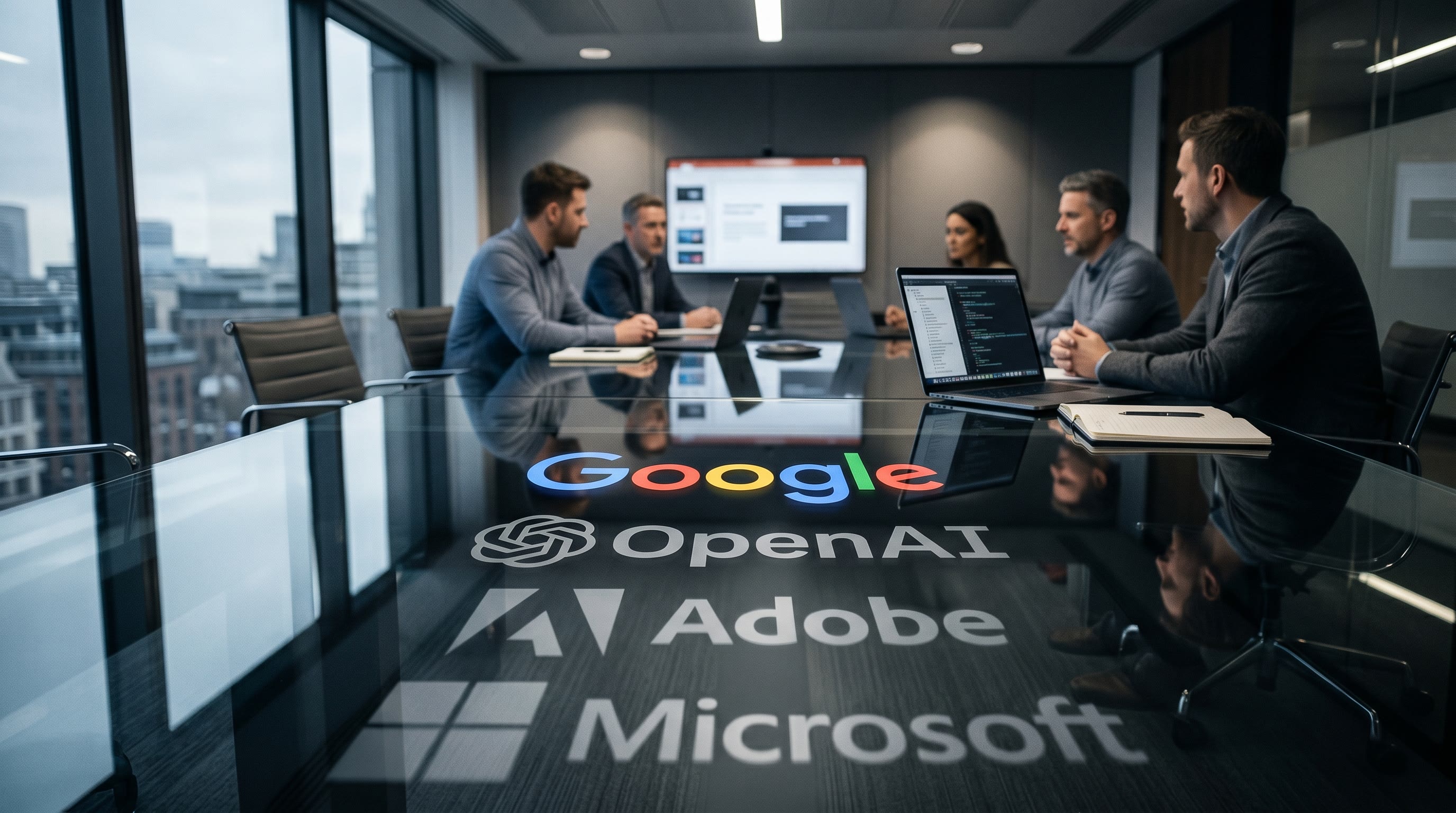
According to new research from Forrester and the 4As, Google is now the preferred AI partner for US marketing agencies. That is a historic shift. It marks the end of the model-obsession era and the start of the operating system wars.
For the first time since generative AI entered marketing, agencies aren't choosing based on the smartest LLM or the most aggressive founder. They're choosing based on which company built an ecosystem that actually works.
The Shift From Tools to Operating Systems
Agencies don't measure success by model leaderboards anymore. They measure it by workflow.
When a creative director needs to generate an asset, they don't think about inference quality. They think about whether that asset connects to their media buying, data activation, and commerce infrastructure. When a performance marketer optimizes a campaign, they don't celebrate a clever prompt—they celebrate a system that lets them rewrite, test, and deploy creative to three channels in minutes.
Google won because it made a deliberate move from "an ads platform using AI" to "an AI-enabled marketing operating system." That's a different product entirely.
Adobe expected to dominate this transition. Anthropic had the model pedigree. OpenAI had the cultural momentum. Microsoft had enterprise scale. But none of them connected the dots fast enough. Google already owned search, video, display, analytics, and commerce data. It added AI orchestration on top of an infrastructure that was already touching every part of the buyer journey.
The question agencies asked themselves wasn't "Who has the best model?" It was "Who has the system where every component talks to every other component?"
Why Systems Win
On the submarine, we didn't pick the best individual component. We picked the system where every component talked to every other component. When the reactor scram alarm fires, the procedure doesn't care which valve is the "smartest." It cares that every valve operates in sequence. It cares that sensor A triggers actuator B, which triggers decision C, which executes procedure D. One misaligned component and the whole boat is at risk.
Marketing is no different.
An agency that spends $2 million on Google Ads isn't going to build that campaign in Claude or ChatGPT or a fine-tuned custom model sitting in isolation. They're going to build it in a system that knows about their audience, their product catalog, their media budget, and their previous conversion data. They want creative generation that talks to bid automation that talks to conversion tracking that talks to attribution.
The Forrester research made this explicit: "Agencies are no longer buying AI models. They're buying and building marketing operating systems." The report continues: "The name of the game is no longer to optimize isolated marketing tasks but to orchestrate end-to-end marketing working systems that unify data, creative, activation, and measurement."
That's not hyperbole. That's the market saying out loud what has been true for the last eighteen months,the vendor who wins is the one who lets you stop thinking about individual tools and start thinking about workflow.
The Adoption Curve Accelerated
Generative AI adoption in marketing agencies jumped from 33 percent in 2023 to 79 percent in 2025. That acceleration isn't because Claude got smarter or OpenAI got cheaper. It's because frameworks started solidifying. Agencies figured out what problems AI could solve, and they figured out what infrastructure those problems required.
McKinsey data shows 40 percent of marketing work is now AI-related. That's not 40 percent of ideation or 40 percent of copy. That's 40 percent of the operational work,from asset generation to testing, from audience activation to media allocation.
When you're allocating 40 percent of your work to a new category, you don't pick the best point solution. You pick the company that can orchestrate all of it.
Google is the top partner because it answered the question agencies were already asking. Microsoft is expected to grow marketing gravity because it's leaning into enterprise orchestration,building systems for agencies that work inside larger corporation IT infrastructure. Everyone else is still selling models.
The Question Agencies Are Really Asking
One agency executive quoted in the research asked a question that reveals the entire game: "Why should I believe any tech company agents won't make biased, self-serving recommendations in their automated ad programs?"
That's the question that kills the mythology around the smartest model. If Google's system prioritizes Google's own ad inventory over an agency's best media buys, then the intelligence is compromised. If Microsoft builds an orchestration layer that secretly favors Microsoft services, the system is corrupted. If OpenAI's API adds friction to anyone who doesn't use GPT-4o, the ecosystem fails.
Agencies chose Google not because they trust Google more, but because Google's advertising dominance makes transparency easier to audit. When Google's algorithms benefit Google's search and YouTube revenue, at least the financial motive is visible. Everyone knows Google owns the ad inventory. The system can be optimized around that reality.
The Owner-Operator Lesson
If you're running a marketing organization,whether agency, brand, or platform,the lesson is stark: model quality is table stakes. All of them are good enough now. The game is orchestration.
This is why the campaign model is dead and the always-on system has replaced it. You can't think in campaign cycles anymore because the system doesn't work in cycles. It works in continuous activation, continuous testing, continuous optimization.
The ATLAS Model for Growth reflects this shift. Activation is no longer a launch event. It's a perpetual state. You're constantly testing creative variants, audience segments, channels, and bidding strategies. The system that lets you do that fastest,without switching between five different interfaces,is the system that wins.
When we examined the three AI marketing platforms owner-operators need to know about in June 2026, the competitive advantage wasn't raw model capability. It was workflow cohesion. The platform that let you take a brand insight, generate creative options, test them against audience segments, and deploy to three channels in one session was the one that created organizational velocity.
Look at the operators' verdict on AdGPT going live and campaigns running in minutes. The utility wasn't that the AI was intelligent. It was that the system was connected.
Systems Beat Slogans
Google didn't win this position because it hired better AI researchers or because it's treating this like a moonshot. It won because it treated it like infrastructure. Infrastructure is invisible when it works. You don't think about your plumbing until it fails. Google built plumbing that connected the entire agency kitchen,from the data reservoir to the creative foundry to the media distribution network.
OpenAI built a brilliant model that everyone wanted to plug into their existing broken systems. Adobe tried to integrate intelligence into existing creative software. Anthropic built the smartest LLM. But Google built a system.
That's not abstract theory. That's Forrester's data and 4As' research showing which vendor agencies are now choosing to spend money with.
The upcoming report, "The State Of AI Inside US Marketing Agencies, 2026," will likely show this pattern deepening. When you have 79 percent adoption and 40 percent of your work is AI-adjacent, you don't care about elegance or purity or which company has the most charismatic founder. You care about whether the system makes you faster, smarter, and more profitable.
Agencies chose Google because Google made the shift from tools to systems first. Everyone else is still catching up.
What Owner-Operators Should Do This Week
The Forrester data isn't theoretical. It carries three concrete implications for anyone running marketing operations at a $500K to $5M business.
First, audit your current tool count. The average mid-market merchant ran 17.2 SaaS tools in 2024. That number is falling to 11.4 by the end of 2026. If you're paying for separate tools for creative generation, audience targeting, media buying, attribution, and reporting, you're carrying redundancy. Map every tool to a workflow step. If two tools cover the same step, cut one.
Second, test Google's orchestration layer against your current stack. This doesn't mean switching everything overnight. It means running a single campaign through Google's end-to-end flow: insight, creative generation, audience activation, deployment, measurement. Time the workflow. Compare it to your current process. If Google's version takes 40 minutes and your cobbled-together stack takes four hours, the math speaks for itself.
Third, stop evaluating AI tools by model quality. Every major model is good enough for marketing applications. The Claude vs GPT-4o vs Gemini debate is the wrong conversation for operators. The right conversation is: which system reduces the number of tabs I have open when I launch a campaign? Which system feeds conversion data back into creative generation without a manual export step? Which system lets me test three audience segments and four creative variants without building a spreadsheet to track which combination went where?
The agency executive who asked whether AI agents would make "biased, self-serving recommendations" was raising the right concern. But for owner-operators, the bias risk is secondary to the workflow risk. A biased system that saves you 20 hours a week is still better than an unbiased collection of disconnected tools that burns 20 hours a week in manual stitching.
That's not a defense of bias. That's an acknowledgment that operational friction kills more businesses than algorithmic bias does. Fix the workflow first. Audit the bias second. Both matter. The sequence matters more.
FAQ
Q: Does this mean OpenAI is in trouble?
A: No. OpenAI is a foundational layer for most systems. Google is the orchestration layer. Both can grow. But the agency vendor choice is now about orchestration, not foundation. OpenAI benefits most when other vendors integrate its model into their systems,which they will.
Q: Will this last, or is it just recency bias?
A: This will last until someone builds a better operating system. The company that figures out how to let agencies orchestrate across Google, Microsoft, Amazon, and best-of-breed tools will become the next layer of preference. But for now, Google owns the integration problem because it owns so much infrastructure already.
Q: What about agencies that have already built systems on Anthropic or OpenAI?
A: They're not switching models. They're wrapping them. Smart agencies are building middleware that lets them swap models while maintaining system continuity. The model is becoming fungible; the system is what matters.
Q: Is this good or bad for independent platforms?
A: It's pressure, not death. Independent platforms that can orchestrate across multiple models and data sources can still win. But they have to beat Google on flexibility, speed, or focus. Being "open" isn't a competitive advantage anymore; being connected is.
Q: What should an owner-operator do right now?
A: Audit your workflow. Where is friction in your system? Where do you jump between three tools to accomplish one task? That's where the next wave of value gets created,companies that eliminate those jumps.