
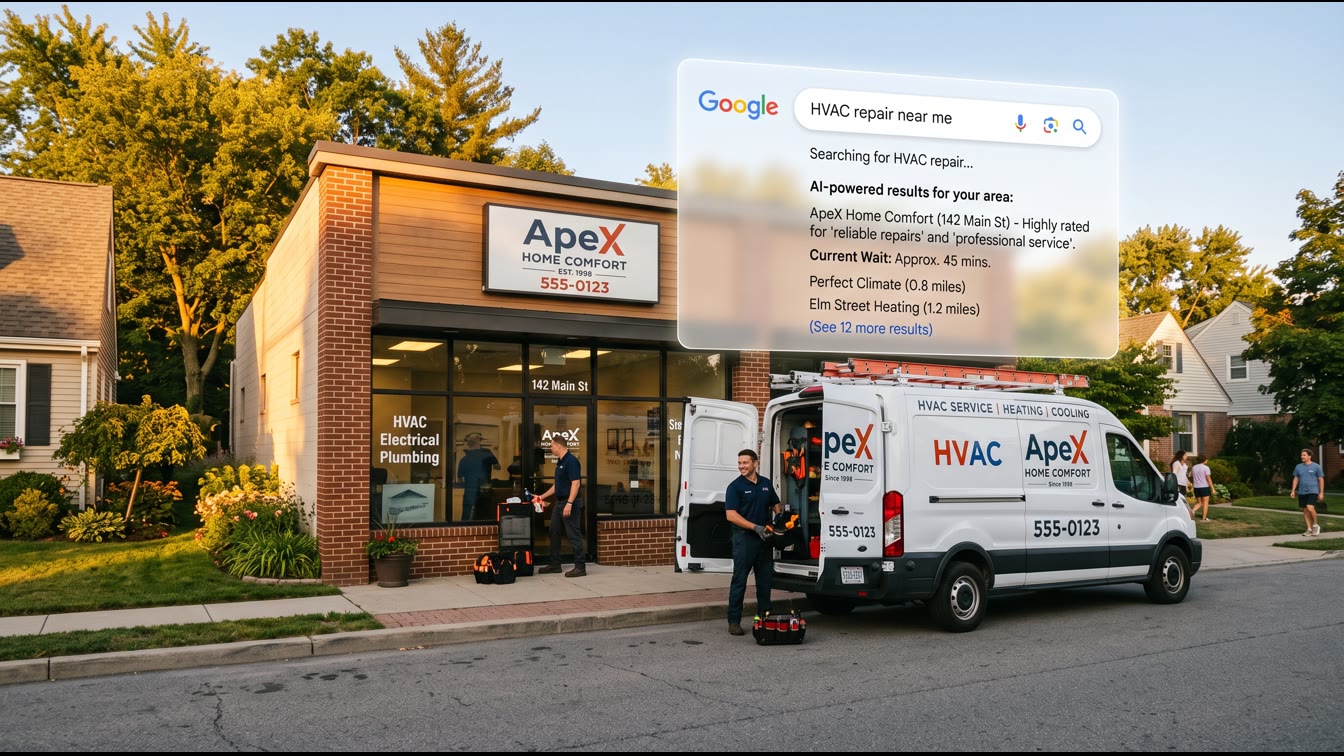
Google AI Overviews now appear in 43% of searches, up from 15% a year ago (TechCrunch). For a plumber, HVAC contractor, landscaper, or dentist, that means the homeowner asking "who fixes furnaces near me" is often getting an AI-written answer before your listing ever loads. GEO, Generative Engine Optimization, is the discipline of earning a place in that answer. This is a 90-day plan, broken into three 30-day blocks, to get your service business cited by AI instead of buried under it.
I spent years underwater running a nuclear reactor before I spent years running businesses and raising capital for founders. A submarine crew does not wait for a casualty to write the procedure. You write the procedure, you drill it, and you execute it before the alarm sounds.
Service businesses need the same discipline right now, because the alarm already sounded. AI Mode visits on Google jumped from 126 million to 279 million in eleven months (TechCrunch). That is not a future trend. That is last quarter.
Why service businesses feel this first
Local service search is high-intent and question-based, exactly the query pattern AI Overviews were built to answer. "Best HVAC company in Denver" and "emergency plumber open now" are precisely the prompts Google routes into an AI-generated answer instead of ten blue links.
Organic click share across all of Google search has already dropped to 40%, down from 44.9% in March, as more sessions stay inside Google's own AI layer (eMarketer). For a contractor whose entire funnel starts with a local search, that is not an abstract industry trend. That is the phone not ringing.
Google's own SERP data backs this up at the platform level too. In the U.S., AI Overviews now trigger on roughly half of all queries, and organic click-through can fall by as much as 61% once one appears (ainvest.com). Getting cited inside that answer is no longer optional homework. It is the new front door.
The ATLAS Model: the operating system for this playbook
Every framework I use with clients traces back to something I learned running a nuclear watch station or underwriting risk at Hartford and Munich Re. ATLAS is no different. It stands for Audit, Target, Layer, Amplify, Sustain. Five stages, five commands, ninety days.
Audit: know your current position before you spend a dollar fixing it. Target: pick the exact questions and pages that move revenue, not vanity traffic.
Layer: build the structural signals AI engines actually read. Amplify: earn third-party mentions that make your entity trustworthy at scale. Sustain: monitor monthly so gains do not erode quietly.
Each 30-day block below maps to one or two ATLAS stages. Run them in order. Do not skip ahead.
Days 1-30: Audit and Target
Week one. List the 15 to 20 questions your actual customers ask before they call you. Not keywords. Questions.
"How much does a new AC unit cost in Phoenix." "What is the average cost to re-pipe a house." "Do I need a permit for a retaining wall." Write down the real phrasing, not the SEO shorthand version.
Run every question through ChatGPT, Perplexity, and Google AI Overviews. Log who gets cited and from which page. This is your intelligence-gathering phase. You cannot fix a gap you have not measured.
Week two. Audit your top 20 web pages for extraction-readiness. Does the page answer its core question in the first two sentences, or does it bury the answer under three paragraphs of throat-clearing?
AI engines lift the first clean sentence they find. A wall of marketing copy gets skipped even if the page ranks well in traditional search.
Week three. Check entity consistency. Your business name, address, phone number, and category need to match exactly across your website, Google Business Profile, Yelp, Angi, and any trade directories.
AI systems triangulate across sources. Inconsistent listings force the model to average conflicting signals, and an averaged signal is a weak signal.
Week four. Set your baseline citation rate. Out of your 15 to 20 questions, what percentage produced an answer that named you. That number is your starting line.
Write it down. You will not believe how much it moved by day 90 if you skip logging it now.
Days 31-60: Layer
Week five and six. Rebuild your top 10 service pages with an answer-first format. Open each page with a 40 to 80 word direct answer under a clear question heading, then expand with detail below.
"A residential re-pipe in a 1,500 square foot home typically runs $4,000 to $8,500 depending on pipe material and access" beats three paragraphs about your company history before you get to the number.
Week seven. Implement FAQPage schema markup on every service page, using the actual questions from your day-one audit. FAQ schema helps AI engines extract question-and-answer pairs cleanly.
It maps almost exactly to how buyers phrase prompts to ChatGPT and Perplexity. This is one of the lowest-cost, highest-return fixes in the entire ninety days.
Week eight. Add Organization and LocalBusiness schema to your homepage and service-area pages. Add real statistics with sources on every page where you can: average job cost, typical timeline, number of jobs completed this year.
The Princeton and Georgia Tech GEO study, presented at KDD 2024, found that adding statistics, quotations, and citations each lifted a source's visibility in AI answers by up to 40%. It disproportionately helped pages that were not already ranking #1 on Google, which means this step benefits the underdog contractor most.
Days 61-90: Amplify and Sustain
Week nine and ten. Build cross-platform agreement. Pitch a guest post to a local news outlet or trade publication. Answer questions on Reddit threads and Nextdoor where your buyers actually discuss contractors.
AI systems weigh a consistent story across independent sources more heavily than a single strong page. One great page is a data point. The same story told across ten independent sources is a pattern the model trusts.
Week eleven. Publish one dedicated pillar page built specifically to be quoted: a cost guide, a comparison of service options, or a maintenance checklist with original data from your own job history.
This is the single highest-value content type in the entire playbook. It gives AI engines a citable statistic that exists nowhere else, which is exactly what the Princeton study found engines reward most.
Week twelve. Re-run your original 15 to 20 prompts across ChatGPT, Perplexity, and Google AI Overviews. Compare against your day-30 baseline.
Log the delta by prompt, not just in aggregate, so you know which specific pages moved and which still need work. Then set a recurring monthly check. GEO is not a project with an end date. It is a watch rotation.
Signals a specialized platform is worth the spend
A new class of tools built specifically for this problem launched this year. BonsaiX and Bodhi, for example, package entity SEO, structured data, and AI citation building into a single subscription aimed at local trades like roofing and HVAC (SurferSEO).
If your team cannot execute the ninety-day plan above with existing staff, a specialized platform buys you speed. If you can execute it in-house, the ninety-day plan above costs you time, not cash.
Either path works. What does not work is doing nothing while a competitor across town builds the entity signals AI systems are already learning to trust.
The anecdote that explains why I built this as a plan, not a slogan
When I ran my nuclear watch station, we did not fix problems as they appeared. We ran a written procedure, verified each step against a checklist, and signed off before moving to the next evolution.
Skipping steps under time pressure is how reactors get shut down and how careers end. I have watched founders raise seven figures and then blow the execution because they treated the plan as a suggestion instead of a sequence.
This playbook works the same way a reactor startup procedure works. Run the steps in order. Verify each one. Do not skip ahead because week six feels slow.
What this costs you if you wait
Every month you delay is a month a competitor's entity signals compound while yours sit flat. The GEO research community calls this the source preference flywheel. Engines that already cite a brand tend to keep citing that brand, because trust, once established, is sticky.
First movers in a local category do not just get cited more today. They get cited more by default next quarter, because the model has already learned to trust them. Waiting is not a neutral choice. It is ceding ground to whoever moves first.
Budget and staffing for each 30-day block
Owners always ask what this actually costs to run. Days 1 through 30 is mostly your time or an office manager's time: running prompts, auditing pages, and checking directory listings. Budget four to six hours a week and zero new software spend.
Days 31 through 60 is where you need either a copywriter comfortable rewriting for clarity, or a freelance technical hand for schema markup. Budget $1,500 to $4,000 depending on how many of your top 10 pages need a full rebuild versus a light edit.
Days 61 through 90 is digital PR and content production. Budget $2,000 to $5,000 for a guest post placement or two and one strong pillar page with original data. That range roughly matches the entry tier of dedicated GEO platforms like BonsaiX, so compare apples to apples before you decide build versus buy.
The total ninety-day investment for most single-location service businesses lands between $3,500 and $9,000. Compare that to the cost of one lost job per month for a year, and the math is not close.
A note on multi-location and franchise operators
If you run more than one location, run the Audit block separately for each service area. AI Overviews increasingly localize answers, so a citation win in your Denver market does not automatically transfer to your Colorado Springs location.
Build one shared pillar content library in the Amplify block, but keep entity consistency checks and local schema markup location-specific. A multi-location operator who treats GEO as a single national campaign will win the city where the flagship office sits and lose everywhere else.
Doctrine Connection
This is the FOCUS Strategy at street level: pick the highest-value actions, sequence them, and execute without drift. A 90-day plan only works if you actually run all three blocks. Most service businesses will do week one and quit by week four. The ones who finish all twelve weeks will own the AI answer in their zip code before their competitors know the game changed.
FAQ
Q: What is GEO and how is it different from SEO? SEO optimizes a page to rank on a results list. GEO optimizes a passage to be extracted and cited inside an AI-generated answer. A page can rank third on Google and never get quoted by an AI engine if a competitor's page states the same fact more cleanly.
Q: How long until a service business sees results from this playbook? Structural fixes like answer-first formatting and FAQ schema can surface in Perplexity within days, since it retrieves content in near real time. Google AI Overviews and ChatGPT typically take a few weeks longer, because they lean more on established authority signals.
Q: Do I need new content, or can I fix existing pages? Both. Fixing your top 20 existing pages for extraction-readiness is faster and cheaper than building new content. Reserve new pillar content for original data assets that do not exist anywhere else, since those earn the highest citation rate.
Q: What if my business has weak reviews or an inconsistent listing history? Fix entity consistency first, before anything else in this playbook. AI systems trust businesses whose name, address, category, and description agree across every platform. Inconsistency forces the model to average conflicting signals, which suppresses citation regardless of how good your content is.
Q: How do I know if this playbook is working? Track your citation rate monthly using the same 15 to 20 prompts from day one. A rising rate against your own baseline, and against your closest competitors, is the only proof that matters. Traffic reports from before this shift are measuring a channel that is shrinking.
*Jeff Barnes is the founder of demg.ai and CEO of Angel Investors Network. The views expressed are his own and do not constitute professional advice. demg.ai provides marketing education and systems for owner-operators. Past results do not guarantee future outcomes.*