
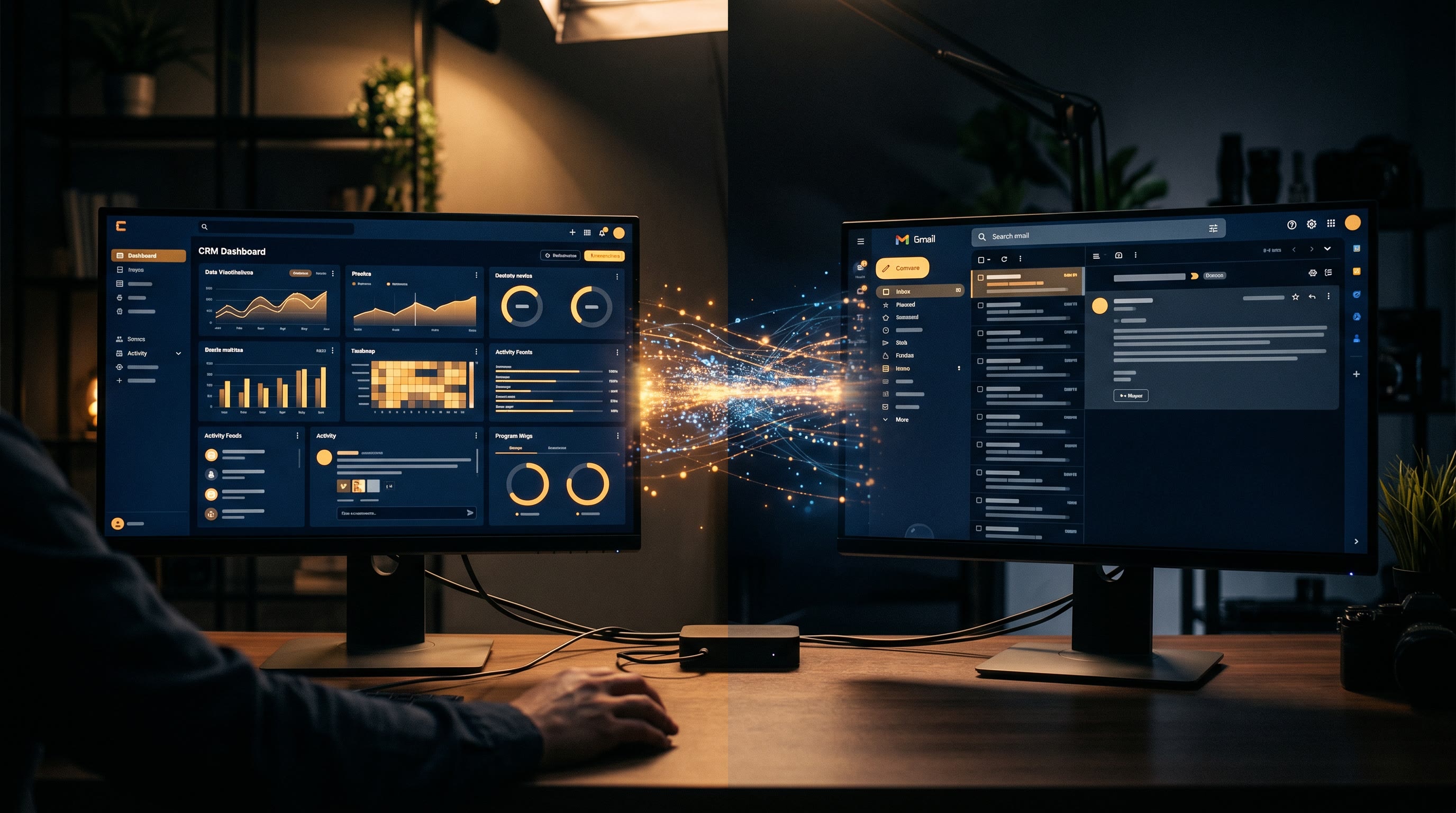
Bridging GoHighLevel and Klaviyo cut this brand's customer acquisition cost by 31%. Not by spending less. By stopping the waste that was already happening. Three automation bridges did the work: buyer suppression from acquisition segments, personalized cart recovery tied to ad creative, and a day-30 win-back sequence. The brand was running $780K in annual revenue. Meta CAC was sitting around $212 fully loaded. After the integration, it dropped to $146. That's not a rounding error.
Most ecom operators treat GHL and Klaviyo as separate tools doing separate jobs. GHL handles the CRM, the pipelines, the SMS follow-up. Klaviyo handles the email flows. But here's what breaks: neither system knows what the other knows. Klaviyo is emailing buyers who are still inside your acquisition audiences. Meta is charging you to re-acquire customers you already have. Your cart recovery emails are generic because Klaviyo doesn't know which ad creative the shopper clicked.
The fix isn't complicated. It's a data bridge. Build it right and your CAC math changes immediately.
The Problem With Running GHL and Klaviyo in Silos
In 2026, fully loaded ecom CAC on Meta runs $212 to $230 per customer according to Eightx's benchmark data across DTC brands. Google non-brand runs $40 to $140. Those numbers assume your targeting is clean. They don't account for what happens when you're bidding on your own customers.
Klaviyo tracks email behavior. It knows open rates, click rates, purchase events if you've set up the Shopify integration. What it doesn't know is everything that lives in GHL: the full contact timeline, the ad source, the SMS history, the pipeline stage. GHL has the CRM context. Klaviyo has the email intelligence. Neither has the whole picture.
This gap creates three specific problems. First: buyers stay inside your acquisition segments, so you pay to reach people who already converted. Second: cart recovery emails go out without context, so they're generic and low-converting. Third: win-back sequences fire late or not at all because inactivity signals are buried in different platforms.
All three are fixable. Here's how this brand fixed them.
Bridge 1: Buyer Suppression From Acquisition Segments
The first automation bridge is the simplest. Every time a purchase event fires in GHL (synced via the native Shopify-GHL integration), a webhook updates Klaviyo to add that profile to a suppression list inside your Meta and Google acquisition audiences.
The brand was bleeding roughly 12% of ad spend on existing customers. People who bought three months ago were still seeing acquisition ads. Klaviyo didn't have the GHL purchase signal fast enough to suppress them cleanly. After building the webhook bridge, suppression happened within four hours of purchase. That 12% waste went away.
The math is obvious. If you're spending $30K a month on paid acquisition and 12% of that is going to existing customers, that's $3,600 per month in pure waste. Eliminating it doesn't cost anything. It just requires connecting the systems.
The setup: GHL Workflow triggers on "order placed," fires a webhook to Klaviyo's API, adds the profile to a "Recent Buyers: Suppress" list. That list syncs to your custom audiences via Klaviyo's Meta and Google integrations. Done.
Bridge 2: Personalized Cart Recovery by Ad Creative
This one is where it gets interesting. Standard cart recovery emails convert at around 8%. The brand was at 7.4% before the integration. After connecting GHL's UTM tracking data to Klaviyo's flow logic, cart recovery jumped to 14.2%.
Here's what changed. GHL captures the UTM parameters from the original ad click: which campaign, which ad set, which creative. That data lives on the contact record in GHL. The webhook bridge pushes it to a custom property in Klaviyo. Now your cart recovery flow has context.
A shopper who clicked a lifestyle creative gets a cart email that mirrors that aesthetic. A shopper who clicked a problem-solution creative gets an email that leads with the problem. A shopper who clicked a social proof ad gets testimonials in the recovery sequence.
This isn't personalization theater. The ad creative tells you exactly what message landed enough to get the click. Use it again in the follow-up. That's why the conversion rate nearly doubled.
The technical setup requires UTM capture in GHL (build this at the form or funnel level), a custom contact property for ad creative ID, and conditional logic inside the Klaviyo cart recovery flow that routes based on that property.
Bridge 3: Day-30 Win-Back at the CRM Layer
Klaviyo can fire win-back sequences based on email inactivity. But email inactivity is a lagging indicator. A customer might still be buying. They just might not be opening emails. GHL knows more: it tracks SMS responses, site visits via pixel, and pipeline movement.
The third bridge uses GHL's inactivity trigger instead of Klaviyo's. If a contact has no order event, no SMS reply, no site activity for 30 days, GHL fires a workflow. That workflow pushes a tag to Klaviyo: "Win-Back Eligible." Klaviyo's flow triggers off that tag.
The difference matters. You're triggering off actual customer inactivity, not just email engagement drop. The win-back sequence that fires is more accurate. You're reaching people who are genuinely at risk of churning, not just people who haven't opened your newsletter.
The brand saw win-back flow entry rates increase by 23% after switching the trigger source. More people in the flow, earlier, with better timing.
The Screen Share That Changed the Conversation
I was doing a screen share with the founder when it clicked for him. I pulled up the GHL contact timeline for one of their top customers. Full journey: the original Meta ad click, the first purchase, three SMS exchanges with support, a return visit, a second purchase, then radio silence for 47 days.
I said: "Your Klaviyo doesn't know any of this. It only knows the email part."
He went quiet for a second.
Then: "So we've been emailing her with win-back messaging that assumes she's a one-time buyer. But she's bought twice."
Right. Because Klaviyo only saw two email purchases. It didn't see the SMS exchanges. It didn't see the return visit. It didn't know she was a high-engagement customer who went quiet; it just knew she stopped opening emails.
"You're not losing to competitors," I told him. "You're losing to your own data."
That's the real problem. Not platform capability. Not ad spend. Fragmented data producing fragmented decisions.
Ownership beats wages. The operators who own their customer data, all of it unified, will always outperform the operators running disconnected tools. Because data ownership is compounding. Every integration you build makes the next decision smarter.
What the Numbers Looked Like
Before the integration:
- Blended CAC: $212 (fully loaded, Meta)
- Cart recovery CVR: 7.4%
- Win-back flow accuracy: low (email-only signal)
- Estimated ad waste on existing buyers: ~12%
After the three bridges:
- Blended CAC: $146 (-31%)
- Cart recovery CVR: 14.2% (+92%)
- Win-back trigger accuracy: significantly improved
- Ad waste on existing buyers: under 2%
The $780K brand didn't change its products. Didn't change its ad budget. Didn't hire more people. It connected the systems it already had.
For context: 2026 ecom CAC benchmarks put apparel brands at $90 to $120 blended. Beauty runs $90 to $130. This was a health and wellness brand. Starting at $212 fully loaded, they were above category. Ending at $146 gets them into a sustainable range where the unit economics actually work.
How to Build This Integration
The technical path has four components.
Step 1: Native Shopify-GHL sync. Connect Shopify to your GHL sub-account under Settings > Integrations. This syncs order events, customer data, and abandoned cart webhooks automatically.
Step 2: UTM capture in GHL. Add UTM parameter capture to your GHL forms and funnels. Store UTM source, medium, campaign, and creative ID as custom fields on the contact record.
Step 3: GHL-to-Klaviyo webhook bridge. Build three GHL workflows. Workflow A: on purchase event, POST to Klaviyo API to add profile to buyer suppression list. Workflow B: on cart abandonment, POST UTM creative data to Klaviyo custom property before the cart flow triggers. Workflow C: on 30-day inactivity, POST a win-back tag to Klaviyo to trigger the win-back flow.
Step 4: Klaviyo flow logic. Update your cart recovery flow to branch on the ad creative property. Update your win-back flow to trigger on the GHL-pushed tag rather than email-only inactivity.
Klaviyo's OAuth-based API (required for marketplace integrations as of early 2025) handles the authentication. Build the webhooks inside GHL's workflow action builder. No third-party middleware required if you're comfortable with direct API calls; use Integrately or Make.com if you want a no-code layer.
Why Most Brands Don't Do This
It requires someone who knows both platforms. GHL specialists often don't know Klaviyo's API. Klaviyo specialists often don't know GHL's workflow logic. The overlap is small.
It also requires a CRM-first mindset. Most ecom operators are email-first or ad-first. They optimize inside the channel. The integration play requires thinking across channels: asking what does GHL know that Klaviyo should know, and vice versa.
If you're running GHL Agent Studio automations already, this is a natural extension. You're already building in GHL. Adding the Klaviyo bridge is one more workflow set.
If you're thinking about product recommendations layered into the cart recovery flow, AI product recommendations for Shopify brands under $3M covers the logic for that layer.
And if you're a founder looking at these numbers thinking about exit multiples, a 31% CAC reduction changes your EBITDA story materially. That story connects directly to the Exit Engine framework for building a sellable marketing system.
FAQ
Does this require custom development? Not if you use a no-code middleware layer like Make.com or Integrately. The GHL-to-Klaviyo connection can be built with webhook actions in GHL and Klaviyo's standard API endpoints. Technical comfort helps but isn't required for the basic suppression and tagging bridges.
Will this break my Klaviyo flows? No. You're adding a new trigger source and new conditional branches, not replacing existing flow logic. Your existing Klaviyo flows keep running. You're layering on top of them, not rebuilding.
How long does the buyer suppression update take? With a direct webhook setup, suppression updates in Klaviyo within minutes. That Klaviyo list syncs to Meta/Google custom audiences on Klaviyo's sync schedule, which runs at least daily. For most brands, meaningful suppression happens within 24 hours of purchase.
What if my UTM data is inconsistent? Build a fallback branch in your Klaviyo cart recovery flow for contacts with no creative ID property. They get your standard cart recovery sequence. Only contacts with clean UTM data get the personalized branch. Start there and clean up your UTM hygiene over time.
Does the day-30 win-back replace my existing win-back flow? It replaces the trigger, not the content. Your existing Klaviyo win-back email content stays. You're just switching from an email-inactivity trigger to a GHL-inactivity trigger that's more accurate. The emails themselves don't change.
Citations
- Eightx. Average CAC by Channel 2026. https://eightx.co/blog/average-cac-by-channel
- Eightx. eCommerce CAC Calculator and Benchmarks 2026. https://eightx.co/blog/ecommerce-cac-calculator-benchmarks
- Tenten. D2C CAC Benchmarks 2026 by Industry. https://tenten.co/shopify/d2c-cac-benchmarks-2026/
- Klaviyo Developer Docs. OAuth Setup. https://developers.klaviyo.com/en/docs/set_up_oauth
- NetPartners Marketing. GoHighLevel Shopify Integration. https://www.gohighlevel.com/?fp_ref=angel-investors-network22
- Integrately. GoHighLevel + Klaviyo Integration. https://www.gohighlevel.com/?fp_ref=angel-investors-network22
- Global High Level. Migrate Klaviyo to GoHighLevel. https://www.gohighlevel.com/?fp_ref=angel-investors-network22