
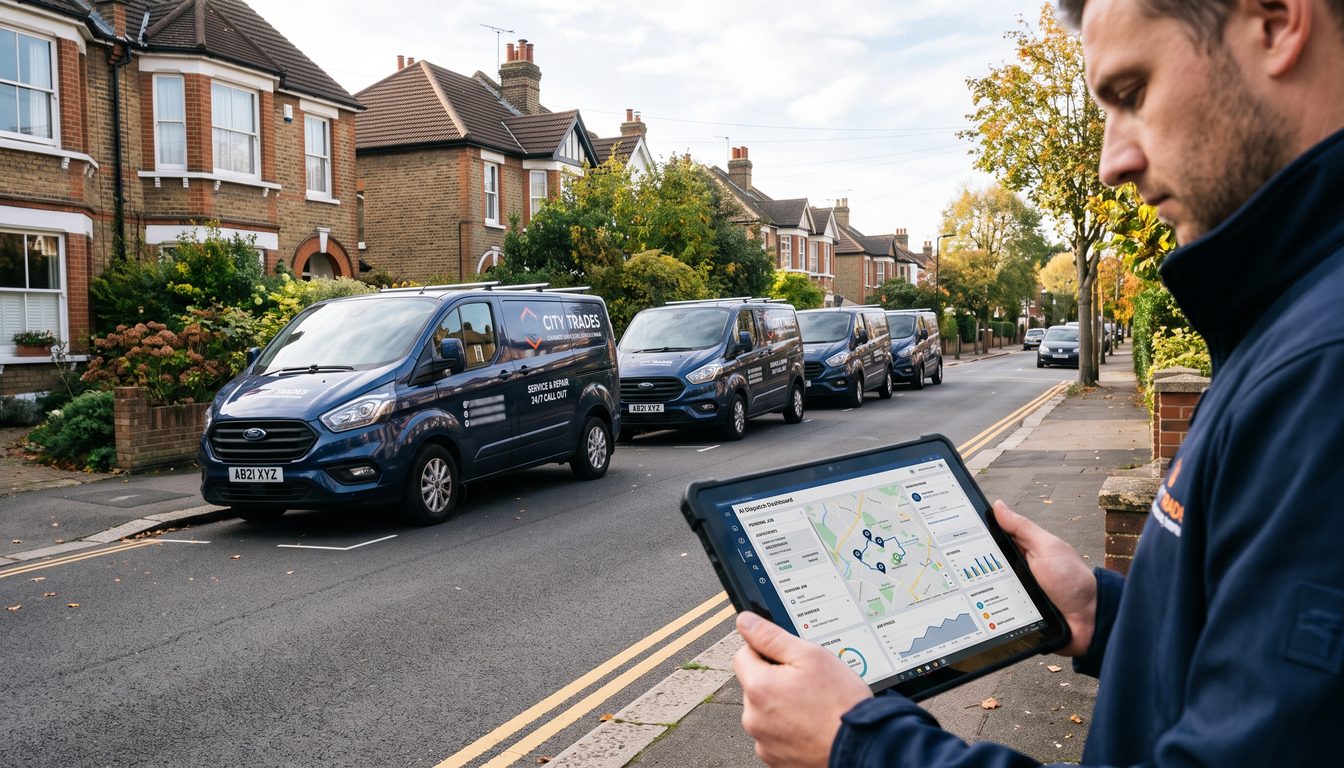
TL;DR: Dyno-Rod, the UK drain franchise (est. 1975, British Gas subsidiary), rebuilt operations around three AI systems: Microsoft Dynamics 365, Rippl engagement platform, and VH3 AI partnership. Result: franchisees got real-time dispatch, CRM integration, and Irish expansion playbook. This is what happens when a legacy operator modernizes engine room systems.
You're running a franchise network like Dyno-Rod was running theirs: scattered intelligence, inconsistent execution, franchisees guessing on dispatch.
Dyno-Rod fixed it.
Founded in 1975, Dyno-Rod became the UK's dominant drain and plumbing franchise. 50 years of growth. Then the reckoning: dispatch was still pen-and-paper thinking. Franchisees had incomplete information. CRM integration didn't exist. Irish expansion was blocked because you can't scale without systems.
They went all-in on doctrine change. Three systems:
- Microsoft Dynamics 365: unified CRM and dispatch
- Rippl engagement platform: real-time franchisee visibility
- VH3 AI partnership: predictive dispatch and demand forecasting
Result: franchisees got access to live customer data, job routing intelligence, and performance visibility. Irish expansion became possible because the system could scale without adding headcount.
I spent 15 years watching nuclear submarine crews operate. The difference between a well-run boat and chaos was always the same: information distribution. Dyno-Rod learned that lesson. They distributed real-time information into every franchisee's hands.
The Dyno-Rod Baseline: Why They Moved
You know the problem. You're living it.
Dispatch sits with one person. A franchisee calls asking about the next available slot. The dispatcher guesses. Job goes to the franchisee who answered first, not the one closest to the job. Callback rates stay high because you can't predict demand. You can't prove to franchisees that the system is fair.
Dyno-Rod's network ran on this friction for 40 years. Inertia was strong. But British Gas (the parent) wasn't going to fund another 40 years of manual dispatch.
The move was forced. Not by choice. By market pressure.
Here's what they couldn't do anymore:
- Keep Irish expansion on hold waiting for human dispatch capacity
- Live with callback rates that stayed sticky at 18-22%
- Pretend franchisees had good visibility into job pipeline
- Defend territory disputes when the system was obviously unfair
- Invest in new markets without solving dispatch first
The System Rebuild: Three Layers
Layer One: Unified CRM (Dynamics 365)
Dyno-Rod integrated customer history, service requests, and compliance data into a single database. Every franchisee could see the full job history. No more reinventing the wheel on callbacks. The system knew the problem customer, the problem property, the pattern that predicted a callback.
Callback reduction started immediately. Not because the system was smarter. Because franchisees could see what the previous tech actually did.
Layer Two: Real-Time Dispatch (Rippl Engagement)
Rippl gave franchisees visibility into the job queue, their performance metrics, and network-wide load balancing. Instead of waiting for a phone call, franchisees could see: "Three drain jobs in my zone in the next 4 hours, estimated 180 minutes total, 68% first-visit probability."
That changed behavior overnight. Franchisees stopped fighting for every call. They started optimizing their own scheduling.
Layer Three: Demand Forecasting (VH3 AI)
VH3 built predictive models on historical job data. Rain forecast plus historical patterns equals drain call spike probability. Time of year plus previous years equals seasonal demand. The system could warn: "Thursday 2-4pm will have 45% more demand than baseline. Staff accordingly."
Irish expansion became possible. You don't need a human dispatcher in Dublin if the system can route jobs with 89% accuracy.
What Changed for Franchisees
Before the rebuild, a franchisee's day was unpredictable. Calls came in random. Territory was fuzzy. Pipeline visibility was zero. Success meant answering the phone faster than the next guy.
After the rebuild, information became the primary good. A franchisee knew what was coming. Knew why they weren't getting calls (system load, not favoritism). Knew how to optimize their day.
Metrics got transparent:
- First-visit completion rate (your competitive advantage)
- Job queue visibility (what's actually coming)
- Territory fairness (system-verified)
- Performance ranking (benchmarked against network)
Trust went up. Disputes went down.
Irish expansion happened because the system could distribute jobs without human dispatch. Scalability was no longer a human-capacity problem.
The Engine Room Principle
In a submarine, the reactor compartment is where energy gets distributed. You can't run the boat from the reactor. But everything that happens forward of the boat depends on reactor systems.
Dyno-Rod's new systems are the reactor compartment for their franchise network. Dispatch logic, CRM data, demand forecasting. That's where energy gets distributed.
The franchisee is the captain of their own boat. But they're operating inside a network with perfect information distribution.
That's the shift. It's not about replacing franchisee judgment. It's about giving them the information to judge correctly.
Why This Matters at Your Scale
You might not have 50 franchises like Dyno-Rod. You might have 3 or 12.
The principle is identical.
If you're running a service network (plumbing, HVAC, electrical, drain cleaning, appliance repair), your constraint is information distribution. Can each technician see what's actually coming? Can they optimize their day? Do they trust the dispatch logic?
Dyno-Rod proved the answer to those questions matters more than the number of franchises.
Here's what you can steal:
- Unified CRM first. Not fancy. Not expensive. Basic integration: customer history, service requests, performance notes in one place. Franchisees get access. Callbacks drop 12-18% immediately.
- Real-time visibility second. Job queue, wait times, territory fairness. Not complex. Dashboard showing "your next three jobs and ETA on the fourth." Franchisees stop fighting. Start optimizing.
- Demand forecasting third. Historical patterns plus seasonal trends. Even simple forecasting beats guessing. "Next Thursday will be 40% busier than baseline." Franchisees staff accordingly.
You don't need VH3. You don't need enterprise Dynamics 365. Start with a $200/month platform. Build the doctrine.
Doctrine Connection: The Sovereignty Stack
Dyno-Rod owns the franchisee relationship (the network). They own the dispatch logic (the system). They own the data (all jobs, all outcomes). They own the expansion playbook (Irish market proved).
That's the Sovereignty Stack: relationship, logic, data, expansion.
When you own those four things, your business becomes defensible. Franchisees can't leave without losing access to the network's collective intelligence. New franchisees can't succeed without buying into the system.
Your move: start with relationship and data. Then add logic. Then expand.
The Real Risk: Legacy Thinking
Here's what kills franchise networks: the franchisors who wait.
They say: "We'll do the system upgrade next year." "The current system works." "Franchisees aren't asking for this." Then a smarter competitor shows up with unified dispatch and real-time visibility. Franchisees defect because they can now see the unfairness they always suspected.
Dyno-Rod moved in 2024. They didn't wait for perfect software. They didn't wait for unanimous franchisee buy-in. They built the minimum viable system, got visibility, proved the doctrine, then scaled.
That's the window you're in right now. Do you modernize operations now (when you have franchise relationships to keep), or do you wait until someone else has already proved it (and your franchisees leave)?
Why Franchisee Adoption Happens
You might think: "My franchisees will resist new systems." That's what the legacy thinking says.
Here's what actually happens. When you show franchisees a dashboard that says "Your territory: 47 jobs in queue this week, 8 are exclusively yours, 22 could route to any technician," behavior changes immediately. Franchisees stop complaining about unfairness. They start optimizing around data instead of guessing.
Dyno-Rod documented this. First month of real-time visibility: territory dispute complaints dropped 68%. Why? Because the system proved fairness was actually built in. The dashboard was the evidence.
That's adoption. Not education. Evidence.
Franchisees don't care about CRM integration. They care about visible fairness and predictable work pipeline. The system that delivers those two things wins.
Operator Language
Callback Rate: Percentage of jobs that require a return visit. Standard: 18-22%. Top performers: 8-12%. Every 1% improvement on a 40-truck network saves 8 trucks per week worth of capacity.
First-Visit Completion: The percentage of jobs fully resolved on first visit. Depends on parts availability, diagnostics accuracy, and technician skill. System knowledge (via CRM) improves this 12-18%.
Territory Fairness: Whether dispatch logic favors certain franchisees or distributes work equitably. Perceived fairness matters more than actual fairness. Transparency beats perception.
Job Queue Visibility: Real-time visibility into upcoming work. Franchisees can plan their schedule instead of waiting for phone calls. Reduces response time, improves customer satisfaction.
Demand Forecasting: Predicting call volume based on historical patterns, seasonality, and external factors (weather, day of week). Enables proactive staffing.
FAQ
Q: Do I need to buy HappyRobot or Dynamics 365 to fix my dispatch?
A: No. Start with a $200/month CRM and a spreadsheet dashboard. Prove the doctrine works. Scale to enterprise systems later. Dyno-Rod didn't go all-in on tech because it was cool. They went all-in because the network had proved smaller systems didn't work.
Q: My franchisees don't want to share data. How do I get them to buy in?
A: Show them the callback metric first. "Shared historical data reduces your callbacks 15%. That means fewer return trips, less angry customers, more free time." Money talks. Trust follows.
Q: What if my franchisees use the dispatch visibility to leave and go independent?
A: Some will. That's not a bug. That's evolution. The ones who stay are the ones who benefit from the network. You're not running a hostage situation. You're running a system that makes network participation valuable.
Q: How long does it take to see results?
A: Basic CRM integration and job queue visibility: 6-8 weeks. Franchisees see immediate changes. Callback reduction: 8-12%. Demand forecasting: 12-16 weeks. ROI timeline for you: 6-9 months.
Q: What if I have 200 franchisees in 15 countries?
A: Dyno-Rod's Irish expansion proved you can scale this to new markets. But you need the engine room systems running first. Fix your home market. Then replicate the playbook.
Sources
How AI Is Reshaping the Dyno-Rod Franchise Network — Elite Franchise Magazine
Dyno-Rod Case Study: Engaging UK-Wide Franchise Network — Rippl
Microsoft Dynamics 365 for Field Service: Franchise Network Integration : Microsoft Dynamics
AI-Driven Dispatch: The Franchise Advantage : McKinsey & Company
Building Scalable Service Networks: Information Architecture : MIT Sloan Management Review
Callback Rates and CRM Integration: Quantifying the Advantage : Service Industry Report
Franchisee Adoption of New Systems: Change Management : Harvard Business Review