
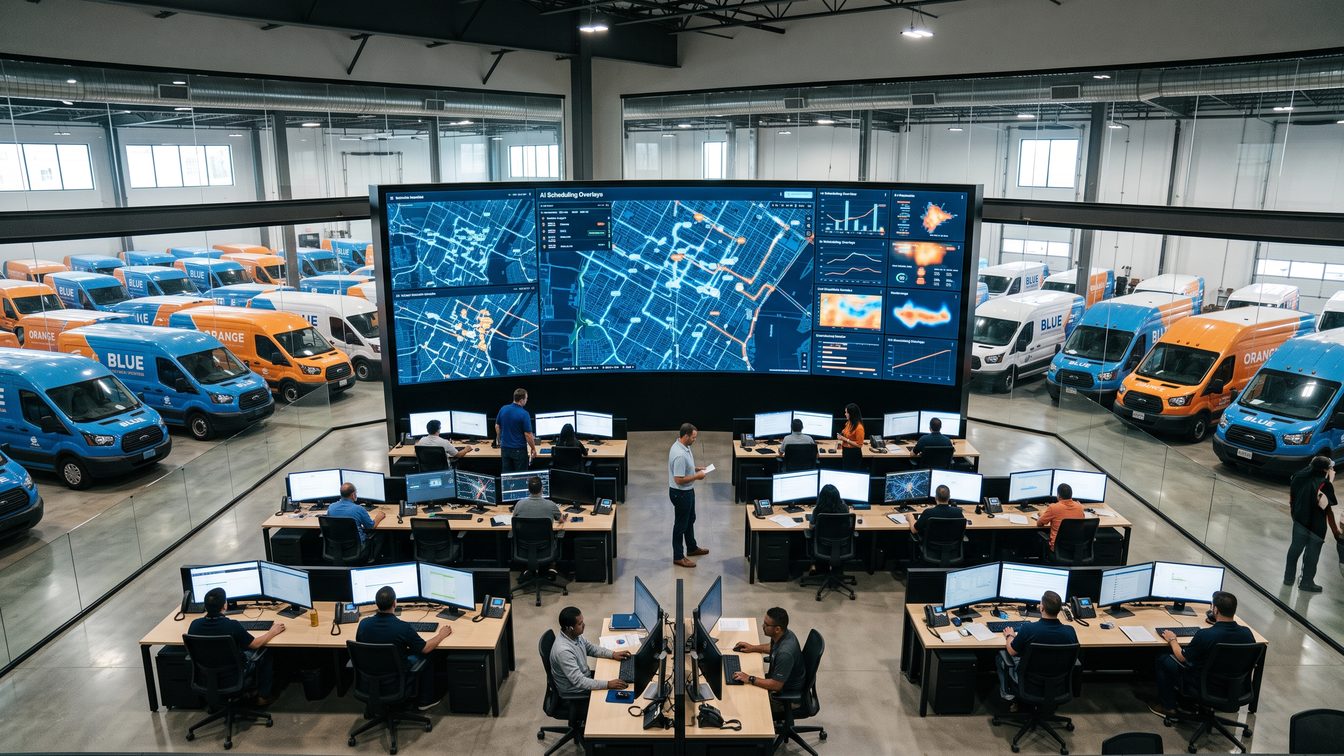
According to Elite Franchise Magazine, Dyno-Rod spent 18 months rebuilding its franchise network around AI agents. No press release called the system a co-founder. No dashboard greeted franchisees by name. The company just removed the admin work and gave local owners the data. That is the whole doctrine, and it beats the alternative being sold everywhere else.
Dyno-Rod is a UK drain cleaning and plumbing franchise. Some of its locations have served the same communities for 60-plus years. That kind of tenure is a balance sheet asset: local trust, built over decades, that no software can manufacture. The risk to an asset like that is not too little technology. The risk is technology bolted on top of the work instead of built into it. Claire Shenton, Head of Franchise Systems and Data at Dyno-Rod, understood that risk and built around it.
The Problem Was Never "Not Enough AI"
Every franchise network runs on the same choke points: booking, dispatch, invoicing, and compliance paperwork. Multiply those choke points across dozens of independently owned locations and you get a head-office bottleneck. Franchisees wait for reports. Customers wait for callbacks. Engineers wait for job details that live in three different systems.
Dyno-Rod's fix was not a chatbot layered on the old workflow. It was a rebuild. The company put Microsoft Dynamics 365 in as its CRM and dispatch platform, and Microsoft Fabric as its data platform. On top of that, a dedicated Systems and Data function built AI agents for job booking, invoicing, engineer support, and terms-and-conditions compliance. Shenton put the goal plainly: "The goal is not simply to add more layers of technology, but use it to remove friction from the business and give franchisees better information, better tools and more time to focus on customers."
That sentence is the whole case study. Everything else is implementation detail.
Compare that to the marketing coming out of the small-business software world right now. Platforms are launching AI products and branding them as co-founders and chief marketing officers, complete with daily stand-up meetings where the "agent" briefs the owner like a direct report. That framing sells subscriptions to owners who want a shortcut. It does not survive contact with a 60-year-old plumbing franchise that has to answer a burst pipe call at 2am. Dyno-Rod never gave its agents a name or a personality. It gave them a job: remove the friction between a customer's problem and a franchisee's response.
Speed Is the Product
Customers do not care about your tech stack. They care about one thing: is help coming, and how fast. Dyno-Rod engineered its agents to answer that question in seconds. "We have developed AI tools to ensure the work request is with the right franchise within seconds of the customer making the request, regardless of what channel the customer uses to contact us," Shenton said. Phone, email, website, messaging app. It does not matter. The routing is the same, and it is fast.
Speed like that is a moat. A competitor running manual dispatch cannot match seconds-to-route no matter how good their people are. The system beats the individual. Shenton's read on customer psychology backs this up: "A customer wants peace of mind to know we are on our way as quickly as possible to help them out. That's what we want technology to offer our customers." Not a personality. Not a chat window with a name. Peace of mind, delivered fast, engineered to be invisible.
Data as an Asset, Not a Report
Most franchise networks treat head office as a gatekeeper. Franchisees ask for numbers, wait, and get last month's report. Dyno-Rod inverted that. Franchisees now get up-to-the-hour access to KPI performance, engineer performance levels, and forecasting, with no head office bottleneck standing in the way.
That is a balance sheet decision, not an IT upgrade. Data withheld is data wasted. Data in the hands of the person closest to the customer compounds. Shenton frames it as a shift from data as a retrospective tool to data as something franchisees use proactively to decide "where we need to focus next." An owner-operator who can see engineer performance in real time can fix a bottleneck this week instead of finding out about it next quarter.
Head office gatekeeping is a common failure mode in franchise systems, and it is not unique to plumbing. A franchisor holds the data because the data is valuable, and holding it feels like control. But control that starves the franchisee of information does not protect the brand. It starves the unit that generates the brand's revenue. Dyno-Rod's decision to open up KPI performance, engineer performance, and forecasting to every franchisee inverts the usual incentive. The franchisor's job becomes building the pipes, not hoarding what flows through them.
Watchstanding, Not Guessing
I served on a nuclear submarine before I ever underwrote a risk or wrote an ad. The reactor plant ran on procedures. Every casualty, every abnormal condition, had a doctrine: a checklist built in advance, refined by people who had seen the failure before, executed the same way every time regardless of who was standing watch. The nuclear Navy does not train operators to improvise in an emergency. It trains them to follow the procedure so precisely that improvisation is rarely needed.
Dyno-Rod is running the same logic on a franchise network. Terms-and-conditions bots for engineers are not a gimmick. They are a procedure, encoded, so that compliance does not depend on which engineer is on shift or how tired he is at 4pm on a Friday. The company is now building agents that run directly on engineer devices, handling tasks so the engineer can "safely prioritise the customer experience." Shenton called it "a big leap forward for us." Translation: take the paperwork off the watchstander so the watchstander can watch.
Every reactor plant casualty drill I ran had one purpose: remove the variable of human memory from the moment that mattered most. Dyno-Rod's agents do the same thing for a plumbing dispatch. The engineer does not need to remember the compliance script. The system carries it.
The Risk Nobody Talks About
Centralizing technology and data across a franchise network carries a real risk: head office starts making decisions that used to belong to the local owner. Franchise systems can drift toward over-control. The franchisee becomes an operator of someone else's playbook instead of an owner-operator of his own territory.
Dyno-Rod's answer is a dedicated Change Forum, where the Systems and Data team works directly with franchise network members to shape the change and development roadmap together, rather than issue it top-down. Shenton describes the goal as "collaboratively peeling away layers of complexity while meeting obligations." That is change management with teeth, not a townhall for show. Skip that step and you get technology that looks good in a boardroom deck and fails on the ground, because the people running the ground never bought in.
This is the part most AI vendors skip. They sell the software. They do not sell, or build, the forum where the people using it get a vote.
The Proof Scales Beyond One Network
Dyno-Rod is not alone in proving this model, and the scale of the comparable results should sober up anyone who thinks this is a UK-only story. Sila Services, a roll-up of HVAC, plumbing, and electrical brands across the US Northeast and Midwest, deployed an AI agent (Avoca AI) across 35-plus brands. The results: 130,000-plus calls handled per quarter, 22% of total Sila revenue now booked through the AI agent, and a 95% customer acceptance rate, meaning almost no one asks to be transferred to a human. Sila's web-based Simple Scheduler produced a 32% booking rate against an 11% rate on the previous tool, rolled out across all 35-plus brands in two weeks. One customer told Sila's team, unprompted: "I didn't realize you were a digital assistant. You're a pretty high quality one. I thought you were human, so well done." Nobody built that agent to be liked. They built it to work, and the byproduct was a customer who could not tell the difference.
The Maids, a residential cleaning franchise with 180-plus locations across North America, ran a parallel play with the Dispatch platform: automate scheduling and notifications at the franchisee level, give field teams real-time access to their daily schedules, and let customers choose their own notification channel. Online booking rose 68%. The company's own framing matches Dyno-Rod's almost word for word: differentiate the customer experience, then use that differentiation to recruit better franchisees.
Three networks, three verticals, one pattern. Redesign the work. Do not decorate it.
Doctrine Connection: Systems Beat Slogans
Wix launched an AI agent product this month and gave it a daily stand-up meeting with the owner. Other platforms are calling their agents co-founders and chief marketing officers. That framing sells software. It does not run a franchise network.
Dyno-Rod never called its agents anything. It called them tools that remove friction so franchisees have "more time to focus on customers." Shenton's clearest statement of doctrine: "Ultimately systems change is less about automation and more about redesigning work itself, and it is here that predictive analytics and AI agents will become increasingly important." Read that twice. She is not describing a personality. She is describing an operating system.
The moat here is not a chatbot with a name. The moat is a franchisee who spends his day with customers instead of paperwork, who sees his numbers in real time instead of waiting for head office, and who can respond to a work request in seconds while a competitor is still checking voicemail. That franchisee outexecutes on response time and customer experience every single week, and the compounding advantage shows up on the balance sheet at renewal, at referral, and eventually at exit valuation. Shenton's own long-range target names the doctrine outright: "My goal over the next 5-10 years is to take our people out of the systems and place them with our customers." Systems beat slogans. Every time.
FAQ
Q: Did Dyno-Rod replace its franchisees with AI? No. The agents handle booking, invoicing, compliance documentation, and dispatch routing. Franchisees still own the customer relationship and the territory. The stated goal is to move people out of admin systems and into direct contact with customers, not to remove people from the business.
Q: How long did the transformation take? Dyno-Rod's rollout spanned 18 months, covering automated job booking, automated invoicing, engineer knowledge tools, and terms-and-conditions compliance bots. The company frames this as an ongoing systems change, not a one-time software install.
Q: What is a Change Forum, and why does it matter? It is a dedicated group where Dyno-Rod's Systems and Data team works directly with franchise network members to shape the technology roadmap before it rolls out. It exists because centralized technology decisions can override local judgment if franchisees never get a voice in the design. Skipping this step is the single biggest risk in any franchise-wide AI rollout.
Q: How does the Sila Services and The Maids data apply to a business that is not a franchise? The mechanism is the same regardless of legal structure: 130,000-plus quarterly calls at Sila, a 95% AI acceptance rate, and a 68% jump in online booking at The Maids all came from redesigning intake and scheduling around the work, not from adding a friendly chatbot on top of an unchanged process. Any owner-operator handling inbound service requests manually is looking at the same opportunity. The full Dyno-Rod interview with Shenton is worth reading in full at Elite Franchise Magazine.