
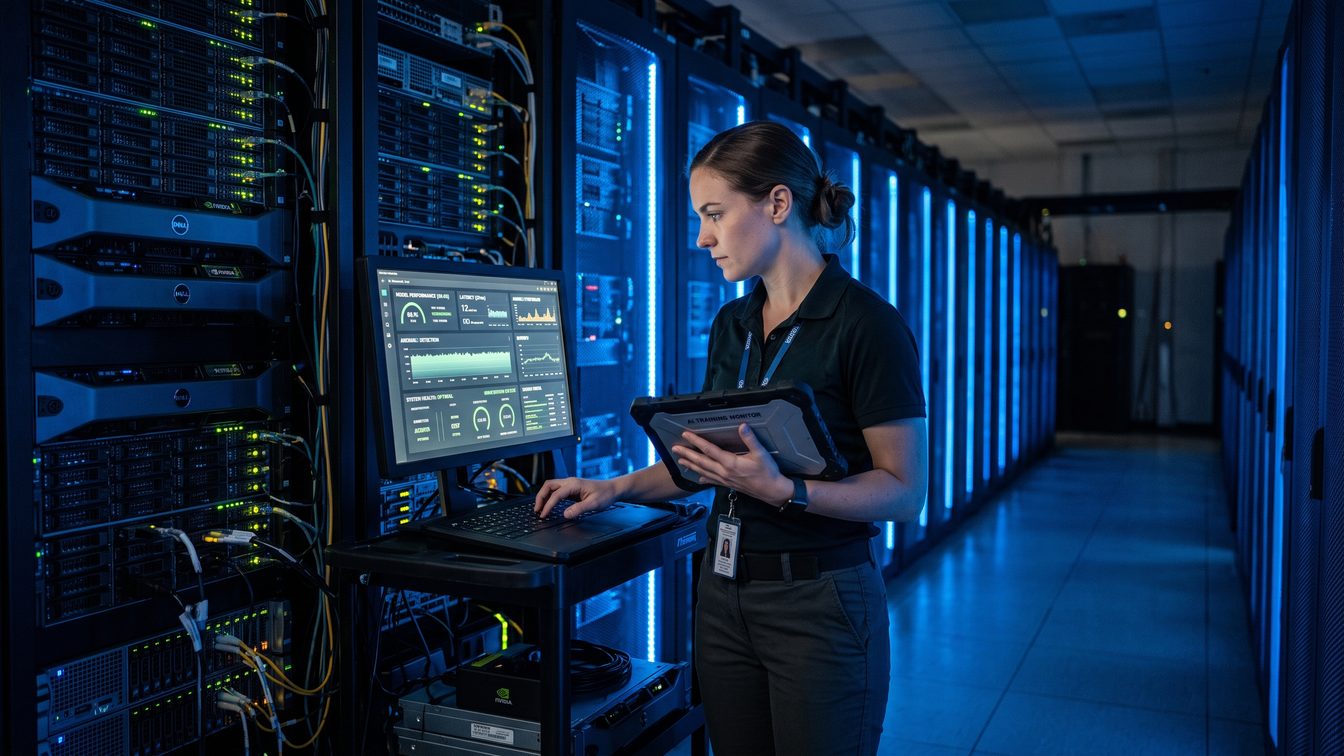
The $915M Question
Dynatrace just paid $915 million for Arize. (dynatrace.com) That is not a typo. For a company that monitors whether your AI actually works in production.
I read that number and thought about Hartford Steam Boiler. Back in 1835, they insured boilers. Nobody buys boiler insurance as a lifestyle choice. They buy it because a boiler failure costs everything. I spent time with their innovation scouts last year. They taught me something operators forget: you don't sell to companies that have the problem solved. You sell to companies that have not yet admitted the problem exists. By the time Dynatrace paid $915 million for AI observability, the market had moved from "is this a problem?" to "this is our biggest operational risk."
Dynatrace is signaling something loud. AI is moving to production faster than ops teams can actually run it.
What AI Observability Actually Is
AI observability is not your infrastructure monitoring with an AI paint job. This is different.
Traditional monitoring tells you: your service is up, response time is 200ms, CPU is 45%. AI observability tells you: your LLM hallucinated on 0.3% of requests, your agentic workflow failed to complete 15 transactions, your model accuracy dropped 2.1 points overnight.
Arize traces every prompt, every completion, every decision point in your agent stack. It flags when output quality slides. It connects that signal back to your infrastructure (GPU utilization, latency, token counts) and your business metrics (revenue impact, user friction). One platform. One story.
Dynatrace's press release hit on August 13, 2026. They were blunt: AI observability spans the full lifecycle, from model evaluation before release to how LLMs and agents behave in production. The category is projected to exceed $10 billion by 2030. AI teams evaluate models in one tool. Infrastructure teams operate in another. When an AI transaction fails, the root cause could sit anywhere: the prompt, the retrieval system, the model weights, the GPU memory, the orchestration layer. Arize closes that gap.
Why an Operator Should Care
You own a SaaS company. You have two paths.
Path one: you keep your AI observability fragmented. Your ML engineers use one dashboard. Your platform engineers use another. When a customer complains that the AI feature broke, nobody knows where the fault is. You have 12 hours to figure it out. Your revenue per user drops 8%. You ship a hotfix at 2 AM. This happens again in six weeks.
Path two: you own your stack. You see AI behavior alongside infrastructure behavior. When the LLM starts failing, you know whether it is model drift, a prompt injection, token limits being hit, or GPU overload. You know within minutes. You fix it before your users notice.
The Sovereignty Stack is what keeps you operator-independent and exit-ready. It is the infrastructure, data, and observability you control without being held hostage by a vendor's roadmap or acquisition strategy. AI observability is now a tier-one component of that stack.
Dynatrace did not buy Arize for mid-market companies. They bought it to own the enterprise observability moat. If you are building on smaller budgets, you cannot assume Arize stays independent or stays affordable. You need to understand what Arize does, what you genuinely need, and whether you can build, buy, or leave that capability behind.
The Market Consolidation Play
This acquisition is part of a pattern. Infrastructure vendors are collecting observability tools the way generals collect territory. Dynatrace already owned application monitoring. Now they own AI observability. Next, they will layer it into their platform so that buying Dynatrace feels like the only rational choice.
For a $500K-$5M operator, consolidation cuts both ways. On one hand, having everything in one platform means fewer tools, fewer integrations, fewer vendors to manage. On the other hand, when that one vendor raises prices, you have no escape route. You have already built your operations on top of them.
Microsoft released a guide in April 2026 called "Your AI Steering Committee's 2026 Checklist." They were explicit: the biggest bottleneck to AI velocity is not the technology. It is "line-of-sight and control over the AI agents being deployed." You need to know what your agents are, what data they touch, and what they are doing. That is not an option. That is a requirement.
What you control, you own. What you outsource, you don't.
The Hallucination Problem
Arize was built to solve a specific problem: LLM hallucination detection. A hallucination is when your model returns confident-sounding nonsense.
Let me give you a real example. You build a customer support chatbot. It is powered by Claude or GPT-4. The chatbot is trained on your knowledge base. A user asks a question. The model returns an answer that sounds authoritative, cites a "policy section" that does not exist, and sends the user in the wrong direction. Your reputation takes a hit. You get a refund request.
Hallucinations are not a training problem. They are a production problem. You can have the best training data in the world. The model will still hallucinate sometimes. What matters is detection at scale. Arize measures output quality in real time. It tells you how often this is happening and to which user cohorts.
That capability costs money. It is also non-negotiable if you ship AI features to customers.
Dynatrace CEO Rick McConnell said it plainly during Dynatrace Perform 2026: "If software has to work perfectly, what that means is that it could not break in the first place, and the only way that we can handle that is through an AI-integrated platform." Translation: observability is not optional anymore. It is how you prevent failures instead of reacting to them.
The Build vs. Buy Question
Can you build this yourself?
Yes. But you will not.
Building an AI observability layer means: tracing instrumentation for every major LLM provider (OpenAI, Anthropic, Google, Cohere, open weights). It means flagging anomalies in real time. It means correlating model behavior with infrastructure metrics. It means persisting billions of spans and making them queryable. It means doing this cost-effectively at scale.
That is a multi-year engineering effort. Your best engineers could be building your product instead.
Dynatrace is betting that the market recognizes this constraint. If they are right, Arize's technology becomes the baseline for any serious operator.
The question for you is not whether AI observability matters. It does. The question is whether you inherit it via Dynatrace, build it yourself, use a specialized vendor and risk acquisition, or ship a product that users cannot fully trust.
You cannot choose none of the above.
The Three-Year Outlook
In three years, I expect the market to split into two camps.
Camp one: operators who built observability into their product from day one. They have user trust. They have compliance coverage (they can audit which data the model saw, which decisions it made, why it made them). They ship features faster because they are not firefighting hallucinations.
Camp two: operators who skipped this and now have a legacy observability debt. They have angry customers. They have regulatory pressure. They are building observability as an afterthought, which costs twice as much and ships half as well.
There will not be much middle ground.
I learned something watching Hartford Steam Boiler scout innovation. Vendors who own the failure-detection layer end up owning the entire category eventually. Arize owned AI failure detection. Now Dynatrace owns Arize. In three years, if you are buying an observability platform for any other reason, you are probably going to end up buying from Dynatrace anyway.
The $915 million was not extravagant. It was strategic.
Sources
- dynatrace.com
- arize.com
- microsoft.com
- thenewstack.io
- dynatrace.com
- metisstrategy.com
FAQ
Q: Do I need to use Dynatrace if I need AI observability?
No. Datadog is building in this space. New Relic has observability offerings. Specialized vendors exist (Humanloop, WhyLabs). But Dynatrace just signaled that AI observability is table-stakes for enterprise platforms. That pressure will move downmarket fast. If you are at $2M ARR and serious about AI, this is something you will encounter in vendor selection within 18 months.
Q: What should I evaluate in an AI observability platform?
Three things: (1) Does it detect hallucinations and output quality drift? (2) Can it correlate AI behavior with infrastructure metrics in the same system? (3) Can you audit and replay what happened for compliance? If the answer is no to any of these, it is not actually AI observability. It is just logging with a dashboard.
Q: Can I delay this until Series B?
Technically yes. Practically no. If you are shipping AI to customers now, you are building the risk surface now. Waiting until Series B means your early customers have already had bad experiences. Your CAC goes up. Your NPS goes down. You are retrofitting trust instead of building it in.
Q: What is the total cost of ownership?
It depends on volume. Arize's pricing is based on spans (LLM calls and traces). A Series A SaaS doing $500K ARR with 1-2 AI features might pay $1K-$3K monthly. A company at $5M ARR with AI-heavy workflows might pay $10K-$20K monthly. Budget for this in your Series A raise. It is not optional.
Q: Should I be worried that Dynatrace owns the observability layer?
Yes and no. Yes, because a single vendor controlling your observability is a dependency. No, because fragmented observability is worse. Your actual risk is not having observability at all. Once you have it, the vendor risk is secondary. Start with the control plane. Worry about the vendor later.
The Operator's Verdict
Dynatrace paid $915 million for three things: (1) the Arize technology stack, (2) their developer brand and open-source trust, (3) the market signal that AI observability is mandatory.
The third thing is worth more than the first two.
For you as an operator: AI observability is not a differentiator anymore. It is a table-stakes component of your Sovereignty Stack. You need it before you get to Series B. You need to own visibility into how your AI actually behaves in production. You need to be able to answer, in under five minutes, why a customer-facing AI feature failed.
Due diligence is non-negotiable. That means understanding your AI observability options, testing them with real production workloads, and budgeting for them now.
Dynatrace's acquisition tells you something else: the best time to bake this into your architecture was six months ago. The second-best time is today.
The Upstream Risks You Cannot Ignore
Vendor consolidation at the observability layer creates a second-order risk most operators do not talk about. When Dynatrace bought Arize, they did not just buy technology. They bought access to your AI behavior data. They can see how often your models fail. They can see which customers hit which error patterns. They can see performance curves you have not published.
This is not paranoia. It is precedent. Last year, a major cloud infrastructure vendor acquired two observability companies, integrated them, and then used the aggregated data to build a competing product that undercut their customers. The customers did not find out until quarterly reviews.
The Sovereignty Stack demands that you understand where your observability data flows and who owns the view. If Dynatrace owns the view, you are outsourcing your operational intelligence. That is sometimes necessary. Just do it with eyes open.
Read Joey Jablonski's research on third-party AI risk from Metis Strategy. He is explicit: AI vendors break the two quiet assumptions that govern traditional vendor risk management. One, vendors used to be stable. AI systems are not. Two, risk used to live at the vendor. With AI, risk lives at the foundation model provider, the vector database, the middleware that nobody on your team even knows exists.
When you inherit observability from Dynatrace, you inherit all of those upstream dependencies. That is not a reason to avoid them. It is a reason to audit them.