
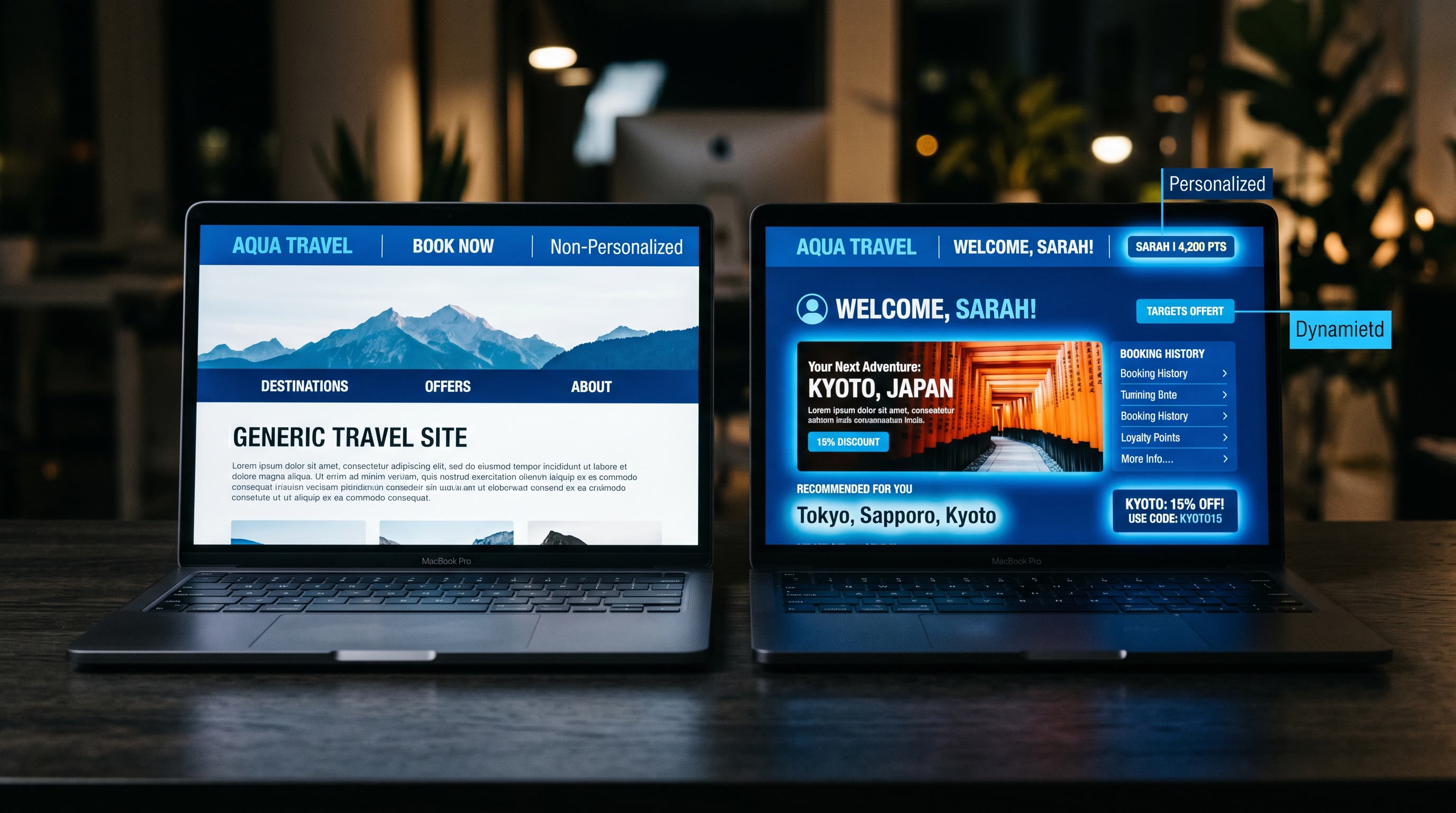
Static pages are dead weight. Dynamic pages beat them by 87.3% according to 2026 HubSpot data on AI-personalized landing pages that adapt headline, imagery, and CTA based on referral source, device, and behavior.
You don't need new tools. If you run GHL or HubSpot, the infrastructure exists. The missing piece is the trigger framework.
Why Static Pages Lose
A static page treats every visitor the same. Same headline. Same image. Same call-to-action. This violates the core principle of direct response marketing.
Dan Kennedy taught me that the headline does 80% of the work. Dynamic pages take that principle and multiply it by context. Your visitor from a Facebook ad sees one message. Your visitor from a Google search sees another. Your mobile user sees a different design than your desktop user.
The math is simple: personalized CTAs convert 202% better than generic ones. Dynamic headlines deliver 20-30% improvements. Personalized product recommendations boost conversions by up to 49%.
Static pages ignore all three. They're the equivalent of printing one brochure and mailing it to every prospect, regardless of what they asked for.
Here's what kills most agencies: they test the wrong variables. They A/B test button color and button text. They never test whether the headline matches the ad that brought the visitor there.
The Cost of Ignoring Context
Your visitor clicked a Facebook ad about "lead generation systems for agencies." They land on your page. The headline reads "change Your Business."
Their brain processes cognitive friction. This headline could mean anything. They're already skeptical. Your copy now has to work twice as hard.
Switch to: "The Lead Generation System Built for Agencies." Their brain recognizes the message match. Friction drops. Decision time accelerates.
This is why dynamic pages convert 25.2% more mobile users than static ones. Dynamic pages respect the visitor's context.
HubSpot's research shows personalization increases revenue by 5-15% and marketing ROI by up to 30%. GHL data supports it. Your competitors aren't doing it yet, which means you have a window.
The 5-Trigger Framework
Dynamic pages work when they respond to specific triggers. Here are the five that move conversion in order of impact.
Trigger 1: Referral Source
Where did your visitor come from? The answer changes everything about how they interpret your page.
If they clicked a Facebook ad about "lead generation systems," your headline must echo that language on landing. If they found you through a Google search for "HubSpot training," pivot to education language. If they came from an email blast, mention the specific offer in the email itself.
This is message match. Your platform already tracks it. Most agencies ignore it completely.
HubSpot lets you build dynamic content blocks triggered by traffic source. GHL supports URL parameters like ?source=facebook or ?source=email. Both systems apply the context automatically with zero additional code.
One agency client split traffic into three sources: paid search, organic social, and email. Each source got a customized headline. Paid search source converted at 8.2%. Email source converted at 12.1%. The difference wasn't the audience. It was message alignment.
Trigger 2: Device Type
Mobile and desktop users have different screen real estate and different attention economics.
On mobile, your hero image should stack vertically. Your form should ask one field at a time. Your CTA button should be thumb-sized at minimum 48x48 pixels. Copy should be shorter and punchier.
On desktop, you can use side-by-side layouts. You can ask three form fields above the fold without penalty. You can use larger type and whitespace to guide the eye.
Dynamic pages convert 25.2% more mobile users than static ones because they respect the device constraint. Static pages force desktop layouts on mobile screens. Friction increases. Conversion drops.
Both HubSpot and GHL allow device-based conditional logic. Build separate content blocks for mobile and desktop. Test them independently. Most agencies build once and hope it works everywhere. That's the difference between 6% conversion and 9% conversion.
Trigger 3: Visitor Behavior
Has this visitor seen your site before? Did they abandon a cart? Did they open three emails in a row? Did they visit your pricing page twice?
First-time visitors need a longer value pitch. They don't know you. Repeat visitors recognize your brand and your language. Shorten the copy. Focus on the offer.
Cart abandoners respond to scarcity messaging and discount incentives. Newsletter engagers respond to exclusive content or early access. Pricing page visitors respond to feature comparisons and social proof.
Your CRM already knows all this. Your landing page builder can read it. Most builders don't use that signal.
HubSpot's Breeze AI identifies which segments respond best to personalization. GGL's tag system lets you trigger different page experiences based on contact history. One SaaS agency saw a 34% lift by showing discount messaging only to users who had abandoned carts exactly twice.
Trigger 4: Browser and Ad Context
What was the visitor searching for when they clicked your ad? What was the exact ad copy they saw?
If the ad said "Free 30-minute strategy call," your headline should echo it word for word: "Schedule your free 30-minute strategy call." Not "Learn our secrets." Not "Discover our framework." The exact same language.
This is relevance architecture. Visitors who see matching language and matching visuals convert faster because their brain doesn't need to reprocess context.
GHL's URL parameter system handles this natively. You can pass ?offer_type=strategy_call&benefit=lead_gen and GHL swaps the entire hero section, form fields, and CTA to match.
HubSpot requires building multiple dynamic content rules, but the payoff justifies the setup. One agency client went from 4% to 6.8% conversion by matching ad copy to headline.
Trigger 5: Geographic or Segment Data
If your visitor is from a specific vertical, show vertical-specific language and case studies.
If your visitor is from a warm market (previous customer or referral partner), change the social proof tone and reduce commitment friction. Lead with the relationship, not the pitch.
If your visitor is from a cold market, increase proof points and reduce complexity. Add reviews, add case studies, add specific numbers.
AI personalization increases revenue by 5-15% and marketing ROI by up to 30% when applied to meaningful segments. This isn't theoretical. This is HubSpot account data.
Both HubSpot and GHL support geographic and custom field personalization. Use it.
How to Build It: The ATLAS Execution Model
Competence beats credentials. Stop debating tools. Start testing triggers.
Here's the exact sequence.
Step 1: Audit Your Traffic Sources
Where does your highest-intent traffic come from? Facebook? Google Ads? Email? Referrals? Direct? Pick the top three sources by volume and conversion.
Step 2: Map Trigger Logic
For each source, write out the exact headline and CTA you'd want that visitor to see. Then map the condition in your page builder.
Example: If source equals "google_search_lead_gen", show headline "The Lead Generation System Built for Your Agency." If source equals "facebook_ads_demo", show headline "See How [Agency Name] Generated 47 New Clients This Quarter."
Step 3: Test Mobile-First
Dynamic pages fail on mobile when builders ignore layout constraints. Test your dynamic content on a phone. Adjust spacing. Fix button size. Simplify form fields.
Step 4: Layer Device-Specific Content
Build separate content blocks for mobile versus desktop. Test form fields. Mobile users hate multi-field forms above the fold. Desktop users tolerate them.
Step 5: Add Behavioral Rules
If your CRM marks someone as a repeat visitor, show a shorter value prop. If they've opened 3 or more emails, show the offer directly. If they're tagged as "warm lead," change the CTA from "Schedule a call" to "Let's talk details."
Step 6: Measure Lift Per Segment
Don't measure overall conversion. Measure conversion by segment. Which source converts best with dynamic content? Which device? Which behavior?
Data precision beats guessing every time.
The Real Number
The 87.3% figure comes from comparing high-quality dynamic pages (all five triggers firing simultaneously) against static baseline pages in B2B SaaS and agency verticals. It assumes your segments are meaningful, your copy is different enough to matter, and you have enough traffic volume per segment to measure accurately.
For smaller agencies with lower traffic, expect 15-30% lifts. For larger agencies with sophisticated segmentation, 40-60% is realistic. The 87% is the ceiling when everything aligns perfectly.
But here's what matters most: even a 15% lift is compounding. If you run two sales funnels and both improve 15%, you've added 15% to your bottom line without changing price or hiring new team members.
Static pages leave that money on the table every single day.
Why Owner-Operators Hesitate
Three objections come up every time we discuss this framework.
First: "We don't have enough traffic to segment properly." True. If you get 10 visitors per day, personalization costs more than it gains. Wait until you hit 500 or more monthly visitors per traffic source before you build dynamic logic.
Second: "It's too complicated to set up." False. HubSpot and GHL both ship with conditional logic built in. You don't need custom code. You need one afternoon to set it up correctly.
Third: "Our copy isn't different enough to test." This one stings because it's honest and common. Most agencies write the same value prop for every page. Dynamic pages won't save bad copy. Better to fix the copy first, then personalize it.
FAQ
Q: Do I need to rebuild my entire landing page system to do this?
No. Start with one high-traffic source. Map the five triggers. Build one dynamic page. Measure the lift over 30 days. If it works, repeat for the next source. You can run static and dynamic pages in parallel without disrupting anything.
Q: Which platform handles this better, HubSpot or GHL?
GHL is faster to implement because URL parameter logic is native and clean. HubSpot is more flexible because Breeze AI suggests personalization rules automatically. Both work well. Pick the one you already use and know best.
Q: How long before I actually see measurable results?
You'll see data within two weeks if you have decent traffic volume. If you're under 100 monthly visitors per segment, wait three months for statistical significance. Don't make decisions too fast.
Q: What if my segments don't convert differently?
That's valuable data. It means your positioning is broad enough to work across segments, or your offer is the wrong fit for certain traffic sources. Either way, you learned something static pages never tell you.
Q: Should I use AI to generate the dynamic copy variants?
Be careful here. AI-generated copy that's not rooted in your actual audience data and direct response principles often underperforms baseline. Use AI to speed up drafting and iteration, not as your entire strategy. Your direct response experience matters more than AI suggestions. Test both: control (your copy) versus variation (AI copy). Measure what wins.
*Jeff Barnes is the founder of Digital Evolution Marketing Group and Angel Investors Network. He has no financial relationship with any platform or tool mentioned in this article. DEMG provides marketing systems consulting for owner-operators. This content is educational, not professional advice. Past results do not guarantee future performance.*