
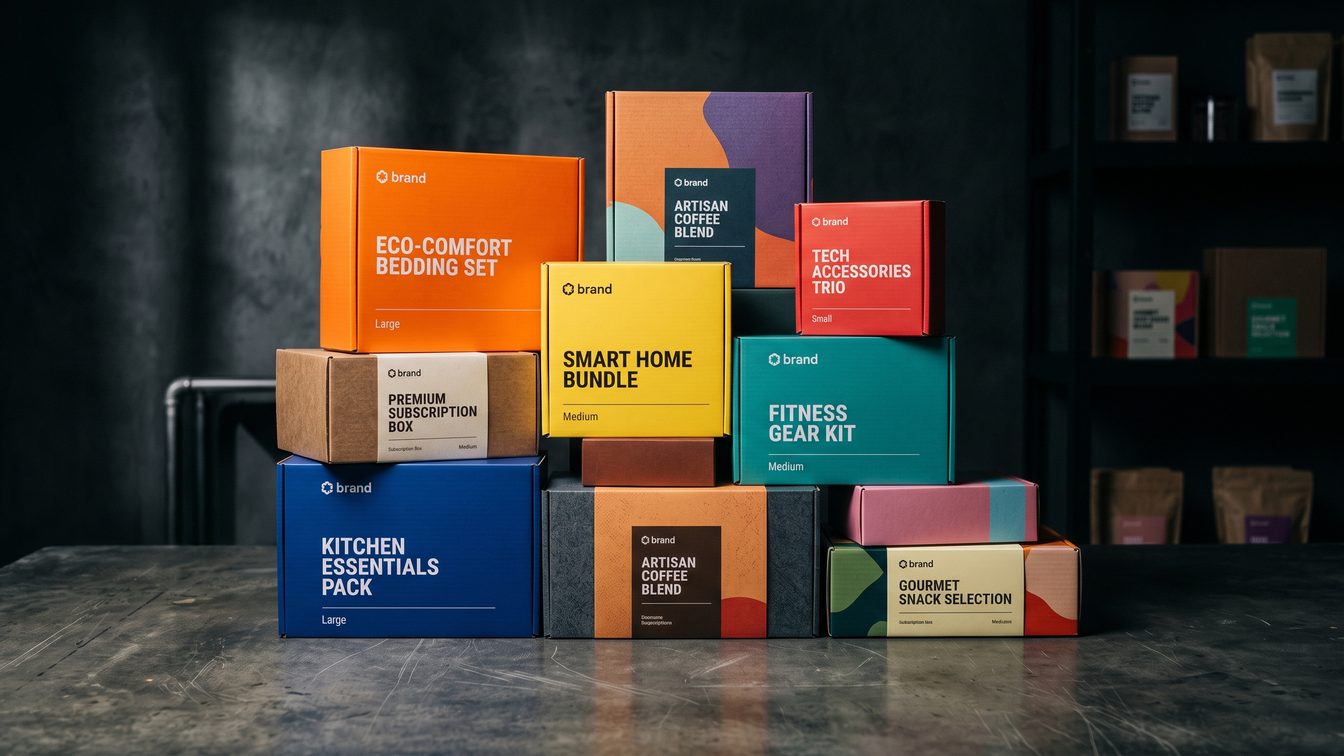
The Bundle Problem Nobody Talks About
Most ecommerce operators build bundles once. Maybe twice a year if they're disciplined. They pick products that make logical sense, price them by gut feel, and never update them until inventory forces their hand.
Meanwhile, AI is watching the data your customers leave behind at every touchpoint. It sees which products move together. Which margins stack. Which inventory is bleeding velocity. And it builds bundles accordingly, then rotates them as signals shift.
Static bundles leave money on the table. Dynamic bundles pick it up.
How AI Bundles Beat Manual Ones
Amazon's Bundle Intelligence platform documented the gap. Their AI-generated bundles outperformed manually created ones by 43% in conversion rates. Revenue lifted 67%. AOV increased 68%. Slow-moving inventory turned over 34% faster because the algorithm knew exactly which A-list products could carry B-list items.
That's not because algorithms are magical. It's because they process signals at scale.
Manual bundling is pattern-matching on a spreadsheet. You see 50 orders last month. Maybe you notice that 8 included both Product X and Product Y. You think, "Hey, bundle those." You price it. You're done.
AI sees 50,000 orders. It calculates correlation coefficients across every product pair. It measures margin contribution. It tracks velocity trends week-over-week. It tests pricing elasticity. Then it builds 12 different bundles for 12 different customer segments, and rotates them when the data says to.
One is linear thinking. The other is signal processing.
Data's DNA: Analyze Every Signal Customers Leave Behind
Ecom operators are drowning in data they don't touch. Every cart abandonment. Every product page. Every repeat purchase. Every category drift. Every price sensitivity point.
A smart bundling system ingests all of it.
Purchase correlation tells you what moves together. Track it week-over-week and you'll see seasonal patterns, cross-sell opportunities, and cannibalization risks (when bundling Item A with Item B kills standalone Item A sales). The algorithm adjusts accordingly.
Margin profiles tell you which bundles fatten contribution dollars. A high-AOV bundle that kills margins is a trap. AI bundles for *profitable* AOV, not just AOV. It pairs 15% margin items with 45% margin items to drive blended margin higher.
Inventory velocity is the third pillar. Slow-moving SKUs are capital sitting on shelves. Pair them intelligently with your top 5 velocity drivers and they move. Amazon's data showed 34% faster turnover. That's not better marketing, that's algorithms knowing that Customer Z wants the fast-mover, but Customer Y will accept the slow-mover if the bundle hits her price sensitivity.
Customer segmentation is the engine. Are they first-time buyers? Repeat customers? High-LTV accounts? Different segments have different bundle tolerance. The system learns who buys what and personalizes the offer.
You can't do this manually. Spreadsheets stop working at scale.
The Economics: Where the Lift Comes From
Swell's 2026 bundling research pulled data from thousands of merchants. The playbook is consistent:
AOV Lift: 20-30% typical range. Top performers hit 35%. MakeBeCool's Black Friday 2022 data showed bundle AOV was 20% higher than non-bundle baseline. McKinsey research cited by Swell showed bundling boosts sales 20% and profit 30%.
Conversion Improvement: 15-25% average. Best-in-class implementations reach 40%. Why? Bundles solve the "what should I buy" problem. They lower decision friction. They make the offer feel complete.
Inventory Turns: 30% faster. That's not marginal. That's the difference between cash locked up for 120 days versus 84 days. Over a year, faster turns compound. You replenish what works. You cull what doesn't. Capital flows to winners.
Margin Stacking: +2-3% blended margin. Bundled products have lower per-unit marketing cost (you're marketing one bundle, not 3 SKUs). Operations get simpler. The math works.
Swell also noted that bundling drives 40% higher retention rates (when personalized) and improves customer lifetime value 25-35%. That's the compounding piece. AOV lifts once. Retention lifts forever.
Here's the competitive moat: Fewer than 20% of ecommerce operators run post-purchase offers at all, per Finaloop research. 68% of shoppers are receptive. You're likely competing against merchants who haven't even started. An AI bundling system puts you years ahead.
An AIN Case Study: Deal Structures and Bundle Sweeteners
I spent years in deal structures, watching how founders sweeten multiples when use matters. Same logic applies to bundles.
I watched a founder pair a commodity item (razor blades, low margin, high volume) with a premium consumable (aftershave, high margin, low volume). On its own, aftershave convert at 4%. Bundled with razors at the right price, it convert 18%. AOV jumped. But here's the key: the founder didn't predict that correlation. He studied his data. He noticed that his highest-LTV customers bought both. He built the bundle for *them*. Then he watched it spread.
That's what AI bundling does at scale. It finds the correlations hiding in your data. It doesn't guess. It measures.
The deal lesson: the bundle isn't the product. The bundle is the *offer structure* that makes the full transaction click. Price it correctly and it compounds.
Building the System: What You Need
A dynamic bundling system has three parts:
The Analyzer. Ingests purchase history, cart data, margin profiles, and velocity signals. Builds correlation matrices. Segments customers. Identifies the top 20 product pairs worth bundling (by predicted AOV, margin contribution, and inventory efficiency). This runs daily or weekly, not once a year.
The Pricer. Takes the top bundles and tests pricing elasticity. Which price point maximizes contribution? Does $79 bundle convert better than $74? What's the sweetspot where AOV × Conversion × Margin is maximized? Pricing is A/B tested, not guessed. Some systems use dynamic pricing, adjust bundle price based on inventory levels, seasonality, or customer segment.
The Rotator. Decides which bundles to show to which customer, on which channel, at which moment. First-time buyers see bundles that lower friction. Repeat customers see bundles that increase AOV. Email gets different offers than the post-purchase page. This is where personalization drives the real lift.
You don't need a $500K platform. Shopify apps exist for this. Custom systems can be built in weeks. The barrier isn't technology, it's updating your mental model from "bundle once, forget" to "bundle as a living system."
The Implementation Question: Build or Buy?
Build: In-house systems give you control. You understand the logic. You can A/B test faster. You own the feedback loop. Cost is 8-12 weeks of engineering time plus ongoing maintenance.
Buy: Bundling apps handle the work. They integrate with your platform. Setup is faster. Cost is typically $500-2K/month depending on order volume.
The right answer depends on your order volume and margin tolerance. If you're doing $1M+ revenue and bundling could move 2-3% blended margin, the ROI on a build is strong. If you're $500K revenue and testing, buy an app first.
Either way: start. Static bundles are dead weight. The question isn't whether to bundle dynamically, it's when.
FAQ
Q: Won't customers get annoyed seeing different bundles?
A: Personalization isn't randomness. It's smarter. A first-time buyer and a repeat customer have different needs. Show the right bundle to the right person and conversion lifts. Amazon, Shopify, and others have done this for years. Customers don't complain, they convert.
Q: What if my margins vary wildly across products?
A: That's exactly why AI bundling works. The algorithm will pair high-margin items with velocity drivers to maximize blended contribution. It won't put two low-margin products together unless inventory pressure demands it. Margins are an input to the system, not an afterthought.
Q: How long until I see AOV lift?
A: TenTen's research shows 8-12% AOV lift within 1-2 weeks of implementing intelligent bundling. Full maturity (20-30% lift) takes 6-8 weeks as the system learns and optimizes. You'll see inventory movement faster, often within 2 weeks.
Q: Do I need AI to do this, or is it just good analytics?
A: You need systematic analysis that updates frequently. Call it AI, call it automation, call it analytics, the name doesn't matter. What matters: Your bundles change weekly based on data, not on your annual review. That requires a machine running the logic, not a human in a spreadsheet.
The Move
Start with your top 100 SKUs. Look at which products appear together in orders. Note the margin contribution of each. Identify the 5-10 products with velocity problems. Build 3-5 intentional bundles pairing velocity drivers with inventory bleeders. Price each bundle 15-25% below the sum of parts (test this). Rotate the bundles every 2 weeks based on performance.
If you're running $500K-$5M revenue, this should be a 3-week project. If you're larger, it's a systems play. Either way, the question isn't complexity. It's prioritization.
Bundles are one of the highest-ROI levers in ecommerce. Static ones give you nothing. Dynamic ones compound.
Pick up the signal. Build the system. Let it run.