
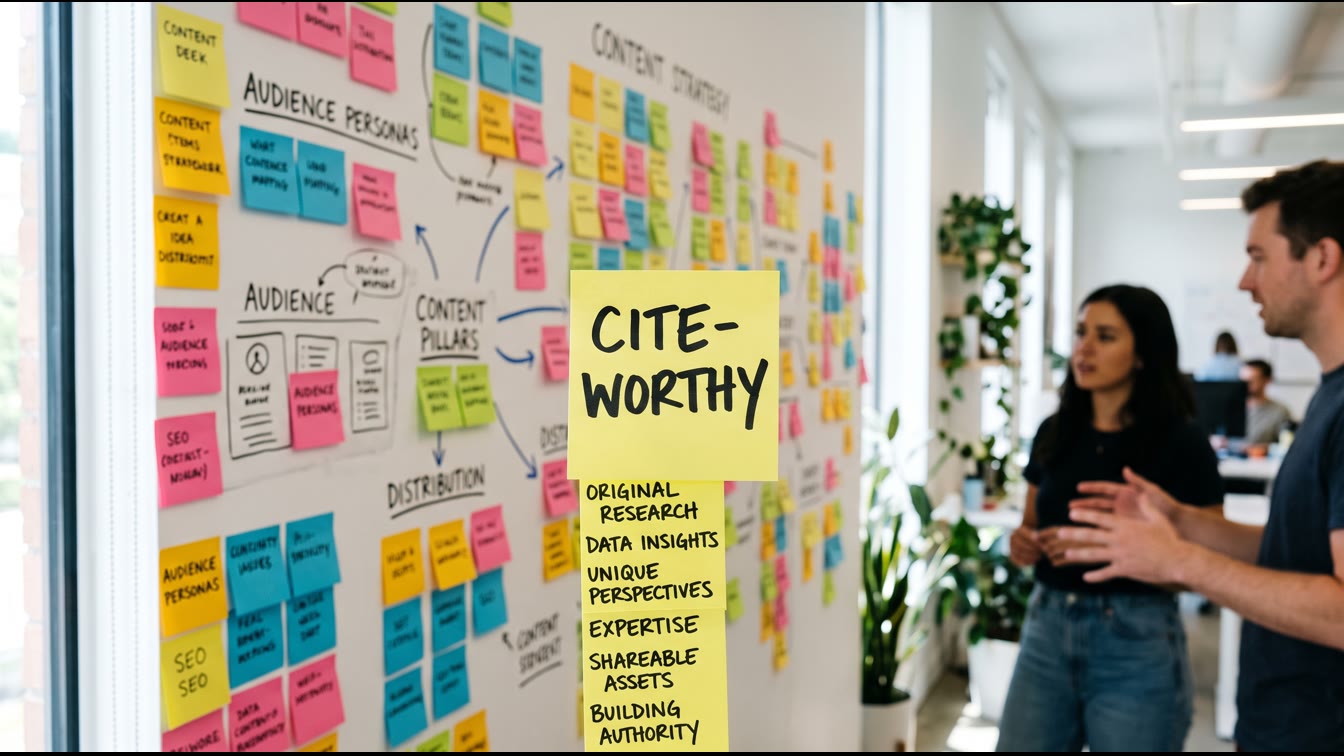
AI Overviews cut organic clicks 38% on the queries where they appear, according to a randomized field study from Carnegie Mellon and the Indian School of Business (Search Engine Journal). Agencies still selling "we rank your pages" are selling half a service. The other half, getting cited inside the answer itself, is where the client's traffic and trust now live.
Patrick Moran at Clearpath Digital already moved 60% of his content budget toward what he calls cite-worthy content. That reallocation is not a trend chase. It is survival math, and every agency operator needs to run the same numbers this quarter.
I spent six years in a nuclear power plant before business school, and the one lesson that never left me is this: you do not fight the physics, you redesign around it. Zero-click search is the new physics of search.
Fighting it by publishing more thin pages is like adding more valves to a system that is already leaking pressure. The fix is structural, not volumetric.
The number that should be in every agency pitch deck
The Carnegie Mellon study is the first randomized, causal evidence on this, not a correlation chart. Researchers randomly assigned 1,065 real Chrome users to see or not see AI Overviews across 68,089 searches.
When the Overview appeared, outbound clicks fell from 0.61 to 0.38 per search. Zero-click search jumped from 54% to 72% (PPC Land).
Ahrefs found something worse on top of that. A follow-up study measured a 58% CTR drop for top-ranking pages when an Overview appears, nearly double what they measured a year earlier. The effect is not stabilizing. It is getting sharper.
Here is the part agencies keep burying in the bad news: brands cited inside an Overview earn 35% more organic clicks and 91% more paid clicks than brands left out entirely, according to Seer Interactive's analysis of 25 million organic impressions (cintra.run).
Being inside the box now beats ranking below it. That is the pitch. Stop selling rank. Start selling the box.
The FOCUS Strategy, applied to citation
I built the FOCUS Strategy for founders trying to cut through noise and find the one lever that moves capital. Applied to content, it runs five steps, and every agency operator I coach starts here.
Findings first. Before you write anything, find the sub-questions AI systems are actually fanning out to answer. Use the "People Also Ask" phrasing as your closest public proxy for that fan-out.
Lily Chen at Riser Commerce puts it plainly: structured data is now "a prerequisite, not a bonus." Skipping this step means writing content for a query nobody's model is actually decomposing.
Original data or nothing. Generic buyer's guides do not survive this era. Deeply original guides built on first-party data do.
If your client has order history, support tickets, or a proprietary dataset, that is the moat. AI systems extract facts, not filler, and a unique number beats a thousand words of throat-clearing.
Chunk for extraction. Large language models tokenize your page as plain text, not as structured JSON-LD (Space & Story). They read in fragments, rank the fragments, then stitch the best ones into an answer with a citation.
Write every section so the first sentence is a complete, standalone answer. That is the fragment the model grabs.
UGC hubs over static pages. Video-indexed content and user-generated review hubs hold up better than static SEO pages because they refresh constantly and carry the kind of specific, dated detail models favor over generic copy. A hub that updates weekly beats a landing page that has not changed since 2023.
Structured layer, always. FAQPage schema is back in relevance. Not because Google shows the dropdown anymore, it retired that rich result on May 7, 2026, but because the underlying markup still tells crawlers exactly which text is a question and which is the answer (algoblueprints.com).
Keep it on pages that are genuinely Q&A. Strip it from pages that bolted it on for a dropdown that no longer exists.
The templates that earn citations
I do not hand clients a content calendar full of blog-post ideas anymore. I hand them four templates.
The first-party benchmark report. Pull a number nobody else has: average order value by cohort, return rate by category, time-to-repurchase. Publish it with a date stamp and update it quarterly.
Models cite fresh, sourced numbers far more than opinion. A single proprietary number outperforms an entire opinion piece.
The direct-answer buyer's guide. Every section leads with a 40-to-60 word answer, then supporting detail. No throat-clearing intro paragraph.
The AI does not read your preamble. Neither does the buyer, and I would know, I have read a thousand pitch decks that buried the answer on page nine.
The FAQ block with 5 to 10 real questions. Not schema-stuffed filler. Phrase each question the way an actual buyer would type it, answer it in one direct sentence, then expand.
Panstag's research on schema correlation found FAQPage markup raises citation probability over 20% versus pages without it, when the questions are genuine (Panstag).
The UGC-anchored comparison page. Pull real customer language from reviews or support transcripts into a comparison table. Real phrasing beats marketing copy every time a model is choosing which source sounds most like a trustworthy human answer.
The client conversation you need to have this month
Most agency-client relationships were built on a rank-tracking dashboard. That dashboard is now reporting a metric in decline, and the client sees it before you explain it. Get ahead of that conversation instead of reacting to it.
Bring the number, not the theory. Zero-click search rose from 54% to 72% on triggered queries in the Carnegie Mellon data. Ahrefs measured global publisher traffic falling 33% between November 2024 and November 2025, with the US decline running steeper at 38% (cintra.run). A client who sees both numbers together stops asking why rankings are stable while traffic keeps sliding.
Then bring the counter-number. AI-referred visitors convert at 4.4 times the rate of traditional organic visitors, according to Semrush's research on AI search traffic patterns. Lower volume, dramatically higher intent.
That is not a consolation prize. That is the actual opportunity hiding inside the bad news, and it is the number that keeps a retainer instead of losing it.
Where agencies still get this wrong
The most common mistake I see is agencies chasing citation the same way they used to chase rank: more pages, more keywords, more publishing velocity. That approach fought the last war. AI systems are not counting your page count. They are extracting the single best fragment for a given sub-question, regardless of which domain it sits on.
A ten-page site with one genuinely authoritative benchmark report can out-cite a five-hundred-page content farm. I have seen operators raise serious capital on the strength of one number nobody else in their category had bothered to publish. Content strategy in 2026 rewards the same instinct: fewer assets, deeper ownership of the data inside them.
The second mistake is treating structured data as decoration instead of infrastructure. Schema is not a growth hack you sprinkle on top of thin content. It is the labeling system that tells machines what your content actually is.
Skip it, and you are asking the AI to guess. Guessing costs you the citation.
Why the FAQ schema debate is a distraction from the real work
Half the SEO industry spent the spring of 2026 arguing about whether FAQ schema is dead. Google quietly retired the FAQ rich result, the expandable dropdown beneath a listing, on May 7, 2026, with a deprecation banner and no announcement (algoblueprints.com).
That argument misses the point entirely. The dropdown display disappeared. The FAQPage schema type did not. Google still parses it, still uses it to understand page structure, and AI systems reading your visible page text still benefit from content that is unambiguously organized as questions and answers.
Do not waste a single billable hour ripping FAQ schema off pages where it genuinely belongs. Spend that hour instead auditing which pages have schema bolted on decoratively, chasing a rich result that no longer exists, and strip it from those. Then redirect the freed-up time toward writing better questions.
The agencies still fighting over schema syntax in 2026 are optimizing the wrapper. The agencies winning new retainers are optimizing what is inside it: real buyer questions, answered directly, backed by a number the client actually owns.
What this means for agency pricing
If you are still billing for "content volume," you are billing for the wrong output. A client with ten original, cited-worthy pages outperforms a client with two hundred generic ones.
Reprice around citation rate and structured coverage, not word count delivered. I have watched founders in my network raise eight figures on the strength of one proprietary data point published at the right time.
The same principle applies here at a smaller scale. One number nobody else has beats a hundred paragraphs nobody remembers.
Agencies that make this pivot now own the relationship. Agencies that keep selling rank position are selling a metric that is worth 38% less than it was two years ago, and shrinking.
Reposition the retainer before the client does the math themselves. The client who reads the Carnegie Mellon study before you bring it up is a client about to fire you.
FAQ
Q: Does adding FAQPage schema guarantee my client gets cited in AI Overviews? A: No. Schema removes a barrier to extraction; it does not replace the need for a genuinely good answer. Google has stated no special schema is required for AI Overview eligibility. The content still has to be the best available answer to the question.
Q: Is FAQ schema dead now that Google removed the FAQ rich result? A: The dropdown display is gone as of May 7, 2026. The FAQPage schema type itself remains valid and is still parsed by Google and cross-referenced by AI systems reading your visible text. Keep it on genuine Q&A pages, remove it from pages where it was decorative.
Q: How many content pieces should an agency produce per month under this model? A: Fewer, better pieces beat volume. Prioritize one original data asset or benchmark report per quarter over ten generic blog posts per month. Citation rate is the metric that matters, not publishing cadence.
Q: What is the fastest way to prove this shift to a skeptical client? A: Show them the Carnegie Mellon click data alongside a screenshot of a competitor being cited in an Overview for a query your client currently ranks for but is not cited on. The gap sells itself.
Q: Do UGC hubs and video content really outperform written buyer's guides for citations? A: They hold up better because they refresh constantly and carry specific, dated, first-person detail that generic written guides lack. Use both. Written guides handle depth; UGC hubs handle freshness and authenticity signals.
Make your client the source AI systems trust enough to quote. That is the retainer worth defending in 2026.
*Jeff Barnes is the founder of demg.ai and CEO of Angel Investors Network. The views expressed are his own and do not constitute professional advice. demg.ai provides marketing education and systems for owner-operators. Past results do not guarantee future outcomes.*