
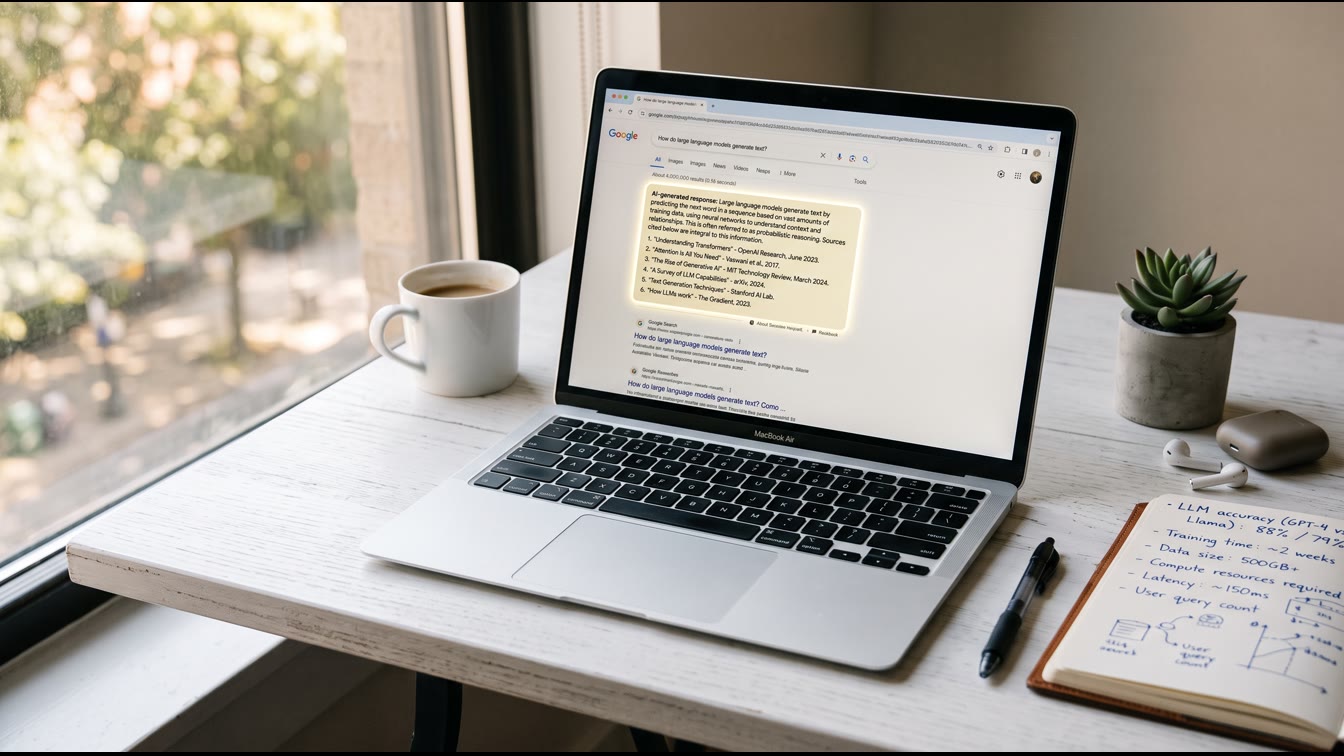
Citation share is the percentage of AI-generated answers in your category that name your business. It matters now because Google AI Overviews appear in 43% of searches, up from 15% a year ago, according to Similarweb data reported by TechCrunch in July 2026. Rank #1 on Google and still lose the customer if the AI answer never says your name. That is the new scoreboard.
Owner-operators who only track keyword rankings are reading a gauge that no longer reflects the reactor core. The gauge still moves. It just does not tell you what is actually happening inside the plant.
I ran nuclear reactors on a submarine before I ran a business. On a boat, you do not care what the gauge used to measure. You care what it measures right now. The crew's life depends on the read being current, not historical.
Search rankings are the old gauge. They tell you where you sit on a page fewer people scroll to the bottom of. Citation share tells you whether the AI answering the question even knows you exist.
The data behind the shift
Three numbers should end the debate for any owner-operator still optimizing for blue links alone. Read them slowly. Each one stacks on the last.
First, AI Mode visits on Google grew from 126 million in June 2025 to 279 million in May 2026, more than doubling in eleven months (TechCrunch). Second, organic click share on traditional Google results dropped from 44.9% in March to 40% as Google keeps more sessions inside its own ecosystem (eMarketer). Third, Seer Interactive tracked organic click-through rate on AI Overview search pages falling from 1.76% in 2024 to 0.61% in 2025, a 61% collapse, before a partial rebound in early 2026 (Seer Interactive).
Here is the number that should get an owner's attention fastest. Adobe's Q2 2026 traffic report found AI-referred visits converted 42% better than non-AI traffic in March 2026, a record high. That is a full reversal from a year earlier, when AI traffic converted 38% worse (Adobe).
Fewer clicks are coming through the door. The ones that do come through are buying at a materially higher rate. That combination changes the math on where an owner should spend attention.
Volume is down. Quality is up. Citation share is the metric that captures both halves of that trade in one number.
Why rankings alone lie to you now
A keyword ranking tells you your position on a results page that a shrinking share of searchers ever scroll through in full. Search Engine Land, covering the same Seer Interactive research, reported organic CTR on AI Overview queries falling 61% and paid CTR falling 68% over the same period (Search Engine Land). Brands cited inside the AI Overview earned 35% more organic clicks and 91% more paid clicks than brands left out. That gap is the whole ballgame.
Ranking #3 while your competitor gets cited in the AI answer means your competitor wins the customer before your listing ever loads. Rank is a proxy. Citation is the event.
Think of it like sonar versus radar. Radar tells you what is on the surface, in the open, where everyone can see it. Sonar tells you what is moving underneath, where the real decision is happening.
AI Overviews are the water beneath the results page. If your business does not show up in the sonar sweep, the surface picture does not matter at all.
Data's DNA: the framework for reading AI search signals
I built the Data's DNA framework at Angel Investors Network because founders kept bringing me vanity metrics and calling them strategy. Capital does not fund vanity metrics. It funds numbers that predict cash. The framework has four strands, and each one maps directly onto citation share.
Strand one is Source. Where does the AI pull its answer from? Run your top ten buyer questions through ChatGPT, Perplexity, and Google AI Overviews. Log the domain cited for each.
That log is your baseline. No baseline, no measurement, no improvement. I learned that lesson the hard way running the underwriting book at Hartford and Munich Re, where an underwriter who could not name his loss ratio by line was flying blind with other people's capital.
Strand two is Density. How many times does your name appear in the answer versus zero, versus once, versus cited as the primary source? A single mention buried in a list is not the same asset as being the named answer to "who is the best plumber in this zip code."
Strand three is Nature. What kind of citation is it? A linked citation with attribution outranks an unlinked mention, because click-through on linked citations runs several multiples higher. Track the type, not just the count.
An owner who counts every mention as equal is grading on a curve that does not exist in the buyer's mind. A buyer who sees your name with a live link behaves differently than a buyer who sees your name in passing with no way to click through.
Strand four is Attribution. Does the citation lead anywhere measurable? Tag your AI-referred sessions in GA4, watch first-touch attribution in your CRM, and compare conversion rates against your other channels the way Adobe did at the category level.
Run those four strands monthly and you have a citation share dashboard instead of a hunch. A dashboard is a command instrument. A hunch is a rumor.
The Owner-Operator Frame applied
Every owner-operator I coach through Angel Investors Network eventually asks the same question. "How much of this do I do myself versus delegate?" Apply the Owner-Operator Frame here the same way you would to a P&L.
You do not need to become a GEO technician. You need to know three numbers well enough to hold your marketing team accountable for them.
Your citation rate. Your share of voice against named competitors. Your AI-referred conversion rate. Three numbers, memorized, the same way you know your gross margin without opening a spreadsheet.
An owner who tracks those three numbers monthly cannot be fooled by a vanity ranking report. An owner who does not track them is trusting an agency's word for a result the owner never verified.
I have raised capital for clients who could not answer basic questions about their own unit economics. Do not run your marketing the same way. You would never run your balance sheet on faith alone.
What good citation share looks like
There is no universal benchmark yet, because the discipline is roughly two years old. What I tell clients instead is to build a relative benchmark against their three closest competitors.
If a competitor is cited on 40% of the prompts you tested and you are cited on 10%, you have a ten-point gap and a clear target. That gap is fixable.
Structured FAQ content, original data, and named-author authority all move the needle. The Princeton and Georgia Tech GEO study, presented at KDD 2024, first quantified these levers at scale, finding that adding statistics, quotations, and citations each lifted a source's visibility in AI answers by up to 40%.
That finding disproportionately helps businesses that do not already rank first on Google. A ten-point citation gap is closable in a single quarter if you attack it the way you would attack any operational bottleneck, one lever at a time, measured before and after.
Measure the gap. Close the gap. Measure again. That is the whole discipline, and it is no different from running a nuclear reactor watch.
You take the reading, you compare it to spec, you adjust, and you take the reading again. Skipping the second reading is how casualties happen, on a submarine or in a marketing budget.
A closing number worth sitting with
Google's own zero-click trend, tracked by SparkToro using Similarweb panel data, shows roughly 68% of searches in 2026 ending without any click to the open web, up from about 45% a decade ago. Citation is now the only exposure many buyers ever get to your brand before they call.
If you are not measuring it, you are not measuring the moment that actually decides the sale. You are measuring an echo of a moment that already passed.
Build the habit before you need the discipline
I tell every client the same thing about capital raises. You do not build your data room the week before the term sheet arrives. You build it eighteen months earlier, so the numbers are already clean when the investor asks.
Citation share works the same way. The owner-operators who start logging their baseline this month will have twelve months of trend data by next summer. The ones who wait until a competitor visibly outpaces them in AI answers will be starting from zero, one full search cycle behind.
A nuclear watch officer does not wait for the reactor to misbehave before learning to read the instrument panel. You learn the panel on day one of the watch, long before anything goes wrong. Treat citation share the same way. Learn to read it before you need it to save the quarter.
Doctrine Connection
This is Data's DNA in practice: the discipline of measuring what actually predicts revenue instead of what is easy to screenshot for a client report. Citation share is not a vanity number. It is a leading indicator of whether your business exists in the only search result that increasingly matters.
FAQ
Q: What is citation share and how is it different from a search ranking? Citation share is the percentage of relevant AI-generated answers that name your business as a source. A ranking measures position on a traditional results page. Citation share measures presence inside the AI answer itself, which now appears in 43% of Google searches.
Q: How do I measure my own citation share without expensive software? Start manually. Take your top 10 to 20 buyer questions, run them through ChatGPT, Perplexity, and Google AI Overviews, and log whether you are cited, who else is cited, and the source URL. Repeat monthly. That spreadsheet is your baseline under the Data's DNA framework.
Q: Does citation share actually convert to revenue? Adobe's Q2 2026 data found AI-referred traffic converted 42% better than non-AI traffic in March 2026. Seer Interactive found brands cited in AI Overviews earned 35% more organic clicks than brands left out. Fewer visits, higher intent, better close rate.
Q: Should I abandon SEO and go all-in on GEO? No. Content that already ranks well in traditional search is more likely to be cited by AI Overviews, which draw from Google's existing index. SEO and GEO are complementary systems, not competing ones. Run both, measure both.
Q: How often should an owner-operator review citation share? Monthly, minimum, with quarterly deep audits against named competitors. AI answers drift as models update, so a single check tells you nothing. You need repeated sampling to know your real trend.
*Jeff Barnes is the founder of demg.ai and CEO of Angel Investors Network. The views expressed are his own and do not constitute professional advice. demg.ai provides marketing education and systems for owner-operators. Past results do not guarantee future outcomes.*