
The Acquisition That Named Your Real Problem
If you missed it last week, BlueConic acquired Blueshift on June 17, 2026, and the reason the press release language matters is not the deal itself. It is the specific phrase they used to describe what they built: "a single system to capture first-party behavior, decide next best action in real time, and execute across email, push, in-app, SMS, and web." That is not a product pitch. That is a diagnosis of what most owner-operators are failing to do with five separate subscriptions that do not talk to each other.
This article is not about whether you should buy BlueConic. Most of you reading this are not 600-customer CPG and retail enterprises. But the architecture they just paid to consolidate is the exact architecture you should be running on a fraction of their budget. Here is how to think about it, what it actually costs, and where operators get stuck.
What BlueConic Actually Built by Buying Blueshift
BlueConic's core product is a customer data platform: first-party data ingestion, identity resolution, audience segmentation. Strong at capture and storage. Weaker at the "what do we do next, right now" layer.
Blueshift fills that gap. Blueshift's product is AI-driven cross-channel campaign orchestration. Not just "send an email when someone abandons a cart." More like: score every customer's intent in real time, decide whether email, push, or SMS is the right channel for that specific person at that specific moment, and fire the right message without a human touching a workflow. Their customer list reflects this: StitchFix, Tuft & Needle, Five Below, Udacity, LendingTree. These are businesses where retention is a revenue line, not a marketing metric.
The combined entity has 600-plus customers across CPG, retail, DTC, travel, and hospitality. The thesis, stated directly by Vijay Chittoor, Blueshift's CEO: "AI agents as first-class operators from the start, not retrofitted features." That framing is important. Most tools in your stack were not designed with AI decisioning at the center. They were built for human-operated workflows and AI was added later, bolt-on style. BlueConic just paid to own a system where AI is the primary operator, not a feature toggle.
The competitive language from BlueConic is even more pointed: "Real-time context is the new competitive moat. Brands that own how they capture, decide, and act on first-party behavior will be structurally harder to compete with as agents become the primary operating model."
That sentence is worth printing out and posting near your screen. The moat is not your brand. It is your data loop.
The Four-Tool Problem Most Operators Are Living With
Here is the standard stack I see when I do a tools audit with a founder running a DTC or subscription business doing $2M to $15M annually:
- A CDP or data warehouse (Segment, Amplitude, or Mixpanel): $500 to $2,000 per month
- An email platform (Klaviyo, ActiveCampaign, or Mailchimp): $200 to $800 per month
- An SMS tool (Attentive, Postscript, or Klaviyo SMS): $100 to $500 per month
- Push notification tool (OneSignal, Pushwoosh, or Braze if they scaled into it): $50 to $300 per month
- Paid analytics layer for attribution (Triple Whale, Northbeam, or GA4 plus something else): $300 to $600 per month
Conservative total: $1,150 to $4,200 per month. More realistically, $2,500 per month for a business doing $5M in revenue.
The problem is not the cost. The problem is that none of these tools share a unified behavioral signal in real time. Klaviyo knows what emails a customer opened. It does not know that the same customer browsed your highest-margin product category three times in the last 48 hours and has a predicted LTV in the top decile. That context lives in your CDP. But the CDP does not trigger the Klaviyo flow unless someone built that integration manually, it runs on a 24-to-48-hour sync cycle, and the segment logic was written six months ago by a contractor who no longer works there.
You are not running a retention loop. You are running a series of disconnected automations that occasionally overlap.
The Loop BlueConic Just Paid to Own
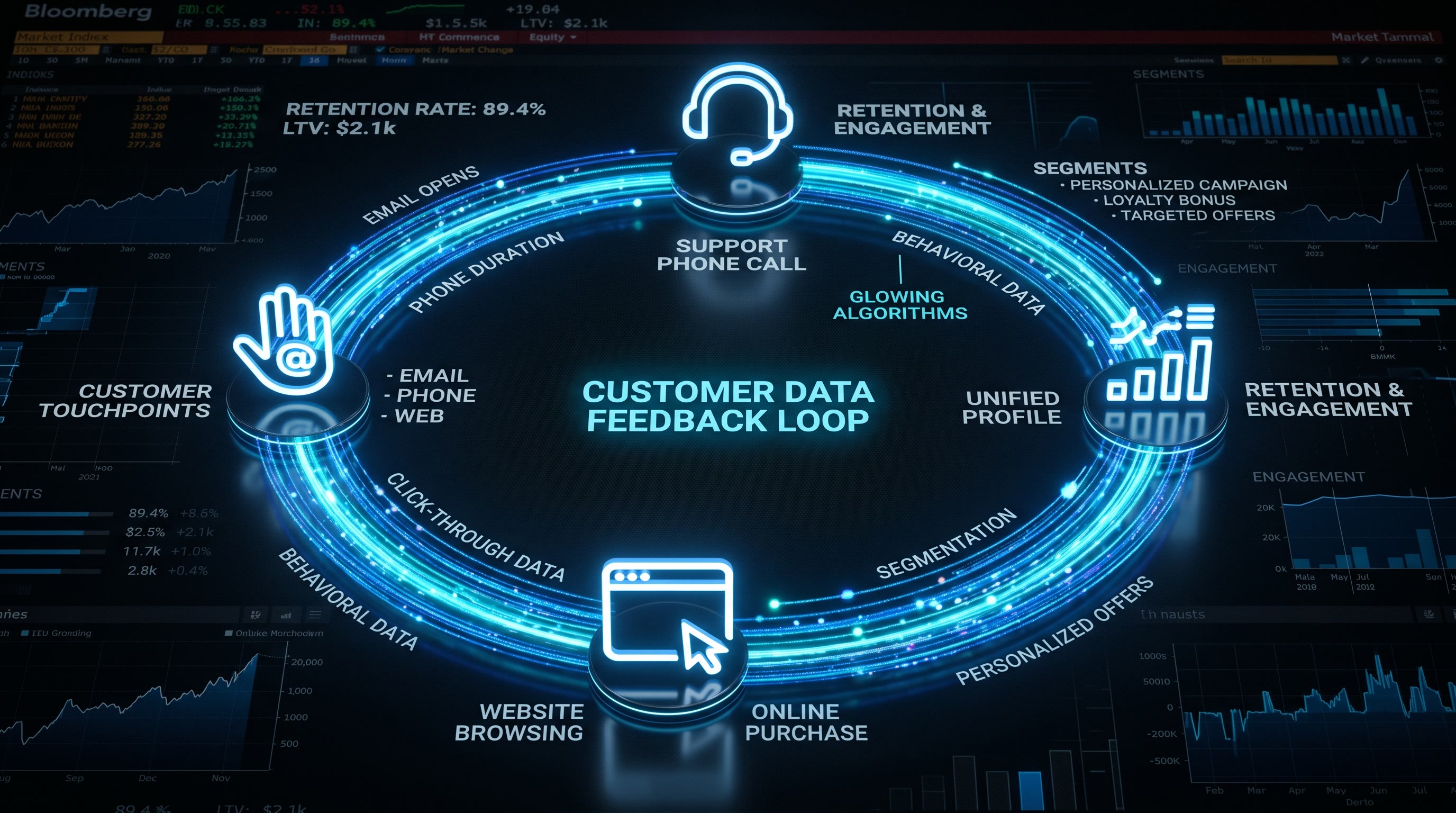
The architecture that makes the BlueConic-Blueshift combination valuable is not complicated. It has three components, and they have to be connected in real time or the whole thing degrades:
Capture: Every behavioral signal (page views, product interactions, search queries, purchase history, support tickets, content engagement) flows into a unified profile. Not a daily batch. Real time.
Decide: An AI layer scores each profile against your business objectives (convert, retain, expand, recover) and determines the next best action for each customer at each moment. Not a segment-level decision. An individual-level decision.
Execute: The system fires the action through the right channel without human intervention. Email, SMS, push, in-app, web personalization. The channel choice is part of the decision, not a preset.
The loop closes when the execution result (open, click, purchase, ignore) feeds back into the profile, which updates the score, which changes the next decision. Every interaction makes the next one smarter. This is what operators mean when they talk about owning the data loop, and it is the foundation of the Data's DNA framework for identifying the six behavioral signals that predict churn before customers leave.
How to Build a Version of This Without Buying an Enterprise Platform
The good news: the architecture is replicable. The bad news: you have to actually build it, which means making decisions most operators avoid.
Step 1: Consolidate your behavioral data into one place.
If you are on Klaviyo and Segment, pick one as your source of truth and pipe everything into it. If you are not on a CDP, Klaviyo's data platform is functional enough for most sub-$10M businesses. The goal is a single profile that contains browsing behavior, purchase history, email engagement, SMS engagement, and support history. Without this, steps two and three are impossible.
The unified customer data architecture at under $200 per month is the starting point. It outlines how to structure this without buying enterprise software.
Step 2: Build your scoring logic.
You do not need Blueshift's AI to score your customers. You need a spreadsheet (or a simple SQL query) that ranks customers by three variables: recency of last purchase, frequency of engagement in the last 30 days, and predicted next purchase window based on category. That is a basic RFM model, and it will outperform your current "send to everyone who opened in 90 days" logic by a significant margin.
The operators who do this well add a fourth variable: content affinity. What product categories does this customer interact with that they have never bought? That gap between browse behavior and purchase behavior is where your highest-ROI interventions live.
Step 3: Map channel decisions to score thresholds.
This is where most operators stop, and it is where the money is. Once you have a score for each customer, you need a decision rule: at score X, send email. At score Y with email unopened for 14 days, send SMS. At score Z with mobile app installed, send push. This does not require AI. It requires a decision matrix you build once and update quarterly.
Step 4: Close the loop.
Every send needs to flow its result back into the customer record. If someone converts from an SMS, that signal should change their score. If three emails go unopened, that signal should change their channel assignment. This is the step that turns your stack into a learning system instead of a broadcast system.
A Note From My Own Experience
I have run Angel Investors Network since 1997. When I built our investor matching system, the breakthrough was not the algorithm. It was owning the data loop. Every interaction fed back into the next recommendation. An investor who passed on a deal in category A told us something. An investor who asked for more detail on a deal in category B told us something else. The matching got better not because the model was sophisticated, but because we stopped treating each interaction as a one-time event and started treating it as a data point in a continuous signal stream.
That is exactly what the BlueConic-Blueshift deal is operationalizing at enterprise scale. The principle is the same whether you are matching investors to deals or matching customers to their next best action.
The Authority Moat Implication
There is a longer-term reason to care about this beyond retention metrics. When AI agents become the primary interface for commerce and information discovery, the brands that will surface first are the ones with the richest first-party behavioral profiles. Not the ones with the biggest ad budgets.
This is the core argument behind the authority moat: why customer data is your cheapest acquisition channel. The retention loop you build today becomes the acquisition engine of 2027. Every behavioral signal you capture and act on increases the density of your customer profile. That density is what trains future AI systems to recommend your product, personalize your offers, and reduce churn before it becomes a cancellation.
BlueConic's statement is blunt: "Brands that own how they capture, decide, and act on first-party behavior will be structurally harder to compete with as agents become the primary operating model." If that sentence does not change how you think about your stack, read it again.
Due Diligence Is Non-Negotiable
Before you restructure your stack around this architecture, do the actual audit. Pull your current tool costs. Map which tools share data in real time versus on a delay. Identify the gaps in your behavioral capture: what customer actions are you not recording? Where does your scoring logic live, and when was it last updated? What percentage of your retention campaigns are firing based on real-time signals versus static segments?
Most operators who do this audit discover that 40 to 60 percent of their automation spend is running on stale data. That is not a vendor problem. It is an architecture problem. And the solution is not buying BlueConic. It is being honest about what your current stack is actually doing.
Due diligence is non-negotiable when the system you are building is supposed to make decisions about every customer interaction. Garbage data in means garbage decisions out, regardless of how sophisticated the AI layer is.
FAQ
Q: Do I need a full CDP to build this retention loop?
Not necessarily. For businesses under $5M in annual revenue, a well-structured Klaviyo account with custom properties mapped to behavioral events will cover most of what a CDP does for retention purposes. The gaps start to matter at higher volume and when you need cross-channel attribution at the individual level. The decision point is usually when your customer count exceeds 50,000 active profiles or when your team starts spending more than 10 hours per week managing segment logic.
Q: What is the minimum viable version of real-time behavioral scoring?
A three-variable model: days since last purchase, number of sessions in the last 30 days, and category browse depth (how many pages deep they go in your highest-margin category). You can build this in a spreadsheet, run it weekly, and sync the output to Klaviyo as a custom property. That is not real time, but it is far better than no scoring at all. Run this for 90 days, measure lift, then decide if the investment in real-time infrastructure is justified.
Q: How does the BlueConic-Blueshift acquisition affect existing Blueshift customers?
Based on the acquisition announcement, existing Blueshift customers should expect their product to continue operating while the integration roadmap is defined. In practice, enterprise acquisitions of this type typically mean 12 to 18 months before any forced migration or product sunset. If you are a Blueshift customer, the immediate action is to document your current integration architecture so you understand what changes when the products consolidate.
Q: Is SMS still worth adding to the retention loop in 2026?
Yes, but the role has shifted. SMS is no longer a blast channel. It is a high-intent recovery channel. The correct use is not broadcasting promotions. It is triggering on specific behavioral signals: cart abandonment with no email open after 4 hours, lapsed customers with 90-plus days since purchase, post-purchase follow-up for high-ticket items. SMS conversion rates for these specific triggers run 3 to 5 times higher than email for the same trigger. The cost per message justifies the spend when the trigger logic is tight.
Q: What is the single biggest mistake operators make when building this architecture?
Building it for the average customer instead of the individual customer. The entire point of the capture-decide-execute loop is that it makes individual-level decisions, not segment-level decisions. If you spend six months building sophisticated segments and then send the same email to everyone in a segment, you have not built a retention loop. You have built better segmentation for the same broadcast model. The test is simple: can your system send two different messages to two customers in the same segment based on their individual behavioral signals? If not, the architecture is not finished.
*Sources: BlueConic acquires Blueshift - Pulse2 | PRWeb acquisition announcement | Blueshift customer case studies*