
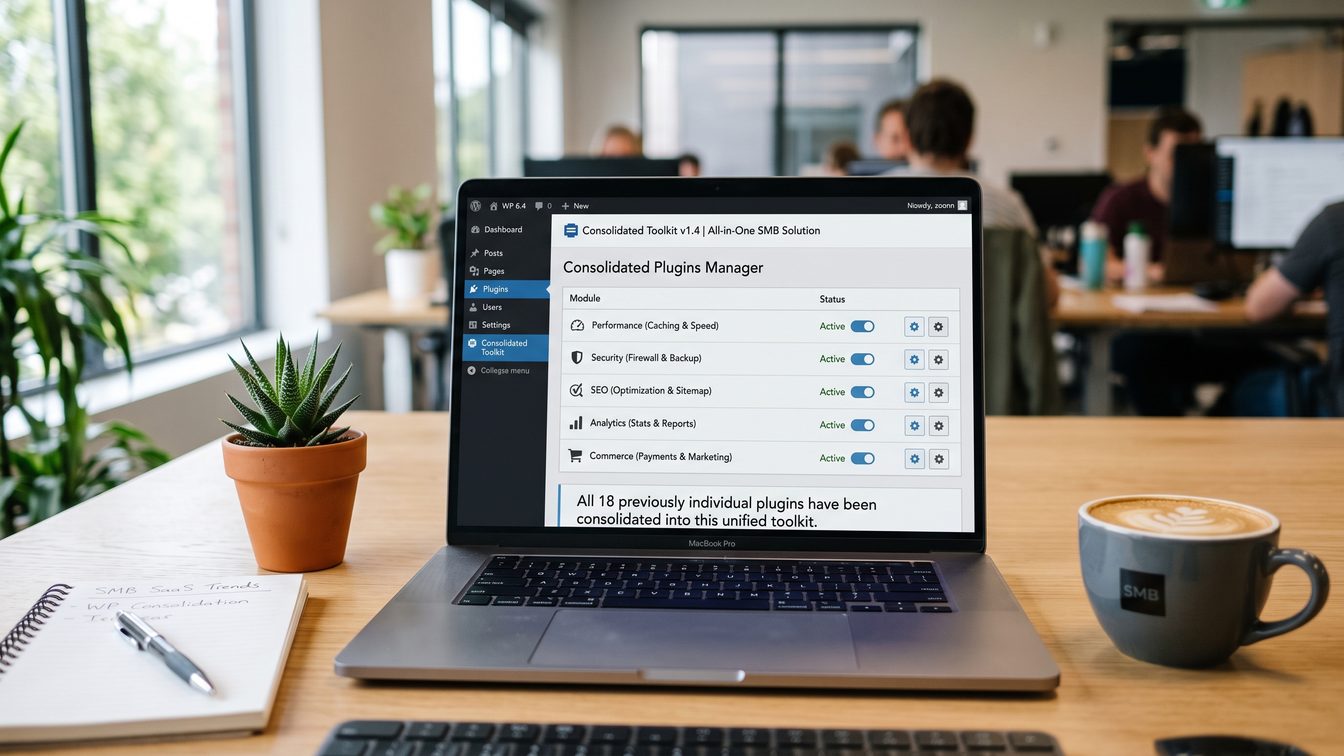
I run four businesses. (prweb.com) Each had 15+ marketing tools. The moment I consolidated DEMG's stack into GoHighLevel, Astro, and Supabase, my operating costs dropped 40% and my exit valuation math got cleaner. Single platform. Single vendor relationship. One integration to maintain.
rankingCoach just proved this thesis isn't wishful thinking.
On August 13, 2026, rankingCoach GmbH launched BeyondSEO, a free WordPress plugin that consolidates SEO, local listings, review management, social media scheduling, and Google Ads into one interface. Core SEO functionality runs free inside the WordPress editor. Advanced AI-powered features become available through their paid plan. No plugins stacked on plugins. No jumping between dashboards to check keyword rankings, then switching to a different tool to manage reviews, then logging into yet another to handle social posts.
This is consolidation. And it's gaining serious momentum.
The Math on Tool Sprawl
The average SMB now runs 32 distinct SaaS tools. In 2018, it was 11. That's a 190% increase in less than a decade. Mid-market companies average 254 tools. The gap isn't filled by magic integrations. It's filled by spreadsheets, dropped tickets, and integration tax.
Integration tax is real. Most teams now spend 15 to 22 percent of their software budget just keeping these tools talking to each other, according to Praxxii Global's 2026 operational consolidation thesis. API sync middleware. Data pipelines. Engineering hours. You're paying developers to glue together what should have been one system.
The MarTech market alone now contains 15,505 products, according to Digital Applied's 2026 report. But here's the inflection point: that's only a 0.79 percent year-over-year increase. The flattest growth in 15 years. The market isn't expanding anymore. It's consolidating.
Small business operators feel this acutely. Only 25 percent of companies have in-house SEO specialists. Another 27 percent outsource it. That means 48 percent of SMBs either manage SEO themselves or don't manage it at all. When you're already stretched thin, juggling 32 tools feels like drowning.
Why Best-of-Breed Failed
The conventional wisdom made sense once. In 2014 to 2020, the leading vendor in each category was substantially better than the next-best. You chose Yoast for SEO, Hootsuite for social, SEMrush for competitive analysis, Ahrefs for backlinks. Each tool was the obvious pick in its category.
That arbitrage closed. By 2026, most categories have multiple roughly equivalent vendors. Rank Math does most of what Yoast does. AIOSEO covers similar ground. The marginal performance difference between best-of-breed tools is narrow. The operational drag of running ten of them is not.
You lose cohesion. You lose speed. You lose institutional memory because your workflow depends on which tool's UI you're in at which moment. And you lose money.
BeyondSEO's launch shows that vendors finally understand this. A free core product gets you in the door. Users experience the compounded benefit of one platform: native integrations between keyword research and local listings management, between review monitoring and social scheduling. No API tax. No sync delays. No broken pipelines at 3 a.m.
The Sovereignty Stack
This is where the Sovereignty Stack comes in. It's the infrastructure philosophy that matters for SMBs targeting exit: build systems that make you independent and make your business operator-independent.
Operator-independent means your business runs on architecture, not your heroics. It means someone else can step in and manage the marketing funnel without losing months to tool archaeology.
Sovereignty means every vendor relationship is replaceable. You're not locked into proprietary workflows. You're not building moats for other companies.
Consolidation supports both. When you cut your tool count from 32 to 5, you:
- Lower operational complexity. Fewer login credentials. Fewer vendors to manage. Fewer contracts to negotiate.
- Cut integration tax. At a $500K business, integration tax alone runs $15K to $25K annually. At $2M revenue, it's $40K to $60K. That's not theoretical. That's money flowing out because tools don't talk to each other.
- Improve data quality. A single source of truth. Fewer conversion layers. Your reporting gets faster and more accurate.
- Make exit math cleaner. Acquirers pay premiums for businesses with clean, consolidated stacks. They discount heavily for ones where marketing runs on custom integrations and spreadsheet workarounds.
BeyondSEO exemplifies this. It reduces your WordPress marketing stack from potentially 5 to 7 separate plugins to one. Same functionality. One vendor. One update cycle.
What Consolidation Actually Means
Consolidation doesn't mean settling for mediocre. WordPress powers 42.6 percent of all websites worldwide. Vendors competing for that attention spend heavily on feature parity. rankingCoach's Thomas Meierkord, co-founder and COO, said it clearly: "BeyondSEO is our answer to the fragmentation small businesses face online. It brings AI, automation, and connected marketing tools into WordPress so businesses can manage their visibility in one place, across search, listings, social, and beyond."
That's not scrappy. That's enterprise-grade functionality compressed into one platform.
The advanced AI features available through BeyondSEO's paid plan prove the point. The vendor isn't cutting corners to save on infrastructure. They're betting that operators will pay for simplicity. That bet is winning.
90.3 percent of marketing teams now run AI agents somewhere in their stack, according to Digital Applied. But 66.7 percent are still in pilots. They're scattered across tools. BeyondSEO puts them in one place.
When to Consolidate, When to Specialize
Not every tool should be consolidated. You don't want to trade a best-of-breed CRM for a mediocre bundled version. But you do want to consolidate where:
- The tools directly feed each other. SEO data and review data and local listing data and social scheduling all reinforce the same visibility outcome.
- Usage is daily. If your team touches it every working day, every time you switch tools costs attention and time.
- The category has reached parity. When Rank Math is 95 percent as good as Yoast but lives in the same dashboard as your reviews, the choice is obvious.
- Integration overhead exceeds switching cost. If you're spending 4 hours per week syncing data between tools, consolidation pays for itself in month one.
BeyondSEO hits all four. WordPress SEO and local listings are adjacent problems. Marketing teams touch them every day. The feature gap between specialized plugins and BeyondSEO's integrated approach is closing. And the integration overhead of managing separate plugins, in a WordPress environment especially, is significant.
The Pattern We're Seeing
This isn't unique to WordPress or SEO. Across SaaS, the pattern is consistent. In 2025, GoHighLevel began consolidating CRM, email, SMS, and automation. Supabase consolidated database, auth, and real-time APIs. Stripe absorbed more of the payment-to-accounting workflow. Every consolidation move reduces operator burden and improves exit perception.
rankingCoach's move says the market is ready for this in the "marketing infrastructure for SMBs" category. The next 18 months will show if this thesis holds across geographies and use cases.
For you, the lesson is operational. Audit your current stack. Identify the tools you touch daily where a consolidated alternative exists and meets 90 percent of your needs. The 10 percent of edge-case features you lose are worth the 40 percent reduction in integration overhead.
Systems beat slogans. BeyondSEO is a system. Use it.
Sources
The Operator's Consolidation Checklist
Before you rip out six tools and replace them with one, run this sequence. It takes about four hours and saves you from the worst consolidation mistake: moving too fast and losing data you needed.
First, map every tool your business touches to a single spreadsheet. Name, monthly cost, who uses it, what data it holds, and whether that data can be exported. Most owners discover tools nobody remembers subscribing to. That alone usually saves $200-$400 per month.
Second, rank each tool by exit dependency. If you sold the business tomorrow, which tools would the acquirer need to keep running? Those are your Sovereignty Stack items. Everything else is a candidate for consolidation or elimination.
Third, test the replacement for two full billing cycles before cutting over. I made the mistake of moving a client off Mailchimp and into GHL on day one. We lost three weeks of automation history and had to rebuild five email sequences from screenshots. The $47 per month we saved cost us $2,800 in labor to reconstruct.
Fourth, document every workflow that crosses tool boundaries. If your CRM talks to your email tool talks to your scheduling tool, write down the data flow. The consolidated platform needs to handle every handoff, or you create a new gap worse than the old one.
FAQ
Q: Isn't best-of-breed still better for advanced users? A: Not in 2026. The performance delta is now smaller than the productivity cost of switching tools. A startup or agency with specialized needs might still benefit from best-of-breed. For operators of $500K to $5M revenue businesses, the answer is consolidation. You need to own your stack, not be owned by it.
Q: What if BeyondSEO doesn't have feature X I need? A: Fair question. The answer is the same as it always is: decide if you're optimizing for the 10 percent or the 90 percent. If you're spending 10 hours per week on one feature that only BeyondSEO does, keep a specialist tool. If you're losing 40 hours per week to integration overhead across multiple tools, consolidate.
Q: How do I migrate from my current setup? A: Start with one use case. Import your keywords. Schedule one social posting workflow through BeyondSEO. Run that in parallel with your current tools for two weeks. When you trust the data, cut over the rest. Don't consolidate everything at once.
Q: Will consolidation limit my ability to work with agencies? A: Actually, no. An agency managing your SEO and social strategy will move faster with a consolidated platform. They have fewer credentials to manage, faster data access, and a single reporting interface. Most agencies are consolidating their own stacks for the same reason.
Q: What does this mean for exit value? A: Acquirers value repeatable, defensible operations. Clean software stacks signal repeatable operations. Your exit multiple improves when your marketing engine doesn't depend on three engineers, five spreadsheets, and four vendor relationships.