
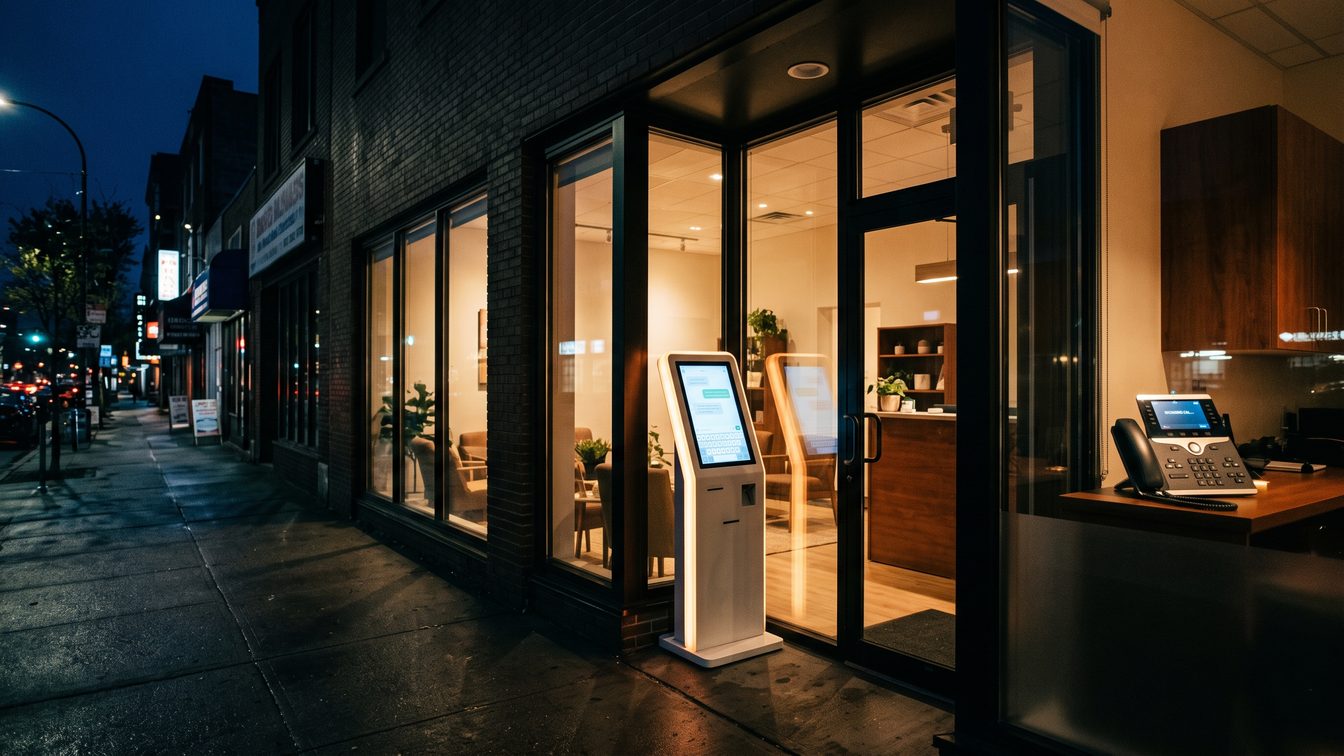
TL;DR: AutomationIQ launched six AI agents built for local and mid-market service businesses: Voice Agents, Text/iMessage Agents, Web Chat Agents, a Unified CRM, Google Business Profile optimization (OPTO), and Ringless Voicemail. The pitch is simple. Answer every call, text, and chat instantly, all day, every day, without hiring a receptionist. The math backs it up. Service businesses lose 40 to 62% of inbound calls, and most of those callers never call back. ATLAS Model for Growth starts with A for Automate, and a phone that always gets answered is the single highest-impact automation a $2M operator can buy this year.
On a submarine, the watch never goes unmanned. Ever. Someone is always on the helm, someone is always on sonar, someone is always monitoring the reactor. You do not get to put a sign on the panel that says "back in ten minutes." The ocean does not wait for your lunch break, and neither does your next customer.
Most service businesses run their phone like the watch went unmanned. The technician is in a crawl space. The office manager is on another call. The owner is driving between jobs. And the phone just rings.
The Cost of an Unmanned Watch
The numbers on missed calls are worse than most owners think. Across small businesses, 62% of inbound calls go unanswered, and industry-specific data on home services puts the figure between 40% and 70% depending on the trade (Dialfyne, 2026). Of the callers who reach voicemail, 85% never leave a message, and most of them call your competitor within sixty seconds (CallJolt, 2026).
Run the math on your own numbers. A two-truck HVAC operation missing 18 calls a week at a $400 average ticket and a 30% conversion rate is leaving roughly $112,000 a year on the table, based on industry benchmarking of exactly that call pattern (CallJolt, 2026). The average small service business loses about $126,000 a year to missed calls alone (Dialfyne, 2026).
That is not a marketing problem. That is a staffing problem wearing a marketing costume. You do not need more leads. You need to stop dropping the ones you already paid to generate.
Speed Is the Whole Game
Here is the part that should change how you think about response time. Contacting a lead within five minutes makes you 21 times more likely to qualify them compared to waiting thirty minutes, and roughly 100 times more likely to even connect with them at all (Kixie, 2025). The advantage decays fast. Eighty percent of your close-rate edge disappears within the first thirty minutes (Optifai, 2026).
Yet the average B2B company takes 42 hours to respond to a lead, and only about 23% of companies respond within five minutes (Optifai, 2026). Seventy-eight percent of deals go to whichever business responds first (Dialfyne, 2026). Speed is not one factor among many. Speed is close to the whole game.
What AutomationIQ Actually Built
AutomationIQ launched its full platform on July 7, 2026, out of St. Petersburg, Florida, under founder Anthony, with a stated mission to make enterprise-grade automation affordable and fast to deploy for local and mid-market businesses (Digital Journal, 2026). The launch offering includes six core AI agents.
Voice Agents answer inbound and outbound calls instantly, with what the company describes as human-level accuracy. This is the direct fix for the missed-call problem above. The phone gets answered on the first ring, at 2am on a Sunday exactly the same as 10am on a Tuesday.
Text and iMessage Agents run conversational engagement with leads through text, which matters because a large share of today's service-business customers would rather text than call in the first place.
Web Chat Agents sit on your website as a chat presence available around the clock, functioning as a salesperson who never clocks out.
Unified CRM consolidates every conversation, across every channel, into one place, so a lead who texts on Monday and calls on Wednesday does not look like two different people to your team.
Google Business Profile Optimization (OPTO) automates review requests and responses and cross-posts content to GBP, Instagram, Meta, LinkedIn, and YouTube. This matters more than it sounds like it should. Reviews contribute roughly 10% of local ranking factors, and hitting ten total reviews produces a measurable ranking bump in Google Maps results (SterlingSky, 2025). Every ten new reviews correlates with close to a 3% lift in profile conversions (Shopify, 2026).
Ringless Voicemail delivers personalized messages directly to voicemail without ringing the recipient's phone, a lower-friction touch for warm follow-up.
The company's stated differentiator is deployment speed. Anthony frames it directly: real results in weeks, not months, which matters for an owner-operator who cannot survive a nine-month enterprise software rollout.
ATLAS Model for Growth: Automate First
I built the ATLAS Model for Growth to give owner-operators an order of operations, because most founders try to do all five letters at once and end up doing none of them well.
A, Automate. Find the highest-frequency, lowest-judgment task draining your time or your revenue, and remove the human bottleneck first. For a service business, that is almost always the phone.
T, Track. Once the task is automated, you need a single source of truth showing what happened. A unified CRM that captures every channel in one thread is the tracking layer, not an afterthought.
L, Learn from the data. This step is about compounding the record you built in Track into decisions, not adding more tools. Which channel produces booked jobs, not just conversations. Which time of day converts. Which technician closes more.
A, Align the team. Automation without alignment just creates a faster mess. Your dispatchers, technicians, and office staff need a shared view of what the automated system is doing on their behalf, or they will quietly route around it.
S, Scale. Only after the first four steps hold do you add volume, whether that is more locations, more ad spend, or more service lines.
Most owners try to scale first. They spend on ads to generate more leads for a phone system that is already dropping 60% of the leads it has. That is pouring water into a bucket with a hole in the bottom and blaming the faucet.
AutomationIQ's stack maps almost exactly onto the first two letters of ATLAS. Voice, text, and chat agents are the Automate layer. The Unified CRM is the Track layer. Get those two right before you spend another dollar on lead generation.
The Jeff Barnes Story: The Watch Never Goes Unmanned
When I was an engineering watch supervisor, we ran rotating shifts so the reactor plant, propulsion, and power systems were always monitored, always, with zero gaps. It did not matter if it was 3am. It did not matter if half the crew was seasick. The watch got relieved on schedule, and there was always a qualified person on station.
I think about that every time I hear an owner say "we just can't afford to have someone answering the phone at night." You cannot afford not to. A missed call at 9pm from someone with a burst pipe or a broken AC in July is not a low-priority lead. It is a customer actively shopping your competitor's phone number right now, tonight, while yours rings out.
The submarine analogy is not decoration. It is the actual operating principle. You do not staff for the average moment. You staff for the moment someone needs you, because you do not get to choose when that moment happens. AutomationIQ and tools like it exist to let a $2M operator run that kind of always-on watch without hiring three more people to do it.
What This Means for a $2M to $5M Operator
At $500K to $2M in revenue, a missed call is a bad day. At $2M to $5M, a missed call is a strategic liability, because you are trying to build a business a buyer will eventually want, and buyers price businesses on systems, not on the owner's phone-answering heroics.
A voice agent that answers in two seconds, every time, and a CRM that logs every touch is not a nice-to-have feature. It is the difference between a $2M business that runs on the owner's hustle and a $3M business that runs on a system. One of those sells for a multiple. The other one sells for the owner's severance.
Phone calls convert 10 to 15 times better than web form leads (Dialfyne, 2026), which means the highest-value lead channel in most service businesses is also the one most commonly left unattended. Fix that gap before you fix anything else.
FAQ
Q: Will an AI voice agent actually sound convincing enough for service-business customers, or will callers hang up? A: The company describes human-level accuracy, and voice AI has improved substantially in recent years. Test it yourself on a subset of after-hours calls before routing all traffic through it, and monitor abandonment rate closely in the first thirty days. Do not take a vendor's accuracy claim as a substitute for your own data.
Q: How does OPTO's automated review request system avoid looking fake or spammy to customers? A: The system automates the request and response infrastructure, not the review content itself. Real customers still write real reviews. The automation removes the friction of remembering to ask and drafting a reasonable reply, which is where most owners fail today, not the authenticity of the review itself.
Q: Is a Unified CRM actually necessary if I already use a CRM from my field service software provider? A: Only if your current CRM captures voice, text, chat, and social in one thread. Most field-service CRMs are built around job scheduling and invoicing, not omnichannel lead capture. Check whether your existing tool logs a chat conversation and a follow-up call from the same lead as one record before assuming you already have this covered.
Q: What is the fastest way to test whether speed-to-lead is actually costing me money, before I buy any new software? A: Pull your call log for the last 30 days and calculate your answer rate and average time-to-callback on missed calls. If your answer rate is under 80% or your average callback time is over 15 minutes, you are very likely losing bookings to competitors who respond faster, based on the industry decay curves cited above.
Q: AutomationIQ just launched. How much risk is there in adopting a brand-new platform for something as critical as lead capture? A: Real risk, and worth naming directly. A company built around rapid weeks-not-months deployment is easier to pilot than a legacy enterprise system, which lowers switching cost if it does not work out. Start with one channel, most likely voice, keep your existing phone number and CRM export intact, and expand only after you have thirty days of your own performance data.
Doctrine Connection
This connects to the DEMG doctrine on Systems Before Scale: an owner-operator does not get to choose between growth and infrastructure, because unmanaged growth just multiplies the size of the leak. A business that cannot answer its own phone at 9pm has a systems problem, and adding marketing spend on top of that problem only makes the loss bigger, faster. The ATLAS Model exists because founders instinctively reach for the S, Scale, when the real starting point sits at A, Automate. An owner-operator preparing to exit needs a business that keeps capturing revenue when the founder is not standing next to the phone. That is not a convenience. It is the literal definition of a business a buyer can trust to run without you.
*Disclosure: This article discusses AutomationIQ, an early-stage automation platform, based on its public launch announcement. DEMG has no financial relationship with AutomationIQ. Statistics on missed calls, speed-to-lead, and local SEO are drawn from third-party industry research cited above. Results from any automation platform will vary by business, market, and execution. This is not a paid endorsement.*