
TL;DR
Stockouts cost the average ecommerce store 4 to 8 percent of annual revenue in direct lost sales, and 51 percent of Shopify SKUs experience at least one stockout period a year. For a $1M store, that math runs $40,000 to $80,000 a year before you count the customers who never come back. AI reorder alerts, built on sales velocity, seasonality, and vendor lead time, close most of that gap for the cost of a $20 to $300 monthly tool, or a weekend build with Claude and the Shopify API.
Key Takeaways
- Stockouts cost ecom stores 4 to 8 percent of annual revenue. An independent study of 524 Shopify and Amazon products found a 5.2 percent revenue lift when stockouts were eliminated.
- The reorder math is not complicated: reorder point equals lead time demand plus safety stock. Everything past that is refinement, not requirement.
- Off-the-shelf tools run $20 to $300 a month for stores under 2M in revenue. Inventory Planner scales with GMV and gets expensive fast. Lighter AI tools built for small merchants do not.
- Stocky, Shopify's own POS inventory app, is being retired on August 31, 2026. Do not build a reorder workflow on top of it. Build on the native Shopify inventory API or a third-party app instead.
The Stockout Problem Is a Balance Sheet Problem
I have sat across the table from a dozen ecom operators at DEMG who could tell me their ad spend to the dollar but could not tell me their stockout rate. That is backwards. You can run a flawless Meta campaign and still bleed revenue if the product the ad points to is out of stock when the click lands.
The numbers are not soft. IHL Group puts the global cost of retail stockouts at $1.157 trillion a year. An 8fig study of 524 Amazon and Shopify sellers doing at least $100,000 in annual revenue found 51 percent of products experienced a stockout, and eliminating those stockouts would have added 5.2 percent to total revenue.
Storebeep's breakdown puts the average ecommerce out-of-stock rate at 8 percent of SKUs at any given time, which translates to roughly 4 percent of annual revenue in direct missed sales alone. Layer in customer churn and wasted ad spend, and a $500,000 store is looking at $22,000 to $24,000 a year walking out the door.
The trust cost compounds the revenue cost. Once a customer hits your product page and finds "sold out," a meaningful share do not come back, even after you restock. You paid to acquire that customer once. A stockout makes you pay again, or lose them for good.
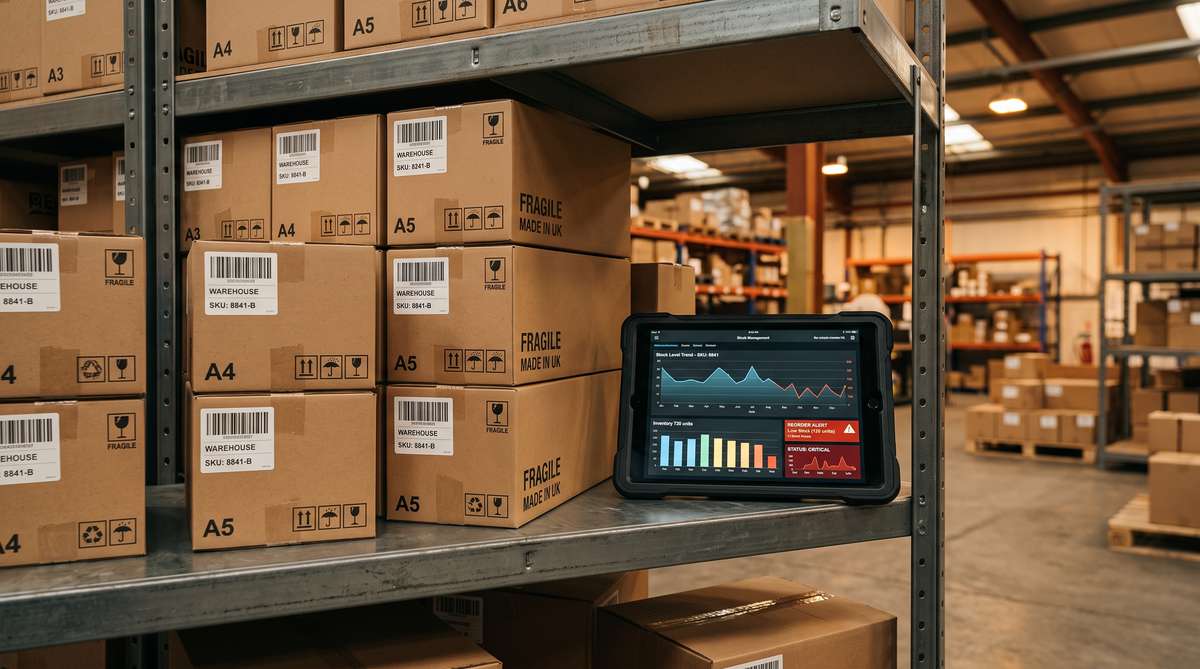
Inventory management is watchstanding. You monitor levels, set thresholds, and respond before the casualty happens. Most owner-operators run the watch manually, checking a spreadsheet when they remember to.
AI does not replace the watchstander. It automates the watch itself, so the alert fires before the shelf goes empty instead of after.
AI Reorder Logic: Velocity, Seasonality, Lead Time
Strip away the vendor marketing and the reorder math is one formula: reorder point equals lead time demand plus safety stock. Lead time demand is your daily sales velocity multiplied by how many days your supplier takes to ship. Safety stock is your buffer against a slow supplier or a demand spike, typically 20 to 50 percent of lead time demand for steady SKUs, more for seasonal ones.
Here is the formula worked with real numbers. A SKU sells 4 units a day. Your supplier takes 10 days to ship. Lead time demand is 40 units.
Add 15 units of safety stock and your reorder point is 55 units. When on-hand inventory hits 55, the system fires an alert or drafts a purchase order. No spreadsheet required, no gut feel involved.
Velocity is the base signal, but it is not the only one. This is Invoke Data's DNA framework in practice: your customers leave signals behind every time they buy, and purchase velocity is one of the loudest. A 30-day sales spike from a single promotion is not the same signal as a genuine trend, and a naive forecast that treats them the same will overbuy every time. Seasonality adjustment means feeding the system 6 to 12 months of history, ideally a full seasonal cycle, so the model can tell a July spike from a holiday spike.
Lead time is the variable operators underweight most. A supplier who ships in 10 days on a good month and 25 days during a supply chain hiccup needs a wider safety buffer than your spreadsheet formula assumes. Track actual lead time per vendor, not the number on the purchase agreement, and update your reorder point when it drifts.
Tool Options: Inventory Planner, Stocky, or Build It Yourself
Inventory Planner by Sage is the deepest tool in this category. It forecasts demand at the SKU and variant level, factors in seasonality and per-vendor lead times, and generates purchase order recommendations with open-to-buy budgeting. The Essentials tier for single-warehouse Shopify sellers runs $119.99 a month. Above that, pricing is a custom quote scaled to your gross merchandise volume, and a $15M GMV brand with 2,000 SKUs typically lands at $3,600 to $7,200 a year.
The vendor cites 92 percent forecast accuracy for brands with six months of clean data. Treat that figure as vendor-adjacent, not audited, because it has not been independently confirmed. For a store doing $500,000 to $1M in revenue, Standard-tier pricing can outrun the value it delivers. Know your SKU count and GMV before you take a sales call, or you will not recognize a bad quote when it lands.
Stocky, Shopify's own inventory app bundled with POS Pro, is being discontinued as of August 31, 2026. If you are evaluating it today, stop. Shopify is moving reorder logic into its native admin, including automated low-stock alerts through Shopify Flow, and third-party apps that integrated with Stocky's API will need to migrate. Build on the native Shopify inventory system or a current third-party app, not a product on its way out.
A custom build on Claude plus the Shopify GraphQL Admin API is the option most owner-operators skip past, and it should not be skipped. The Shopify API exposes orders, inventory levels, and inventory items directly. A script pulls 90 days of order history, calculates daily sales velocity per SKU, applies your lead time and safety stock inputs, and outputs an order-by date and reorder quantity.
That is a weekend project for a competent developer, or a few hours with Claude Code, and it costs nothing in recurring subscription fees. The trade-off is maintenance. You own the code, and you own the fixes when Shopify changes its API version.
Lighter AI-native tools built specifically for merchants under enterprise scale have entered this gap too, running $20 to $30 a month flat, no GMV tiers. They will not match Inventory Planner's depth, but for a single-warehouse store under 2M in revenue, depth is not the constraint. Consistency is.
Implementation: Four Steps
- Pull 6 to 12 months of clean sales history. Strip out discontinued SKUs, one-off clearance sales, and anything a promotion distorted. Garbage in, garbage forecast out.
- Set lead time and safety stock per vendor, not per store. A domestic supplier and an overseas manufacturer do not get the same buffer. Default to 14 days lead time and 7 days safety stock if you have no better data, then correct it after one order cycle.
- Run the system in shadow mode for two to four weeks. Let it generate recommendations. Do not let it place orders yet. Compare its reorder-by dates against what actually happened.
- Turn on automated alerts, not automated purchasing. A prioritized queue that flags SKUs approaching their reorder point beats a black box that orders on your behalf. Approve high-value and new-product orders by hand until the system has proven itself across several cycles.
Cost-Benefit Math
Run the numbers on a $1M revenue store. At the industry-average 8 percent out-of-stock rate, direct lost sales run roughly 4 percent of revenue, or $40,000 a year. Add churn from customers who do not return after hitting "sold out," and total exposure lands closer to $48,000 to $50,000.
A lightweight AI reorder tool at $25 a month costs $300 a year. Inventory Planner's Essentials tier costs $1,440 a year. Even a custom Claude build with a few hours of developer time, amortized over a year, runs under $2,000. Set against $48,000 in exposure, every option on this list pays for itself inside the first month it prevents even one meaningful stockout.
This is not a tool decision. It is a payback-period decision, and the payback period is measured in weeks.
Sources and Further Reading
- The hidden cost of stockouts: A data-driven analysis
- 29 Inventory Stock-out Rate Statistics for eCommerce Stores
- Migrating from Stocky to Shopify inventory management
Frequently Asked Questions
How much revenue do stockouts actually cost a small ecom store? Independent research places the number between 4 and 8 percent of annual revenue in direct lost sales, with an 8fig study of 524 Shopify and Amazon products finding a 5.2 percent revenue lift when stockouts were removed. For a $1M store, that is $40,000 to $80,000 a year before customer churn.
What is the simplest formula for setting a reorder point? Reorder point equals lead time demand plus safety stock. Lead time demand is your daily sales velocity multiplied by supplier lead time in days. Safety stock is a buffer, typically 20 to 50 percent of lead time demand, larger for seasonal or promotion-heavy SKUs.
Should I use Stocky for Shopify inventory alerts? No. Shopify is retiring Stocky on August 31, 2026. Build your reorder workflow on Shopify's native inventory management and Shopify Flow, or a current third-party app, so you are not migrating off a discontinued tool inside a year.
Is a custom Claude and Shopify API build worth it over a paid tool? It is worth it if you have technical capacity and want zero recurring subscription cost. The Shopify GraphQL Admin API exposes the order and inventory data you need to calculate velocity, lead time demand, and reorder points directly. If you lack that capacity in-house, a $20 to $300 monthly tool is the faster, lower-risk path.
Doctrine Connection: Due Diligence Is Non-Negotiable
Every vendor in this category cites an accuracy number. Inventory Planner says 92 percent. Every AI forecasting startup says something similarly clean. Ask where the number comes from before you build a purchasing decision on top of it.
If it is vendor-marketing copy and not an audited study, treat it as a claim, not a fact, and verify it against your own first 90 days of data.
The same discipline applies to the tool itself. Stocky looked like a safe default for years, right up until Shopify announced its retirement. Read the migration notices, check the API changelog, and confirm a vendor's roadmap before you wire your reorder logic to it.
Due diligence is not paperwork. It is the difference between an alert that fires on time and a purchasing process that breaks the week you needed it most.
Jeff Barnes has no personal position in any company, tool, or platform named in this article. DEMG has no current commercial relationship with any party mentioned. DEMG provides marketing strategy and AI operations guidance, not investment advice. Results described are illustrative and not guaranteed.