
The Stress Test Most Agencies Are Not Running
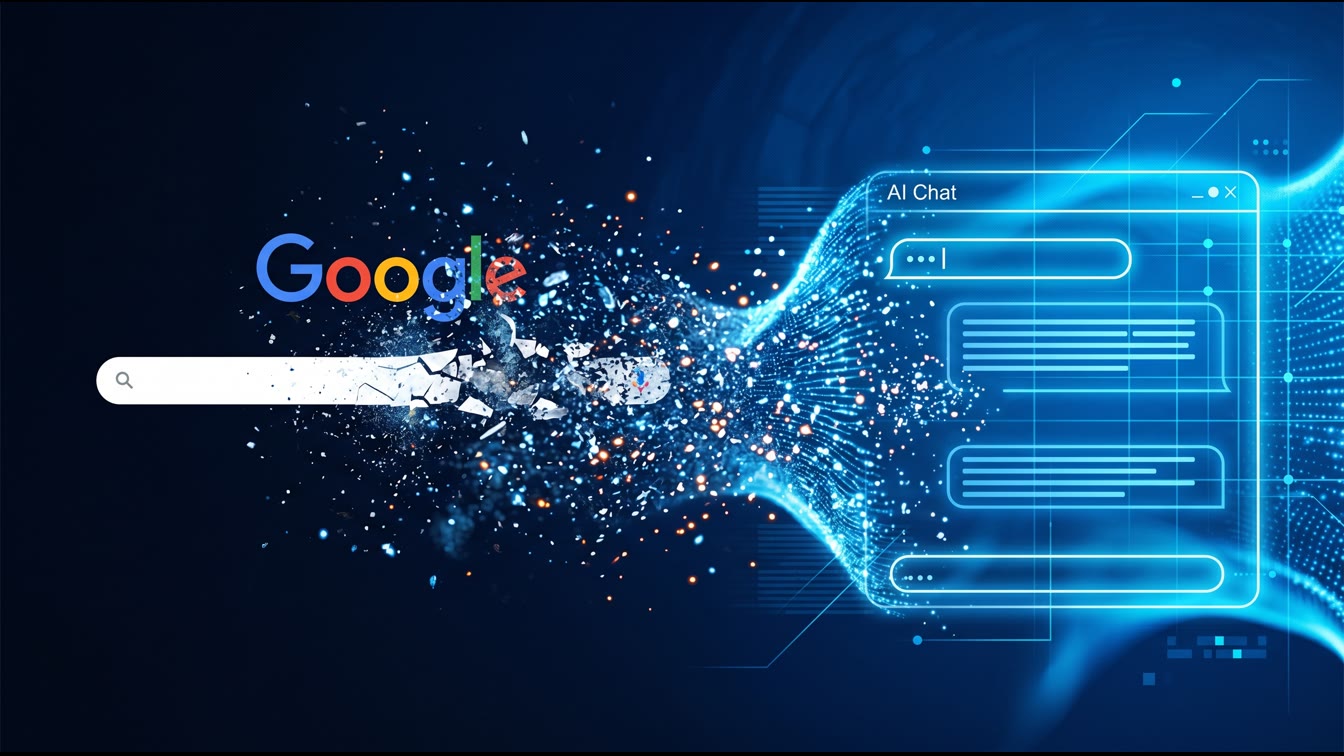
Gartner published the prediction in February 2024: traditional search engine volume will drop 25% by 2026 as AI chatbots become substitute answer engines. The prediction is specific, the source is credible, and the timeline is now.
For agencies built on organic search as an Awareness-stage traffic driver, 25% volume decline is not an incremental headwind. It is a structural disruption to the growth model.
The ATLAS Model is the five-stage growth system I've seen work for agencies: Awareness, Traffic, Leads, Appointments, Sales. Every stage feeds the next. If Awareness-stage traffic drops 25%, the disruption propagates through every downstream stage. Traffic drops. Leads drop. Appointments drop. Sales slow.
The stress test asks one question: does your agency's growth system survive this disruption? The answer depends on how exposed your Awareness stage is to the specific channel — organic search — that is losing volume to AI answers.
Sources: Gartner: Search Engine Volume Drop 25% | SEO Decline GEO Rise | GEO Statistics 2026
How to Run the Stress Test
Pull these numbers from your analytics and CRM. If you don't have them, the audit itself reveals a problem.
Step 1: What percentage of your agency's new business pipeline originates from organic search?
This is your Awareness-stage exposure. A pipeline where 60% of new conversations start with a prospect who found you via organic search is highly exposed. A pipeline where 20% starts from organic search and 80% comes from referrals, partnerships, and direct outreach is well-distributed.
The benchmark: agencies in the 2026 study cohort with more than 40% of new pipeline from organic search are highly vulnerable to the Gartner scenario. Those with less than 20% are resilient.
Step 2: What is your organic search traffic trend over the last 6 months?
Pull Google Search Console or your analytics platform. Is organic traffic up, flat, or declining? If it's already declining, the Gartner scenario is not a future risk. It's a present condition.
A 5% month-over-month decline in organic traffic is a signal. If you haven't noticed or responded, the stress test reveals an operational gap.
Step 3: What does your AI citation presence look like?
Search for your agency's name and your service category in ChatGPT, Perplexity, and Google AI Mode. Does your agency appear? Do competitors appear?
If competitors appear and you don't, the 25% traffic loss is already asymmetric. Your competitors are capturing the AI referral traffic that would otherwise come to your organic results.
Step 4: What happens to your pipeline if Awareness-stage organic traffic drops 25% tomorrow?
Model it explicitly. If you currently generate 40 new inquiries per month and 24 of them (60%) come from organic search, a 25% drop in organic traffic removes 6 inquiries. That's 15% of your pipeline. At your average close rate and deal size, what does that cost you annualized?
This number is the risk quantification. It should motivate action proportional to the exposure.
Where the Most Vulnerable Agencies Are
The agencies most at risk from AI search disruption share three characteristics.
Single-channel Awareness dependence. All or most of their inbound pipeline comes from one source: organic search, a single podcast, one referral partner. When that channel shifts, the entire pipeline shifts.
Topic-based content over entity-based authority. Agencies that built organic traffic through volume content — high-volume topics with competitive keywords — are more vulnerable than those that built authority around their specific methodology, named frameworks, and documented results. AI systems cite entities and authoritative sources. Volume content without entity signals doesn't get cited.
No GEO investment. The agencies that haven't started building AI citation presence are starting from zero in a race where first-movers are compounding. GEO build time is 6 to 12 months to meaningful citation presence. The agencies that started in 2025 are ahead. The ones starting today are 12 months behind.
The counterpoint: legacy domain authority still matters. A site with 10 years of quality content and 4,000 referring domains has stronger AI citation fundamentals than a new competitor. The advantage is eroding, not gone. But it is eroding faster than most legacy agencies realize.
The Resilient Agency Model
Agencies that survive a 25% organic search decline have done three things.
Diversified the Awareness stage. The resilient agency generates inbound from at least four channels: organic search, AI citations (GEO), direct outreach, and community or referral. When one channel drops 25%, three others absorb the volume. No channel represents more than 35% of new pipeline.
Built AI citation presence before the disruption. The agencies with strong GEO infrastructure are not just surviving the search decline — they are capturing traffic that previously went to competitors with traditional organic positions. The overlap between Google's top-10 organic results and AI citations has dropped from 75% to 17-38% in early 2026. An agency that ranks #3 in organic search does not automatically appear in AI answers. And an agency that doesn't appear in organic search can appear in AI answers if its content is structured for GEO.
Transitioned to authority content. Authority content beats volume content in the AI search era. One piece of content — a proprietary research study, a named methodology framework, a comprehensive original analysis — outperforms 50 generic blog posts in AI citation frequency. The research finding: original statistics see a 42% higher citation rate in AI Overviews compared to generic guides.
The ATLAS Adaptation
Here is how each stage of the ATLAS model adapts to the AI search shift.
Awareness: Add AI citation as a channel alongside organic search. Implement GEO infrastructure: schema markup, authority content, platform presence. Reduce dependence on any single channel below 35% of new pipeline.
Traffic: Measure AI referral traffic as a separate channel in analytics. UTM tag your AI citation pages. Monitor conversion rates from AI-driven traffic versus organic. AI traffic converts at 14x to 16x the rate of organic search.
Leads: The quality of leads from AI citations is higher. Buyers who found you through an AI recommendation have already validated your authority — the AI cited you, which signals credibility. Qualification criteria for AI-sourced leads may be lighter than for cold organic traffic.
Appointments: Same process, but adjust your intake questions to understand how the prospect found you. "How did you hear about us?" with an AI-specific option gives you channel attribution data over time.
Sales: The close rate on AI-sourced leads should exceed organic search leads over time. Track it separately. If it doesn't, your GEO content isn't signaling the right buyer profile.
The system adapts. The structure stays intact.
Thirty-Day Action Plan
If the stress test reveals significant exposure, here is the 30-day response.
Days 1-7: Measure the exposure. Pull the four stress test metrics. Quantify the revenue at risk. Share the number with your leadership team. Risk quantification creates action. Abstract concern does not.
Days 8-14: Claim AI citation presence. Search for your firm in ChatGPT, Perplexity, and Google AI Mode. Document what you find. Identify three to five competitors who appear when you don't. Analyze what those competitors have that you lack: review volume, content structure, schema markup, platform presence. This is your gap analysis.
Days 15-21: Install schema markup. If your site doesn't have LocalBusiness, Service, and FAQPage schema, implement it. This is a 4-hour technical project for a developer. The ROI: 67% improvement in LLM discoverability.
Days 22-30: Publish your first authority content piece. One piece of research-backed content targeting a question AI systems are asked about your service category. Minimum 1,500 words. Direct answer in the first 200 words. Statistics and specific data throughout. Author credentialing on the page.
This doesn't solve the GEO problem in 30 days. It starts the compound curve.
FAQ
Q: Our agency is still growing despite the search shift. Do we still need to stress test?
Growing now doesn't mean resilient later. The 25% search volume drop is a directional trend with a timeline. Agencies growing today on organic search are growing on a declining asset. The question is: how much runway does the current model have, and when do you need the adaptation to be in place? Stress-test now, while growth gives you the margin to adapt without urgency.
Q: We run a B2B agency. Does the Gartner prediction apply to B2B search?
G2's 2026 report shows 51% of software-category buyers start research with an AI chatbot more often than Google. B2B is not immune. B2B search behavior is shifting at least as fast as consumer, because B2B buyers are also individuals who use ChatGPT in their daily lives and have learned to query it for work decisions.
Q: What if we're wrong and AI search doesn't actually disrupt organic as much as predicted?
The downside of building GEO infrastructure when the prediction turns out conservative is: you have additional authority content, better schema markup, and stronger platform presence. These assets improve traditional SEO simultaneously. The downside of not building GEO infrastructure when the prediction turns out accurate is: you lose 15% of your pipeline, permanently, to competitors who built the infrastructure while you waited.
The Doctrine
Legacy matters more than lifestyle.
The agency that builds in protection for the next channel shift — while current performance is strong — builds a legacy business. The agency that optimizes current performance without acknowledging the structural shift is building a lifestyle business that depends on conditions remaining unchanged.
Conditions change. The ATLAS stress test is how you know whether your growth system survives the change.