
The Problem: Tool Sprawl Is a Tax on Owners
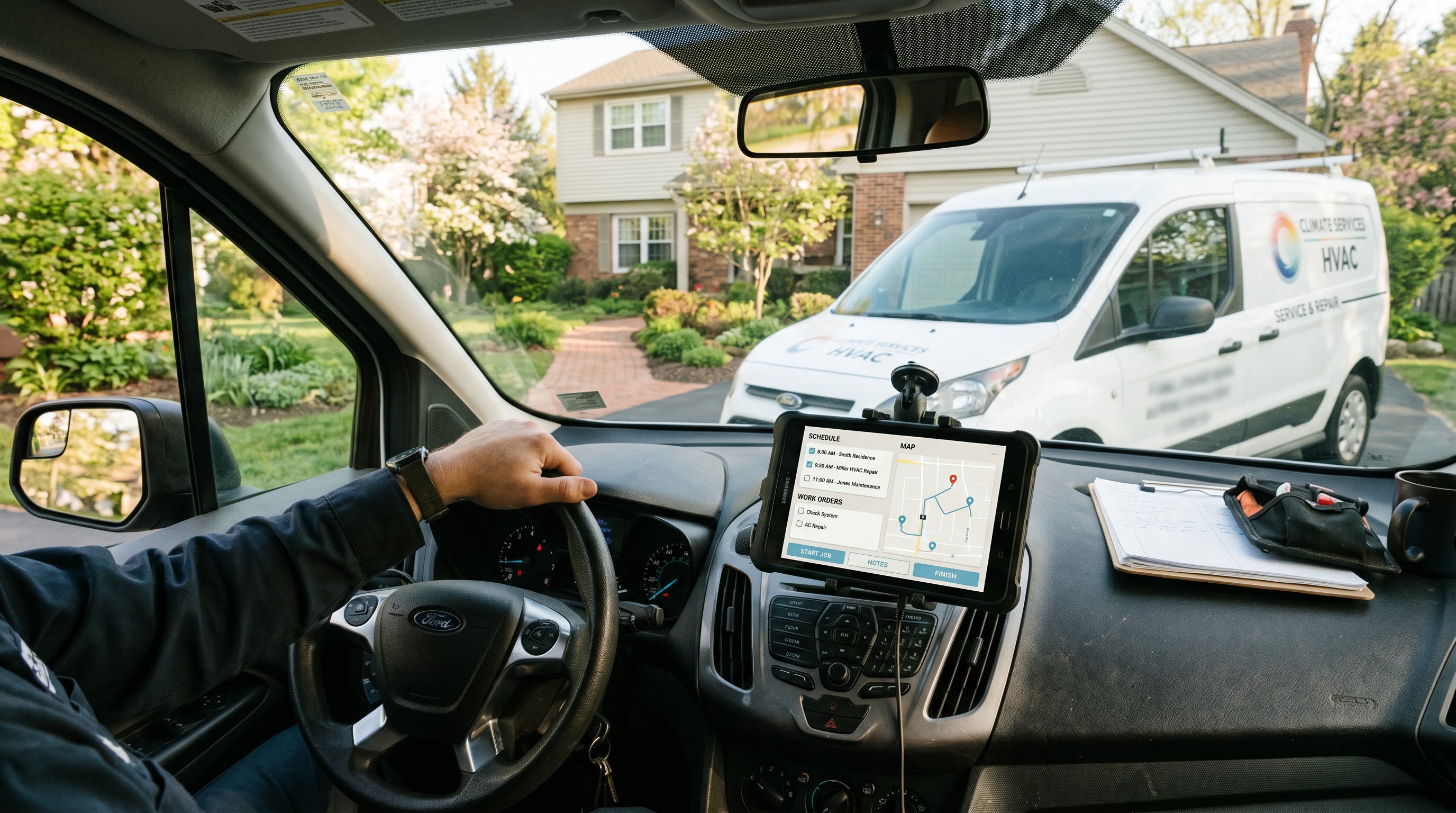
A composite anonymized HVAC services company doing $1.8M in annual revenue came to us with a quiet killer on their balance sheet: $4,200/month in SaaS charges across 11 disconnected platforms. CRM here, scheduling there, invoicing over there, email marketing in another silo, chat tool, social scheduler, analytics dashboard, project management system. The math looked like this—at $7,900 per employee per year (SBE Council/Zylo benchmark for 2026), this owner was paying three times the market average. And that was before the 5x inflation SaaS vendors are hitting the market with year over year.
Here's what nobody talks about: the real cost isn't the monthly fees. It's the manual re-entry. It's the data silos. It's that nobody owns the system.
The ATLAS Audit: Finding the Bottleneck
We walked through the ATLAS framework with their team. Audience, Traffic, Leads, Automation, Scale. The diagnosis came fast.
Audience: Clear. Residential HVAC customers in a 10-mile radius.
Traffic: Decent organic presence, minimal paid spend.
Leads: 40-50 inbound per month. But here's the leak, lead data lived in three different tools. No single source of truth. Sales team manually copied information between systems. Every. Single. Day.
Automation: This is where the sprawl hit hardest. They had email automation (one tool), scheduling automation (another tool), invoicing reminders (third tool). None of them talked to each other. A new lead would enter their CRM. Someone would manually key it into the scheduler. Someone else would trigger the email. By the time the job was scheduled and invoiced, the data had been re-entered four times.
Scale: Impossible with 11 tools. Adding an employee meant more manual processes, more data entry, more mistakes.
The owner's response: "We're not missing features. We're missing a system."
The Consolidation Move
They consolidated to four tools. Not three, not five, four, based on what actually worked.
- GoHighLevel (GHL). Replaced six tools. CRM, email marketing, scheduling, chat, funnel builder, SMS. One platform. One database. One source of truth for every customer interaction.
- AI-powered scheduling layer. For the admin overhead of appointment setting and reschedules. The math: 3 hours per week saved at $35/hour loaded cost = $5,460/year.
- Single analytics dashboard. To track the metrics that matter: lead source, conversion rate, job cost, margin by job type.
- Project management tool. Lightweight, for job tracking and team communication during jobs. Integrated with GHL so the customer timeline synced automatically.
That was it. Everything else got cut.
The Numbers
| Metric | Before | After | Delta | | --- | --- | --- | --- | | Monthly SaaS spend | $4,200 | $2,770 | -$1,430 | | Annual SaaS spend | $50,400 | $33,240 | -$17,160 | | Manual data re-entry (hours/week) | 8 | 1.5 | -6.5 | | Lead-to-invoice cycle time (days) | 4–6 | 1–2 | 50% faster | | Operating margin before consolidation | 18% | 36% | +18 points |
That $17,160 wasn't reinvested in more tools. It went to margin. Owner took it home.
The Hartford Steam Boiler Lesson
I spent time as an innovation scout inside Hartford Steam Boiler. 55,000 people, century-old organization. The #1 waste I found wasn't poor strategy or bad hiring. It was paying for systems nobody owned. Duplicate databases. Tools running parallel that did the same job. Licenses for people who'd left the company two years prior.
The ownership problem scaled. With 11 tools, nobody owned the system. Everyone touched it. Nobody was accountable for its output. The CRM owner didn't talk to the scheduling owner. The email person didn't know what the chat tool was doing.
Consolidation fixes that. One platform, one owner, in this case, the office manager and the owner checked it every week. Data accuracy went up. Accountability showed up. Margins followed.
The Risk: Vendor Concentration
There's a real caveat here. Consolidating six tools into one platform (GHL) creates single-vendor dependency. If GHL goes down, your whole operation feels it. If they change their pricing, you're exposed.
This company mitigated that three ways:
- Built the analytics dashboard as an independent layer. If they ever need to exit GHL, the reporting and metrics structure stays.
- Documented their entire workflow in the manual, processes that live in the system but aren't dependent on the system.
- Stayed disciplined about adding new tools. Before any new platform came in, the question was simple: does this replace something, or does it add complexity?
The Action: Your 90-Day Audit
Here's what to do this week.
List every SaaS tool your business pays for. Don't think about it, just list them. Include the $2/month things nobody remembers. Add up the monthly bill.
Then map data flow. Where does a customer record live? How many places does it get re-entered? How many of your people spend time copying information between systems?
That's your audit. The math will tell you whether consolidation makes sense for your business. For most service businesses doing $500K to $5M in revenue, you're carrying at least 2-3 redundant tools. That's $400-700 per month you're leaving on the table.
The ATLAS framework helps identify which bottleneck is killing you. But the solution is always the same: fewer tools, clearer ownership, better data.
Ownership beats wages.
FAQ
Q: Isn't consolidation risky? What if the platform goes down?
Yes, but fragmentation is also risky, you lose data in transit between systems. Mitigation: document your workflows independent of the platform, keep an analytics layer separate, and pick vendors with uptime track records. GHL, for instance, has 99.9% uptime. That's actually better than most in-house systems.
Q: How long does consolidation take?
Implementation usually takes 2-4 weeks for a $1-3M service business. The first week is messy. By week three, the team's adapted. By week four, you're seeing time savings. The hard part is changing behavior, people reverting to old habits.
Q: What if we need a tool that doesn't integrate with GHL?
Build a data bridge. Use Zapier or native APIs to move critical data to your consolidated platform. Don't let a tool sit in isolation. If it can't talk to your system, it adds friction.
Q: How do we know which tools to cut?
Usage. Pull your credit card statements for the last 12 months. Then ask your team: which tools do you actually use every day? Most companies find 3-4 tools they'd miss and 7-8 they wouldn't. Start there.
Q: What about the learning curve with a new platform?
GHL has a steep learning curve upfront, but it's a week of training for most teams. The payoff is speed: after day five, you're faster than you were with the old system.
The Doctrine Connection
Consolidation isn't about cutting cost. It's about creating clear ownership. When one person owns the system, accountability shows up. Data improves. Margins follow. Wages are a line item. Ownership is an asset on your balance sheet.
*Disclosure: Jeff Barnes, MBA has no personal position in any company, fund, or platform named in this article. demg.ai has no current commercial relationship with any party mentioned. demg.ai provides marketing education and consulting services, not investment advice. Past performance does not guarantee future results.*