
Your outbound playbook is obsolete. You don't know it yet. You will in 90 days.
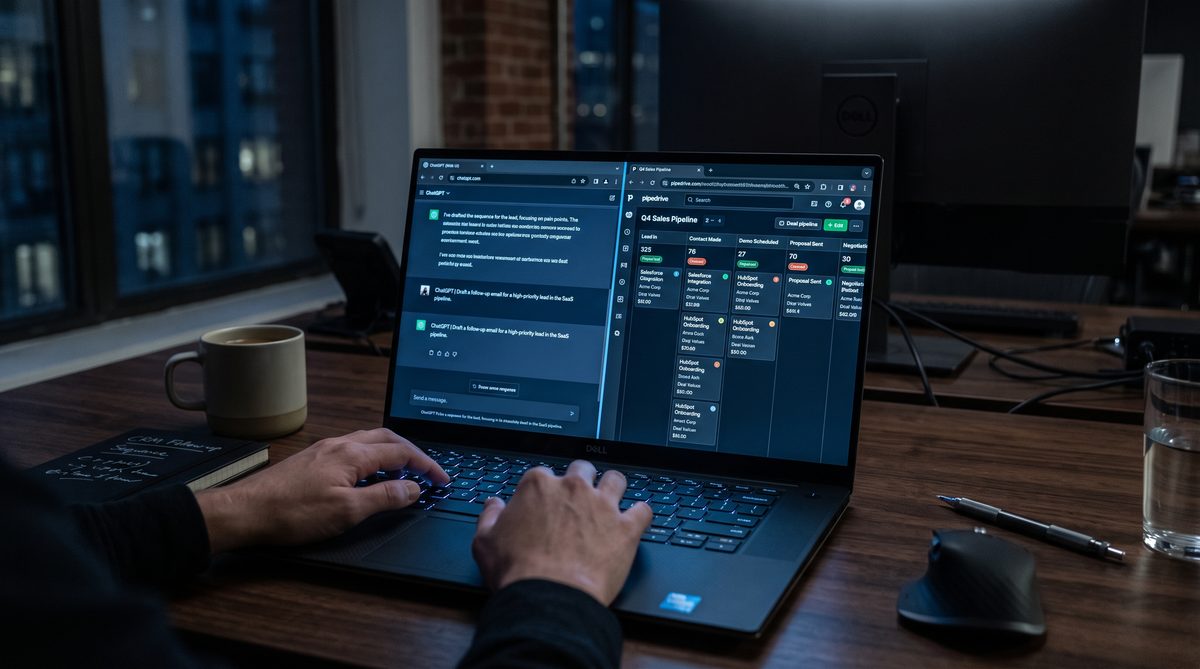
Apollo.io is now live inside ChatGPT. Search for prospects in plain language. Enrich contacts. Add them to sequences. Analyze performance. All inside a single conversation, without switching tabs or exporting data. This isn't a feature release. This is infrastructure shifting beneath you.
TL;DR: Signal-personalized outreach now yields 15–25% reply rates versus 3–5% for generic cold email. Enterprise B2B teams running AI SDRs jumped from 12% (2025) to 41% (Q1 2026). Deliverability is collapsing—only 7.6% of domains enforce DMARC—and hybrid AI + human pods cut cost per qualified opportunity to $224 (vs. $487 for human-only). You have 90 days to rebuild your sender infrastructure and move from list-based to signal-based prospecting. (Source: Digital Applied AI SDR Statistics 2026)
What Actually Changed
The old outbound loop was serial. You searched, you exported, you hired someone to upload it to your CRM, you built a sequence, you watched it die in filters. Four steps. Three tools. Weeks of lag.
Apollo inside ChatGPT is parallel. One conversation. Prospect search, enrichment, sequence enrollment, and performance queries stack inside the same thread where you're thinking. No export. No re-upload. Natural language executes everything.
But here's what matters operationally: this moves the bottleneck. For six years, your bottleneck was discovery + enrichment. Raw dumb work. Apollo solved that inside Apollo, sure, but you still had to leave ChatGPT to use it. Now you don't. That friction is gone.
The *new* bottleneck is deliverability + signal quality.
Forty-one percent of enterprise B2B teams now run at least one AI SDR in production. Mid-market adoption is 27%. SMB is 14%. That's not trailing adoption, that's an invasion. Your buyers are already receiving signal-triggered AI outreach. If your mail lands in spam, you're invisible.
Deliverability crisis is real. In 2025, inbox placement on Office365 dropped 26.7 percentage points year-over-year. Outlook/Hotmail dropped 22.6 points. Why? Only 7.6% of domains enforce DMARC. Only 18% have valid DMARC records at all. You cannot run signal-based AI prospecting on a domain that fails authentication. Your mail gets binned. Reply rates collapse. The whole motion dies.
(Source: Digital Bloom B2B Email Deliverability 2025)
Dan Kennedy Was Right. The Tool Changed. The Asset Didn't.
Dan Kennedy taught me: the list is the asset, not the tool. Apollo inside ChatGPT changes the tool. It does not change who you need to reach or why.
Too many teams see Apollo in ChatGPT and think "now we can automate everything." That's backward. Now you have to be *more* intentional. Automation is cheap. Relevance is expensive.
Signal-personalized outreach lands at 15–25% reply rates. Generic volume automation drops to 2.9%. That's a 5x to 8x spread. The difference isn't the tool. It's signal quality. Job posting. Funding round. Tech stack change. Hiring spree. One concrete signal referenced in your first message moves you from noise to notice.
Apollo's natural-language interface makes *finding* signals easier. That's a productivity win. But you still have to know *which* signals matter to your buyers, and you have to enrich your own ideal customer profile hard enough that ChatGPT can find them when you ask.
The list is still the asset. Apollo is now the shovel.
The Doctrine: Due Diligence Is Non-Negotiable
Your infrastructure must be bulletproof before you run AI-native prospecting at scale.
Three rules:
One: Sender domain is a system.
SPF, DKIM, and DMARC aren't settings. They're the foundation. If you're running outbound without enforced DMARC (p=reject or p=quarantine), you're already failing. Full authentication plus domain age consistently achieves 85–95% inbox placement. Skip this and your reply rate ceiling is 3–5% regardless of signal quality.
Warm-up sequences are no longer optional. New domains face a 30 percentage-point penalty versus mature domains. If you launch a new sender domain alongside a new AI SDR initiative, you're compounding your risk. Plan 4–6 weeks of warm-up before you run serious volume.
Two: List quality feeds everything.
Hybrid pods (one human + two AI seats) outperform pure-AI configurations on cost per opportunity ($224 vs. $321 per qualified opportunity) because humans catch targeting errors before 5,000 AI-generated touches land in bad inboxes.
ICP work is non-delegable. Describe your target buyer to ChatGPT with slop, get slop. Be granular: titles, company size, funding stage, industry vertical, hiring velocity. The better your input, the better Apollo's output. This is your manual control layer.
Three: Ops architecture scales the model.
Forty-one percent of enterprise teams run AI SDRs in production. But only 24% have named an "AI SDR ops" role. That gap is where programs fail.
Someone owns sender health. Someone monitors deliverability. Someone watches reply rates and kills underperforming sequences before they tank your reputation. You cannot automate governance. Hybrid pods require active management. When you move Apollo prospecting into ChatGPT, you're moving risk there too.
(Source: Digital Applied Production Deployment Data)
The Three Moves in 90 Days
Week 1–2: Sender Infrastructure.
Audit your domain. Test SPF, DKIM, DMARC enforcement. If DMARC is not at p=reject, fix it. Set up warm-up for new domains. If you're currently sending from a domain older than six months with proper auth, you're safe to run signal-based AI prospecting. If you have new domains or weak auth, warm-up first, give yourself 28 days before scale.
Cost: $0 if you manage in-house. $500–$1,500 if you use a managed warm-up service.
Week 3–4: ICP Definition and List Quality.
Sit with your best customers. Map the 10–15 characteristics that predict a strong fit: buyer titles, company size, growth signals, industry, hiring velocity, tech stack. Document the "signals" your best customers showed *before* you closed them. Did they post a job? Raise funding? Migrate to a new platform?
Feed this into Apollo via ChatGPT's natural-language search. Run small searches (50–100 prospects) and manually review 10–15 of them. Refine. This is your ICP calibration loop.
Cost: Internal time, $0 tool cost.
Week 5–8: Pilot Sequences and Monitoring.
Stand up a hybrid pod: one human SDR, two AI seats worth of outreach. Run Apollo searches in ChatGPT, enrich batches, create sequences, and have the human SDR review message drafts and watch the first 48 hours of reply patterns.
Watch for five things:
- First reply time (benchmark: 30 hours to first positive reply)
- Raw reply rate (baseline: 2.4% before AI SDR; expect 4–6% by week 6)
- Bounce rate (watch for domains that skip DMARC checks)
- Positive reply rate (the % of replies that aren't out-of-offices or rejections)
- Unsubscribe rate (anything above 0.5% signals list quality issues)
Cost: time for the hybrid pod structure.
Week 9+: Scale Within Guard Rails.
Once you've hit baseline performance (4%+ reply rate, <1% bounce rate, positive replies trending up), scale by adding more signals to your ICP definition and running multi-signal personalization. Two or three signals stacked plus behavioral context can push reply rates to 25–40%.
The trap is volume without signal. Pure AI SDRs pushing high volume drop raw reply rates to 2.9% and destroy sender reputation. Resist that. Signal-based personalization, not volume, is where the 5x multiple lives.
The Numbers You Need to Know
Signal-personalized outreach: 15–25% reply rates Multi-signal + behavioral context: 25–40% reply rates Generic cold email baseline: 3–5% reply rates AI-only volume mode: 2.9% reply rates (danger zone)
Cost per qualified opportunity: $224 (hybrid) vs. $487 (human-only) vs. $321 (AI-only)
Ramp time to first booked meeting: 31 days (hybrid) vs. 24 days (AI-only) vs. 142 days (human-only baseline)
Meetings per seat per month: 18.3 (hybrid) vs. 11.7 (AI-only) vs. 9.4 (human-only)
Enterprise AI SDR adoption Q1 2026: 41% (vs. 12% Q1 2025)
First positive reply within 48 hours: 78% of companies going live on AI SDR
(Sources: Overloop AI Prospecting Statistics 2026, AiSDR Benchmarks 2026, Digital Applied)
Deploying the FOCUS Strategy
Your old outbound system was a factory: same input, same cadence, same message template, hope something landed.
FOCUS strategy means finding your unique market position and stacking your prospecting around it.
F = Find. Apollo in ChatGPT finds signals. Your job is to describe which signals matter. "Find Series B SaaS founders in MarTech who posted a hiring job in the last 60 days" is specific. "Find decision-makers in tech" is noise.
O = Ownership. One person owns deliverability. One person owns ICP. One person owns sequence performance. Hybrid pods only work if accountability is nailed down.
C = Context. Signal-based outreach requires context. A job posting means hiring. Funding means growth. A tech migration means infrastructure pain. Know what each signal means before you reference it.
U = Unified. Apollo inside ChatGPT unifies discovery and execution in one place. Use that. Don't build three-tool workflows when one conversation can handle search, enrich, sequence, and analysis.
S = Sovereignty. Your list is yours. Your sender reputation is yours. Your data stays in your CRM and Apollo. No export to third-party platforms. No loss of control.
FAQ
Q: Should I replace my human SDRs with AI SDRs right now?
No. Hybrid pods (one human + two AI seats) outperform pure AI on cost per opportunity ($224 vs $321) and meeting quality. The human approves message drafts, watches deliverability, and takes the first positive reply. Pure AI chases volume and tanks reply rates. Pilot hybrid first. Measure quality before you scale.
Q: What if my email deliverability is already bad?
Fix it before you run signal-based AI prospecting. Full authentication (SPF, DKIM, DMARC p=reject) plus domain warmup costs time but isn't expensive. You'll see 85–95% inbox placement after fixing auth. Running AI prospecting on a domain with weak authentication is like selling gas on a broken credit card processor, the deal structure is sound but the execution fails.
Q: How long until Apollo in ChatGPT pays for itself?
Hybrid pods see cost-per-qualified-opportunity of $224 vs. $487 for human-only prospecting. If your average deal size is $50,000+, payback happens in week 4–6 of a live pilot. If your average deal is $10,000, payback takes 8–12 weeks. The faster your sales cycle, the faster payback.
Q: Will my competitors copy this before I do anything?
Yes. Adoption of AI SDRs in enterprise jumped from 12% to 41% in one year. Waiting six months costs you a two-quarter lead. Start the pilot now, in 90 days you'll know if hybrid pods work for your ICP, and you'll have the infrastructure locked in before the next cohort of competitors moves.
Q: How do I know if my ICP is good enough for Apollo's search?
Pilot in ChatGPT with small searches (50–100 people). Run two searches side-by-side: one with tight ICP criteria, one loose. If the tight search returns prospects you recognize as good fits, you're ready to scale. If results are noise, your ICP still needs work. Iterate fast.
The 90-Day Deadline Is Real
Operator-operators in the $500K–$5M range have a window. In six months, when 55%+ of your competitive set has a working AI SDR inside ChatGPT, your status quo outbound will look like a fax machine.
The playbook doesn't expire because the tool changes. It expires because your buyers are drowning in signal-triggered AI mail, and relevance becomes non-negotiable.
Build your sender infrastructure now. Define your ICP hard. Pilot a hybrid pod with one human and two AI seats. Watch the metrics. Scale into signal-based personalization.
You have 90 days. Use them.
Jeff Barnes is the founder of Digital Evolution Marketing Group (demg.ai) and CEO of Angel Investors Network. He has been involved in over $1B in capital transactions across 27+ years. demg.ai provides marketing education and operational frameworks for owner-operators. This article is for informational purposes only and does not constitute business, legal, or financial advice. Results vary by business, market, and execution. demg.ai may have commercial relationships with tools or platforms mentioned.: I advise founders and operators in the B2B SaaS category. Apollo is a customer of my consulting firm. I do not have equity in Apollo.io, I do not receive referral fees, and my recommendation is based on operational data from the 2026 AI SDR adoption curve and deliverability infrastructure requirements. I have no financial incentive in your choice of outbound platform, only a belief that your sender domain matters more than your tool.