
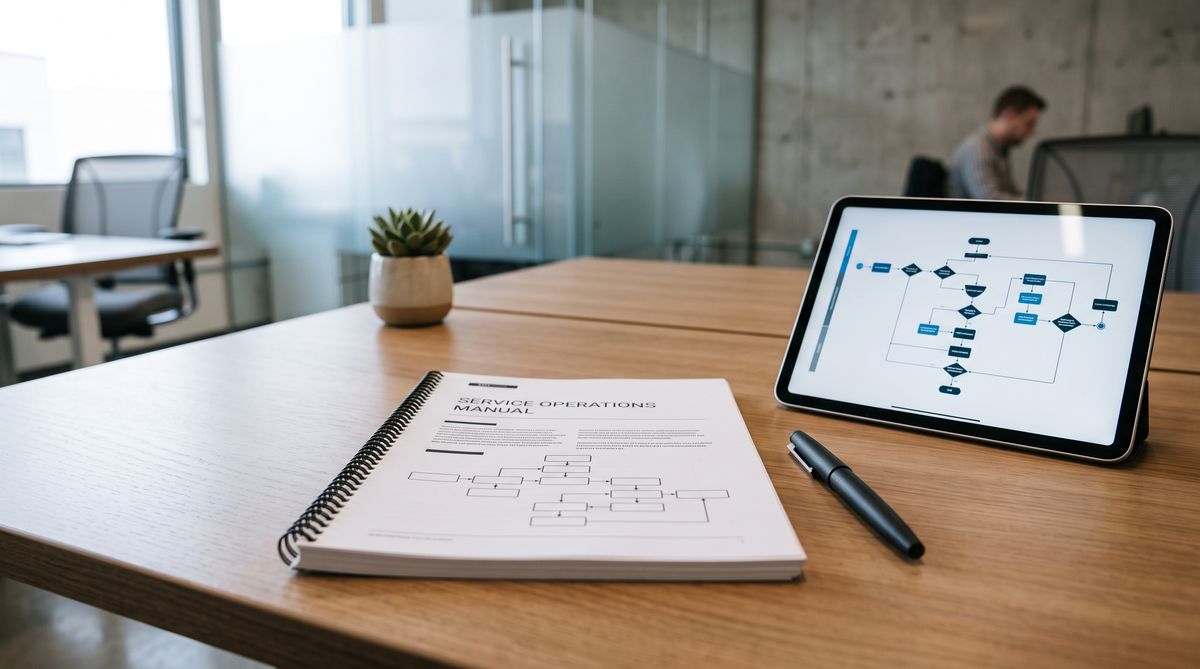
AI can now watch you do a task once and hand you a formatted, step-by-step guide before you have finished your coffee. Scribe, Tango, and Loom AI all turn a screen recording into a document with numbered steps, screenshots, and written instructions in under a minute. Claude then takes that raw capture and turns it into an actual SOP, with decision points, exceptions, and an owner attached.
None of this fixes compliance by itself. A 2024 Intertek Alchemy survey found that only 27 percent of frontline employees consistently follow written protocols even after training. The fix is not a prettier document. It is a shorter distance between doing the work and documenting it, plus a review cadence that treats the SOP like equipment, not paperwork.
Key Takeaways
- Scribe and Tango auto-capture clicks into a step-by-step guide as you work. Loom AI turns a narrated screen recording directly into a text document, with an SOP template built in.
- Claude is the finishing step, not the capture step. It converts a raw click-through into a real SOP: purpose, steps, decision points, exceptions, owner, review date.
- Written SOPs do not guarantee compliance. Industry audits routinely find actual adherence 20 to 25 points lower than what leadership assumes.
- SOPs are a load-bearing layer in the Sovereignty Stack. A business a buyer can run without you in the room commands a higher multiple than one that cannot.
The SOP Problem: Nobody Reads the 40-Page Doc
Most owner-operators have written an SOP exactly once, during a slow week, in a burst of guilt about not having one. It runs 40 pages. It lives in a shared drive folder three clicks deep. Nobody has opened it since the day it was written, including the person who wrote it.
The data on why backs up what you already suspect. That same Intertek Alchemy survey found the top reason employees skip a documented protocol is preference for doing it "the old way," cited by 57 percent of respondents. Disengagement and a lack of real consequences tied at 34 percent each.
The document was not the problem. The distance between the document and the daily habit was.
Separate research from CYPHER Learning puts a number on what that distance costs. Rule-breaking averages $1.6 million a year in the businesses it surveyed. Seventy-one percent of leaders believe staff are likely breaking the rules but do not find out until something has already gone wrong. Nobody is watching the gap between the SOP and the floor until the gap becomes a refund, a lawsuit, or a lost client.
On the submarine, every procedure was written, trained, and drilled. Not because sailors were incompetent. Because undocumented processes kill. In business, they just bleed cash slowly.
The Navy never treated a written procedure as optional paperwork. It treated it as the only acceptable version of how the job gets done. The owner-operator's real problem has never been ignorance. Writing a proper SOP by hand has always cost more time than doing the task ten more times, and AI is the first thing that has actually changed that math.
How AI-Generated SOPs Work: Screen Recording to Doc
The new workflow is simple. You do the task once, on camera, the same way you would do it on any normal Tuesday. The tool captures every click, keystroke, and screen change while you work, then assembles a numbered guide with a screenshot and a written description for each step. Scribe and Tango both do this automatically through a browser extension, with no editing required to get a usable first draft.
Loom takes a different path. You narrate a screen recording the way you would explain the task to a new hire standing over your shoulder. Loom AI's workflow feature then converts that video directly into a written document, and it ships with an SOP template built in alongside step-by-step guide, PR description, and QA-steps formats. You get a document without ever touching a text editor.
Neither output is a finished SOP. It is a first draft with the mechanical steps captured and the judgment calls missing. That is where Claude comes in.
You paste the raw capture in and ask it to add the parts a screen recording cannot see on its own: what triggers the process, what a person decides at each fork, what counts as done, who owns it, and when it gets reviewed again. The operator reads that draft in minutes, corrects anything the AI got wrong, and approves it. That review step is not optional. It is the only place a human judgment call gets checked before the document goes live.
Tool Comparison: Scribe vs Tango vs Loom AI vs Claude
Scribe. Free Basic plan covers browser-only capture with unlimited guides, no export. Pro Personal runs $25 per seat monthly on annual billing, $35 billed month to month, for one creator with desktop capture and PDF or HTML export. Pro Team drops to $13 per seat annually but requires a five-seat minimum, which puts the real team floor at $780 a year even with two active creators. Enterprise is quote-based; some buyers report quotes north of $18,000 annually. Scribe holds a 4.8 out of 5 rating on G2.
Tango. The free tier covers a limited number of workflows and up to ten users per workspace with browser-only capture. Paid plans price per user, generally in the $15 to $26 monthly range depending on seat count and billing frequency, and add desktop capture, branded exports, and a "magic copy" feature that pastes a formatted guide straight into Notion, Confluence, or Google Docs. Tango also holds a 4.8 on G2, with 60 percent of reviewers from small businesses, roughly matching Scribe's audience.
Loom AI. Loom is built for narrated video, not click-by-click screenshots. Most AI features, including auto summaries, filler-word removal, and the workflow that turns a video into a text document, require the Business + AI plan, which comes with a 14-day trial. Loom is the right tool when the process depends on explaining a judgment call out loud, not just clicking through a fixed sequence.
Claude. Not a capture tool. Claude is the editor that takes whatever Scribe, Tango, or Loom produced and turns it into a document a new hire could actually run from: named owner, review date, decision points, and the exceptions that only show up when you ask "what happens when this goes wrong."
Implementation: How to Roll This Out
Pick the highest-frequency process first, not the one that feels most urgent to write down. A process the team runs daily and gets wrong occasionally returns more per hour of documentation effort than a rare edge case that only happens once a quarter.
Record it once, without editing or a second take. The goal is capturing the real method, not a polished performance of it. A process rewritten at a desk without ever watching the floor tends to get more compliant on paper and less accurate in practice, which is exactly how SOPs drift from what people actually do.
Run the raw capture through Claude with a specific prompt: add the trigger, the decision points, the exceptions, a named owner, and a review date. Then have the operator read the draft in ten minutes flat and correct anything the AI missed. That review is the whole point of keeping a human in the loop.
Assign an owner and a review cadence before you publish it, and put the finished SOP where people actually search for answers, not in a folder nobody opens. A document with no owner and no next review date is already halfway to being the 40-page relic it was supposed to replace.
Measuring Adoption: Did It Actually Get Followed
Writing the SOP is the easy 20 percent. The other 80 percent is finding out whether anyone follows it once you are not watching. A recent retail audit framework found that head offices routinely assume compliance sits near 85 percent, while photo-verified floor audits put the real number closer to 60 percent. Task completion below 70 percent signals a broken process, not a bad shift.
Spot-check instead of trusting the document's existence as proof of anything. Pull a random sample of completed tasks each week and compare them against the written steps. One audit of training-compliance systems found that manual tracking typically holds compliance around 78 percent, while clear ownership and fast access to the current version pushed a comparable process to 97 percent within a year.
If you, the owner, are still the one answering "how do we handle this" every week, the SOP failed regardless of how polished it looks. That question is the actual adoption metric. Everything else is a vanity number.
Frequently Asked Questions
Do I still need to write SOPs myself, or can AI do it entirely?
AI drafts. You approve. The capture tool sees what happened on screen; it does not know which step is a judgment call built from three years of scar tissue. You are the only one who knows where the exceptions live, so the review step stays yours.
Which tool should I start with, Scribe, Tango, or Loom AI?
If the process is a click-through inside software, start with Scribe or Tango and let the auto-capture do the mechanical work. If the process depends on explaining a decision out loud, narrate it in Loom and let its AI workflow generate the first draft as text. Claude finishes either path.
How much does this actually cost for a 10-person service business?
Realistically, a few creators on Scribe's Pro Personal tier or Tango's paid plan run somewhere between $50 and $150 a month, and most teams never need more than two or three people generating guides. Compare that against the $20,000 to $80,000 a year that documentation research attributes to faster onboarding, fewer errors, and recovered manager time on a business this size, and the tool cost is close to a rounding error.
What happens when the process changes next month? Does the SOP go stale?
That is the actual advantage of the screen-recording approach over the old Google Doc. Re-record the five-minute clip, regenerate the draft, run it through Claude again, and republish. The whole update cycle takes less time than reading this FAQ, provided someone owns the document and a review date forces the question.
Doctrine Connection: Responsibility Beats Excuses
An undocumented process is an excuse factory. When something breaks and no written standard exists, everyone in the room can point somewhere else. The technician blames unclear expectations. The manager blames a rushed hire.
The owner blames bad luck. Nobody is wrong, exactly, because nobody ever agreed on what "right" looked like in writing.
A documented, drilled SOP removes that exit. The team member either followed the standard or did not. The owner either wrote a standard worth following or did not. There is no third option left to hide in.
That is why SOPs sit inside the Sovereignty Stack as a foundation layer, not a nice-to-have on top of it. A business where every core process is written, owned, and reviewed is a business that runs without the founder's memory as the backup system. Buyers price that independence directly into the multiple, because an operator-independent business is the only kind they can actually underwrite.
Jeff Barnes has no personal position in any company, tool, or platform named in this article. DEMG has no current commercial relationship with any party mentioned. DEMG provides marketing strategy and AI operations guidance, not investment advice. Results described are illustrative and not guaranteed.