
The Opening Move
When I built Angel Investors Network in 1997, the question was whether you showed up on AltaVista. Today the question is whether your client shows up when someone asks ChatGPT for recommendations. First Page Sage now includes an AI Visibility Score as a core metric measuring how often brands appear in AI-generated responses. This isn't theoretical anymore—it's an audit clients will pay $2,500 for.
AI visibility audits are tight, repeatable, and storable as recurring quarterly revenue. You run the audit once. Then you package it. Then you sell it over and over.
The Audit Itself
An AI visibility audit tests four major language models—ChatGPT, Perplexity, Claude, Gemini,against a panel of questions your audience actually asks. The questions fall into three buckets: branded recall ("What does [company] do?"), category recommendation ("Best [service] tool for [person]?"), and head-to-head ("[Competitor] vs [your company].")
You create two prompts per category. Six prompts total. You run each through all four engines. You score each response 0, 1, or 2 points:
- 2 points: The engine names the client with an accurate description.
- 1 point: The client appears only in footnotes or source links.
- 0 points: No mention, or a wrong description.
Twenty-four total scores (6 prompts × 4 engines). Max possible: 48 points. Most mature companies score between 9 and 18,meaning there's room to sell the fix.
The Delivery Cadence
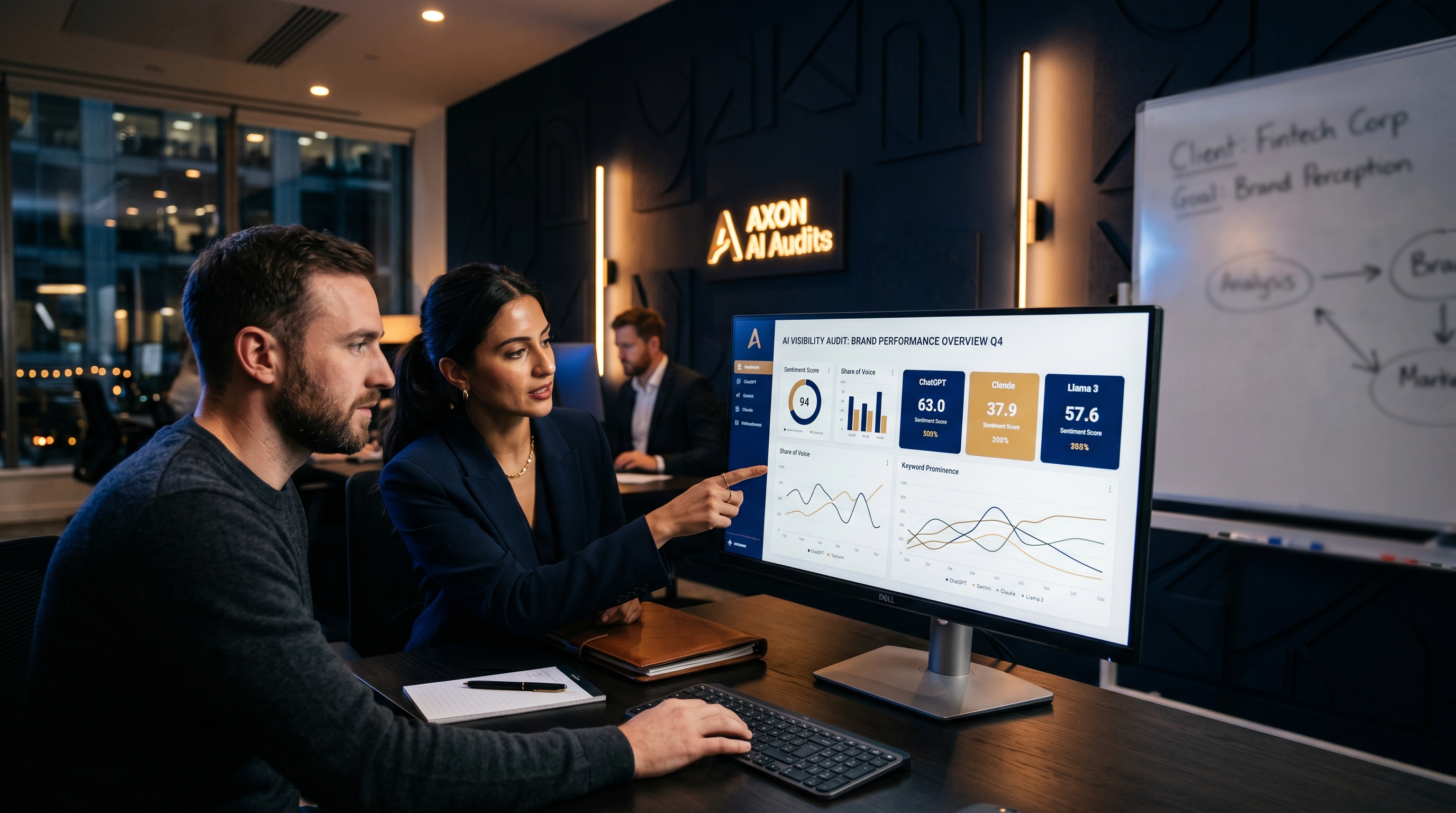
Run the audit quarterly. Screenshot everything. Document the exact response from each engine. Build a simple scorecard showing trending,is the client's score climbing month-to-month, or sliding? This becomes the dashboard you present at quarterly business reviews.
The pattern analysis matters as much as the raw score. If a client scores well on branded recall but poorly on category recommendation, the problem is visibility on G2, Reddit, and industry review sites,not on earning Wikipedia or Crunchbase mentions. If they score poorly on everything in Claude but well in ChatGPT, the issue is training-data entity strength versus live content retrieval. The architecture is different between engines, and your diagnosis drives their content roadmap.
The Pricing Structure
Initial Audit: $2,500
- One-time delivery of six-prompt panel, four-engine testing, scorecard, and root-cause diagnosis.
- Deliverable: PDF scorecard, trend analysis, 3–5 recommendations for content or authority building.
- Time: 4–6 billable hours (testing, analysis, writing).
- Margin: 60–70% if you've templated the intake and scoring process.
Quarterly Refresh: $750/quarter (or $2,200 annually)
- Same six-prompt panel, re-run against the four engines.
- Comparative analysis year-over-year and quarter-over-quarter.
- Updated recommendations based on competitive movement.
- Time: 1–2 billable hours per refresh.
- Margin: 80%+ on repeats because setup is zero.
This is recurring revenue. One client on four-quarter contracts = $3,000 in annual billing, or $2,100 in gross margin at standard agency rates. Twenty clients = $42,000 in annual audit fees alone. The math works.
Building the Offering,The ATLAS Framework
Use this framework to productize the audit:
A,Audience Definition
- Map the client's 2–3 customer personas.
- Build prompts that reflect how those personas actually search.
- If the client sells B2B software, include "how to [use case]" and "[tool] alternatives."
T,Testing Cadence
- Initial audit covers one snapshot (today's visibility).
- Quarterly cadence begins immediately after initial delivery.
- Lock the prompt panel for 12 months so trending is apples-to-apples.
L,Language & Engine Selection
- Always cover ChatGPT (largest user base) and Perplexity (live web retrieval).
- Include Claude and Gemini; omit niche engines.
- For international clients, test the same queries in local languages if applicable.
A,Analysis & Attribution
- Score per engine (which LLM fails the client most?).
- Score per category (branded recall vs. recommendations vs. comparisons).
- Identify specific missing assets: comparison posts, Reddit discussions, review-site profiles.
S,Storage & Syndication
- Keep all screenshots, scores, and verbatim responses in a shared folder (Google Drive or Notion).
- Build a simple trend dashboard; refresh monthly.
- Make it easy for the client to show the people involved.
The FAQ
Q: How long does an audit actually take to run?
A: The hands-on work is about 3–4 hours for the initial audit (intake, testing, scoring, writing). If you've templated your methodology, it's closer to 2–3 hours for refreshes.
Q: What if a client scores 48/48? Do they have nothing to fix?
A: Rare. And yes,at that point the audit shifts to defensive monitoring (is a new competitor eating share?) and amplification (how do we ensure this visibility stays?). That's a different conversation, but it keeps them on quarterly retainers.
Q: Can I automate this or use a tool?
A: Tools exist (Otterly.ai, Frizerly, and others track AI visibility), but you lose the diagnosis work. Your value isn't the testing,it's the root-cause analysis and recommendations. Run the audit manually the first time, at minimum. After three audits, you may see patterns that let you use a tool. But don't outsource the thinking.
Q: What's the difference between this and GEO (Generative Engine Optimization)?
A: An AI visibility audit is *diagnostic*,it tells you where you stand and why. GEO is *prescriptive*,it's the work you do after the audit to fix the gaps. Sell the audit. Use it to land GEO projects.
Q: How do I position this to a client who's never heard of it?
A: Start with the threat: "Your customer is asking ChatGPT for recommendations. If you don't appear in that answer, you lose the deal. This audit shows you exactly where you're missing." Then show a competitive benchmark,run the same panel for them and their top competitor. The comparison sells itself.
The Delivery Template
Create a Notion or Google Sheets template that includes:
- Intake section: Client name, audience personas, competitive set, key service categories.
- Prompt bank: Pre-built prompts for each category (fill-in-the-blanks for client name and category).
- Scoring grid: Engine × Prompt matrix. auto-calculating totals and per-category averages.
- Screenshot storage: Folder for all four engine responses (for documentation and client review).
- Findings section: 2–3 root causes (entity-strength gap, content absence, authority deficit, citation/retrieval issue).
- Recommendation roadmap: 3–5 specific actions ("Publish on G2 and Capterra," "Secure a Crunchbase profile," "Write a head-to-head comparison post").
Once you've built the template once, every audit takes 2 hours instead of 6. That's where your margin lives.
The Sales Angle
Don't bury this in a proposal. Lead with it. Most agency conversations start with "How's your SEO?" and "What's your Google ranking?" You're offering a new lens: "How visible are you in AI?" It's novel. Clients don't have audits for this yet. The first question they ask will be, "How visible am I right now?" The answer is: "Let's run a $2,500 audit and find out." That's a closed conversation.
Why This Works at $2,500
Clients pay $2,500 for a brand audit. They pay $2,500 for a website health check. They'll pay $2,500 to understand their AI visibility because the fear is real,if ChatGPT doesn't know you exist, you lose market share to competitors who do. And once you've run the initial audit, you have permission to repeat it quarterly and position it as essential monitoring.
The economics are brutal for you if you price too low. The client's entire Q3 lead generation could hinge on being visible in AI answers. $2,500 is a rounding error. Charge accordingly.
The Doctrine
Due diligence is non-negotiable. Before you start auditing for a client, understand their business model. If they sell to Google Sheets users, Perplexity matters more than Claude. If they sell to Fortune 500s, LinkedIn strategy and third-party mentions matter. If they're in a competitive vertical (CRM, project management, payroll), head-to-head comparisons drive their visibility. Customize the audit. Don't run a template.
Closing Move
AI visibility audits are the new SEO audits. First Page Sage has proven the metric works. Agencies that start selling this now will own the market in 18 months. The setup cost is zero. The marginal cost per audit is $200 in labor. The price is $2,500. The repeat rate will be 70%+. Start building your template this week.
Further Reading
- The Complete AI Visibility Audit Methodology
- How to Measure Brand Visibility in AI Search Engines
- First Page Sage's AI Visibility Research 2026
- /blog/aeo-strategy-agencies
- /blog/geo-content-positioning
- /blog/agency-service-packaging
*Jeff Barnes, MBA has no personal position in any company, tool, or platform named in this article. DEMG.ai has no current commercial relationship with any party mentioned. DEMG provides marketing education and systems, not investment advice. Past performance does not guarantee future results.*