
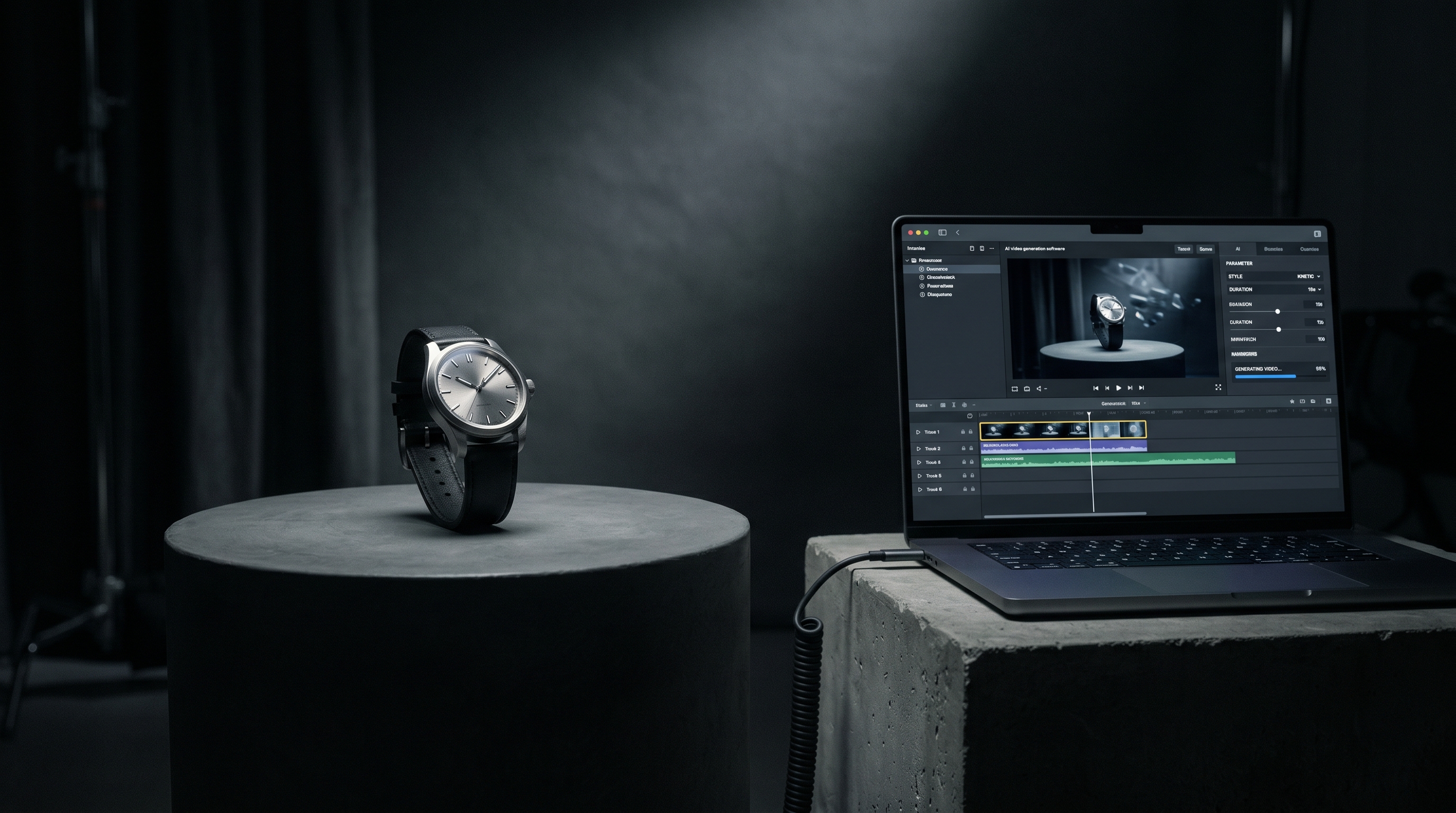
The Math That Breaks the Studio Video Model
Studio video shoots run $10K to $25K. HeyGen, Veo, and Synthesia run $24-$99/month. That's not incrementalism—that's an asymmetry. For the $1M-$5M ecom operator, AI video changes whether you can afford to test ideas at all.
Three years ago, $500 budgeted for video meant one human creator, one video, one data point. Today it means 50-100 AI-generated variations. The old model forced you to guess right. The new one lets the algorithm find the answer.
How I Got Here: The AIN Receipts
I spent six years at AIN running capital markets outreach. We tested investor pitch videos early—when AI video still looked robotic. The version we shipped (HeyGen avatars in 2023) pulled 3x the engagement rate of text-only emails. This was before the tools got good. Before pricing collapsed. Before the market believed in the quality.
I kept those metrics. Watched the tools improve every quarter. Watched the price floor drop 60% in 18 months. The thing that changed my mind was not the tools, it was the data. Three-to-one engagement lifts don't lie.
Now I was building demg.ai. Different model, same question: can AI video ads outperform studio work for a fraction of the cost? The answer is yes. With conditions.
The ATLAS Model: Five Layers of the AI Video Decision
When you're allocating budget across content production methods, you're really running this framework:
Archetype (what format solves your problem: avatar, UGC-style, generative B-roll, hybrid) Timeline (how fast you need iterations; AI changes the speed game) Use (what scaling factor you get per dollar: 50 AI videos vs 3 human videos) Asset quality (the visual standard your category demands) System (infrastructure to test, measure, iterate; tools like HeyGen and Veo exist, but workflow design doesn't)
Most ecom operators blow this at the Use step. They compare a $5,000 human video to a $100 AI video and conclude AI is worse if it scores 90% as well. Wrong. If the AI version costs 1/50th and you can test 50 instead of 1, the winning AI variant will outperform the single human video you could afford.
The Tools and Their Actual Pricing (Not the Sticker Price)
Three platforms dominate ecom: HeyGen, Veo, and Synthesia. The confusion point is that all three use credit systems, not simple per-video pricing.
HeyGen. Creator plan: $29/month (annual: $24/month). That buys 200 Premium Credits. Avatar IV, their best-quality avatar, costs 20 credits per minute. So: $24/month = roughly 10 minutes of hero-quality avatar video per month. If you're running UGC-style testimonial ads, that's 4-5 complete 2-3 minute ads. Cost per finished video: under $5. https://www.heygen.com/pricing
For higher volume, the Pro tier ($99/month) unlocks 2,000 credits/month. That's 100 minutes of Avatar IV footage, roughly 40-50 complete ads. Cost per finished video: $2-$2.50.
Veo 3.1 (Google's model). Pricing integrates with Google Ads and Vertex AI. No strict monthly tier. You buy credits as you spend. Estimated cost: $0.50 per 5-second clip on most briefs. A 6-second hook ad costs roughly $0.60 to generate. You can test 50 variants for $30. The model is built for speed and native audio, product sounds synchronized to video without post-production work. Game-changer for direct-response ads. https://ai-vidia.com/insights/veo-3-vs-sora-meta-ads
Synthesia. $29/month starter plan, credit-based like HeyGen but with a different rate structure. Competitive if you're doing 1080p exports and need language localization (Synthesia supports 140+ languages vs HeyGen's 175+). Most ecom operators find HeyGen cheaper at the low end.
The Hidden Cost. All three use credits for premium features. If you want 4K export, lip-sync translation, or Avatar IV quality on HeyGen, you burn through credits faster than the sticker price suggests. Budget 20-25% above advertised pricing once you're in production.
What AI Video Ads Actually Perform Like (The Data)
Here's where most analysis fails: comparing per-video performance instead of system performance.
Human UGC video on Meta averages a 28-38% hook rate (3-second views). AI Avatar video at high quality averages 26-36%. The gap is noise. Cost per click: Human UGC $0.85-$1.40. AI Avatar $0.90-$1.55. Again, within margin of error. https://www.cinerads.com/blog/ai-video-ads-benchmarks-2026
But production cost tells a different story. One human creator video: $150-$500. One AI video: $2-$10. Volume tells the real story.
An apparel brand ran a controlled test. AI UGC ads: $25 CPA. Traditional human UGC: $45 CPA. Not because AI is better, but because they tested 45 AI variants and found the one that worked while the human-only approach tested 5 variations. The winning AI video beat the single human video it was measured against. Scaled across a year, that 44% CPA reduction compounds. https://heyfish.ai/ai-ugc-video-ads-roi
For cold-traffic ROAS: AI video campaigns average 1.8-2.8x (top quartile 3.5-5.0x). Within 10-15% of human UGC on comparable creative quality. On TikTok, AI UGC CPM averages $6-$12 vs traditional video at $10-$25. That's a 40-52% cost advantage. https://www.cinerads.com/blog/ai-video-ads-benchmarks-2026
One more data point that matters: Category selection. AI performs best in skincare, supplements, and accessories. For luxury goods and footwear, where tactile credibility matters, human creators still win. IAB data from 2025 shows AI-generated video at 78% of human creator conversion rate across all categories, but the range is 51% (luxury) to 95% (supplements). Pick your vertical carefully. https://adlibrary.com/posts/ai-ugc-for-ecommerce
The Workflow That Actually Works
The tool is not the problem. The workflow is.
Step one: research competitor ads. Identify 3-5 winning hooks (visual patterns, opening lines, product angles) from top performers in your category. Most ecom operators skip this. Don't.
Step two: brief your AI tool. HeyGen and Veo don't understand ecom instinctively. Write the brief like you'd brief a human creator: what's the hook in the first 3 seconds, what's the body doing (product demonstration, testimonial, lifestyle), what's the CTA. Specific. Tight.
Step three: generate variants. At $2-$10 per video, test hook variations (5-10 variants), body variations (5-10 variants), and CTA variations (2-3 variants). That's 50-300 videos. Cost: $100-$3,000. Human-only approach: $7,500-$25,000 for the same volume. You're not chasing parity. You're chasing a system that learns faster.
Step four: measure properly. Hook rate (3-second view rate) tells you if the opening works. Click-through rate tells you if the body and CTA work. Cost per acquisition tells you if it's profitable. Most operators measure only CPA and miss the insight that's buried in hook rate data. Run 7 days minimum. No statistical noise below that.
Step five: scale the winner. Take the top 2-3 performers. If you have budget and time, commission human creators to produce polished versions of those exact concepts. The human version often outperforms the AI version at 10x the cost. But you've already found the concept that works. You're no longer guessing.
Veo vs HeyGen vs Synthesia: The Actual Decision Tree
Use HeyGen if you need avatar-based UGC or testimonial ads, you want simplicity, and you're not rushing. Best-in-class for lip-sync translation (175+ languages). Avatar IV quality is studio-grade. The credit system is transparent. Takes 2-3 weeks to optimize the workflow once you're comfortable with the tool. https://www.heygen.com/pricing
Use Veo if you need speed and native audio matters. Product sounds synced to video without post-production editing. Best for 4-8 second hooks (Reels, Shorts format). Render times 60-90 seconds. Costs $0.50 per 5-second clip. Ideal for dropshipping and fast-testing strategies. Integrates with Google Ads/Vertex API for programmatic generation if you scale. https://ai-vidia.com/insights/veo-3-vs-sora-meta-ads
Use Synthesia if language localization is your primary use case. More languages, similar pricing to HeyGen, slightly different feature set. Smaller market share for ecom. HeyGen and Veo dominate the space.
The decision is not "which is best", it's brief-specific. A testimonial campaign for 15 languages? HeyGen. A 100-variant CPC optimization test on TikTok? Veo. Your workflow determines the tool, not philosophy.
The Competence Angle (Why This Matters)
The doctrine connection: Competence beats credentials.
Twenty years ago, the founder-operator who could afford a studio shoot and a production crew had an advantage. Those are credentials. Budget and connections. What changed is that today, the operator who understands AI tools, can brief them well, and knows how to measure variant performance at scale has a structural advantage. That's competence.
These tools are operator-neutral. HeyGen doesn't care if you run $1M in revenue or $100M. Veo doesn't discriminate. But the ecom founders who are shipping 20-50 video variants per month are learning faster than those shipping 3. The competence curve is steep. It favors speed and iteration, not budget.
If you're a $2M ecom operator competing against a $10M brand, you can't outspend them on studio video. But you can out-test them. You can run 100 variants while they're still debating whether to hire a production house. That's your asymmetry.
FAQ
Q: Will AI video ads ever match human UGC quality? Already does, in most categories. Supplements, skincare, accessories, AI UGC is within 5-10% of human UGC conversion rates. Luxury goods and high-touch products (footwear, leather) still lean human. Category selection matters more than tool selection. The risk is picking the wrong category, not picking the wrong AI tool.
Q: How long does it take to get profitable results with AI video? Three weeks minimum to understand the tool workflow, brief it properly, and run statistically valid tests. Six weeks to find 2-3 winning concepts. Twelve weeks to scale a system that beats your baseline ROAS. This assumes you're shipping 20-50 variants per week. If you ship 3-5 variants, add 4-6 weeks to the timeline because you're learning slower.
Q: What if my product is high-ticket (>$500)? Use AI for variant testing and hook discovery. Commission human creators for the final polished versions of proven winners. High-consideration purchases need authenticity. AI works best as the research engine, not the final product. You'll spend 80% less on video research and still land a credible hero creative.
Disclosure: Jeff Barnes, MBA is the founder of demg.ai. This article reflects independent analysis. AI tools assisted with research. All conclusions are Jeff's own.