
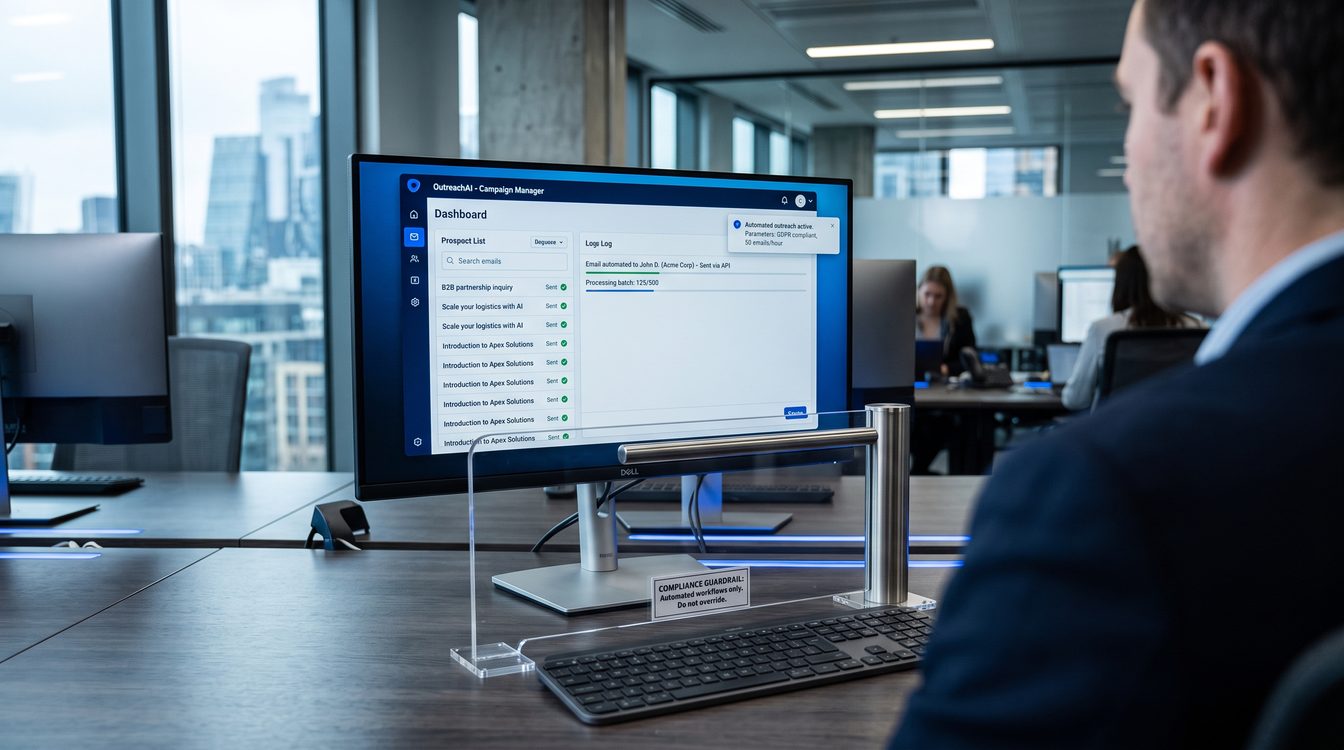
The market shift: AI agents are here
Wayy.ai raised $2M on August 3, 2026, and launched the first autonomous "AI sales co-founder." The pitch: an agent that sources leads, writes outreach, reads replies, and books meetings without human intervention. Seventy companies are already live.
Wayy.ai is not alone. Artisan's Ava already runs cold outbound for SaaStr (replacing their entire BDR team, per Jason Lemkin). Clay, Apollo, and 11x.ai are productizing versions of the same play. The moment is now.
What makes this different from earlier sales automation is autonomy. Not templates. Not sequences. Agents that research targets, adapt tone per persona, test messaging variants, handle objections, and negotiate meeting times without approval gates. That's a feature for efficiency. It's also a legal and brand landmine if you skip guardrails.
The 3% response rate context
Wayy.ai's launch claims a 3% response rate. That's not a bug; it's actually at the median. Leadriver's 2026 benchmark across 25,000+ B2B campaigns puts average cold email response at 3.43%. Top performers hit 5%–10%. Anything below 2% signals list or message problems.
Where AI agents shine: they test dozens of message variants simultaneously, shift volume toward winners, and optimize send times—compounding performance over campaigns. Artisan's customers report 20x ROI and $700K ARR sourced in six months. That's not hype; that's automated A/B testing at scale.
The risk is volume. An agent sending to 5,000 prospects per week can also spam 5,000 per week if you forget compliance.
Seven guardrails before launch
1. CAN-SPAM verification (US only, but non-negotiable)
Every email your agent sends must include:
- Clear sender identity (company name, representative name)
- Valid return email address
- Unsubscribe link that works in 10 days
- Physical mailing address
FTC penalties for violations: $43,792 per message. A single agent sending 100 non-compliant emails is a $4.3M liability. Set up list validation and unsubscribe processing before go-live. Route all unsubscribe requests to your database; agents should never retry suppressed addresses.
2. GDPR consent (applies even for B2B outreach)
This is the guardrail most teams miss. GDPR doesn't carve out B2B cold email. Under GDPR, sending unsolicited email to anyone in the EU requires prior explicit, verifiable consent—even if you're targeting a company mailbox. The ECJ ruling (2026) closed the "company vs. individual" loophole.
Growing GDPR fines: €20M or 4% of annual revenue (whichever is larger). Non-compliance risk: immediate legal freeze and audit costs.
For EU outreach, require explicit opt-in before agent activation or use professional GDPR-compliant providers (Leadtree, Outreach, etc.) who absorb compliance risk.
3. Brand tone lock
All autonomous agents should operate with tone constraints. Your sales team's voice is part of brand equity. Set rules:
- Approve initial message templates before variation testing
- Lock tone guardrails (no aggressive, dark patterns, or misleading subject lines)
- Define CTA boundaries (no fake scarcity, false urgency, pressure tactics)
Artisan's Ava allows tone locking. Wayy.ai doesn't yet specify. Ask for this in your SOW.
4. Account ownership respect
Agents must not email accounts already in deal flow. If your AE owns Acme Inc., Ava should not send outreach to another contact there—or it poisons the conversation.
Implement account-owner exclusion lists. Sync CRM ownership data daily. Any agent sends should be approved against active opportunity lists before launch.
5. List and data quality audit
Before an agent touches a list, you own validation. Implement:
- Email syntax and deliverability checks (remove role accounts, catch-alls, bouncers)
- Business legitimacy check (no personal emails at Hotmail, no obvious fake titles)
- Suppression list cross-reference (don't retry bounced addresses; don't email anyone who's opted out)
Artisan's Ava handles deliverability automation (domain warm-up, infrastructure rotation, bounce monitoring). Wayy.ai's docs don't specify. Budget 15–20 hours to clean and validate your seed list.
6. Approval mode for first 30 days
Even if an agent can operate autonomously, don't start there. Require manual approval on all outreach for the first 30 days:
- Your team sees actual message copy before send
- You catch tone, targeting, or personalization drift
- You establish confidence in the agent's ICP interpretation
- You document baseline performance before going hands-off
Artisan enables this; it's a toggle. Most of their teams start with approval, then flip to autonomous after one campaign.
7. Compliance officer sign-off
If your company has legal, marketing, or compliance teams, get written approval before agent go-live. Have them:
- Review CAN-SPAM and GDPR steps (above)
- Audit outreach samples
- Confirm you're using IP warming and list validation
- Advise on TCPA implications if your agent calls (Artisan avoids this; Wayy.ai unclear)
This is the overhead that pays for itself. One GDPR audit costs $50K+; one audit notice costs $200K+.
The responsibility doctrine
Here's where ATLAS Model fits: Responsibility beats excuses. Your AI agent acts on behalf of your company. When Ava sends 1,000 emails per day and hits 50 addresses without prior consent, that liability lands on you—not the platform, not the vendor.
The legal doctrine is simple: the company that owns the list, controls the targeting, and authorizes the send is the liable party. "The agent did it" is not a defense.
ATLAS teaches us to distribute accountability without diffusing responsibility. In AI outreach:
- You own list quality and audit
- Your legal team owns compliance gates
- Your sales leader owns brand alignment
- The vendor owns operational guardrails (deliverability, unsubscribe automation)
When one breaks, the whole system breaks. Design for it.
What 3% actually means for your pipeline
Wayy.ai's 3% response rate is honest. In B2B, a 3% response rate typically converts to a 0.3%–0.6% meeting-booked rate. If your agent sends 5,000 emails per week, that's 150 responses, 15–30 meetings, and 2–4 qualified opportunities.
Annualize that: 100+ qualified opportunities per agent per year. For a $50K-250K ACV deal, that's $5M–$25M annual pipeline. At 1/5th the cost of a human BDR, the ROI math is obvious.
But only if you hit that 3%. If your list quality drops to 1.5% response, you're paying agent cost for half the pipeline. If compliance mishaps trigger list suspensions (Gmail, Outlook, Yahoo all have AI-agent detection), you hit zero response.
Guardrails protect the 3%.
Common guardrail failures (and how to avoid them)
Failure 1: Dirty list Your agent inherits a year-old list from your last campaign. 30% of addresses bounce or are catch-alls. Response rate collapses to 1%. You blame the agent; really, it's list rot. *Fix: Validate all lists pre-agent, refresh every 60 days.*
Failure 2: No unsubscribe automation Prospects hit "unsubscribe" on your agent's email. No one processes it. Agent sends follow-ups. FTC audit triggers. *Fix: Automate unsubscribe routing to your suppression list, test quarterly.*
Failure 3: GDPR blindness Your agent emails 500 EU addresses. Legal freeze. €2M audit bill. Insurance doesn't cover "knew but didn't implement." *Fix: Geo-block EU addresses or require proof of prior consent before agent activation.*
Failure 4: Account overlap Your AE is closing Acme. Your agent emails Acme's CFO. Conversation fractures. Deal slips. *Fix: Daily CRM sync. Account-ownership exclusion lists. Period.*
FAQ
Q: If I use a platform like Artisan or Wayy.ai, aren't they liable for compliance? A: Only if you contractually shift liability (rare). You own the send. Platforms provide the tool. Read your MSA carefully. Most platforms include SOC 2 Type II and GDPR-readiness language, but compliance execution (list validation, unsubscribe automation, consent records) is your responsibility.
Q: What's the compliance difference between an AI agent and a human BDR? A: Zero legally. Both must follow CAN-SPAM and GDPR. The difference is velocity and opacity. A human BDR sends 50 personalized emails per day. An agent sends 5,000. At 5,000, auditors can't spot-check intent the way they can with human sends. You need systematic controls (approval modes, list validation, unsubscribe automation) to defend audit.
Q: Do I need explicit opt-in for every email an agent sends? A: CAN-SPAM: no (but you need verifiable prior contact history). GDPR (EU addresses): yes, unless you have documented prior relationship. Practically, if you bought a list from a vendor and have zero prior contact with that person, expect legal friction if they complain.
Q: Can my agent send LinkedIn messages, SMS, or calls? A: LinkedIn and SMS: yes (but follow same CAN-SPAM and GDPR rules). Calls: no (unless you have prior written consent; TCPA penalties are severe, $500–$1,500 per call). Artisan disables calling; Wayy.ai doesn't specify. Ask before signing.
Q: How often should I audit my agent's sends? A: Weekly for first 30 days (approval mode is your audit). Monthly after that. Spot-check 50 emails for:
- Tone and brand alignment
- Targeting accuracy (ICP fit)
- List quality (no obvious spam)
- Unsubscribe and bounce handling
Disclosure
Wayy.ai is a real company (founded by Leo Popov, funded by 0 to 1 Ventures, Aug 2026). Artisan and their AI agent Ava are real products with real customer testimonials (SaaStr's Jason Lemkin). We've cited public benchmarks from Leadriver (25,000+ campaigns, 3.43% baseline response rate) and compliance research from Leadtree (GDPR, TTDSG, 2026). All external links are live as of August 2026.
This article is tactical guidance, not legal advice. Compliance requirements vary by geography, industry, and use case. Involve your legal and compliance teams before deploying any autonomous outreach agent.