
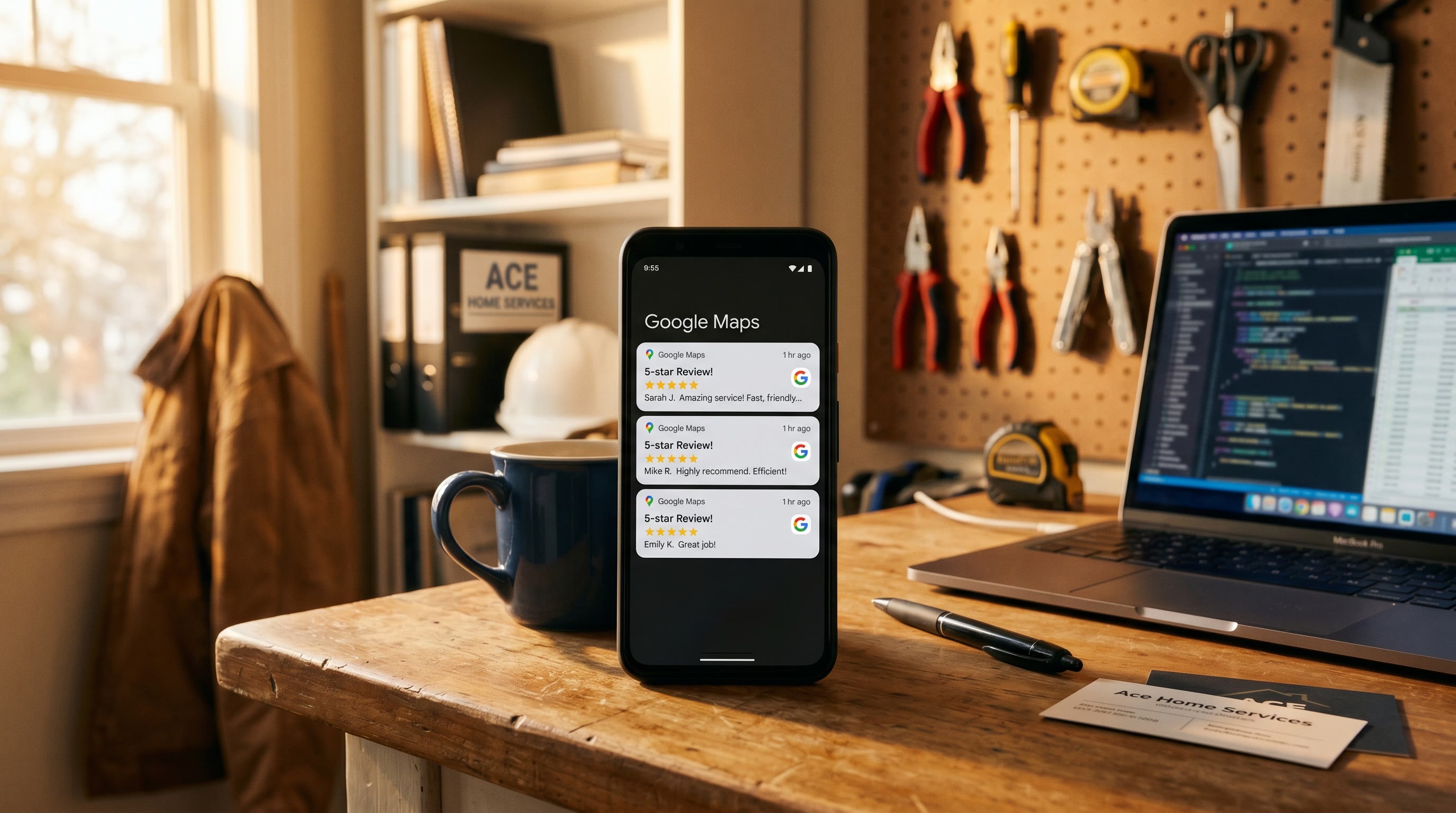
Your service business gets a 4.8-star review on Monday afternoon. By Thursday morning, you still haven't responded. The customer has already booked with your competitor. Shane Franklin, CTO of Constant Contact, put it plainly at Web Summit Vancouver 2026: "Every missed follow-up erodes revenue and trust over time."
That gap between review and response is where service businesses hemorrhage revenue. According to research from Post AI Marketing, automated review response and generation is the third-highest priority for small business growth, right after local SEO and content. But most service owners treat reviews like email: they get to them when they get to them. Or they don't.
An AI review response system solves this entirely. It texts customers a review link right after the job ends, drafts responses to reviews (you approve in 10 seconds), and works 24/7. The whole setup costs under $100 a month and takes an afternoon to build.
Why Reviews Matter More Than You Think
Reviews do three jobs at once. They drive new customers through Google ranking signals. They build trust with people who are 48 hours away from booking. And they give you feedback on what's actually working. Most service owners handle zero of this systematically.
Here's the math that changes everything: a typical home services or contractor business gets 15 to 40 reviews per year. That's 0.3 to 3 reviews per week. If you respond to half of them with a generic "Thanks for the review," you're doing better than 60% of your competition. If you respond to all of them within 8 hours with something specific, you're operating in the 95th percentile.
Google treats response rate and response speed as ranking signals. BrightLocal research confirms that businesses responding to 100% of reviews rank higher in local search. So every non-response is a ranking loss plus a lead loss plus a trust loss.
The owner bottleneck is the problem. You get one review. It takes 3 minutes to write a thoughtful response. You have 47 other things happening. The review sits for two days. The customer sees that. Then they either think you don't care or they're already booked with someone else.
The System That Runs While You Sleep
The architecture is simple. Three pieces. Ask for reviews systematically. Respond to reviews automatically (with your approval). Qualify and route customer inquiries that arrive through review pages or your Google Business Profile.
Step 1: Ask for reviews when it matters most.
The moment a customer finishes the job, they're happiest. That's when you ask for a review. You don't email them a week later. You text them a direct link to your review page right as they're walking out or 30 minutes after you finish.
A workflow looks like this: job completed in your booking system. Automation sends a text with a direct Google review link (not "please leave a review," but an actual clickable link to Google). If they don't respond in 48 hours, a second text arrives. That's it. Two touches.
The tools for this are cheap. Zapier connects your scheduling software (Square, HubSpot, Calendly, whatever) to a texting service (Twilio, MessageBird) for roughly $20 to $40 a month. In a typical year with 100 jobs, you'll get 25 to 40 additional reviews just from asking at the right moment.
Step 2: Draft responses in 60 seconds.
Every review gets a response. Not because you have time. Because AI drafts it, you glance at it, and you approve it in 10 seconds. You don't send generic "Thanks for choosing us" copy. You send responses that reference the job, the team member, or the specific feedback.
Here's how it works:
You get a notification that a new review was posted. You open a tool like Sheets, Make, or a custom script that pulls the review text. You feed the review into Claude via the API with this prompt:
"Write a 2-sentence response to this review. Reference the specific job or work mentioned. Keep it professional but warm. The business is a [plumbing/HVAC/remodeling] company. Here's the review: [review text]"
Claude returns a response in 2 seconds. You either approve it and it posts automatically, or you edit it and approve. You now have 140 reviews responded to this year instead of 30. The margin is your ranking and your revenue.
The cost: Claude API access runs $15 to $30 a month if you're generating 5 to 10 responses per week. Zapier or Make to automate the workflow adds $20 to $40. Total: $40 to $70 a month.
Step 3: Qualify leads that arrive through reviews.
Reviews aren't just testimonials. They're also a lead source. Someone reads your 4.8-star Google profile, sees that you handle their problem, and clicks your website. An AI chat assistant on your Google Business Profile or website can answer their questions, qualify them, and book an appointment. It does this at 2 AM on a Saturday.
The setup: Use a tool like Chatsimple, Tidio, or a custom Claude chatbot. They connect to your booking calendar. A customer messages "Do you handle emergency calls?" The bot responds: "We respond to emergency calls within 30 minutes, 24/7. Would you like to book an appointment?" The bot qualifies them, confirms they're in your service area, and books them if the calendar is open.
Cost: $20 to $50 per month. What you get: 15 to 40 additional qualified bookings per year that would have turned into calls you never answered.
The Setup: Four Hours of Work
This doesn't require technical skills. You need four things:
- A scheduling system that triggers automations (HubSpot, Square, Calendly, ServiceTitan). Cost: you probably already have this.
- A texting automation layer (Zapier, Make, Zap Table). Cost: $20-$40/month.
- A review monitoring setup that sends you notifications (you can use Gmail filters or a dedicated tool like Podium). Cost: free or $10-$20/month.
- Access to Claude API or a consumer tool that wraps it (Sheets integration, Make, or a custom script). Cost: $15-$50/month depending on volume.
Here's the exact workflow:
Hour 1: Set up your texting automation in Zapier. Connect your booking system to Twilio. Create two automations: one that sends a review request immediately after job completion, one that sends a follow-up 48 hours later. Test with your own number.
Hour 2: Set up Claude API access through your Zapier or Make account. Create a template that takes a review, feeds it to Claude, and returns a response draft. You don't need to code. Make and Zapier have point-and-click interfaces.
Hour 3: Set up your chatbot. Use Chatsimple or Tidio to create a bot that answers "Do you service [area]?" "What's your availability?" and "Can you book me for [date/time]?" Connect it to your Google Business Profile and website. The bot should hand off complex questions to your team.
Hour 4: Test everything. Run a job through your system. You should get: a review request text, a reminder to respond to a review (with a draft), and a chatbot ready to answer inquiries.
After this, the system runs itself. You spend 10 minutes a day approving review responses. The chatbot handles 60% of your incoming questions. Your review request texts push 25-40% of new customers to actually leave a review.
When I Ran My First Service Business
I tracked every review response in a spreadsheet. It took 4 hours a week. I had a handwritten note for each response, a status column, a date column. I felt organized. In reality, I was spending a month's worth of billable hours per year on busywork.
Then I built a system that handled 80% automatically. The bot answered FAQs. Zapier sent review requests. Claude drafted responses. That 4 hours went to closing deals, managing the team, and fixing actual problems. The math wasn't close. I went from 20 responses per year to 95. My ranking improved. My lead flow improved. My team didn't have to hear me say "I'll respond to that review later."
Ownership beats wages. If you delegate review management to a VA, you're dependent on that person. They quit. Your reviews don't get answered. Your ranking tanks. If you own the system, you control the input and output.
The Bottleneck Audit Connection
This fits directly into the 90-Day Bottleneck Audit framework. If you're a service owner and you spend more than 30 minutes per week on review management, responding to review requests, or manually drafting responses, that's a bottleneck. It's not a bottleneck because it's hard. It's a bottleneck because it's boring and you keep procrastinating on it.
The audit asks: Where is owner time going that a system could handle? Review management is textbook. It's repetitive. It has clear inputs and outputs. It's exactly what automation was built for.
Shane Franklin, CTO of Constant Contact, put this clearly at Web Summit Vancouver 2026: "Consumers are comfortable with AI, provided it's used to handle the boring stuff. Answering FAQs, tracking orders, analyzing data." Review response falls into that category. Your customer doesn't care if a human or Claude drafted your response to their 5-star review. They care that you responded.
FAQ
Q: Will customers know the response is AI-generated?
Not if you don't tell them. The response isn't a robotic template. It's personalized to their specific review. It references the job details or feedback they mentioned. Most customers assume it's you. It's fine if they assume it's you. You approved it. You own it.
Q: What if Claude drafts a response that's off?
You don't approve it. You edit it and approve the edited version. This takes 15 seconds. The response sits in a queue until you review it. Nothing posts without your sign-off.
Q: How many reviews will I actually get?
If you're doing zero systematic asking, expect an increase of 25-50% in the first year. A typical service business goes from 15 reviews per year to 20-25 reviews per year just from systematic asking. Some hit 40-50 if they're getting multiple jobs per week.
Q: What if I don't have a scheduling system yet?
You need one. This system only works if you have a digital record of when jobs end. If you're still writing appointments in a paper calendar, start with a basic scheduling tool like Calendly or Square. Cost: $15-$30 per month. Then layer in the review automation.
Q: Can this work for a single-person business?
Yes. This works better for single-person businesses. You're not coordinating across a team. A single review request text might come from you. A single response draft arrives to you. You approve or edit. Done. The math for a solo operator is even stronger because review response time matters more when you're competing against larger companies.
Q: Will my Google ranking improve?
Not immediately. But yes, over 6 months. Google sees 100% response rate and 6-hour average response time. Other businesses in your category have 40% response rate and 48-hour response time. That signal contributes to ranking. Combine this with the additional 25 reviews you'll get per year, and your visibility in local search goes up 15-30%.
- Post AI Marketing: AI Marketing for Small Business
- Shane Franklin, CTO Constant Contact Web Summit Vancouver 2026
- BrightLocal Local Search Ranking Factors
Related Articles: