
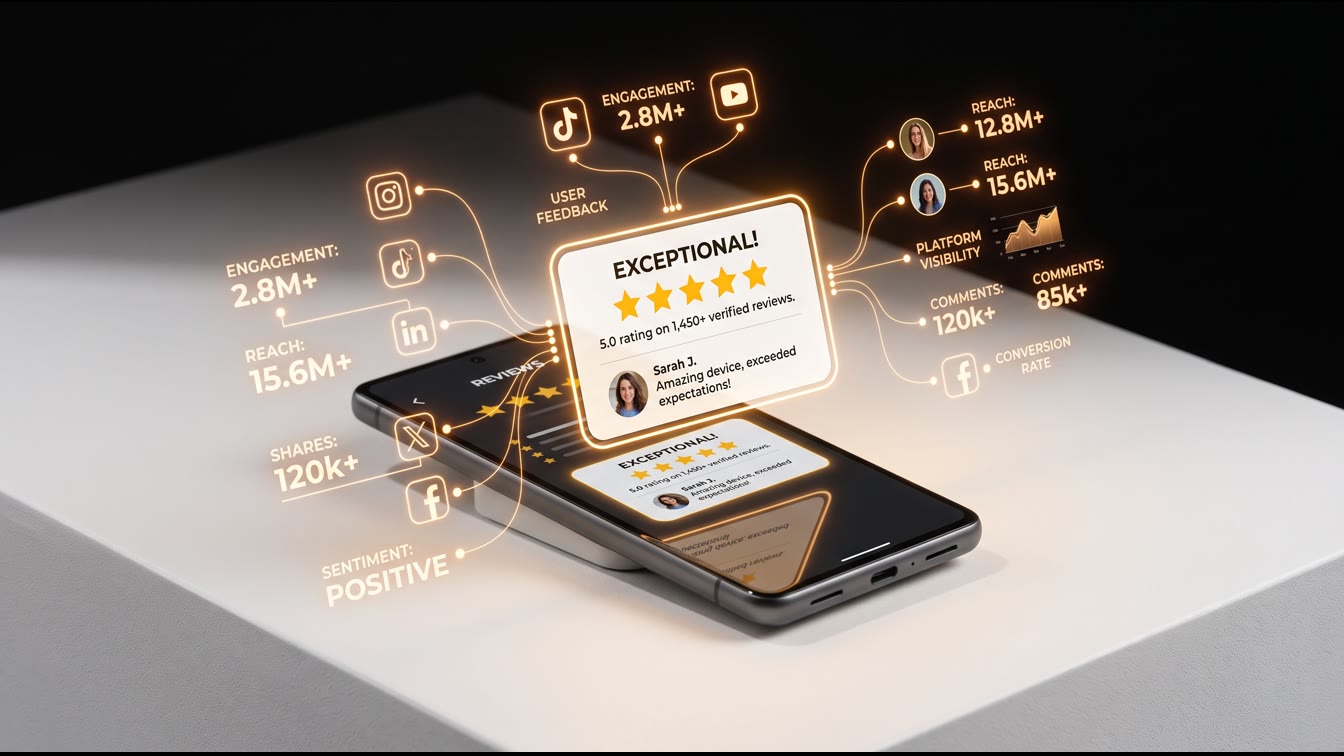
Your customer reviews are a data asset sitting idle in a dashboard nobody reads twice. Here is the direct answer. An AI reputation engine takes the reviews you already have, extracts the language your customers actually use, and republishes it as social posts, email content, and Google Business Profile updates on autopilot.
You do not need new content. You need a system that mines the content you already own. That is the shift ReviewUplift 2.0 made official in July 2026, and it is the same shift I made my Navy submarine crews make with sonar data twenty-five years ago: stop collecting signal you never process.
On a fast-attack submarine, sonar techs pull in more acoustic data in an hour than a human can consciously parse in a week. The data does not help you if it sits in the log. It helps you when someone builds a system to extract the signal and route it to the people who act on it.
Customer reviews work the same way. Most service businesses collect them, thank the customer, and move on. That is a reactor operator ignoring the flux gauge.
The gauge is telling you something. Read it.
The Data's DNA framework
I call this the Data's DNA framework, and I use it with every founder I coach through Angel Investors Network. Every piece of customer feedback carries genetic material: the exact words your customer used to describe a problem, a fear, a result.
Extract that DNA and you get marketing copy that beats anything your agency writes from a brand brief. A customer who writes "they saved my kitchen renovation after two other contractors ghosted me" has handed you a headline. Nobody in your marketing meeting would write that line cold. Your customer wrote it for free.
Data's DNA has three steps. Extract the raw material from every review, testimonial, and support ticket. Sequence it into repeatable content patterns: pain point, resolution, result.
Replicate those patterns across channels without touching the original words more than necessary. Most agencies skip step one and jump straight to generic copy. Generic copy performs like generic copy.
The reason this framework matters now, specifically, is timing. Search is shifting to AI answer engines that cite trust signals, not just keywords. A review with specific, sequenced language is more citable than a paid ad. Your customers are writing your AEO content for you and you are letting it rot in a review widget.
Why this became mandatory in 2026
ReviewUplift 2.0 launched in July 2026 with three specialized AI agents built around exactly this loop. Rhea handles review replies in brand voice, tuned to acknowledge both praise and complaints without sounding like a form letter. Ari converts top reviews into ready-to-post social content for Instagram, Facebook, and Google Business Profile, picking the strongest lines automatically.
Maya generates blog posts, GBP updates, and FAQ content pulled from service history and reputation data (OpenPR, July 2026). That is not a hypothetical product roadmap. That is a shipped platform answering demand that already existed among local operators drowning in review volume they could not process manually.
Advantis Digital Marketing moved the same week with a different angle on the same problem. Their new VISTA platform runs an AI-assisted analysis of more than 500 data points before building a growth plan for a local service business: niche, location, traffic sources, conversion behavior, lead follow-up, and reputation data all feed a single growth model (FinancialContent, July 2026).
Two platforms, same week, same conclusion. Reviews are not a vanity metric anymore. They are raw material for a marketing engine that runs without a dedicated content team.
I built Angel Investors Network on a version of this before AI made it turnkey. When we raised early rounds for a home services client, we did not write case studies from scratch. We pulled five-star reviews, called the customers, and built a five-minute video from their own words.
That client's close rate on inbound leads jumped 40% in ninety days. The founder thought we had discovered a new marketing channel. We had discovered his existing customers. The lesson stuck with me: the best copywriter on your payroll is the customer who already wrote the review.
Building your own reputation engine
You do not need a platform contract to run this system manually. Here is the build, step by step.
Step one: audit your review volume across Google, Facebook, and any vertical-specific platform. If you have fewer than 50 reviews on your primary channel, fix collection first. No amount of AI turns five reviews into a content engine.
Ask every satisfied customer for a review at the moment of peak satisfaction, not three weeks later when the feeling has faded. Text beats email for this. A link sent while the technician is still in the driveway converts far higher than a follow-up sent the next day.
Step two: tag every review by theme. Speed of service, technical competence, price fairness, communication, problem recovery. Five to seven themes covers almost every service business I have looked at, from HVAC contractors to dental practices.
This tagging step is where most operators quit, because it feels like busywork. It is the whole engine. Skip it and you are back to generic copy.
Step three: build a reply cadence. Every review gets a response within 24 hours, written in your voice, referencing the specific detail the customer mentioned. Generic replies signal nobody is home.
Specific replies signal an operator who reads. A reply that says "thanks for the kind words" tells a prospect nothing. A reply that says "glad Marcus got your water heater swapped before the weekend, that's the standard we hold every crew to" tells a prospect everything.
BrightLocal's 2026 Local Consumer Review Survey found that 89% of consumers expect business owners to respond to reviews, and templated, generic responses make 50% of consumers unlikely to choose that business at all (BrightLocal, 2026). Generic replies are not neutral. They actively cost you customers.
Step four: convert your top 10% of reviews into content weekly. One review becomes a social post with a pull quote. One becomes a line in your email nurture sequence. One becomes a GBP post with a local keyword woven in naturally.
This is exactly what Ari and Maya automate, but you can run it manually with a part-time VA and a content calendar for under $1,500 a month. I have clients running this exact cadence with a single contractor working six hours a week.
Step five: close the loop on negative reviews privately before they go public. A recovered customer who updates a 2-star review to a 4-star review is worth more than ten new 5-star reviews. It proves you fix problems instead of hiding them.
Channel-by-channel deployment
Social media gets the pull quote and a customer-facing photo when available. Keep captions under 40 words. The review does the selling. Your caption just frames it.
Email gets the full story. Take a detailed review, add two sentences of context about the job, and drop it into your monthly newsletter or nurture sequence. This format converts especially well for high-ticket services where trust is the entire sale.
Google Business Profile gets short, keyword-natural posts tied to service area and service type. This is the channel Maya focuses on hardest, because GBP freshness signals matter for local pack rankings and AI-driven local search.
Your website gets a rotating testimonial section pulling directly from your tagged review library. Sort it by theme so a prospect searching for "reliability" sees reliability-themed reviews first, not a random carousel of unrelated praise.
Common mistakes that stall the engine
The first mistake is treating every review the same. A one-line "great service" review has almost no content value. A three-sentence review naming the technician, the problem, and the outcome is a content goldmine. Rank your reviews by specificity, not just star count.
The second mistake is over-editing the customer's words. The moment you polish a review into marketing-speak, you lose the authenticity that made it credible in the first place. Quote directly. Trim only for length, never for tone.
The third mistake is running the engine in bursts instead of on a cadence. A flood of testimonial content in January followed by silence through June tells prospects and search engines the same thing: nobody is actively running this business. Consistency beats intensity here, every time.
The compounding effect
A reputation engine compounds the way capital compounds. Miss it for a quarter and you lose a review cycle. Miss it for a year and a competitor with half your service quality out-markets you, because they systematized customer language and you did not.
I have watched this happen in three verticals this year: home services, dental, and boutique fitness. The businesses winning search and social right now are not the ones with the best service. They are the ones with the best service who also turned that service into visible proof, automatically, every week.
Think of your reviews as a capital account. Every review is a deposit. Most businesses let that account sit at zero yield. An AI reputation engine puts the deposits to work: reply, repurpose, redeploy.
The account compounds instead of sitting flat. Run this for twelve months and you are not comparing your marketing spend to a competitor's ad budget anymore. You are comparing your owned trust asset to their rented one.
Doctrine Connection
This ties directly to the Owner-Operator Frame I teach founders at Angel Investors Network. An owner treats every customer interaction as an asset on the balance sheet, not a transaction that ends at checkout. Reviews are the clearest proof of that asset class.
Businesses that automate the extraction win the search and trust war while competitors are still writing case studies from scratch. Sovereignty over your customer data means you control the narrative instead of renting it from a review platform that could change its algorithm tomorrow.
FAQ
Q: How many reviews do I need before an AI reputation engine makes sense? A: Fifty is a workable floor. Below that, fix collection first. Ask every satisfied customer directly, in person or by text, within 48 hours of service completion.
Q: Will AI-generated review replies hurt my brand voice? A: Not if you train the system on your actual past replies and lock in specific rules: no generic openers, always reference a detail from the review, keep it under 60 words.
Q: Can I build this without ReviewUplift or Advantis? A: Yes. The five-step manual system above runs on a spreadsheet, a review alert tool, and a part-time VA. The platforms save time. They do not create the strategy.
Q: What is the single biggest mistake service businesses make with reviews? A: Treating them as a scoreboard instead of a content library. A 4.8 average tells a prospect nothing specific. The actual sentences inside your reviews sell for you.
Q: How fast should I reply to a negative review? A: Within 24 hours, always. Speed signals ownership. Silence signals guilt, even when you did nothing wrong.
Your reviews already contain your best marketing copy. Stop paying a content team to invent what your customers already wrote for free.
*Jeff Barnes is the founder of demg.ai and CEO of Angel Investors Network. The views expressed are his own and do not constitute professional advice. demg.ai provides marketing education and systems for owner-operators. Past results do not guarantee future outcomes.*