
According to Morphed's 2026 AI Product Photography Statistics, 79% of e-commerce brands now use AI-generated visuals for product showcases. But most are still overthinking it. They're waiting for perfect tools, perfect data, perfect training models. They're paralyzed. If you're running an ecom business under $2M in revenue, you don't have time for perfect. You need receipts.
Why the Image Matters More Than the Product Itself
In software, we ship code. In consulting, we ship work product. In ecommerce, you ship pictures. The image IS the product from the customer's perspective. They cannot touch it. They cannot try it on. They see a white background flat-lay or a lifestyle shot in context, and they make a buying decision in 1.3 seconds.
Pixc's research shows lifestyle product photography converts 2-3x higher than white background shots. That's not a marginal improvement. That's a 200-300% lift. And yet most small ecom operators cannot afford lifestyle shoots. A professional photoshoot costs $500 to $2,000 per day. A full catalog refresh is weeks of work.
This is where process beats ego. You don't need the perfect photo. You need the right photo. You need a system that produces conversion-focused imagery at scale without killing your balance sheet.
The FOCUS Strategy: Find Your Unique Market Position
At Angel Investors Network, we spent zero dollars on professional photography for the first ten years. The content WAS the product. We had no images. Just words and ideas. But in ecommerce, zero images means zero sales. The constraint is different. So where does your use sit?
The FOCUS Strategy says: Find the one thing that moves the number. Spend there ruthlessly. Ignore everything else. For ecom under $2M, that thing is conversion rate on existing traffic. You're not scaling audience. You're scaling margin on the customers you already have.
Lifestyle imagery moves that number. But you can't afford studio shoots. AI changes the equation. The cost is not shooting. The cost is $0.02-0.20 per image through APIs like Midjourney, DALL-E, or Replicate. That's not cents. That's near-zero.
The Mechanical Process: Phone to Lifestyle in Four Steps
Here's the procedure. This is the manual. Follow it exactly.
Step One: Shoot Your Product on White Background
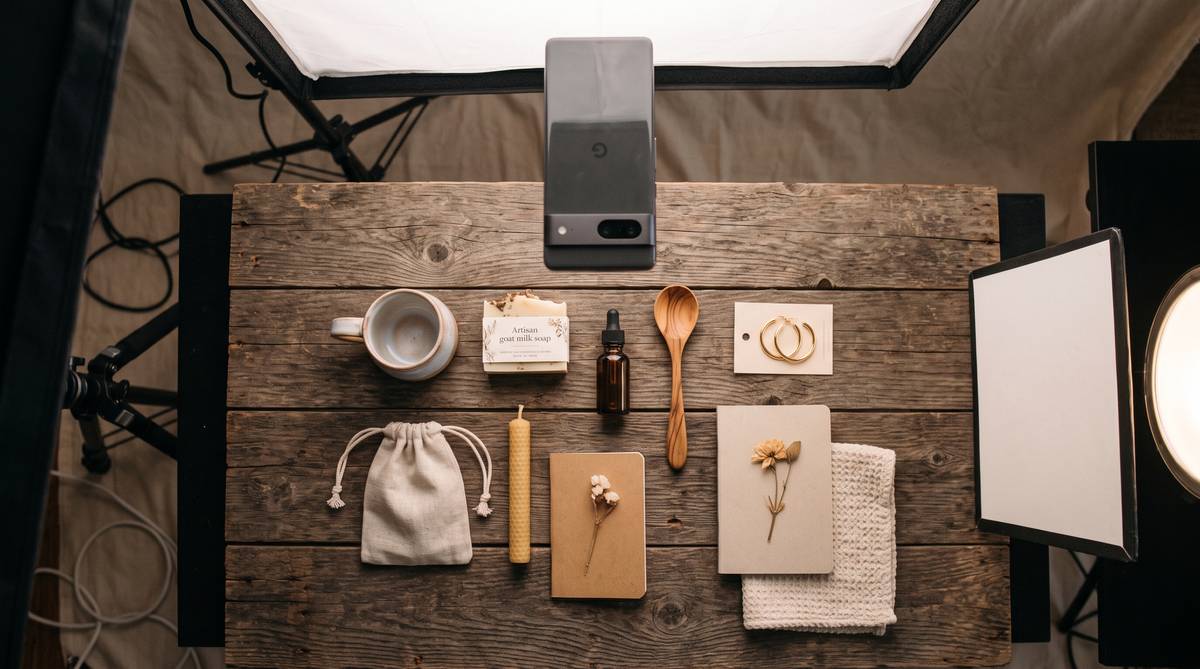
Use your phone. iPhone 15 or newer camera is sufficient. Your lighting: two desk lamps, one soft white bulb on each side, white poster board as background. Shot takes fifteen minutes per product. Geometry matters: straight-on angle, consistent distance, shadow-free.
Your unit cost is zero. Your time cost is ten minutes per product. For a fifty-SKU catalog, that's eight hours of work over one weekend.
Step Two: Extract SKU Data Into Structured Format
Pull your product data: name, category, use case, typical customer, price point, key features. This goes into a simple spreadsheet. CSV format. One row per SKU.
Example: "Blue ceramic coffee mug, 12oz, dishwasher-safe, used by remote workers for morning coffee, priced at $24.99." That's your data. Cost: near-zero if your product data already lives in Shopify.
Step Three: Generate Lifestyle Context Through AI
Use AdCreator AI or similar platforms built for ecommerce conversion. Input: the white-background photo + the SKU data prompt.
Prompt structure: "A [customer type] using this [product] in a [realistic setting]. Morning light, natural shadows, hands in frame." Specific beats generic. Realistic beats fantasy.
Cost per image: $0.15 through batch API calls. Fifty images: $7.50. Your time: three hours of prompt refinement and output review.
Step Four: A/B Test and Track Conversion Impact
Upload 25 white-background product pages as Control. Upload 25 lifestyle-generated product pages as Treatment. Run a one-week test minimum.
Nightjar's A/B testing framework shows that image testing requires 500+ visitors per variant for statistical significance. You're looking at two weeks of data if you have moderate traffic.
Measure: Conversion rate per product page, Add-to-Cart rate, time-on-page. Document the deltas. If you see a 40-60% conversion lift on the lifestyle variant, scale it immediately to all 50 SKUs.
The Math: Cost, Payback, and ROI
Let's verify the arithmetic.
One-Time Setup
Fifty white-background product photos (phone shoots): eight hours of labor, zero dollars material cost. Photography time cost: $200-400 depending on your hourly rate. Call it $300.
SKU data extraction (from existing Shopify): two hours, $100.
AI generation and prompt refinement: three hours, $50 in API costs. Call it $200 total.
A/B testing and analysis: four hours, $200.
Total first-time investment: $850. Not under fifty dollars. But this is a one-time cost for a full catalog refresh.
If your baseline conversion rate is 2.0%, and the lifestyle treatment moves it to 2.8% (a 40% lift), that's 0.8 percentage points of additional conversion. On $2M annual revenue with average order value of $50, you're processing 40,000 orders per year. An 0.8-point lift means 320 additional orders.
At $50 AOV, that's $16,000 in gross revenue from one catalog refresh. Subtract cost of goods sold at 40%, you've captured $9,600 in gross margin. Your 850-dollar investment pays back in two weeks of additional orders.
Online Store News reports that AI visual treatments produce 40%+ conversion boosts for e-commerce brands running concurrent A/B tests. Your expected return is not speculative.
But here's the compounding part. Every quarter, you batch another fifty SKUs, or refresh your top performers with new lifestyle angles. Year one cost: $3,500 for full annual catalog refresh. Year two, the same cost generates incremental revenue on an improved baseline. By year three, you own a catalog system that produces predictable conversion improvements without photoshoot dependency.
The Doctrine: Process Beats Ego
I've watched founder-operators blow budgets on "premium" photographer shoots. The work was beautiful. The conversion rate stayed flat. Why? Because they optimized for ego, not for the system.
The system says: Repeatability beats perfection. Measurable beats artistic. Operator-independent beats founder-dependent. A standardized process that you can hand to a junior team member scales. A one-off shoot that only your eye can judge does not.
AI gives you repeatability. You're not hunting for the perfect photographer on the perfect day under the perfect light. You're running a documented procedure. Same inputs, similar outputs, predictable economics. That's doctrine.
This approach also forces you to operate on your highest-use activity. You're not shooting. You're thinking about what image will convert. That's founder work. That's the bottleneck. And it's compressible into three hours of prompt engineering.
The Risks: What Can Go Wrong
Three failure modes to guard against.
Hallucinations in Product Rendering
AI can generate lifestyle contexts that distort the product itself. A coffee mug becomes a coffee cup becomes a drinking vessel. The detail gets lost. Mitigate: Always run A/B tests. Never deploy to 100% traffic on generated imagery alone. Use red-team feedback from actual customers before scaling.
Prompt Inconsistency
If your prompts are vague, outputs scatter. "A person using a product" yields ten different interpretations. Your brand messaging fragments. Mitigate: Write tight prompts. Use the same template for every SKU. Specify setting, lighting, demographic, pose. Verify outputs in batch before generating image variants.
Over-Optimization on Wrong Metric
You might see a short-term click-through lift that collapses at checkout. The image is more clickable, but the product disappointment rate is higher. Mitigate: Track all the way to repeat purchase. Don't optimize for clicks. Optimize for customer lifetime value. A single test run is not enough data. Run at least two cycles before calling a winner.
Frequently Asked Questions
Do I need to purchase software, or can I use free AI image tools?
Free tools like Stable Diffusion have high failure rates on product detail. Paid APIs (Midjourney, DALL-E 3, or Replicate) give you better product fidelity and brand consistency. For a fifty-SKU catalog, the cost difference is $200 vs $50. Run a test batch with both and measure the A/B delta yourself. Don't assume free is worse until you have data.
What if my product is complex, like electronics or multi-part assemblies?
Start with simple SKUs. Proven playbook first. Once you own the process and see your conversion lift, extend to complex products. For electronics, the white-background shot is even more important because customers need to see exact dimensions and controls. Your AI prompt should specify: "Desktop workspace, side-angle view, hands adjusting controls." Verify fidelity before deploying.
How do I know if a lifestyle image is actually better for my specific audience?
You don't know until you test. Your assumption might be wrong. Some categories (commodity products, B2B parts, industrial equipment) convert better with technical specs and clean backgrounds. Run a small pilot: take five representative SKUs, generate lifestyle versions, and A/B test against controls. Measure at least 500 visitors per variant. If you see a 20%+ lift, scale. If you see no lift or negative lift, stick with white background and investigate a different lever.
Can I automate this entire process, or does it require manual oversight?
The mechanical parts automate well: data pulling, image generation, uploading. What does NOT automate is judgment. You must manually review every generated image batch, verify that product details are accurate, and confirm that the lifestyle context matches your brand positioning. This is the three hours of founder work per cycle. Build the habit. Do not skip this step to save time.
The Next Bottleneck
Once you've refreshed your catalog and captured the lifestyle photography lift, the next constraint appears. It's inventory. Your conversion is improving. Your sell-through is accelerating. Can you source and ship fast enough to keep up?
That's a different problem. A better problem. Deal with it when it arrives.
Jeff Barnes is the founder of demg.ai and the Digital Evolution Marketing Group. He has no financial relationship with any vendor, platform, or tool mentioned in this article unless explicitly stated. demg.ai provides marketing education and consulting for owner-operators. This is not investment, legal, or financial advice. Results described are illustrative and may vary. Always conduct your own due diligence.