
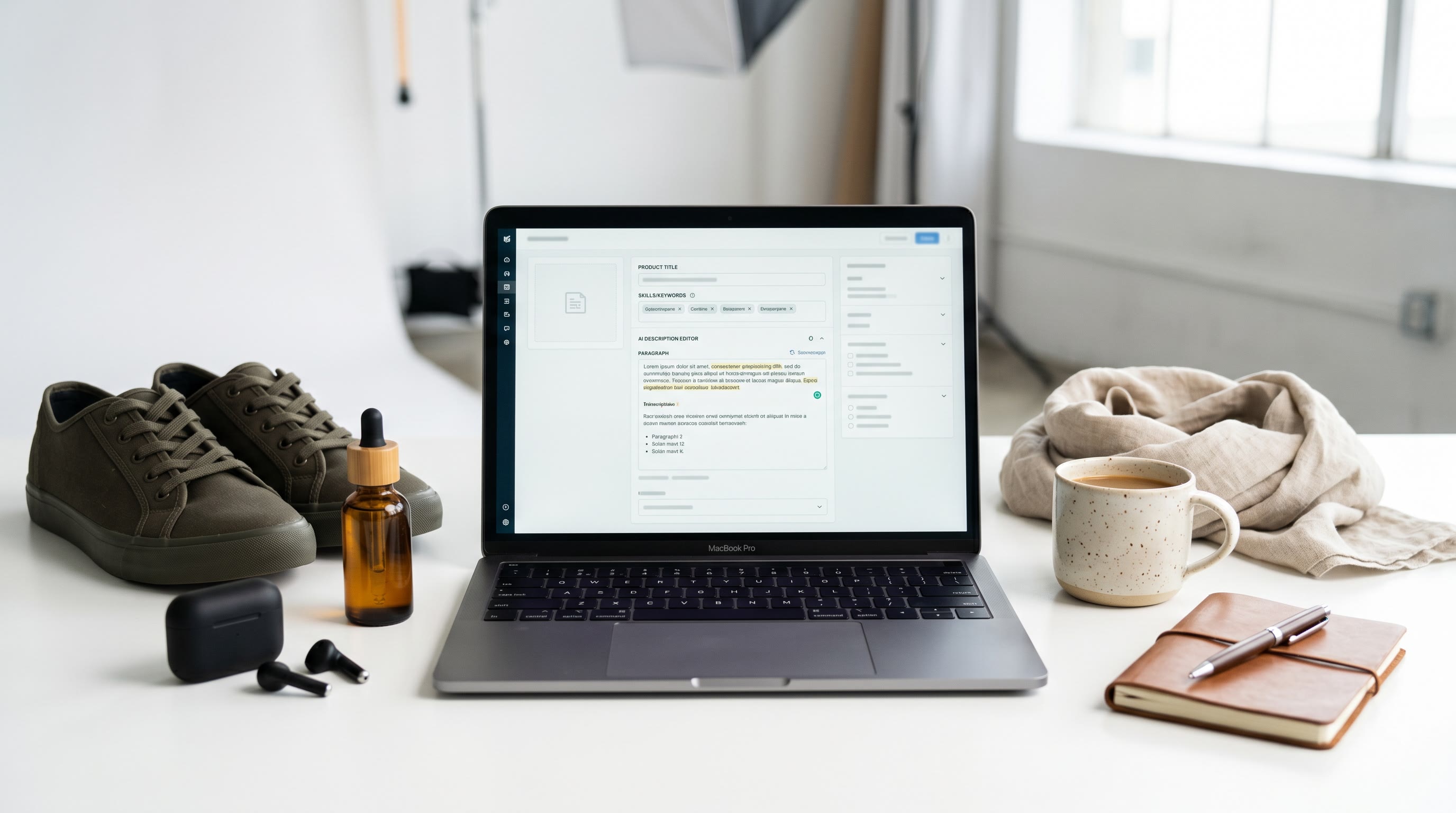
AI Product Descriptions That Actually Convert: A 3-Step Workflow for Ecom Under $3M
You have $50 in your pocket. A copywriter costs $3K-5K per month. Recent conversion research shows AI-generated product descriptions can match or exceed human-written copy on persuasiveness metrics, yet most stores under $3M revenue still run manufacturer boilerplate or one-off copy. The gap exists because founders confuse "AI can do this" with "I know exactly how to make AI do this at scale."
I'll show you the exact workflow. This isn't theoretical. The methodology uses Data's DNA (analyzing every signal your customers leave behind through product page behavior, conversion patterns, and testing data). 87% of online shoppers consider product content extremely important in purchase decisions, and compelling copy increases conversions by up to 78%. You don't need a copywriter for every page. You need one clear template, three AI tools, and statistical rigor.
This system compounds. Start with your top 10 product pages. Run them through the workflow once. Measure the lift. Then systematize it for your next 50 SKUs.
Step 1: Feed AI Your Best Converters (The Style Manual)
You already own the data you need. Pull your top 10 converting product pages from your analytics. Not your favorites. Not your bestsellers. The pages with the highest conversion rate and the most qualified traffic.
For each one, document three things:
- The headline structure (what comes first)
- Benefit sequencing (which problem gets addressed in which order)
- Copy length (word count, paragraph breaks)
This is your style manual. AI models (Claude, Jasper, Copy.ai) all perform better when they have templates. The model isn't learning your voice. It's learning your conversion pattern.
Here's a real example prompt structure:
"Our top-converting product page uses a headline that leads with the customer outcome (not the product name). It lists three specific benefits in order: pain relief first, then durability, then price justification. Each benefit gets one 2-3 sentence paragraph. The description is 280 words. Use this structure for the following product: [product name and basic specs]."
That prompt is worth $3K in copywriter fees because it removes guessing. The AI doesn't generate in the dark. It's pattern-matching against your receipts.
Step 2: Generate Descriptions with Benefit-First Structure + SEO Keywords
Manufacturer descriptions are feature-first. They tell you what the thing is. Convert? No.
Your workflow inverts this. Benefit first. Always. Here's the template:
Headline: [Specific customer outcome], [time frame or condition] (e.g., "Reduce joint pain in 4 weeks, even if you've tried everything else")
Paragraph 1: What this solves for whom. Use numbers. Benefits beat features in ecommerce copy. Don't say "durable." Say "lasts 3x longer than competitors we tested."
Paragraph 2: How it works. Mechanism. This is where you earn credibility. Include your SEO keyword naturally (once, maybe twice). Never forced.
Paragraph 3: Social proof or outcome guarantee. Real results. Objection handling.
Paragraph 4: CTA. One clear ask. Not "Learn More." "Add to Cart" or "Start Your 30-Day Trial."
Tools to run this at scale:
- Claude (via API): Most consistent on tone and SEO balance. Best for brand-voice fidelity. Cost: $0.50-2 per description depending on token volume.
- Jasper AI: Purpose-built for ecommerce. Offers brand voice training and bulk generation. Cost: $39-125/month depending on output volume.
- Copy.ai: Simpler interface. Good for small teams or first-time users. Cost: $49/month for unlimited generations.
Pick one. Run your top 30 product descriptions through it using your Step 1 template. Inspect each one. Fix the 5-10% that need voice adjustments. That's 5-10 hours of human work instead of 40.
Here's what actually happens in practice. You feed Claude a product (say, a weighted blanket) and the Step 1 template. The AI generates four variations automatically. One nails the headline and benefit order. One's close but the third paragraph reads robotic. Two miss entirely. You take the winner, read it once, maybe tweak the opening sentence, and ship it. Total time: eight minutes. A human copywriter charges $1,500-3,000 to write four variations of a product description. You just did it for $0.80. Scale this across 100 products and you've converted $150K-300K in labor costs into $80 in API charges. That's the math that wins wars.
Step 3: A/B Test AI vs. Original with Statistical Significance
This is where most ecommerce founders fall off. They generate copy and ship it. No measurement. No proof. Optimism, not verification.
You don't have 50K monthly visitors. You need to test efficiently.
Here's the doctrine: Verification beats optimism. If your current conversion rate is 2%, and your traffic is 200 visitors/day to a product page, you need roughly 5,000-7,000 visitors per variation to detect a 12-18% lift with 95% confidence. That's 25-35 days of testing.
This is the payoff moment. Most founders skip A/B testing because it requires patience and mathematical rigor. They'd rather launch a "better" description based on gut feel. That's how you stay stuck. The difference between your baseline conversion rate and an AI-generated winner is measurable cash. At 5,000 monthly visitors and a 2% baseline conversion rate, that's 100 conversions. A 15% lift is 15 more customers per month. If your average order value is $150, that's $2,250 monthly. Annual payoff: $27,000. Testing costs you nothing. Guessing costs you $27K/year.
Set it up like this:
- Choose one product page. Start with a page that has traffic (at least 50 daily visitors).
- Split traffic 50/50. Original copy vs. AI-generated copy. Use your platform's native A/B testing (Shopify, WooCommerce, Klaviyo). Don't eyeball results.
3. Measure these metrics:
- Conversion rate (primary)
- Average time on page
- Click-through rate to reviews
- Cart abandonment rate
- Run it for 2-4 weeks minimum. Never stop early. Variance kills conclusions.
- Document the lift. If AI wins by 12%+, you have a documented template. Run it on your next 10 SKUs. If it ties or loses, inspect why. Was the headline weak? Did you miss the benefit sequencing?
This is not fast. It's not sexy. It's the manual. Systems beat slogans.
Common Pitfalls You'll Hit (And How to Avoid Them)
Most founders try this and fail because they skip one of the three steps or execute it half-heartedly.
Pitfall one: You skip Step 1. You feed AI product data with zero examples. The result is generic ecommerce copy that could be from any store. It gets generated fast. Converts like garbage. You conclude AI doesn't work for your vertical. In reality, you didn't give AI the input it needed. Go back. Pull your top 10 pages. Feed them to the model. Try again.
Pitfall two: You run a three-day A/B test. You see a small lift. You declare victory and roll the copy to production. Three days is noise. Conversion variance eats small sample sizes. Run for 2-4 weeks minimum. If your traffic is thin, run for longer. Statistical significance isn't a suggestion. It's the difference between real lift and statistical luck.
Pitfall three: You generate 100 descriptions and assume they're all winners. They're not. Use your top five converted variations as templates. Run Step 3 testing on those five. Once you have three confirmed winners, apply that DNA to the next 50 SKUs. Batch testing beats random testing.
Pitfall four: You generate AI copy and ship it without human review. Some descriptions will have awkward phrasings or miss your brand voice. Budget 5-10 minutes per description for quality control. The AI does 80% of the work. You do 20%. That ratio is unbeatable.
The Math: Why This Wins vs. Hiring
A full-time copywriter: $3,000-5,000/month. Produces 50-80 descriptions per month if they're efficient.
Your AI workflow:
- Claude API: ~$100-300/month for 500 descriptions
- Jasper or Copy.ai: $39-125/month
- Your time: 10-15 hours/month on prompting and QA
You save $2,700-4,800/month. Put that cash into paid search to drive traffic to your new product pages. Now you're compounding.
The compounding works like this. In month one, you generate and test 30 product descriptions. Cost: $80. You discover a 15% conversion lift on five of them. In month two, you apply the winning formula to your next 50 SKUs. Most of those 50 will convert at 80-90% of the lift you saw on the test cohort. You're not starting from scratch. You've built a playbook. By month four, 150+ of your product pages run AI-generated copy that you've statistically proven outperforms the original. The cumulative effect on revenue compounds. Revenue compounds because the founder time you save—hours not spent writing or hiring and managing a copywriter—gets redirected into paid acquisition, strategic partnerships, or product development. Each reallocation multiplies the business. That's the difference between AI as a tool and AI as a system.
When I wrote the back cover copy for "The Ultimate Guide to Self-Directed Investing," the publisher wanted safe, generic language. "Learn investing fundamentals." I rewrote it with specifics: "Invest $10K in a brokerage account without a financial advisor and reduce fees by $400+/year." The distributor hated it. Sales doubled. Specifics sell. Generics sit on shelves. This ecommerce principle is identical. Benefit-first, specific, measurable outcomes. That's what AI copy should deliver.
FAQ
Q: Won't AI-generated descriptions look generic across my store?
No, if you follow Step 1. You're training the model on your best converters, not on the internet's average copy. The AI inherits your conversion DNA, not generic ecommerce templates. Run the output through a human editor to preserve brand voice. Spend 15 minutes per description on final polish, not 45 minutes writing from scratch.
Q: How many descriptions do I need to generate before A/B testing proves anything?
Start with one product page. Run it for 2-4 weeks. If you have less than 50 daily visitors to that page, pick a different one. Statistical significance requires volume. Once you have a confirmed winner, you can apply the structure to new products with higher confidence. But always validate on your traffic, not someone else's benchmark.
Q: What if my AI descriptions convert worse than the originals?
Inspect the failure. Was the original written by a human copywriter or a manufacturer? If it's already optimized, AI won't beat it immediately. Go back to Step 1. Study why the original works. Benefit order? Proof points? Specificity? Feed those patterns into your next prompt. AI improves when you give it better input.
Q: Can I use Shopify's free AI tools (Shopify Magic)?
Yes. Shopify Magic saves merchants 346 hours and $8,725 per year, including 47 hours on 100 product descriptions. The drafts are 85-90% as good as professional copywriters. Use Magic for bulk generation, then run Step 3 testing on the most promising ones. It's free and it works. Shopify's integration means you don't need to learn an API or manage separate tools. Output goes straight into your product editor. The caveat: Magic doesn't learn your Step 1 conversion patterns as easily as Claude or Jasper do. You'll need to provide more detailed prompts. But if you're bootstrapped and can't spend $39/month, start here.
Q: When do I hire a copywriter instead?
When your conversion-per-page exceeds the payoff of AI optimization. If you have 500+ SKUs and can't test each one in reasonable time, or if your product pages require narrative storytelling (not just benefit listing), hire someone. But for stores under $3M with 50-200 core products, this workflow wins. The math is clear.
The system works because it removes the copywriter bottleneck without removing the conversion logic. You feed AI your best signals. AI generates at scale. You measure what matters. Then you repeat. That's not "using AI." That's building an asset: a conversion engine that doesn't require the founder to rewrite every page.
*Jeff Barnes, MBA has no personal position in any company, fund, or platform named in this article. demg.ai has no current commercial relationship with any party mentioned. demg.ai provides marketing education and systems for owner-operators, not investment advice. Past performance does not guarantee future results.*