
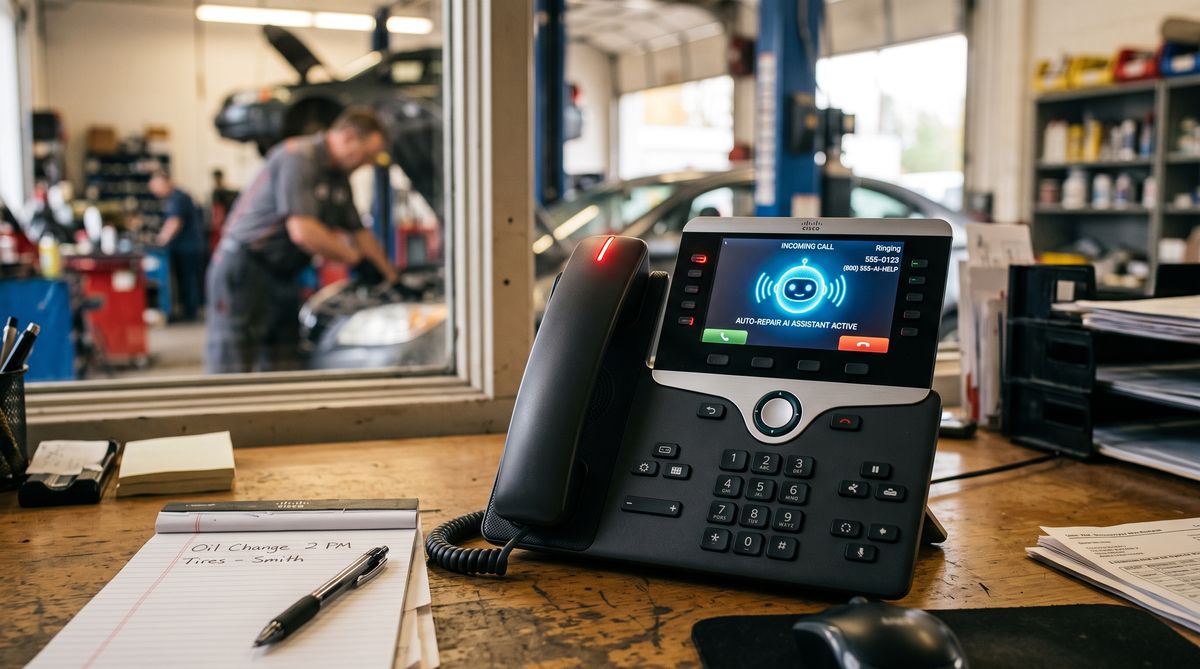
Your phone rings. Nobody picks up. That lost call might cost you $100 to $500.
For service businesses—HVAC, plumbing, dental, auto repair, cleaning—missed calls are missed revenue. The data is brutal: 62% of calls to small businesses go unanswered. You don't even know what you lost. But Owner.com knows. They built an AI phone system that answers every call, takes orders, books appointments, 24/7. It's now part of a $100M ARR platform. Owner plans to expand from restaurants into salons, spas, and grocers. Why not your vertical?
The submarine I served on had one rule: every call gets answered. No voicemail. No exceptions. Your service business should have the same standard. Here's how to build it in 48 hours.
The Math
A typical $500K–$1M service business misses 300–500 calls per month. If you recover 30–50% of those with an AI system:that's 90–250 additional qualified leads per month. At your average deal value, that's $3,000–$15,000 in monthly recurring revenue.
The setup cost is $200–$800 for platform licenses and integration time. You break even in the first month.
Hour 0–4: Choose Your AI Voice Platform
You have four main options. Each trades cost, latency, and flexibility differently.
Bland.ai costs $0.075–$0.15 per minute. Latency is 1.5–2 seconds. You get a web builder, basic CRM hooks, and fast deployment. Good if you want plug-and-play.
Vapi costs $0.10–$0.20 per minute. Latency is 0.8–1.2 seconds. Integration is tighter. Vapi connects directly to Zapier, Make, and native CRM webhooks. Good if your CRM is the core system.
Retell.ai costs $0.12–$0.18 per minute. Latency is 1–1.5 seconds. Their strength is voice naturalness and language support. Choose Retell if language variety matters.
Twilio + Custom Agent costs $0.0135 per minute for calling + $0.02–$0.05 per minute for your LLM (Claude, GPT-4). Total: $0.035–$0.065 per minute. Latency can hit 2–3 seconds if your agent is slow. This is the cheapest option but requires coding.
For most service businesses, start with Bland.ai or Vapi. You'll skip the coding phase. The cost difference is $20–$40 per month if you take 50 inbound calls daily.
Decision rule: If your CRM is already in Zapier or Make, pick Vapi. Otherwise, Bland.ai.
Hour 4–12: Build Your Call Flow
This is the script. Your AI will read it with adjustments based on what the caller says.
Greeting: "Hi, thanks for calling [Your Business]. Press 1 for emergency service. Press 2 to book an appointment. Press 3 for pricing. Press 4 to hear our hours."
Emergency routing: If they press 1, capture their name and address. Confirm address. Say "A technician will call you back within 30 minutes" and hang up. Send that lead straight into your on-call dispatcher via Zapier webhook.
Appointment booking: If they press 2, ask: "What service do you need?" Let them say it in their own words. Your AI should handle 85% of the common ones (AC repair, plumbing leak, brake inspection). For the weird ones, transfer to a human. Then ask: "What day works for you?" Show 3 available slots from your Google Calendar or Calendly. Confirm the appointment.
Pricing: If they press 3, have a simple menu. "Diagnostic fee is $150. Standard service calls are $200–$400 depending on the work." This prevents price shock and weeds out bargain hunters early.
Hours: If they press 4, read your hours and ask if they want to book.
Failure mode: Every call that hits a question your AI can't answer should route to a human agent, not fail silently. Set up a "transfer to live agent" option after 2 failed attempts.
Script length: Keep responses under 30 seconds. Every extra 10 seconds increases hang-up rates by 8%. Be concise.
Connect your calendar to Bland.ai or Vapi via their native integration. If you use Calendly, use Zapier as the middle layer.
Hour 12–24: Connect to Your CRM
Every call is a lead. Your AI should create a contact automatically.
If you use GoHighLevel (GHL): Bland.ai and Vapi both have native GHL integrations. When the call ends, a new contact appears in your GHL pipeline, tagged with "AI Phone : [Service Type]." You can set up automatic follow-up sequences:SMS 2 hours later, email tomorrow, call back in 3 days.
If you use HubSpot: Use Zapier. When the call completes, send the call transcript and lead data to HubSpot via webhook. Create the contact. Trigger a workflow.
If you don't have a CRM: Use Zapier to send leads to a simple Google Sheet, Airtable, or even email. You need a record of the call and the lead info. No spreadsheet is acceptable long-term:get into GHL or HubSpot within 60 days.
What data to capture:
- Caller name
- Phone number
- Service requested
- Preferred appointment time
- Any special notes or questions they asked
- Call duration
- Whether they booked or just inquired
This metadata feeds your follow-up system. A lead who called but didn't book? Nurture them for 30 days. A lead who booked? Confirmation sequence.
Hour 24–36: Test with Real Calls
Don't go live with 500 calls on day one. Take 20 real inbound calls with the AI active. Record everything.
Listen to 5 calls in depth. Ask yourself:
- Did the AI understand the address?
- Did it offer the right service options?
- Did it handle edge cases (same-day emergency, weird service request)?
- Did it ask follow-up questions that mattered?
- Did the caller feel respected or frustrated?
You'll find 3–4 failure modes. Fix them:
Failure #1: Misheard address. Re-record your greeting with clearer audio. Ask the caller to spell their street name. Add a confirmation step: "So that's 123 Oak Street, is that right?"
Failure #2: Wrong service category. Your AI's menu was too narrow. Expand the button-press options. Or let callers speak their service request instead of pressing buttons.
Failure #3: Pricing question the AI can't answer. Add a pricing FAQ to the system. Or route pricing questions to a human. Pricing objections are high-value. Don't let your AI lose them.
Failure #4: Hang-ups on hold. The AI said "Please hold while I check your calendar." Nobody likes holds. Instead, say: "I can book you for Tuesday at 2 PM or Thursday at 10 AM. Which works better?"
Most platforms let you adjust the prompt and redeploy in 15 minutes. Iterate 2–3 times. By call 20, you should see 85%+ successful completions (either booking or successful handoff).
Hour 36–48: Go Live
Start part-time. During business hours, your team still answers the phone. After hours (6 PM–9 AM), the AI takes over.
Forward your main business number to the AI line after 5:59 PM each day. Use a simple rule in your phone system or a Zapier-based call router.
Monitor for 1 week:
- Answer rate: Should exceed 90%.
- Booking rate: Should exceed 40% of calls (some are just info-seekers).
- Hang-up rate: Should be under 15%.
- Human transfer rate: Should be under 20% (calls that need a real person).
If you hit those benchmarks, expand to full-time. Route all calls:day and night:to the AI first. Your team only picks up if the AI can't handle it.
If you miss the benchmarks, pause and debug. Most issues are script-based, not platform-based. Adjust the greeting, the menu, or the routing rules. Retest for 3 days.
The Submarine Standard
On a submarine, every call gets answered. There is no voicemail. There is no "we'll call you back." The standard is absolute.
Your service business can meet that standard now. The technology exists. The cost is low. The ROI is immediate.
An AI phone system isn't fancy. It's not advanced marketing. It's a system. Systems beat slogans. A system that answers every call, captures every lead, and books every feasible appointment will grow your revenue faster than any other single lever you can pull in 48 hours.
Sources and Further Reading
AI phone ordering is not theoretical. Owner.com's $240M Series D announcement documents how Owner.com handles calls, orders, and appointments for thousands of restaurants at $100M+ ARR, powered by AI agents that work 24/7. RuntimeWire's coverage of Owner.com's Series D provides detail on how Owner expanded from pandemic-era online ordering to a full AI operating system. And Forkast's analysis of Owner.com's AI agent model analyzes why Goldman Sachs priced the model at $2.3B: autonomous agents that do the jobs small businesses could never afford to staff.
FAQ
Q: What if I already have a phone system? Your current system can stay. You forward overflow calls or after-hours calls to the AI. The AI handles the surge. Your team never sees the overflow.
Q: Can the AI handle multiple locations? Yes. Most platforms let you create separate call flows per location. One phone number routes to Location A. Another routes to Location B. Each has its own calendar and CRM.
Q: What about GDPR or privacy laws? Tell your callers that the call may be recorded and analyzed. Disclose it in your voicemail greeting or on your website. Most platforms have data residency options (US-based servers, EU-based, etc.). Check your platform's compliance sheet. Don't skip this.
Q: How much volume can these platforms handle? Bland.ai and Vapi handle 500+ concurrent calls. You won't hit that limit. Your business phone likely tops out at 10–20 calls at once anyway.
Q: What if the AI books an appointment the customer forgets? Send them an SMS reminder 24 hours before. Include a link to reschedule. Most AI platforms integrate with Zapier to trigger SMS workflows. This brings no-show rates down from 20% to 8–10%.
Doctrine Connection
Systems beat slogans. A sloganeer says "We answer every call." An operator builds the system that does it.
This 48-hour setup is a system. It has clear milestones. It has measurable gates. It has a feedback loop (test, measure, adjust, deploy). That's what separates playbooks from promises.
If you follow this sequence:platform choice, call flow design, CRM integration, testing, and phased launch:you will have a functioning AI phone system inside 48 hours. Most teams won't. They'll add it to the backlog. They'll say it's too complex. They'll wait for the perfect tool.
You won't. You'll be the owner-operator who captured 30–50% of their missed calls and converted them to $3,000–$15,000 in monthly revenue.
That's the difference between running a system and running behind one.
*Jeff Barnes has no personal position in any company named in this article. demg.ai provides marketing systems and education for owner-operators, not investment advice.*