
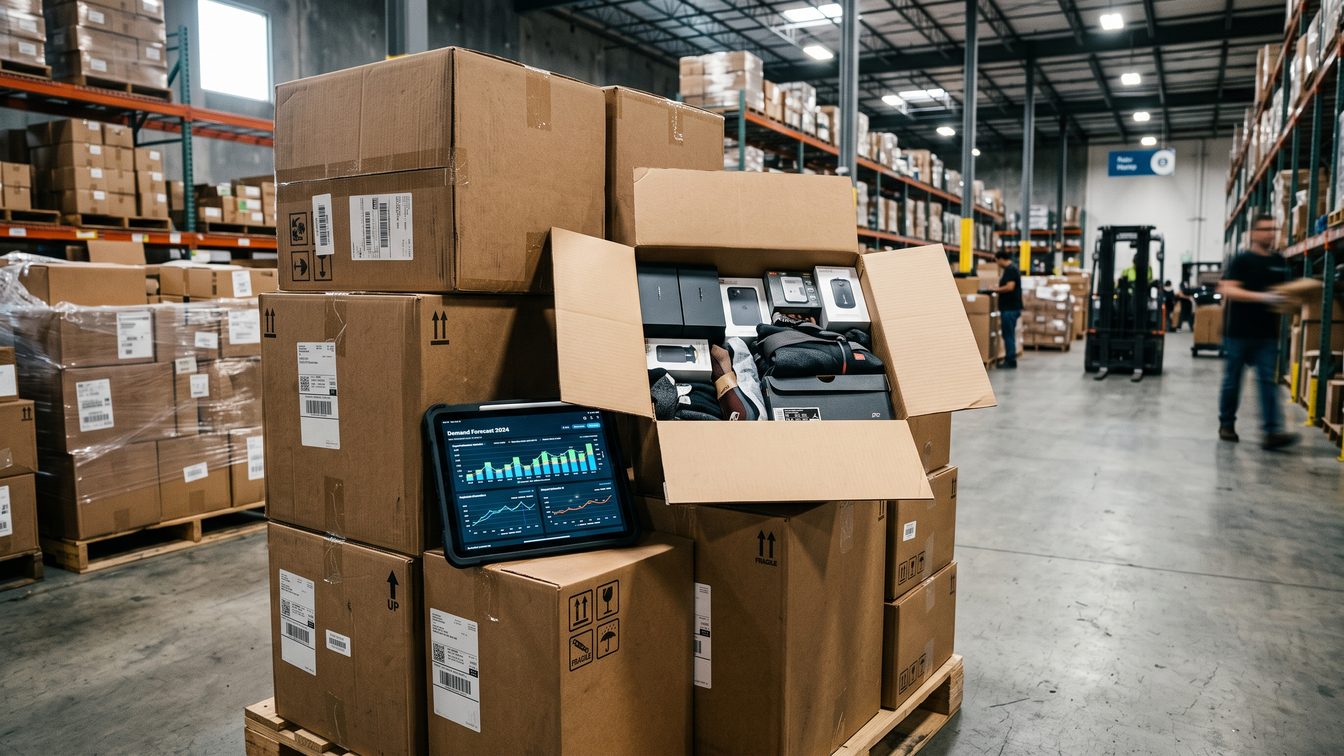
Dead inventory is frozen capital. The average DTC brand under $5M in revenue carries 20 to 30 percent of its SKUs as dead stock, tying up cash that could be deployed into ads, new product lines, or operating runway. Inventory carrying costs eat 20 to 30 percent of total inventory value annually for ecommerce businesses. That means a brand sitting on $300K in inventory is burning $60K to $90K a year just to store and manage product that may never sell. AI forecasting tools plug into Shopify or WooCommerce, learn from your sales history, and predict demand without requiring a data science hire. The ROI timeline is measured in weeks, not quarters.
The Dead Stock Problem Is a Compounding Liability
I have watched ecom operators with $2M in revenue sitting on $400K of dead inventory they ordered based on gut feel. That cash is frozen capital you could be deploying into ads that convert. Every month that dead stock sits in your warehouse, it costs you the carrying charge plus the opportunity cost of capital that is not working.
The IHL Group estimates that inventory inefficiencies cost retailers $1.1 trillion globally every year. For a DTC brand doing $1M to $5M, the proportional impact is brutal because you do not have the balance sheet to absorb a $100K ordering mistake the way a Fortune 500 retailer can.
The root cause is almost always the same: manual forecasting. Spreadsheets. Gut feel. The owner looks at last year's numbers, adds a growth factor, and places the order. When they guess wrong, they are stuck with product that occupies warehouse space and slowly depreciates.
The worst part is the feedback loop. When you stock out of a winner, your sales data shows zero revenue for that SKU during the stockout period. The next time you forecast, the model treats that zero as low demand. You under-order. You stock out again. The snowball rolls downhill.
How AI Forecasting Breaks the Cycle
AI inventory tools work by layering multiple signal sources on top of your historical sales data. They do not just look at last year's number and add a percentage. They factor in seasonality patterns, promotional calendars, external trend data, weather correlation, supplier lead times, and your cash flow constraints.
The output is not a single number. It is a range: best case, probable case, worst case. You set your risk tolerance and the tool tells you exactly how many units to order and when to place the PO so it arrives before the demand spike, not after.
Danish DTC brand Trendhim, which manages 12,000 SKUs across 30 countries, deployed AI forecasting with Kleene.ai and reduced total inventory by 20 percent in 12 months while simultaneously cutting the out-of-stock rate. They also cut replenishment resourcing by 50 percent. That is less inventory, fewer stockouts, and less human time spent on ordering decisions. The trifecta.
The Tool Landscape for DTC Under $5M
You do not need enterprise software. These tools are built for Shopify and WooCommerce operators and priced for businesses your size.
Cogsy ($199/month): Shopify app with 12-month demand forecasting, automated PO suggestions, and cash flow-aware replenishment. Customers report up to 40 percent more revenue from optimized inventory levels and 20-plus hours per week saved on inventory management. Best for Shopify-native brands that want a plug-and-play solution.
Prediko (pricing varies): Shopify-recommended with 2,500-plus merchants and 200-plus five-star reviews. Combines demand planning, supply planning, and analytics in one platform. Strong for brands with complex SKU hierarchies including size and color variants. Visit prediko.io for current pricing.
Singuli (custom pricing): Enterprise-grade AI forecasting that handles multi-channel demand, complex size curves, and deep ERP integrations. Claims up to 20 percent cost reduction across inventory operations. Best for brands approaching $5M that need more sophistication than a Shopify app provides.
Inventory Planner by Sage: Mature tool with strong forecasting and open-to-buy budgeting. Good for operators who think in financial terms and want the inventory forecast tied directly to cash flow planning.
For most DTC brands in the $500K to $3M range, Cogsy or Prediko is the right starting point. Both integrate with Shopify in minutes and start producing forecasts within days of connecting your sales data.
The Math: What AI Forecasting Actually Saves
Take a DTC brand doing $1.5M in annual revenue with $250K in average inventory. At 25 percent carrying cost, that is $62,500 per year just to hold the inventory. If 25 percent of that inventory is dead stock, the brand is carrying $62,500 in product that will eventually be liquidated at a loss.
AI forecasting typically reduces dead stock by 15 to 25 percent. At the conservative end, that is $9,375 in recovered capital from inventory the brand no longer buys. At the aggressive end, that is $15,625. Add the revenue uplift from fewer stockouts on winners (Cogsy reports 40 percent revenue improvement for optimized accounts) and the payback period on a $199-a-month tool is measured in weeks.
The operational savings compound from there. Less time spent on manual forecasting. Fewer emergency reorders at premium shipping rates. Fewer markdowns on product that sat too long. Each of these line items is small individually. Stacked together, they represent the difference between a brand that controls its cash flow and one that is perpetually cash-constrained because capital is trapped in cardboard boxes.
Implementation: The Four-Week Onboarding
Week 1: Install the app in your Shopify or WooCommerce store. Connect historical sales data. The tool needs a minimum of 90 to 180 days of sales history to produce useful forecasts.
Week 2: Configure seasonality rules, supplier lead times, and minimum order quantities. Set cash flow constraints so the tool does not recommend orders you cannot fund.
Week 3: Review the first forecast output against your own intuition. The tool will likely flag SKUs you are over-ordering and SKUs you are under-ordering. Verify those flags against your actual experience before acting on them.
Week 4: Place your first AI-informed PO. Track the forecast accuracy over the next 30 to 60 days. Adjust thresholds based on actual versus predicted demand.
After the first month, the system runs semi-autonomously. You review weekly, approve PO recommendations, and monitor the accuracy metrics. The tool gets smarter with every sales cycle it observes.
The Exit Angle
Inventory management is one of the first things an acquirer examines during diligence. A brand with low dead stock ratios, high inventory turnover, and documented forecasting systems signals operational maturity. It tells the buyer that the business runs on data and process, not on the founder ordering based on feel.
An AI forecasting system that produces clean, auditable demand projections is a tangible asset in the diligence process. It reduces the acquirer's risk assessment and supports a higher multiple. A brand that can demonstrate 90-percent-plus forecast accuracy across four quarters has a fundamentally different valuation conversation than one that wings it.
Key Metrics to Track
Inventory turnover ratio: How many times you sell and replace inventory per year. Higher is better. Target varies by category but 4 to 8 times annually is healthy for most DTC.
Days of inventory on hand: How many days of demand your current stock covers. Target 30 to 60 days depending on lead times and seasonality.
Forecast accuracy: Percentage of forecasts within plus or minus 10 percent of actual sales. Target 85 percent or higher after the first 90 days of AI forecasting.
Dead stock percentage: Share of SKUs with zero or near-zero sales in the past 90 days. Target under 15 percent.
Carrying cost as percentage of inventory value: Target under 25 percent annually.
Doctrine Connection: Capital velocity beats capital volume. Every dollar frozen in dead inventory is a dollar you cannot deploy into ads, product development, or acquisition.
FAQ
Q: How much historical data does an AI forecasting tool need to be accurate? A minimum of 90 days, and the forecasts improve significantly with 12 or more months of data. If you have less than 90 days, most tools will still function but with lower confidence intervals on the predictions.
Q: Can AI forecasting handle seasonal products like holiday or summer inventory? Yes. Seasonality detection is a core feature of every tool in this category. The AI identifies seasonal patterns from your historical data and adjusts forward-looking forecasts accordingly. You can also manually tag promotional periods and events to improve accuracy.
Q: What if I sell through multiple channels like Shopify plus Amazon plus wholesale? Tools like Singuli and Inventory Planner handle multi-channel demand natively. Cogsy and Prediko are Shopify-focused but can incorporate external channel data through integrations. The key is ensuring all demand signals feed into one forecasting model rather than managing channels in silos.
Q: Will AI forecasting work for brands with fewer than 50 SKUs? Yes, and arguably it matters more for small catalogs because each ordering mistake has a larger proportional impact. A 50-SKU brand that over-orders on 5 products has 10 percent of its catalog tied up in dead stock. AI catches those mistakes earlier.
Q: How does this affect my relationship with suppliers? Most operators find that AI-informed ordering actually improves supplier relationships. You place fewer emergency rush orders, your quantities are more consistent, and you can provide suppliers with forward-looking demand projections that help them plan their own production.