
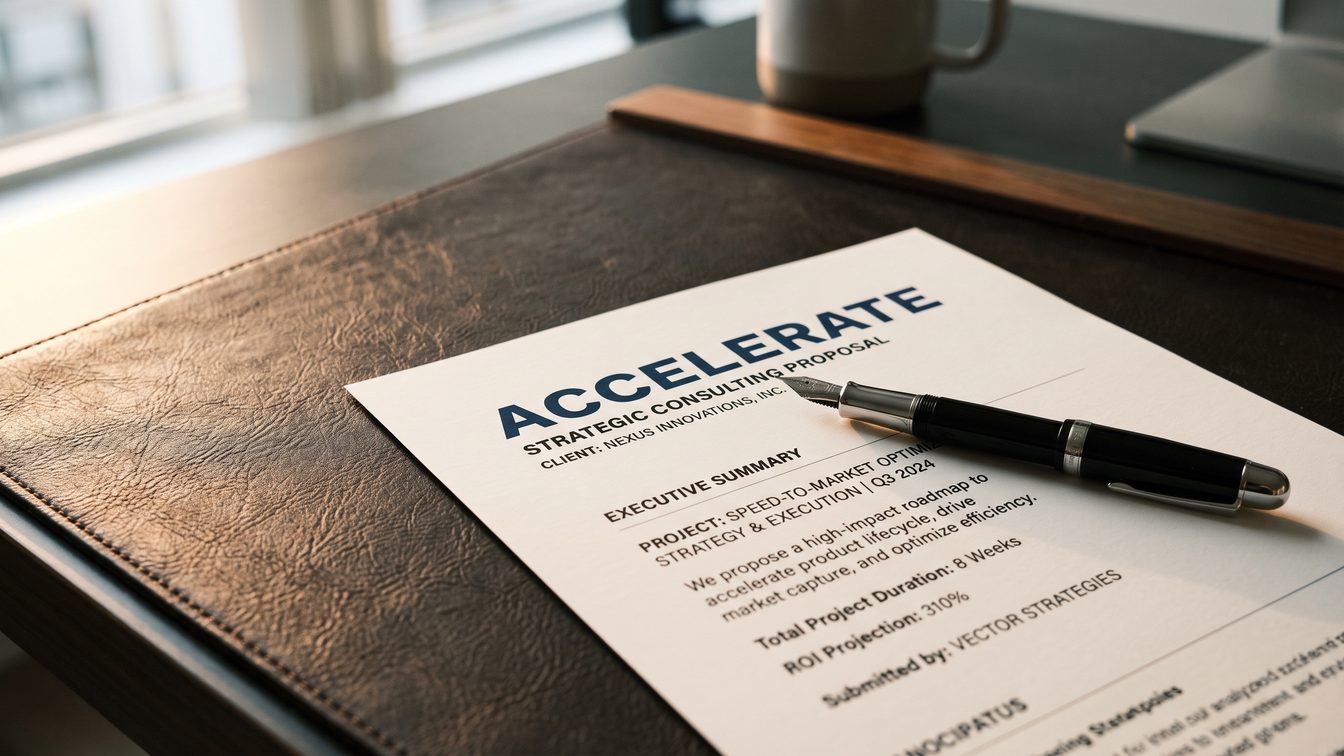
The Problem You Are Living With
You finish a discovery call. Prospect is engaged. Energy is high. You hang up and open a blank doc. Three hours later, you are still writing the proposal from your notes. By the time it goes out, the momentum has faded on both sides.
Most of that work is mechanical. It does not require insight. It requires extraction and assembly.
This is where AI enters. Not to replace your judgment, but to do the work that burns time without producing value. A well-designed discovery-to-SOW system records the call, extracts what was discussed, maps it to your service catalog, generates a draft proposal with pricing, and lands it in your prospect's inbox within 2 hours of hang-up.
Proposals sent within 24 hours close at 2x the rate of those sent days later. Proposals delivered within 2 hours? They are momentum. They signal that you know what you are doing and you move fast.
Why Speed Is Your Real Competitive Advantage
Professional services firms delivering proposals within 48 hours see 35 percent higher close rates than those taking 5-plus days. Most wins or losses are decided in the discovery conversation, not the proposal itself. But the speed at which you respond tells a story about whether you actually listened.
Dan Kennedy built a $40M business teaching consultants to close deals. He called speed of implementation the only sustainable competitive advantage. You cannot sustainably compete on price. You cannot sustainably compete on credentials. But you can compete on being the person who moves first and moves clean.
The ATLAS Model for Your Pipeline
A: Audio. Record and transcribe the discovery call automatically. Otter, Fireflies, or your platform's native recording.
T: Transcript Extraction. Feed the transcript to an AI prompt that extracts named scope items, deliverables, timeline, budget signals, and constraints. Not proposals yet. Just structured call notes.
L: Library and Mapping. Run the extracted scope against your service catalog. If the client said we need customer data analysis, your system maps that to Data Audit plus Insights Workstream. Your catalog has standard deliverables, standard timelines, and standard pricing.
A: Assembly and Tiering. Generate three pricing tiers automatically. Essential: core deliverables only. Recommended: the full scope as discussed. Premium: extends to the nice-to-haves with faster delivery.
S: Send and Track. Route the draft proposal to your review queue. You spend 15 minutes checking scope against what was discussed. Hit send.
What the System Actually Does
You take a 45-minute discovery call with a mid-market firm. They want to build an AI-assisted sales process. You discuss customer research, competitive positioning, messaging frameworks, sales tooling, and team training. Budget signals: $40K to $75K. Timeline: live in 60 days.
Call ends at 2pm. The system starts working.
Transcription captures the call. Within 5 minutes, a structured transcript lands in your workflow. The extraction prompt pulls out scope items: discovery interviews, competitive landscape analysis, messaging framework development, sales tool selection, team training, and a 30-day post-launch check-in.
Your AI prompt maps scope against your service library. It finds your Customer Insights Workstream ($15K base), Positioning and Messaging Workstream ($18K base), Sales Tooling Integration ($16K base), and Training and Enablement ($8K base).
The system generates three tiers.
Essential ($40K): Discovery interviews, competitive analysis, positioning framework, tool selection. No training.
Recommended ($57K): All of Essential plus messaging framework, tool configuration, team training, 30-day check-in.
Premium ($72K): All of Recommended plus extended tool customization, weekly office hours for 60 days post-launch.
Proposal draft is ready by 2:30pm. You review for 10 minutes. Send at 2:40pm.
Prospect opens their inbox 30 minutes later. Three clear options. Pricing on page one. Scope is specific.
Three-day close. Compare that with the consultant who sends a proposal on Friday after spending Wednesday and Thursday writing it.
Three Non-Obvious Choices
1. Separate structural work from voice work. Scope extraction, pricing logic, and risk identification are structural. They should be done by AI. Proposal voice is judgment work. Do that yourself.
2. Invest 20 hours upfront to save 3 hours per proposal forever. Build your service catalog once. Define standard scopes, timelines, and assumptions. Write the extraction prompts. After that, each proposal takes 15 minutes to review.
3. Create a single follow-up rule. Send the proposal. 48 hours later, send a 2-sentence follow-up. Not did you review the proposal. Lead with value: I have been thinking about the 60-day timeline you mentioned. I want to make sure the Essential tier actually works for that window.
Build Your Service Catalog First
Most consultants try to build this system without a clean service catalog. They think they will just make the AI adapt to whatever scope comes up. That does not work.
AI scope extraction works best when you have already defined what your standard scopes look like. If you have not mapped your services into concrete deliverables, timelines, and prices, the AI has nowhere to anchor.
Document for each service: core deliverables, standard timeline in weeks and phases, standard hours and cost, standard inclusions and exclusions, and standard assumptions.
Use your last 5 proposals as the template. What scope do you sell repeatedly? That is your catalog.
FAQ
Q: Will the AI-generated scope feel generic to the prospect?
No, if you have done the extraction step correctly. The scope is grounded in the actual call transcript. You are using the prospect's own language. What feels generic is when the same scope description appears in every proposal regardless of what was discussed.
Q: How do I handle scope creep after the proposal is sent?
Point back to the scope boundaries and assumptions. Your proposal says includes 20 hours of customer interviews and does not include ongoing customer support. If they ask for both, that is a change order. You do not renegotiate. You price the added work separately.
Q: What if the discovery call was fuzzy and scope is not clear?
Do not send the proposal. Run the extraction prompt anyway. Let it surface the gaps. Send that gap list to the prospect as clarifying questions. Get answers. Then write the full proposal.
Q: Who runs this system if I am solo?
You run it. But you are not writing proposals. You are reviewing them. Your job is 15 minutes of review and approval. That is a 10x improvement over 3-hour proposals.