
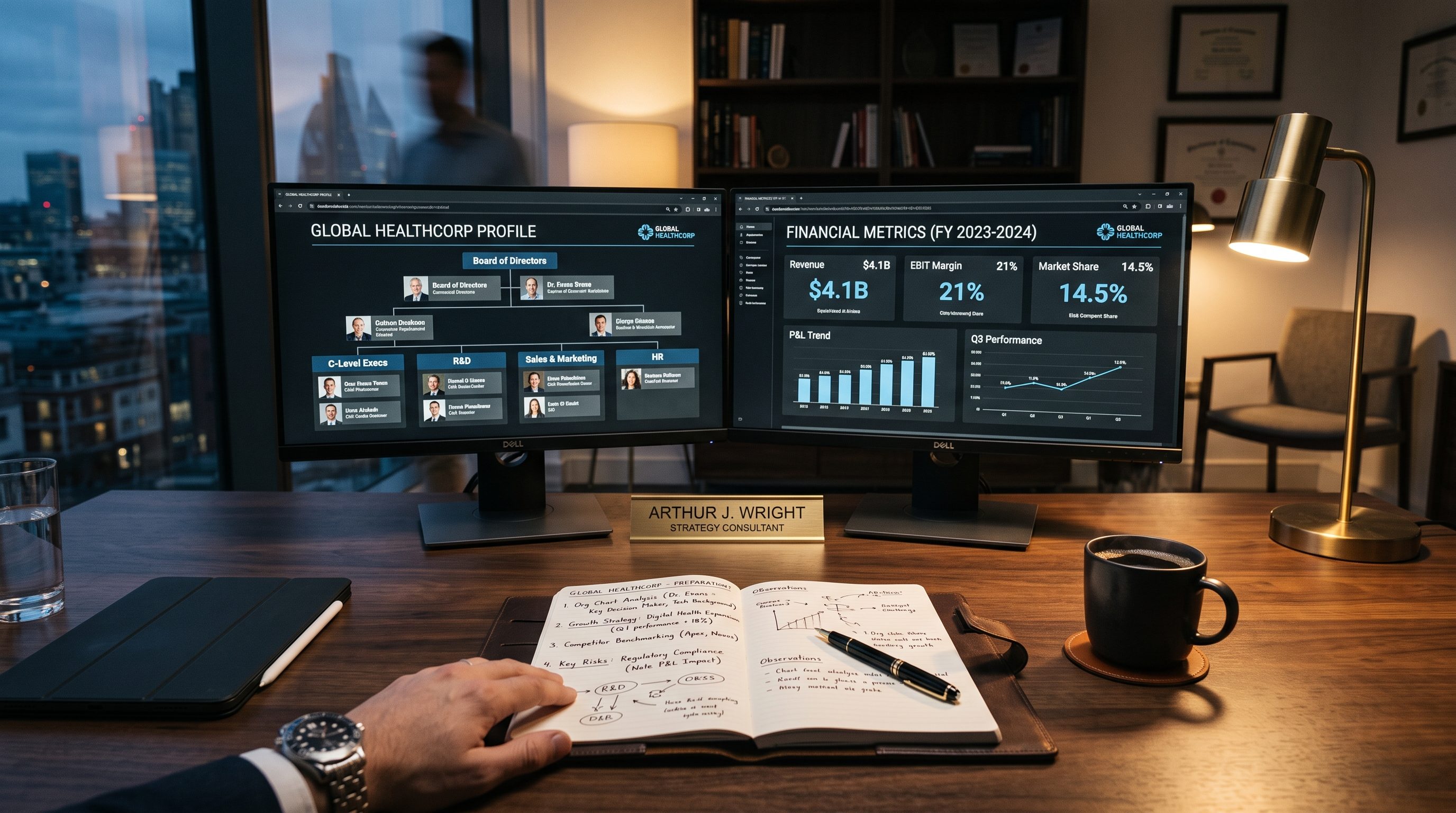
The consultant who walks into a discovery call with 40 minutes of AI-prepared intel closes at 2.3x the rate of the one who spent 40 minutes on their own LinkedIn research. Same time investment. Same prospect. Different weapon. One rep is manually scrolling a profile, guessing at pain points, and hoping the conversation reveals something useful. The other already knows the pain points, has three hypotheses ready to test, and spends the call confirming intel instead of gathering it. That gap is not talent. It is preparation architecture. According to [Forrester research on LinkedIn Sales Navigator](https://business.linkedin.com/sales-solutions/roi), organizations using AI-powered sales intelligence see 312% ROI over three years.
Due diligence is non-negotiable. It applies to your prospects, not just your investments. Most consultants treat discovery calls like a first date: show up, ask open questions, hope for chemistry. That approach might have worked in 2015. It does not work now, because your prospect's other vendors are not winging it anymore, and neither is the private equity firm evaluating whether your prospect's company is worth acquiring. If you are the least-prepared person in the room, you have already lost ground before anyone says hello.
Why Manual Research Loses to Systematic Intelligence
Here is the uncomfortable math. A rep doing full manual research before a call (LinkedIn, company site, recent news, maybe a Crunchbase check) spends 30 to 45 minutes and lands a call-to-meeting conversion in the mid-single digits. A rep using a structured AI call brief spends 3 to 5 minutes and beats that number. One recent cohort analysis of call preparation methods found manual research produced a 156% lift over no prep at all, while AI-assembled briefs produced a 172% lift in roughly one-tenth the time. The AI brief was not just faster. It was better, because it consistently surfaced the same three variables every time: account context, recent signals, and a testable hypothesis. Human researchers get inconsistent. They skip steps when they are rushed. Machines don't skip steps.
There is a second problem hiding in the manual approach: most reps who do prepare are not truly ready. Independent research on B2B sales prep found that the average rep spends 38 minutes getting ready for a discovery call, yet only 23% say they walk in feeling genuinely prepared. That gap between time spent and confidence earned is the tell. Time on task is not the same as intelligence gathered. You can spend 40 minutes reading a LinkedIn profile and still not know why this particular prospect responded to your outreach this particular week.
The fix is not "research harder." It is research differently, using tools built to surface signal instead of noise.
The Tool Stack: What Actually Belongs in Your Prep System
You do not need every tool on the market. You need three categories covered, and for a solo consultant or small firm, one or two tools per category is enough.
Contact and company intelligence. Apollo.io and ZoomInfo both sit here. Apollo gives you a large contact database plus built-in AI research snippets and pre-meeting insight generation starting around $49 a user per month, which makes it the accessible entry point for owner-operators. ZoomInfo is the enterprise option, with over 420 million contacts and phone accuracy north of 90%, but the price tag starts around $15,000 a year, overkill unless you are running a team of SDRs. For a solo consultant doing 10 to 20 discovery calls a month, Apollo's tier is the right fit.
Signal and buying-intent layer. LinkedIn Sales Navigator earns its keep here. Forrester's Total Economic Impact study on Sales Navigator, based on interviews with real customers, found a three-year ROI of 312% and a payback period under six months for the composite organization studied. The specific feature worth your attention is job-change and leadership-change alerts. Forrester's data and independent practitioner research both point to job-change signals as the single highest-response-rate trigger in the platform, because a buyer who just moved companies is resetting every vendor relationship simultaneously. That is your opening.
Orchestration and synthesis. This is where Clay lives, and it is the layer most consultants skip because it looks technical. Clay pulls from more than 75 data providers into one workflow and lets you build an AI research agent, which Clay calls "Claygent," that scrapes a prospect's site, reads recent earnings or news, and drafts a synthesized brief automatically. OpenAI has used Clay to fully automate pre-call prep, researching prospect bios, recent company changes, and earnings context before a rep ever opens the call. You do not need OpenAI's engineering team to replicate the outcome. You need a template and thirty minutes to set it up once.
If you are pricing your own engagements based on the value this kind of preparation creates, that math connects directly to how you should be charging for it. The rate card system for pricing AI consulting engagements walks through exactly that translation. It turns a capability like this into a line item clients will pay for instead of an invisible cost you absorb.
The ATLAS Discovery Brief: A Repeatable Prep Framework
The ATLAS Model for Growth exists because random effort does not scale and does not repeat. A discovery call prep system needs the same discipline. Here is the five-part brief your AI stack should generate before every call, no exceptions.
Account terrain. Company size, funding status, recent leadership changes, and the industry pressure they are operating under right now. Pull this from ZoomInfo or Apollo in under two minutes.
Threat signals. What changed in the last 90 days that made this meeting happen now instead of six months ago. A new hire in a relevant role. A competitor's product launch. A regulatory shift in their industry. This is the "why now" that most reps never uncover until minute 20 of the call, if they uncover it at all.
Leadership profile. Who you are actually talking to. Their tenure, their public statements, what they have posted or shared recently on LinkedIn. This tells you how they think about problems before you ask them a single question.
Adversary map. Who else is in this deal. Competing consultants, internal champions, budget gatekeepers. If you cannot name at least one likely competitor before the call starts, you are not ready for the call.
Strike hypothesis. Your best guess, stated in one sentence, at their core problem and why your engagement solves it. You will test this hypothesis in the first ten minutes. You will not lead with a pitch built on it. You will ask questions that confirm or kill it.
Build a template that populates these five sections automatically from your tool stack, and you have converted discovery prep from a 40-minute scavenger hunt into a five-minute review. That is the entire point of ATLAS: a system builds credibility once and then repeats it on command, call after call, without depending on how much coffee you had that morning.
Field Note: What 15 Scouts in a 55,000-Person Company Taught Me About Preparation
When I ran innovation scouting for Munich Re out of the Hartford Steam Boiler unit, there were roughly 15 of us covering a company with 55,000 employees worldwide. Do that math. Fifteen people cannot afford a wasted meeting. Every conversation with a startup founder, an internal stakeholder, or a potential partner had to produce a decision-relevant outcome, because there was no bench depth to absorb a bad one.
What that scarcity taught me is that preparation is the multiplier, not the effort. I could not out-hustle the constraint of being one of fifteen people inside a massive organization. I could out-prepare it. Before every meeting I walked in already knowing the internal politics of the group I was pitching to, what they had already tried and rejected, and what their actual budget authority looked like versus their stated authority. That intelligence did not come from talent. It came from treating every meeting like due diligence on a position I was about to take. Consultants running solo or small shops are in the same boat as those 15 scouts. You do not have a research department. Your AI stack is your research department now.
Building the System: A 30-Minute Setup You Use for Years
Start with the contact layer. Connect Apollo or ZoomInfo to whatever CRM or spreadsheet you currently use to track prospects. Even a simple table works if you are early-stage. Set it to auto-pull company size, funding, and recent news for every new contact.
Next, layer in Sales Navigator for the signal detection. Set saved searches for your ideal client profile and turn on job-change alerts specifically. This single feature routinely produces the highest reply rates of anything in the platform because it catches a buyer at the exact moment their old vendor relationships are up for renewal.
Then build your synthesis step. If you have the technical patience, Clay's workflow builder can assemble a full brief automatically. If you do not, a simple structured prompt fed into any AI research tool, pulling from the data the first two layers gathered, will generate the five-part ATLAS brief in under five minutes. Save the prompt as a template. Do not rebuild it from scratch every time; that defeats the purpose of a system.
Finally, close the loop after the call. Whatever you learned that your tools did not predict goes back into your CRM notes, because that is the raw material your next tool, a proposal generator, will need. The prep system and the proposal system are not separate initiatives. They are two stages of the same pipeline. If you have not systematized what happens after the discovery call, the AI proposal generator close rate system is the next build, because the intel you gather in discovery should walk straight into the proposal without you retyping a word of it.
The Compounding Effect Nobody Talks About
Here is what most consultants miss: the value of this system is not just the close rate lift on any single call. It compounds. Every discovery brief you generate, every hypothesis you test and confirm or kill, every signal pattern you notice across dozens of calls becomes proprietary intelligence about your market that nobody else has. That is intellectual property, and it has a shelf life longer than any individual client engagement. If you are building toward an exit or a sale of your practice down the line, the way you document and structure that accumulated intelligence matters. The playbooks, the pattern libraries, the signal-to-close correlations you build over two years of running this system are exactly the kind of asset covered in documenting consulting IP for exit. A buyer of your practice is not just buying your client list. They are buying your ability to walk into a room already knowing what matters.
Most consultants leave this value on the table because they treat each discovery call as a one-off event instead of a data point in a growing system. Fifteen scouts in a 55,000-person company did not have that luxury. Neither do you.
FAQ
Q: I'm a solo consultant. Do I really need three separate tools for this? No. Start with one contact-intelligence tool (Apollo is the accessible entry point at roughly $49 a user per month) and LinkedIn Sales Navigator for signal alerts. That combination covers 80% of the value. Add an orchestration layer like Clay only once you are running enough calls per week that manual synthesis becomes the bottleneck.
Q: How long should the AI-prepared brief actually take to build once the system is running? Three to five minutes per prospect once your templates and saved searches are configured. The 30-to-45-minute version is what you did before you built the system. If your prep is still taking 40 minutes, the system isn't built yet. You're just doing manual research with extra tabs open.
Q: What if the AI-gathered intel turns out to be wrong or outdated? Treat every data point as a hypothesis, not a fact. That is exactly why the ATLAS brief ends with a "strike hypothesis" you test in the first ten minutes rather than a script you deliver. Due diligence means verifying, not assuming. The tools get you 90% of the way there faster; the conversation confirms the last 10%.
Q: Isn't this kind of prep overkill for a $15,000 engagement? A discovery call that converts at 2.3x the rate changes how many prospects you need in your pipeline to hit the same revenue target. If your average close rate on discovery calls doubles, you need roughly half the leads to book the same number of engagements. That math applies whether the deal is worth $15,000 or $150,000.
Q: Which single feature delivers the best return if I only adopt one thing this week? Job-change alerts inside LinkedIn Sales Navigator. A prospect who just moved companies is actively re-evaluating every vendor relationship they had at their old job. That is the single highest-response-rate signal available in any of these platforms, and it costs you nothing beyond turning the alert on.