
Build a Client-Ready AI Competitive Brief in 90 Minutes: The Consultant's 4-Tool Stack
Your new client engagement lands Friday. By Monday, the partnership team expects a competitive brief: recent moves, financial position, product roadmap signals, market share shifts, strategic vulnerabilities. You used to clear 6 to 10 hours for this work. Research databases. Phone calls to industry contacts. Three-hour synthesis pass. Another two hours polishing the deliverable into client-grade design.
AI cuts that time to 90 minutes. Not theoretical time. Not "with perfect prompting." Real 90-minute briefs that hold up to partner scrutiny.
I've done this work under pressure. At Hartford Steam Boiler, when Munich Re acquired us and I scouted emerging risks in underwriting technology, I had to produce intelligence briefs fast. The secret wasn't working faster. It was systematizing the research so thinking time went to analysis, not data gathering. The same system works now with AI.
Your stack: Perplexity or Claude for company research. SpyFu or Semrush for SEO and ad intelligence. Exa for market signals and similar companies. Gamma or Beautiful.ai for the final deliverable. Each tool has one job. Each output feeds the next. The handoffs are clean. No redundant research.
Here's the exact workflow.
The 4-Tool Stack Explained
Tool 1: Perplexity AI or Claude for Company Intelligence (20 minutes)
Start with Perplexity. It searches the web in real time and summarizes what it finds. You're not hunting through 47 browser tabs. You ask one prompt. You get structured data back.
Here's the exact prompt:
"I'm building a competitive brief for [CLIENT NAME] in the [INDUSTRY] space. Research [COMPETITOR NAME] and provide: (1) Company founding year, HQ location, leadership team (CEO, CTO, COO names). (2) Last 12 months of announced product launches, feature releases, or service expansions with dates. (3) Recent funding rounds or acquisition activity. If publicly traded, latest quarterly revenue and growth rate. If private, most recent funding valuation. (4) Stated strategic priorities from CEO messaging, earnings calls, or investor updates. (5) Known customer wins or case studies. (6) Job postings in the last 90 days—what are they hiring for? Format as a structured table."
Perplexity returns sourced data. You get URLs linked to each fact. Copy the table into your brief skeleton. Do this for 3 to 5 direct competitors. Twenty minutes for all of them.
If your client needs deeper historical context (board changes, prior pivots, earlier acquisition attempts), Claude handles longer analysis better. Swap Perplexity for Claude and run the same prompt. Claude's context window is larger. The tradeoff: no real-time web search, so you'll supplement with one 5-minute Google search to catch the last 48 hours of news.
Tool 2: SpyFu or Semrush for Ad Spend and SEO Position (20 minutes)
You now have company data. Next question: where are they spending marketing dollars? What keywords are they winning?
SpyFu pulls advertiser data for every competitor. You see: their ad copy variations, top-performing landing pages, estimated monthly spend, keyword bids they're targeting, and historical trends (are they scaling spend or cutting back?).
Semrush does the same with additional SEO tracking: ranking keywords, traffic estimates from organic search, backlink profile, and new content published in the last 30 days.
Your prompt is minimal. Pick your competitor URL. Run the SpyFu or Semrush audit. Export the data. Take three screenshots: (1) ad spend trend over the last 6 months, (2) top 10 keywords they're bidding on, (3) estimated monthly marketing spend. These become your brief's "marketing momentum" section.
Why this matters: ad spend and keyword targeting reveal what the competitor believes will drive revenue. It's where their confidence and capital align. A competitor ramping spend in a keyword you thought was niche? That's a signal. It's not opinion. It's the math.
Tool 3: Exa for Market Context and Similar Companies (15 minutes)
Exa is a search engine built for AI. You ask for "companies similar to Competitor X but solving a different pain point," and Exa returns structured results with summaries.
Your prompt:
"Find 5 companies that are competing in the [INDUSTRY] adjacent to [COMPETITOR NAME]. They may solve a similar problem using different technology, or serve the same customer segment with a different use case. For each, provide: company name, founding year, estimated funding raised, one-sentence description of their positioning, and the specific pain point they're solving. Return as a JSON array."
Exa gives you the landscape. You see who's entering from the side. Who's stealing share in different customer tiers. It takes 15 minutes, and the output is immediately insertable into a competitive landscape diagram.
Tool 4: Gamma or Beautiful.ai for Client-Grade Delivery (25 minutes)
You have research. Tables. Screenshots. Ad spend trends. Exa's competitive map. Now the deliverable.
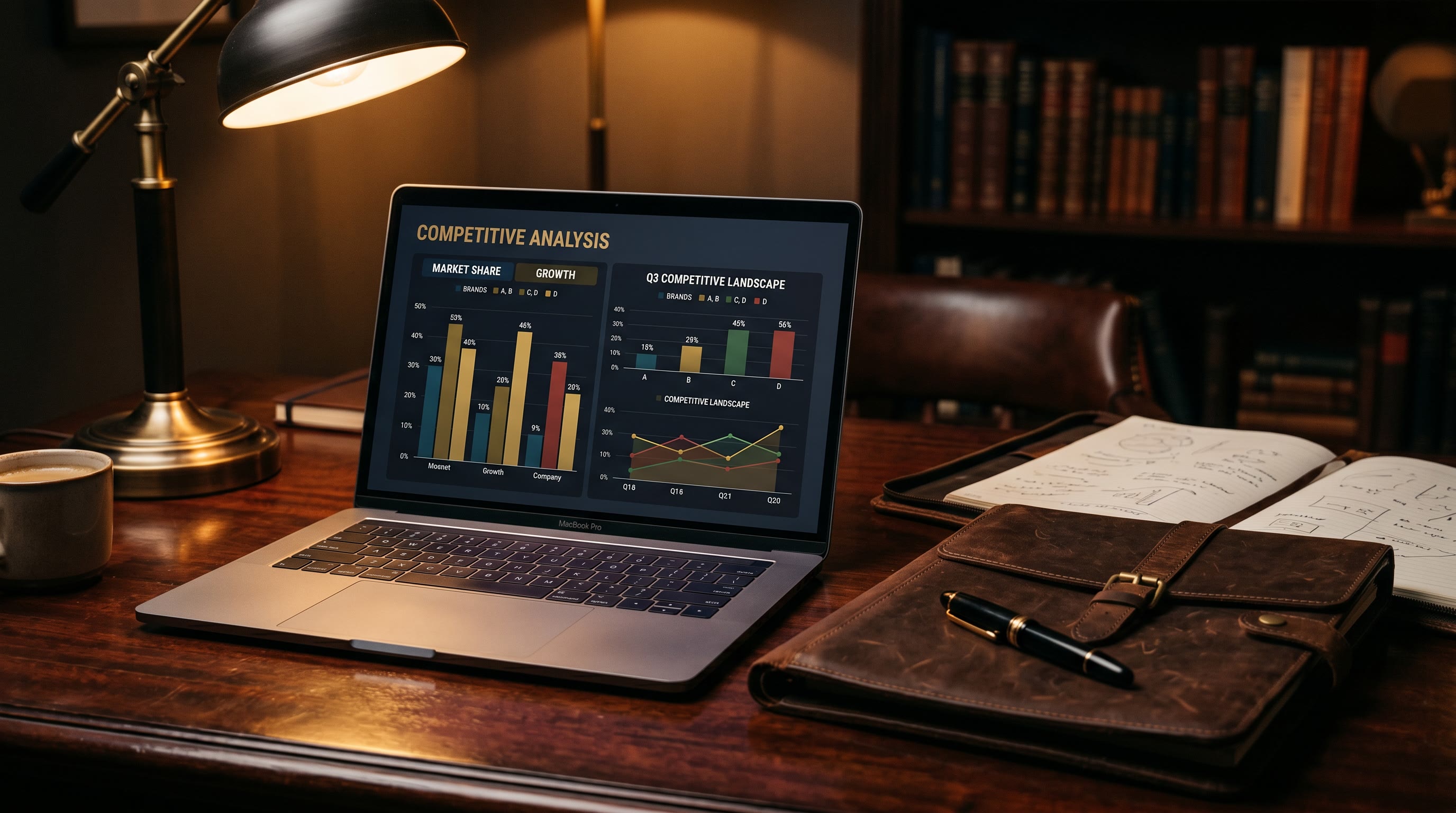
Gamma takes markdown or plain text and generates a polished deck in seconds. You paste your research into Gamma with a prompt: "Create a professional competitive intelligence briefing with these sections: Executive summary (1 slide), competitive landscape (1 slide with 6-company grid), [COMPETITOR] intelligence snapshot (3 slides: company overview, financial position, strategic priorities), marketing spend and keyword analysis (1 slide with chart), market opportunities and threats (1 slide with implications for [CLIENT])."
Gamma builds it. You review, tweak colors to match client branding, and export as PDF or PowerPoint. Twenty-five minutes. The client sees polish. They don't see the time math.
Beautiful.ai works the same way. Both tools have AI slide design. The output looks like it took a designer half a day.
The Exact Timeline
Minutes 0–20: Perplexity research. Three to five competitors. Structured data table.
Minutes 20–40: SpyFu or Semrush export. Ad spend, keyword position, three key visuals captured.
Minutes 40–55: Exa competitive landscape. Five adjacent players. JSON data copied to a working document.
Minutes 55–80: Gamma or Beautiful.ai. Deck assembly, branding review, export.
Minutes 80–90: Buffer. Fact-check one claim per competitor. Verify a financial number against SEC filings or the company website. Read the executive summary aloud—do the implications land? Deliver.
Why This Works
You're not building the brief from scratch every time. You're running a system. Each tool has one input and one output. You're not context-switching between five open documents. You're not hunting for a fact you found three hours ago. Data flows in one direction: research, ad spend, landscape, design, delivery.
The time savings aren't magic. They're compartmentalization. You removed the handoffs that slow you down. Perplexity removes the "open 12 browser tabs and synthesize" step. SpyFu removes the login-to-six-platforms step. Exa removes the manual scrolling through similar companies. Gamma removes the designer waiting list.
Consultants working $500K to $5M engagements often spend this time because the brief is your first deliverable. It signals intelligence. It proves you understand their world before the strategy work starts. A sloppy brief kills deals before they begin. A sharp brief opens doors.
That's the ROI. You recover 5 to 9 hours per engagement. You recover 4 to 6 engagements per quarter if you're doing this work regularly. That's 20 to 36 hours reclaimed. That time goes to the thinking part.the part only you can do. The part that scales valuation.
When This Breaks
If your competitor is stealth-stage (Series A with no public information), Perplexity has little to return. Add a phone call to an industry analyst or a LinkedIn search for founders. Thirty minutes of manual work replaces the twenty-minute Perplexity pass. The system still wins.
If your competitor is international and SpyFu doesn't cover their market, Semrush often does. If neither covers the market, document the gap in your brief. "Competitive ad spend data unavailable in [Country]." It's honest. It's professional.
If the landscape is highly fragmented (30+ micro-competitors), Exa might return noise. Narrow the prompt: "Find 5 Series B or later companies that are explicitly competing for [specific pain point]." Exa's search is smart enough to filter for funding stage and market position.
FAQ
Q: Can I use Claude instead of Perplexity for the initial research?
Yes, if you accept the tradeoff. Claude has a larger context window and handles synthesis better. Perplexity searches the web in real time. If your competitor published news in the last 24 hours, Perplexity catches it. Claude won't. For a brief that needs to be current, Perplexity is better. For a brief that prioritizes depth and synthesis, Claude is better. If you're under time pressure and need both, run both tools and cross-reference.
Q: What if my client is in a regulated industry where I need to cite sources?
All four tools provide citations or source URLs. Perplexity links every fact. SpyFu and Semrush link to the competitor website. Exa returns source URLs. Gamma exports source citations. Your brief is fully traceable. This is non-negotiable in regulated industries. If a claim can't be sourced, exclude it.
Q: How do I know when the brief is "done"?
The brief answers three questions: (1) What is each competitor doing? (2) Where are they investing? (3) What does this mean for my client? If you can answer all three with data that's either 48 hours fresh or evergreen (founding dates, leadership, funding), the brief is complete. Don't chase perfection. Perfectionism is a competitor of done.
Q: Can I automate this further with Make or Zapier?
Partially. You can automate Perplexity prompts and Exa searches via API. You can schedule them to run weekly. What you can't automate is judgment. Which competitors matter? Which market signals are false positives? Which implications are real? That's where your thinking compounds.
Q: What's the difference between this 4-tool stack and hiring a research analyst?
A full-time analyst costs $60K to $85K per year plus overhead. This stack costs $60 to $200 per month. Speed: analyst takes 5 to 8 days per brief. Stack takes 90 minutes. Scale: analyst can do 10 briefs per quarter. You can do 50. Quality isn't lower. It's different. The analyst gives you depth in one direction. The stack gives you speed across the board. For a consulting firm running multiple engagements, the math is clear.
Doctrine Connection: Process Beats Ego
The consultant who insists on doing research the old way.coffee with industry contacts, three-hour synthesis, hand-designed PowerPoints.is betting on scarcity. "No one moves as fast as I do." That's ego math. It's also wrong now.
The consultant who systematizes research using AI compounds speed. You're not faster because you're smarter. You're faster because you removed friction. Process beats ego. Systems beat relying on raw intelligence and hustle.
This brief is a test case. If you can cut 90 minutes off research and get a better brief, what else is held together by "I've always done it this way"? That question, repeated across five to ten projects, is where exit valuation comes from. Founder-independent systems multiply your equity per dollar of revenue. This brief is the first domino.