
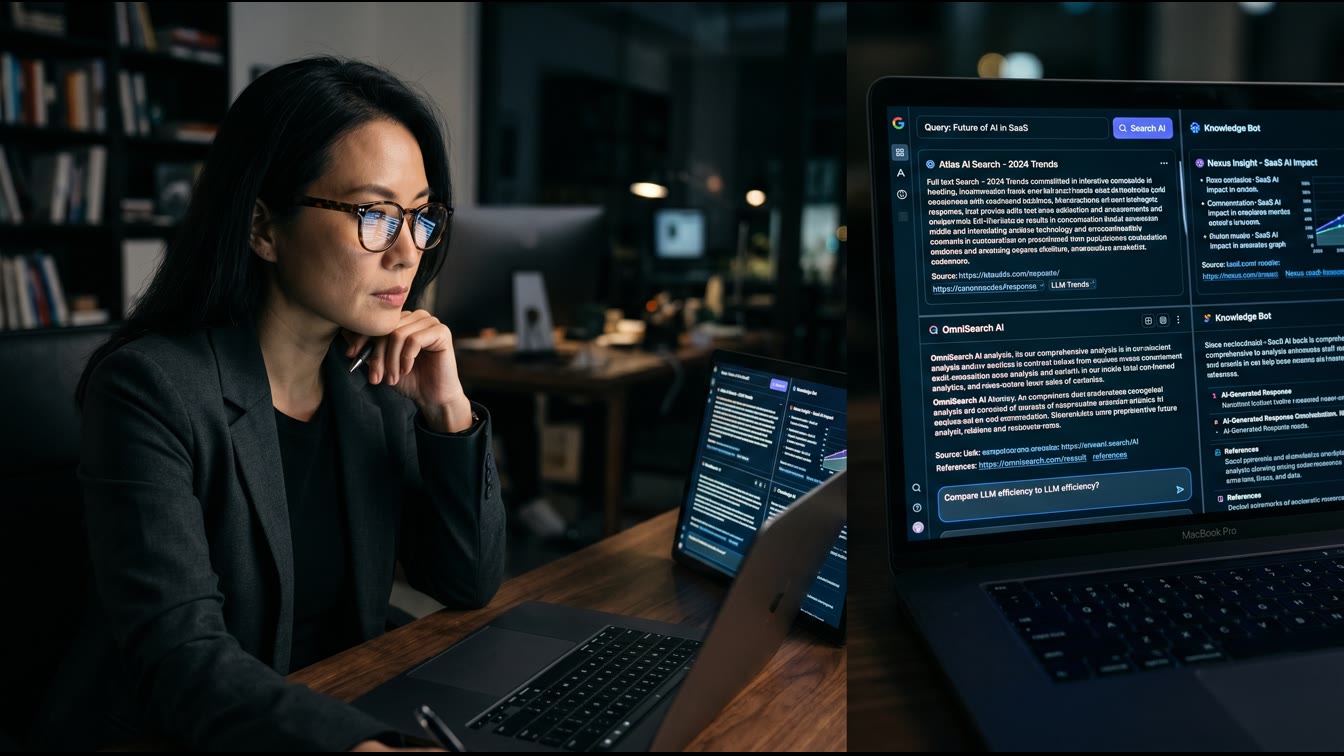
You are either being cited by AI search engines or you are not. That is the whole game now. Answer Engine Optimization — AEO — is the practice of structuring your content so ChatGPT, Perplexity, Google AI Overviews, and Claude pull your name when someone asks a question you should own. For consultants, that matters more than it does for almost anyone else. According to a 2025 Consultancy.org survey cited by Seenos.ai, 42% of executives have already used AI tools to identify potential consultants . up from 18% in 2023. If you are not in those answers, you are not in those conversations.
This is not SEO with a new name. Your content can rank on page one of Google and still be completely invisible in ChatGPT and Perplexity. Ahrefs found that traditional SEO metrics . rankings, backlinks . show little correlation with AI citations. The signals that get you cited are different. The audit takes 15 minutes. Run it once a quarter, minimum.
Why the Math Changed
Here are the numbers you need to know. AI-referred sessions grew 527% in five months across 400-plus websites studied through mid-2025, according to Superlines. Google AI Overviews now appear in 48% of Google searches and reach 1.5 billion monthly users. When an AI Overview appears, organic click-through rates drop 61%. But here is the other side: brands cited in AI Overviews earn 35% more organic clicks than uncited brands. The citation is the position. It is not a bonus.
AI search traffic also converts at 14.2% compared to Google organic traffic at 2.8%, per Superlines. Visitors from AI answers arrive already informed. They skipped the research phase. That is not a coincidence . it is a selection effect. AI answers most surface-level questions directly. The people who still click are closer to a decision.
When I was an innovation scout at Hartford Steam Boiler, part of Munich Re, we tracked every signal that could shift underwriting risk or competitive positioning. No signal went unwatched because one missed signal could mean a mispriced product or an invisible market move. AEO is that same kind of signal for consultants right now. Most are not watching it.
The Five-Step FOCUS Audit
FOCUS stands for: Find your baseline, Observe competitor gaps, Check non-branded queries, Update your citation profile, and Set a standing watch cadence. Run each step in sequence. Do not skip step three.
Step 1: Find Your Baseline
Open a private browser window. Go to Perplexity, ChatGPT, and Google. Run each of these queries using your actual specialty:
- "Who are the best [your specialty] consultants?"
- "What consultant should I hire for [your core problem you solve]?"
- "Recommend a [your vertical] consultant for [specific outcome]."
Record what comes back. Note whether your name appears, whether your website is cited, and what language the AI uses. Perplexity is the easiest platform to audit because it shows a numbered sources panel for every response. You can see exactly which domains shaped the answer. ChatGPT requires browsing mode enabled to pull live results . make sure that is on.
Write down three things: whether you appear, where you appear, and whether competitors appear in your place. This is your baseline. Do not skip this step because it feels obvious . most consultants have never done it.
Step 2: Observe Competitor Gaps
Now run the same queries and look specifically at who is getting cited instead of you. This is where the audit gets useful. AI systems favor certain types of content and sources. Ahrefs' research shows that for commercial searches, 83% of AI citations came from pages updated within the past 12 months, and over 60% from pages refreshed within the last 6 months. Freshness is a citation signal.
Note which domains appear in the sources. Look for patterns: industry publications, case study pages, bylined articles, structured how-to content. That is your gap map. You now know what type of content is winning the citations you are not getting.
Original research and proprietary frameworks earn 5x more AI citations than generic content, per Seenos.ai. A solo consultant who publishes a named framework with real numbers can outrank McKinsey for a specific niche query. That is not a hypothetical. That is the current structure of the market.
Step 3: Check Non-Branded Queries (Do Not Skip This)
This is the step most consultants miss entirely. Checking whether you appear for your own name is table stakes. The real test is whether you appear when no one is searching for you specifically.
Run queries structured around problems and outcomes, not names:
- "How do I fix [specific client problem in your niche]?"
- "What does a good [deliverable you produce] look like?"
- "How much should I pay for [your service category]?"
These are pre-awareness queries. The buyer does not know your name yet. If AI answers with your content, your framework, or your cited work . you are being introduced at exactly the right moment. If AI answers with someone else's content, you have an acquisition gap you cannot close with any amount of LinkedIn posting.
Ahrefs' analysis of 15,000 competitive B2B queries found that 87.3% of companies have AI blind spots . high-value queries where they rank in traditional search but are invisible in AI responses. Most of those blind spots cluster around buying-intent queries.
Step 4: Update Your Citation Profile
Now you know where you are and where you are not. The citation levers are specific. Content with statistics, citations, and quotations achieves 30-40% higher AI visibility, per data from Superlines. Pages updated within two months earn 28% more citations than older content.
The four immediate actions:
Add FAQ schema markup. FAQPage structured data signals to AI systems that your content directly answers questions. This is invisible HTML . your web developer can add it in an hour. Google's AI Overview and Perplexity both weight it.
Write direct-answer opening paragraphs. Every article and case study page should answer the core question in the first 100 words. AI systems sample from the beginning of content. If your first paragraph is an introduction to yourself, it will not get cited. If it is the answer, it might.
Update your best pages. Pick your three highest-traffic pages and add one new data point, one updated statistic, and a current date to the published-on field. That freshness signal alone can shift citation rates.
Publish one named framework. Give your methodology a name. Document it in a single page with step-by-step structure, real client outcomes, and specific numbers. Named frameworks get cited. Generic services pages do not.
Step 5: Set a Standing Watch Cadence
The audit is not a one-time event. AI models update their retrieval sources. Competitors publish new content. Your own content ages out of the freshness window. Standing watch means checking your citation profile on a defined schedule.
For manual monitoring, repeat the 15-minute query test quarterly. For automated tracking, Ahrefs Brand Radar tracks your mentions, citations, impressions, and AI Share of Voice across ChatGPT, Perplexity, Google AI Overviews, Gemini, and Claude. The free AI Visibility Checker gives you a one-time snapshot at no cost. HubSpot's AEO Grader sends your brand information to ChatGPT, Perplexity, and Gemini and returns a scored report across five dimensions: sentiment, presence quality, brand recognition, share of voice, and market position.
At minimum, audit quarterly. If you are actively building content to improve your position, audit monthly.
The Receipts
Here is what the data says about why this matters in 2026:
- AI referral traffic now accounts for 1.08% of all website traffic and grows roughly 1% per month, with ChatGPT driving 87.4% of that share, per Conductor 2026 Benchmarks cited by Superlines.
- Google AI Overviews now appear in 25.11% of all Google searches . up from 13.14% in March 2025 . based on analysis of 21.9 million queries.
- AI-referred sessions to websites grew 357% between June 2024 and June 2025, generating 1.13 billion referral visits in that month alone.
- The position-1 click-through rate drops 58% when an AI Overview is present, per Ahrefs' December 2025 study of 300,000 keywords.
These are not projections. This is the current state of search. The consultant who waits for the trend to become obvious has already lost the first-mover window.
What AI Is Actually Looking For
AI systems cite sources that meet a specific profile. The pattern is consistent across platforms: structured content, recent publication dates, first-paragraph direct answers, named authors with demonstrated credentials, external citations within the content itself, and schema markup that labels the content type.
The word to remember is *authority signals*. AI does not look at your LinkedIn connections or your client list. It looks at what you have published, whether that content is structured to be machine-readable, and whether other credible sources point to it. That is competence made visible through documentation. Credentials are what you say about yourself. Competence is what the content proves.
FAQ
Q: Do I need a paid tool to run this audit? No. The manual query test across Perplexity, ChatGPT, and Google costs nothing and takes 10 minutes. Ahrefs' free AI Visibility Checker and HubSpot's free AEO Grader both provide scored snapshots at no cost. Paid tools like Ahrefs Brand Radar add automated monitoring, competitor tracking, and historical trend data . useful once you have established a baseline.
Q: How often do I need to recheck my AI visibility? Quarterly for most consultants. Monthly if you are actively publishing new content or have identified a specific gap you are trying to close. AI models update their sources on irregular schedules, so a single check does not stay current.
Q: What type of content gets cited most in AI answers? Content that directly answers specific questions, uses structured formatting, includes real data with citations, and has been updated within the past six months. Named frameworks, step-by-step guides, and case studies with specific outcome numbers consistently outperform general service descriptions and about-page content.
Q: My Google rankings are strong. Does that mean I am visible in AI search? Not necessarily. Ahrefs' research found low correlation between traditional SEO rankings and AI citation rates. A page can rank in position one on Google and never appear in an AI Overview or ChatGPT answer. The signals are different. Both audits are worth running independently.
Q: How do I know if a competitor is being recommended instead of me? Run your non-branded queries in Perplexity and note the sources panel. Any domain appearing there for queries about your specialty is winning citations you are not. That is your direct benchmark. Check those pages, identify what they have that yours do not . usually fresher data, more structured formatting, or FAQ schema . and close the gap.
Doctrine Connection
The doctrine here is that competence beats credentials. Credentials are what you say about yourself in a bio. Competence is what your content proves when a machine reads it without context. AI systems do not know your firm's history, your client list, or the awards on your wall. They know what you have written, how it is structured, and whether other credible sources point to it.
The 15-minute audit tells you exactly where you stand in that judgment. Run it. Write down the results. Fix the gaps. Then stand watch every quarter to hold the position you built.