
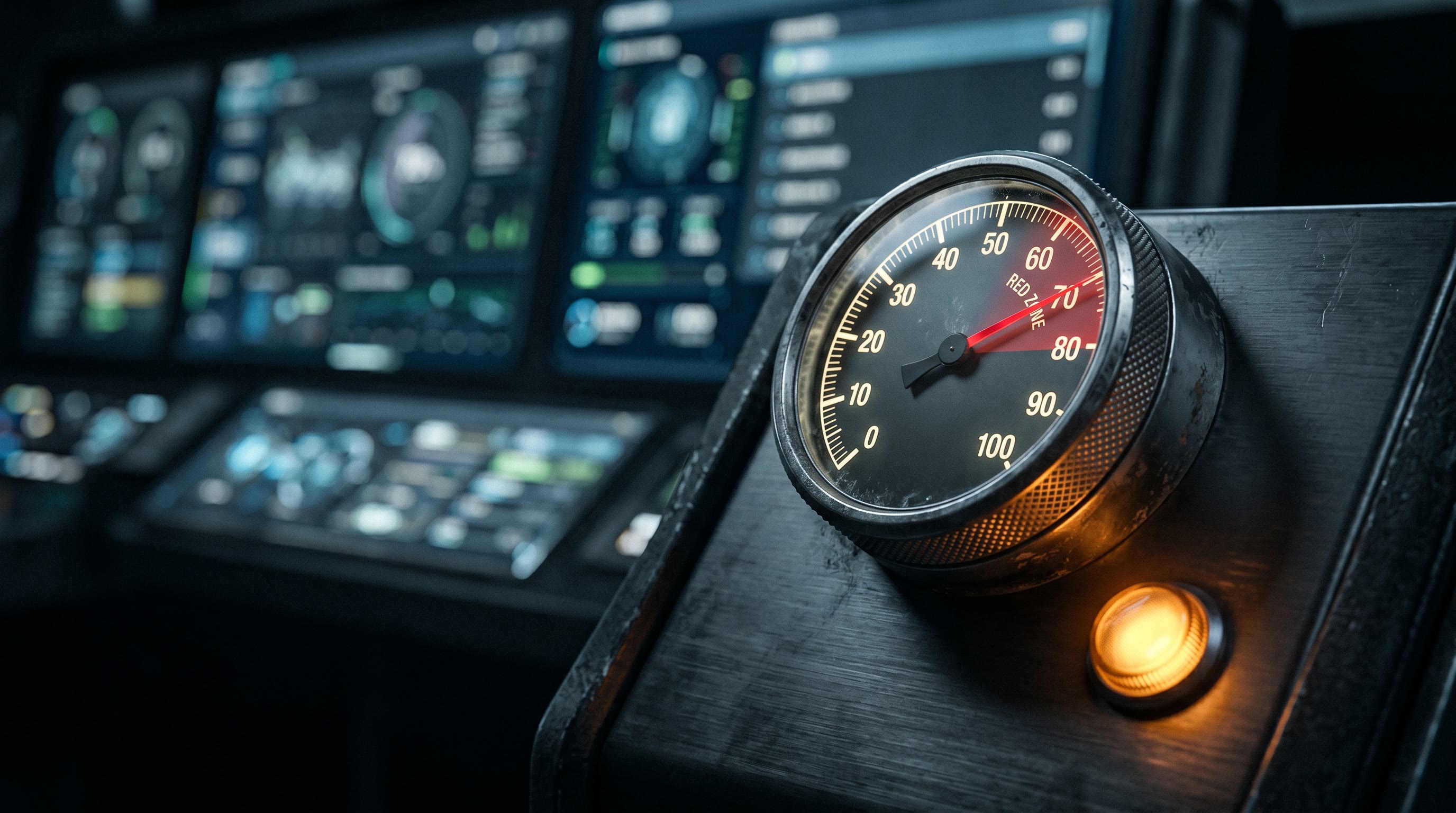
The 80% Threshold: Where Automation Becomes a Wall
You can automate too much. Not in theory. In practice. The threshold is real and measurable. When 80% or more of your customer touchpoints run on automation without human review, satisfaction drops. Period.
This is not philosophy. This is math.
The operator who automates everything is not building a system. You are building a wall between yourself and the people who pay you. The Sovereignty Stack framework says this clearly: own your infrastructure AND your relationships. Not one or the other.
The Data
84% of small business owners say AI saves them time. That number is correct and incomplete.
The median small business now uses five AI tools. Five. They're stacking them: email, scheduling, social posting, customer support, payment processing. The automation is real. The time savings are real. The operational marketing cost reduction is 12.2% on average.
But read deeper. The most effective automation model is collaboration. Human plus AI. Not AI alone.
Gartner projects 70% of new enterprise applications will be built on low-code and no-code platforms by 2026. The pattern is clear: non-technical operators are building systems. They're using tools instead of code. And they're winning. Until they aren't.
When automation crosses 80% density.when you've eliminated human touchpoints at a scale where the customer rarely encounters a real person.satisfaction declines. Marketing automation research from 2026 shows this consistently. More touches. Lower satisfaction.
The Submarine Model
I ran the engine room on the Jefferson City. Precision. Discipline. Every system had automated fail-safes. Alarms. Redundancy. But here's what commanders understand: no submarine captain trusts automation blindly.
You stand watch. You verify. The automated alarm tells you something is wrong. The human decides what to do about it. That is the model for your stack.
The automation alerts you. The human decides.
The automation executes routine work. The human verifies and adjusts. The automation tracks metrics. The human interprets and strategizes.
That balance is not inefficiency. It's survivability. It's the difference between a system that owns its customers and a wall that processes them.
Why 80%?
The number isn't random. When automation handles four out of five interactions, the fifth.the human interaction.becomes the outlier. It becomes the exception. Customers experience friction because inconsistency creates friction. Automated responses are fast. Consistent. Cold. Human responses are warm. They adapt. They break the pattern.
When 80% of your customer journey is automated, the human touchpoint feels like an error. Like something broke and now they have to deal with a person.
Reverse it. When 20-40% is automated and 60-80% includes human involvement, the human touchpoint feels normal. Expected. Good. The automation is the convenience layer. Not the foundation.
Owner-Operator Reality
The owner-operator who automates everything faces a specific problem: replacability. Your system becomes worth something. You become worth less. The business runs without you. That sounds good until you try to sell it.
Acquirable businesses have people. Systems. Process. But they also have owner relationships embedded in the P&L. Customer stickiness. Operator-dependent revenue. That is valuable. That is worth paying for.
The business that eliminated you entirely? It's harder to price. The buyer inherits all the relationship risk. They get operational efficiency but zero personality. Zero adaptability. Zero the human touch that kept customers when things went wrong.
The math is clear. The business that pulls 60% of revenue from relationships and 40% from systems is more valuable than the business that pulls 100% from pure automation. The hybrid is acquirable. The pure-automation shop is a commodity.
The Stack Approach
Your sovereignty stack includes automation. Of course it does. Automation is capital. It compounds effort. It removes drudgery. Klaviyo research shows marketing automation drives engagement and reduces manual work at scale.
But the stack is named for a reason. It layers. Automation at the bottom. Human review in the middle. Strategy at the top.
Email goes out automated. Opens and clicks are tracked. Sequences advance based on behavior. But someone reads the unsubscribe notes. Someone reviews the churn patterns. Someone decides: should we adjust the sequence or follow up personally?
Social media posts schedule themselves. Content calendar automation is real. But someone reads the comments. Someone decides what deserves a personal response versus a templated one.
Your CRM tracks everything. Leads flow in. Drip campaigns activate. Scoring adjusts. But the human sales leader still picks up the phone for the $100K deal. The operator still reaches out to the customer who just renewed.
This is not inefficiency. This is architecture. It's the difference between a system that scales and a system that scales and breaks.
The Cost of Over-Automation
When you automate past 80%, costs hide. They don't disappear.
Customer churn ticks up. Slowly at first. Then faster. You notice lower repeat purchase rates. Higher cancellation. More support tickets that could have been prevented by a phone call.
The automation didn't cause it directly. But the absence of human contact did. The customer hit a problem. The system gave them a template response. They left.
The second hidden cost is competitive vulnerability. A competitor who answers the phone wins. A competitor who calls when you're at 50% churn wins. They're doing what you automated away. They look human. Responsive. In control.
The third cost is data blindness. Automation executes. Metrics flow. But pattern recognition requires judgment. It requires a human who cares enough to notice the anomaly. To ask "why?" instead of accepting what the dashboard says.
You're left with clean data and no insight. That is expensive.
The Sovereignty Stack Framework in Action
The Sovereignty Stack starts with one principle: own your infrastructure. Own your relationships. Own the data. Not your tools. Not the cloud. You.
Applied to automation, it means:
Your email provider is a tool. You own the list.
Your CRM is a tool. You own the data and the customer relationships.
Your automation platform is a tool. You own the workflow logic and the decision points.
And you.the operator.own the threshold. You decide where human involvement enters the flow. You verify the output. You stand watch.
The submarine captain doesn't abolish the engine room. They watch it. They verify it. They're ready to interrupt if something is wrong. That's ownership.
Small business operators who are using AI effectively are doing this. They're using five tools and a human brain. WordStream research shows the top performers combine marketing automation with strategic oversight.
The bottom performers? They set it and forget it. Automation at 95%. Human involvement at 5%. Revenue at 50% of what it should be.
When to Automate, When to Protect
Automate data entry. Automate scheduling. Automate reminders. Automate invoice generation. Automate follow-up sequences that have passed a verification test.
Protect first contact. The first conversation with a customer should have human judgment. Your message. Your voice. Your certainty that you understand their problem.
Protect moment-of-sale. The buying decision deserves human presence. Not a bot. A person who believes in what they're selling.
Protect the escalation. When a customer is frustrated, automation is noise. A person is repair.
Protect the renewal. The moment they decide to stay or leave is not a sequence trigger. It's a relationship checkpoint.
The business that automates entry, scheduling, reminders, and sequences.but protects contact, sale, escalation, and renewal.will outcompete the business that automates all five.
That is the doctrine. Process beats ego. Build the system. But stand watch.
FAQ
Q: Are you saying I shouldn't use marketing automation?
No. Use it. Use email sequences, CRM automation, scheduling, and workflow tools. They're capital. They compound. But use them as tools within a system that you own and oversee. Not as substitutes for judgment.
Q: How do I know if I'm at the 80% threshold?
Count your customer touchpoints in the last month. How many required a human response? How many were fully automated end-to-end? If 80% or more of your interactions were automated without anyone reviewing the outcome, you're at the threshold. Pull back.
Q: What does "stand watch" mean in a marketing context?
It means monitoring. Reading unsubscribe notes. Checking customer churn reasons. Reviewing support tickets. Looking for patterns that the automation didn't catch. It means the operator is present, even if the execution is automated.
Q: If I'm buying a business, what automation level should I demand?
Ask how much revenue is dependent on human relationships. If it's below 20%, the business is fragile. The owner-operator relationship is gone and the business is pure commoditized automation. If it's 40-60%, the business is durable. The operator has built relationships the previous owner maintained. That's acquirable.
Q: Should small teams automate differently than enterprises?
Yes. Small teams should automate fewer touchpoints. You're the watch-stander. You're reading every piece of feedback. Enterprises can automate more because they have people dedicated to watching. But the principle holds: do not exceed 80% automation without adding human review at the decision points.
The Doctrine Connection
This is where Process beats ego becomes operational.
The operator who wants to run everything manually.who rejects automation as lazy.is letting ego run the business. That's the wrong doctrine. Process is better. Systems are better. Automation is better.
But the operator who wants to automate everything.who thinks they can eliminate the human requirement entirely.is also letting ego run the business. The ego of thinking the system is more reliable than judgment. That's also wrong.
Process beats ego means: build the system that works. Use automation where it compounds. Use human judgment where it matters. Stand watch. Verify. That is the operator who owns their business.
Not the one who built a wall.