
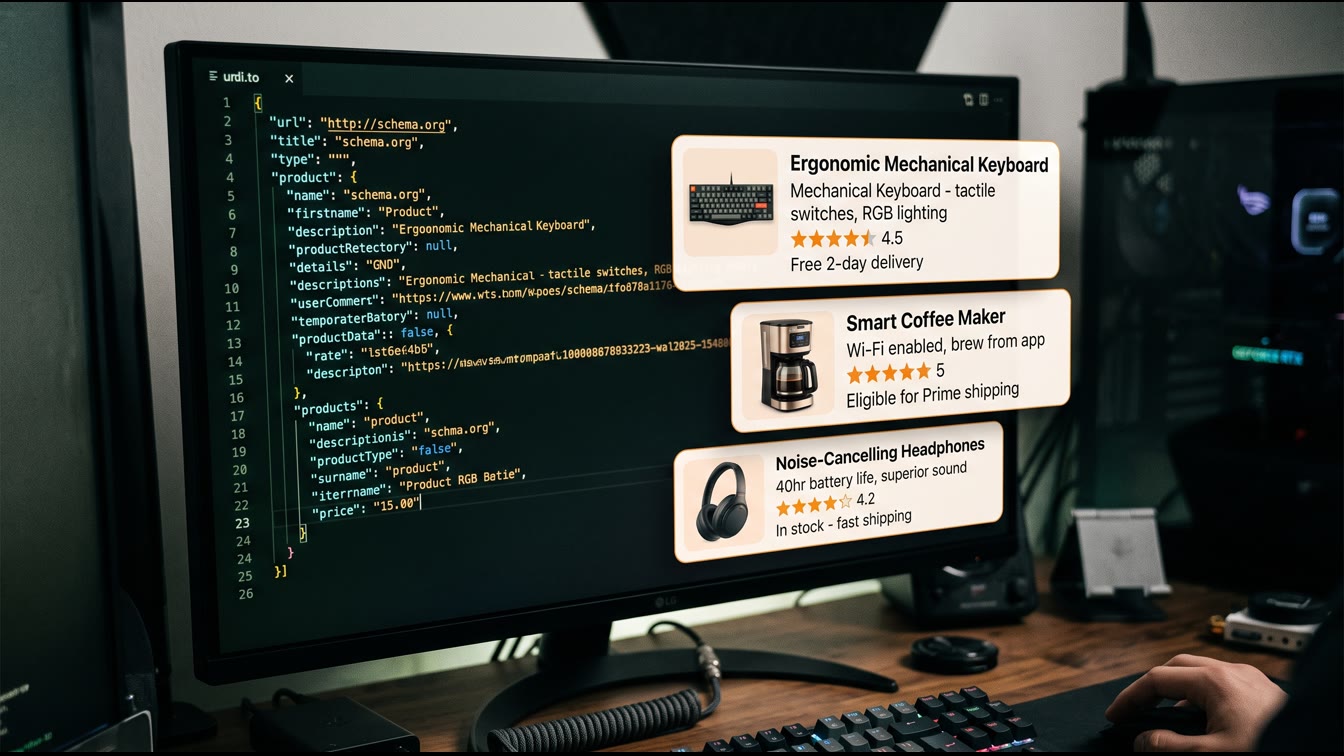
Schema markup went from a nice-to-have to a prerequisite in 2026. Most Shopify stores have not caught up. Here is the direct answer.
Google began weighting MerchantReturnPolicy and ShippingDeliveryTime schema more heavily in its product knowledge graph starting early 2026. Merchants with complete, validated product schema are now appearing inside AI Overviews as cited sources, even when they do not win the click. Five schema types matter most before Q4 2026: Product with full attributes, MerchantReturnPolicy, ShippingDeliveryTime, FAQPage, and Organization.
Add them now or your competitors cite themselves into your customers' search results while you stay invisible.
I ran nuclear reactors before I ran a venture network. A reactor operator does not get to say "the gauge looked fine yesterday." You read the instrument now, because the instrument tells you what is happening right now.
Google's AI Overviews are the new instrument panel for ecommerce visibility, and the readings changed in early 2026. Stores that have not adjusted are flying on yesterday's gauge.
Why schema became mandatory, not optional
"Structured data is now a prerequisite, not a bonus," said Lily Chen, lead technical SEO at Riser Commerce, an agency managing SEO for more than 40 Shopify Plus merchants (Ecommerce Times, July 2026). Chen's team has watched merchants with complete, validated product schema get cited inside AI Overviews as trusted sources.
That citation drives branded search volume even without a direct click. The downstream brand-search effect shows up clearly in Google Search Console once you know where to look.
The mechanism is simple. When a shopper searches "best wireless earbuds under $100," Google's AI Overview synthesizes a recommendation before the shopper ever sees a blue link.
Ahrefs' July 2026 analysis of 2.1 million ecommerce keywords found click-through rates collapsing on positions one through three in query sets where AI Overviews now appear. Merchants who show up as cited sources inside that overview keep visibility. Merchants who do not show up disappear entirely, regardless of their organic rank.
FAQPage schema shows how fast the rules changed. Google reduced FAQ rich-result eligibility back in 2023, and most SEO teams stopped bothering with it. It is back in relevance in 2026 because AI Overviews pull heavily from FAQ-structured content when assembling summaries, even though the visual accordion in search results never returned. The schema stopped being about winning a rich snippet. It started being about winning a citation.
The Owner's Exit Engine framework
I built the Owner's Exit Engine framework for founders preparing to sell a business, and it applies directly here. An acquirer does not buy your traffic. An acquirer buys a system that keeps generating traffic without you standing behind it.
Structured data is exactly that kind of system. It is infrastructure, not a marketing tactic tied to a founder's personal outreach or social following.
A store with clean, validated schema across its full catalog is more valuable to a buyer than a store with equivalent revenue and no schema. The SEO asset transfers cleanly. A buyer's technical diligence team can verify structured data in an afternoon.
They cannot verify "the founder is good at SEO" at all. One is a documented, transferable asset. The other is a risk they price into the offer.
I have sat across the table from acquirers running diligence on ecommerce targets. The first technical question after revenue and margins is almost always the same: show me the site's structured data implementation.
A clean answer speeds the deal. A messy answer slows it down and shaves points off the multiple. Treat your schema like clean financials. Buyers reward what they can verify.
The five schema types to add before Q4 2026
1. Product schema with full attributes. Most Shopify stores stop at name, image, and offers. That was the 2021 minimum and it does not clear the bar anymore.
Add aggregateRating, brand, gtin or mpn or sku, review, availability, hasMerchantReturnPolicy, and shippingDetails directly in the JSON-LD, not injected by JavaScript after page load. Google has said explicitly that dynamically generated markup makes shopping crawls less reliable, especially for fast-changing fields like price and availability.
2. MerchantReturnPolicy schema. This nests under your Organization or Offer markup and specifies your return window, return method, and any return fees. Google began weighting this more heavily in its product knowledge graph updates in early 2026, and it now directly influences Shopping Graph eligibility.
A missing return policy schema is one of the most common gaps technical auditors find on Shopify stores today. It is also one of the fastest to fix.
3. ShippingDeliveryTime schema. Nested inside your Offer as part of shippingDetails, this specifies handling time and transit time as structured data, not just prose on a shipping policy page. Shoppers and AI systems both want a number, not a paragraph.
"Ships in 1-3 days" in plain text does not feed the Shopping Graph. The same claim in schema does.
4. FAQPage schema. Add this to product pages and collection pages, built from real customer questions pulled from your support tickets or "People Also Ask" data for your head terms. Answer each question in 40 to 80 words.
This is cheap to implement and disproportionately cited by AI Overviews for question-format queries, according to the same July 2026 Ecommerce Times reporting on merchant adaptation strategies. Skipping it because the rich snippet disappeared is a mistake. The citation value stayed even after the visual feature left.
5. Organization schema. This lives on your homepage and About page: name, url, logo, sameAs links to your verified social profiles, founder information, founding date, and a contact point.
Organization schema tells an AI system that your brand is the same entity across every platform where you show up. Without it, your brand signal fragments across Instagram, your DTC site, and any marketplace listings, and AI systems cite you with less confidence everywhere.
Implementation, not theory
For Shopify merchants without deep dev resources, a handful of apps handle most of this without custom code. JSON-LD for SEO and Schema Plus both cover Product, Review, and Offer schema with return-policy and shipping fields built in.
Ecommerce Times reporting from July 2026 confirms merchants are already leaning on apps like these specifically to add the MerchantReturnPolicy and ShippingDeliveryTime types Google now weights (Ecommerce Times, July 2026).
Install the app, map your product fields to the schema properties, and validate every template before you consider the job done. Do not trust the app's default output blindly.
Run every page type through Google's Rich Results Test and the official Schema.org validator (Google Search Central). A schema that passes one validator and fails another gets parsed inconsistently by different AI systems, and inconsistent parsing means inconsistent citation.
Re-run that validation monthly, not once. Shopify theme updates and app migrations break schema silently and often.
A store can lose its structured data output in a single theme push with zero visible change on the front end. The only way to catch a silent break is scheduled, repeated validation, not a one-time audit you filed away in January.
What happens if you skip this
Google's own Shopping Graph now holds more than 60 billion product listings, confirmed by Vidhya Srinivasan, Google's VP of Ads and Commerce, at Google I/O 2026. A feed alone does not earn a spot in that graph.
Neither does beautiful page copy with no structured data behind it. You need both a compliant Merchant Center feed and clean on-page schema, because Google's Storebot crawler cross-checks one against the other.
Semrush data released in mid-2026 showed ecommerce sites experiencing a median 22% decline in non-branded organic clicks on queries where AI Overviews now appear, with some home goods and apparel categories dropping more than 34% (Ecommerce Times, July 2026). That decline hits hardest on stores that never adapted their schema. It barely registers on stores that did the work early.
Every quarter you delay is a quarter your competitor's product pages get cited and yours do not. AI Overviews do not wait for your Q1 planning cycle. The merchants moving now will own the AI-cited shelf space by the time everyone else notices it exists.
Doctrine Connection
This is a direct application of the Owner's Exit Engine framework: build the business so the systems, not the founder, carry the value. Structured data is infrastructure a buyer can verify in an afternoon, unlike a founder's personal feel for SEO.
Sovereignty over your own product data, cleanly documented and machine-readable, is what makes your store's traffic an acquirable asset instead of a personality-dependent habit.
FAQ
Q: Do I need a developer to add this schema, or can I use a Shopify app? A: Most stores can get 80% of the way there with JSON-LD for SEO or Schema Plus. Custom attributes like additionalProperty for technical specs usually need a developer's touch.
Q: Is FAQPage schema worth it if the rich snippet accordion never shows up anymore? A: Yes. The visual snippet is gone, but AI Overviews pull from FAQ-structured content when building summaries. The citation value survived even after the visual feature disappeared.
Q: How do I know if my current schema is even working? A: Run every page template through Google's Rich Results Test and the Schema.org validator. Do this monthly, since theme and app updates break schema silently.
Q: What is the single highest-priority schema type if I can only fix one thing this quarter? A: Product schema with full attributes. It is the highest-volume page type on your site and the foundation every other schema type builds confidence on top of.
Q: Does schema markup actually affect my Shopping Graph eligibility, or just AI Overview citations? A: Both. Google's Storebot crawler cross-checks your Merchant Center feed against your on-page structured data, so incomplete schema can quietly cap your Shopping Graph visibility even with a clean feed.
Schema markup is no longer a technical checkbox you hand to a junior developer once and forget. It is the machine-readable proof of your business that AI systems now require before they will vouch for you to a customer.
*Jeff Barnes is the founder of demg.ai and CEO of Angel Investors Network. The views expressed are his own and do not constitute professional advice. demg.ai provides marketing education and systems for owner-operators. Past results do not guarantee future outcomes.*