
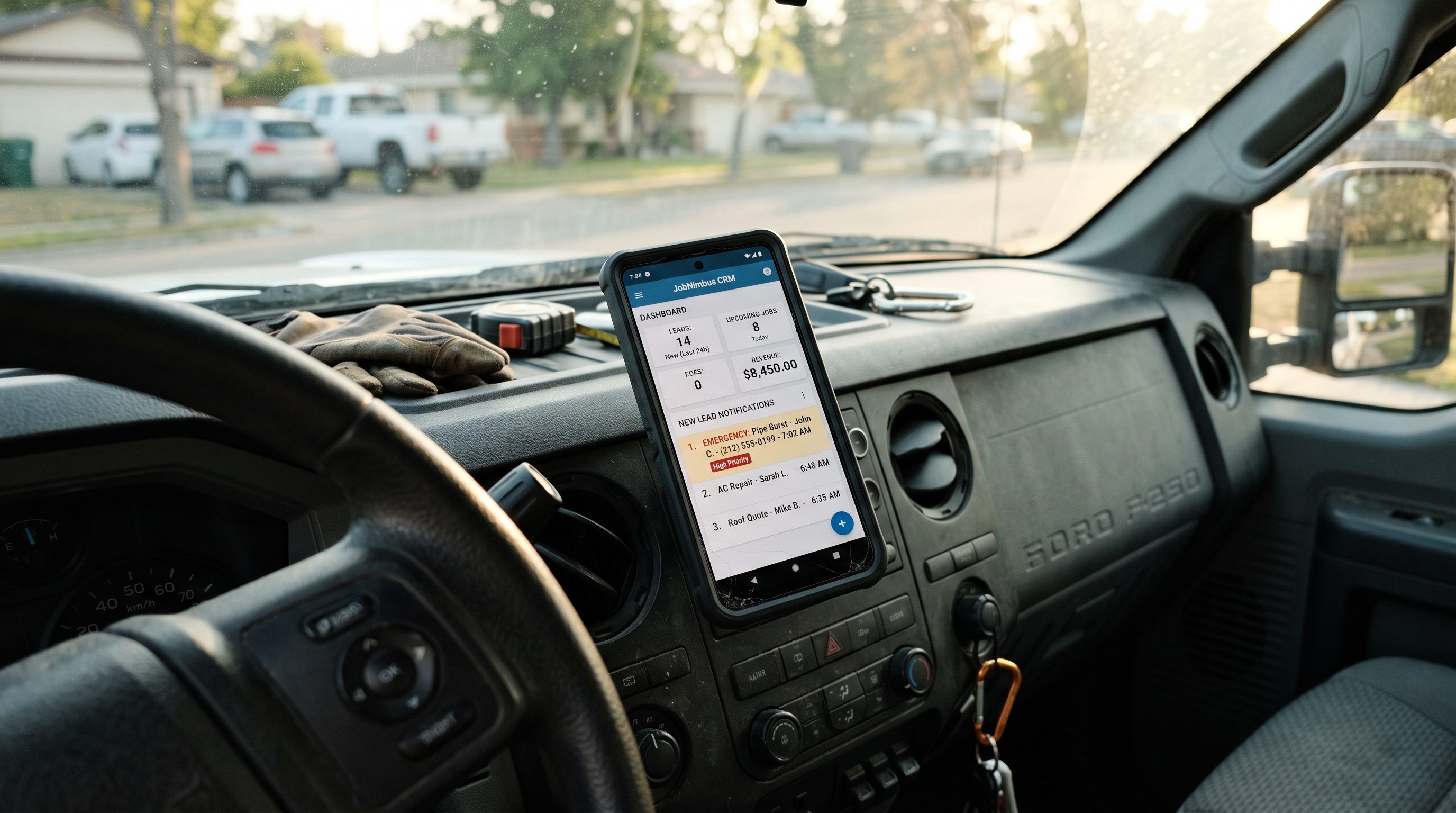
You don't have a marketing problem. You have a system problem.
Most owner-operators under $500K are doing the right things. The pieces just don't connect—and nothing compounds. Until you fix the system, every win is a one-off. Meanwhile your competitor with half your talent is pulling ahead because they have a procedure. DEMG.ai research shows that speed-to-lead is the #1 conversion driver: reply in 5 minutes, you close 9× more. Your team replies in hours. The good leads are gone.
I spent years in the engine room of Navy submarines. We didn't rely on heroics. We relied on the procedure. Every casualty drill was the same drill. Every operator could run it. That doctrine—procedure over personality: is how you scale under $500K without adding headcount.
Here's the 5-step marketing autopilot loop that actually works.
Step 1: Capture Every Lead Into One CRM
You're losing money every day your leads sit in email, text threads, and paper notes.
The first step is not advertising. It's capture. You need one source of truth where every lead lands: regardless of channel. Phone calls, web forms, social DMs, text inquiries. All of it flows into a single CRM.
The best tool for service businesses under $500K is GoHighLevel (GHL). It's a purpose-built CRM for local service providers. You own the data. The price is honest ($197/month baseline). And it talks to everything: your website, Google Ads, email, SMS, even your calendar.
Why this matters: Leadstra research found that most owner-operators are haunted by one of six scenarios. The most expensive is "founder bottleneck": every discovery, proposal, and close runs through you. The second most expensive is "the referral black hole": happy clients would refer you, but no system asks for referrals or captures them. A CRM solves both instantly.
Action: Spend 3 hours this week mapping your lead sources. Phone? Form? DM? Text? Each source needs a GHL integration or a manual rule. Once leads hit the CRM, they're operator-independent. You're not.
Step 2: Set Speed-to-Lead: Automate First Response
A response in 5 minutes crushes a response in 2 hours. The math is clear.
DEMG.ai documented this across real service businesses: speed-to-lead is the #1 conversion driver. Most small service teams reply when they remember. By then, the prospect has already called three competitors.
The procedure: automate the first response. You don't need a human in the first 5 minutes. You need a conversational AI agent that says, "Got it. Here's what happens next." It confirms the appointment request. It answers FAQs. It buys you time to qualify.
Tools: GHL has built-in SMS and email automation. For chat and DM automation, use ServiceAgent's AI agent system or DEMG.ai's conversational AI. The cost is negligible compared to lost leads.
ServiceAgent reported a 17.5% click-through rate on automated responses versus 1.9% for manual handling. That's the difference between a working system and a leaking pipeline.
Action: Pick your largest lead source. Build one automated response sequence. Test it this week. Measure response time. Aim for under 5 minutes from lead capture to first response.
Step 3: Build a Nurture Loop for the 30%
Your sales team closes the 10% who are shopping today. Good. But predictable revenue comes from the 30% who like you, aren't ready, and don't want a pitch.
This is where most service businesses fail. They chase cold leads instead of warming warm leads. They spend $4,000 a month on agencies trying to manufacture demand instead of $400 a month on email automation keeping interested prospects engaged.
The procedure is simple: segment your leads into three buckets.
- Shopping now (10%): Your sales team works these immediately.
- Interested, not ready (30%): Nurture sequences.
- Not your customer (60%): Don't chase them.
For the 30%, you need a 12-week email sequence that doesn't sell. It educates. It builds authority. It stays top-of-mind until they're ready. GHL has native email automation. DEMG.ai's AI content engine can generate subject lines and sequences. ServiceAgent can build Facebook and Instagram nurture workflows too.
Action: Audit your current leads. How many are shopping today? How many are interested but stalled? Build a 12-week sequence for the stalled group. Use templates from GHL or DEMG.ai. The content doesn't need to be perfect. It needs to run every week without you touching it.
Step 4: Automate Local Authority (Listings, Reviews, and Content)
When a prospect searches for your service type in your zip code, where do they land?
If the answer is "I don't know," you have a local authority problem. Your Google Business Profile is outdated. Your Yelp listing is missing reviews. Your website doesn't rank for local keywords. A prospect finds you by accident, not by design.
The procedure: automate what's repeatable. Listings, reviews, and content.
Listings: Google Business Profile and Yelp need to be correct and current. ServiceAgent automates GBP optimization, Yelp updates, review requests, and review monitoring. Cost: part of the platform fee. Return: higher local visibility, more calls.
Reviews: After every job, ask for a review. Then ask again. Most service businesses ask once and give up. Systematically asking for reviews: and following up with non-responders: lifts your rating 0.5 to 1.0 stars. That's a 15-20% lead lift at no acquisition cost.
Content: This is where DEMG.ai's AI content engine pays dividends. You need 3-5 pieces of local, keyword-rich content per month. Not a blog. Local landing pages and FAQ content that answers questions prospects are actually Googling. "How much does an HVAC service call cost in [your city]?" "Emergency plumbing near me." The AI engine generates these, you approve, they rank.
Action: This week, claim and optimize your Google Business Profile. Make sure your hours, phone, and address are correct. Next week, set up a post-job review request in GHL. Next month, decide: self-generate content or use DEMG.ai's content engine? Either way, publish 3 pieces of local content by the end of the month.
Step 5: Track ROI. Close the Loop.
No system runs without visibility. You need to know which channel produces leads. Which leads close. What the payback period is.
Most service businesses under $500K can't answer these questions. They spend $3,000 on Google Ads, $1,500 on a website, $800 on software, and can't connect any of it back to revenue. That's not a marketing problem. That's a measurement problem.
The procedure: wire everything to your CRM. Every lead source tags the lead with its source. Every closed deal is tracked in GHL. Every month, you know: which channel brought in the most qualified leads? Which conversion rate is highest? What's the payback period on paid ads?
ServiceAgent and DEMG.ai both offer attribution dashboards that do this automatically. GHL can do it with manual tagging. Pick one and run it.
Your math should look like this:
- Lead source: Google Ads, $1,200/month
- Leads from that channel: 12
- Conversion rate: 33%
- Closed deals: 4
- Revenue from those deals: $8,000
- Net profit (after service cost): $4,000
- Payback period: 10 days
If the payback period is under 14 days, you scale that channel. If it's over 30 days, you cut it.
Action: This week, add a "lead source" field to every contact in GHL. Tag the last 30 leads with where they came from. Next week, audit your closed deals and tag them with their source. Next month, you'll have real data.
ATLAS Model Connection
These five steps sit inside the ATLAS Model for Growth. ATLAS stands for Attention, Trust, Lead generation, Activation, and Scale. This autopilot loop is the "Activation" phase: turning interested prospects into customers at scale without founder involvement.
But it works because of the sequence. You can't activate at scale if you haven't captured leads systematically (Step 1). You can't nurture if you haven't built authority (Step 4). You can't scale if you don't know your math (Step 5).
The doctrine here is operator-independent systems. Freedom beats comfort. You'd rather have 4 hours a week reviewing dashboards than 40 hours a week chasing leads. The procedure gives you that freedom.
My Experience
I ran a nuclear submarine's reactor. We had three shifts, four operators, and one mission: don't let it fail. We didn't rely on the smartest operator. We relied on the procedure. Every shift ran the same casualty drill. Every operator could execute it without the captain. That's the only way you scale.
I've seen the same pattern in service businesses. The owner tries to be the system. Works fine at $50K revenue. Breaks at $200K. Explodes at $500K. The math doesn't work.
When I started the Angel Investors Network and later my own ventures, I learned that Dan Kennedy was right: the system is the solution, not the salesman. Marketing automation is the same. The tool isn't the bottleneck. The system is. When you have a documented procedure: lead capture, first response, nurture, authority, tracking: everything gets easier. You can hire someone to run it. You can sell the business with it. You can scale without burning out.
FAQ
Q: Isn't marketing automation impersonal?
No. Automation handles the repetitive parts so you can be personal where it counts. Your first response is an AI agent. Your nurture sequence is email. But your sales call is you: warmed up, qualified, and ready. The prospect has already decided they want to talk to you. Your job is to close, not to convince.
Q: What if my service business is totally local and offline?
The loop still works. Even plumbers, electricians, and HVAC contractors get leads from Google, their website, and referrals. All three feed the CRM. Phone calls come in. You automate the confirmation and qualification. The rest is the same. ServiceAgent specializes in home service businesses and reports 52 leads per quarter for clients who implement these systems versus 8 for those who don't.
Q: How much time do I need to spend running this?
Once it's set up, 4-6 hours per week. Setup takes 2-4 weeks. You're mapping lead sources, building sequences, setting tags. After that, you review metrics, approve content, and close deals. Everything else runs without you.
Q: What's the total cost?
GHL: $197/month. Email automation: included. AI agent for chat/SMS: $39-99/month (ServiceAgent or DEMG.ai). Content generation: $997-2,000/month if you use DEMG.ai's AI engine, or free if you write it yourself. Google Ads budget: $500-2,000/month depending on your market. Total: $1,700-4,300/month, all variable and all trackable to revenue.
Q: How long until I see ROI?
Your first response automation should improve speed-to-lead immediately. Your nurture sequences take 8-12 weeks to show results. Content authority takes 3-6 months. But if you set up attribution properly, you'll see ROI on paid ads within 30 days. The system compounds over time.
Disclosure
I'm an advisor to DEMG.ai and have professional relationships with several of the platforms mentioned here. I don't benefit from your choice of tool, only from your choice to have a system. The specifics matter less than the doctrine: every step is documented, operator-independent, and measurable. Pick the tools that fit your budget and your business. Build the procedure. Let the system work.
Freedom beats comfort. A procedure beats heroics. That's the only way you scale.
Jeff Barnes is the founder of demg.ai and Digital Evolution Marketing Group. This article represents his analysis and does not constitute professional advice. Verify all claims independently.