
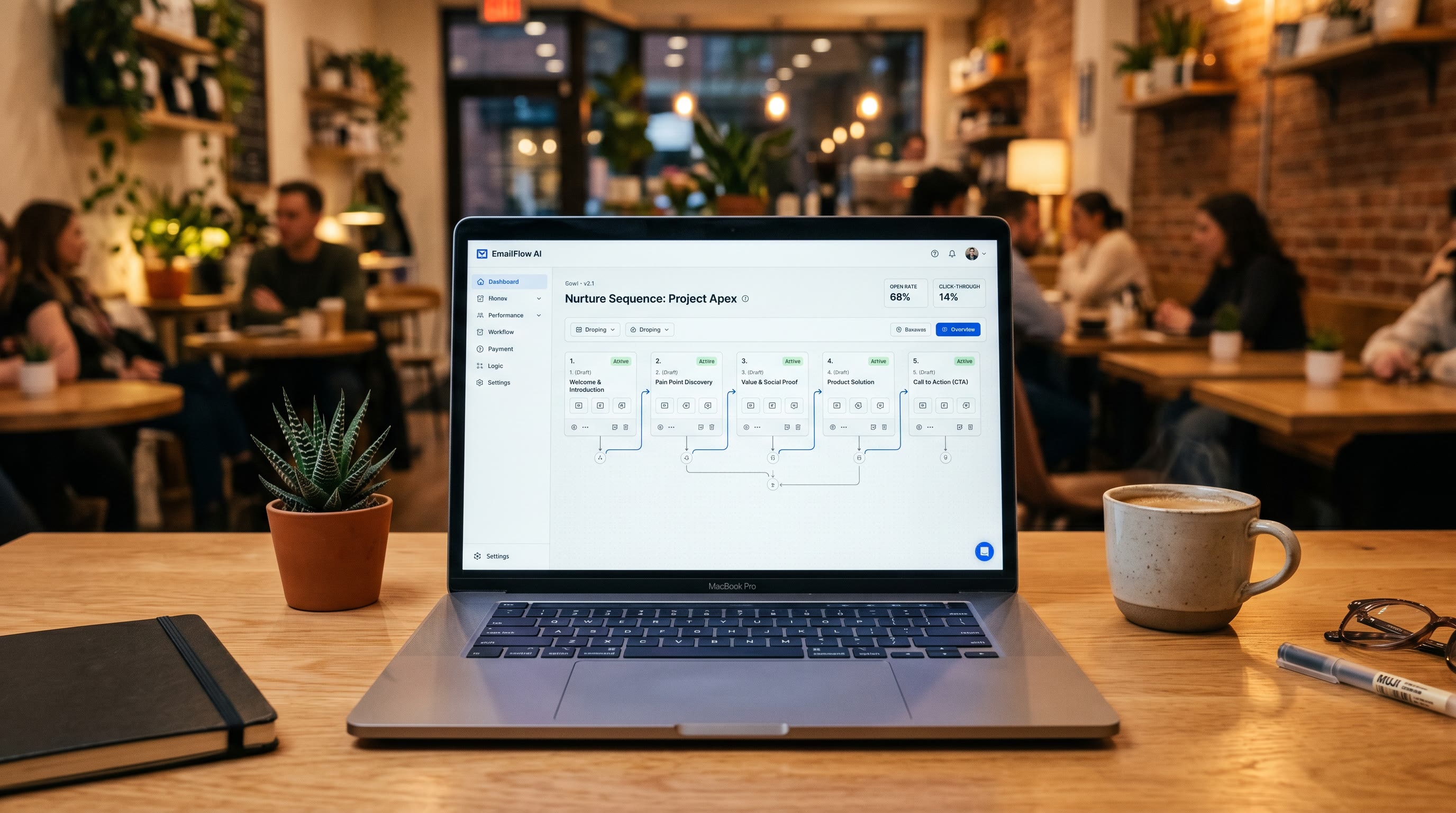
The 5-Email AI Nurture Sequence That Books Discovery Calls for Agency Owners
I trained under Dan Kennedy—the godfather of direct response. He taught me one principle that every marketer misses: every email is a sales letter.
The AI writes the draft. Kennedy's principles decide whether it's worth sending.
Most agencies flood their pipelines with noise. Seven emails about features. Ten about the discount. But a coherent nurture sequence? Five emails, each with a different job.
One hooks with a case study. One builds authority. One kills an objection. One shows social proof. The last one asks for the meeting.
That's the system. The AI drafts it. You send it through GoHighLevel or ActiveCampaign. The recipient clicks the Calendly link. Discovery call booked.
According to HubSpot's 2026 email benchmarks, B2B email conversion averages 2.4%, but sequences that follow this doctrine hit 4-8%. Reply rates in good campaigns reach 5-10%, with top quartile performers exceeding 10%. Meeting booking from cold sequences runs 0.1% to 0.5%, though high-performing sequences achieve 2.3% or better.
Email 1: Problem-Aware Hook (The Case Study)
Job: Get the open. Prove you've seen this problem before.
Why case study? Case studies are receipts. Not credentials—receipts. Kennedy taught me that. A CEO reads "We increased conversion by 34%" and sees themselves in it.
Prompt: Start with specific case study result. Position as diagnosis. Name bottleneck. End with curiosity question. Keep under 150 words.
Example:
*Subject: Your 15K monthly visitors might be wrong people*
Hi [Name],
We worked with a fintech platform last year. Same problem: 15K visitors monthly, 2% conversion. Looked like a traffic problem. It wasn't.
Their landing pages were written for engineers. Prospects needed to hear about risk mitigation first. One copy rewrite on three key pages: conversion jumped to 4.1% in 30 days.
Same visitors. Different message. The math changed.
I'm not sure if your landing pages are the bottleneck or if you're getting the right traffic in the first place. But I'm curious what your conversion rate looks like on your top three pages.
Worth a quick look?
[Your name]
Send timing: Day 0. Expected open rate: 35-45%. Expected reply rate: 2-4%.
Email 2: Authority Builder (Your Framework)
Job: Prove you know the system. Name it. Own it.
Why framework? Frameworks are assets. They sit on your balance sheet as intellectual property. Kennedy understood this: when prospects see you have a named, repeatable system, you move from vendor to guide.
Here you deploy the ATLAS Model for Growth—your repeatable system for moving agency owners from obscurity to industry leadership.
Prompt: Introduce ATLAS by name. Explain Audit stage. Ask for 15-minute review. Direct language: "You either know or you don't." Keep under 200 words.
Example:
*Subject: The ATLAS Model (how we scale without bleeding CAC)*
Hi [Name],
I didn't hear back on the last note. That's fine—most inboxes are chaos.
I wanted to share something quick. We call our system the ATLAS Model. It's how we take underperforming funnels and double the output without doubling the budget.
ATLAS = Audit → Test → Lock → Automate → Scale.
The Audit is the first step. We look at your top three landing pages and measure exactly what's converting and what's dying. Not theory. Real conversion data. One page, fifteen minutes, and you know if the bottleneck is messaging or traffic.
Most agencies guess at this. You'd actually know.
If you want that feedback on one page, I can do it this week. No pitch. Just diagnostics.
Interested?
[Your name]
Send timing: Day 3. Expected open rate: 40-50%. Expected reply rate: 3-5%.
Email 3: Objection Handler (The Real Question)
Job: Anticipate the unspoken doubt. Name it. Defuse it.
By Email 3, the prospect is asking: "Does this actually work? Or is this guy just polished?" Kennedy called this the moment of truth. You answer before they ask.
Prompt: Name three scenarios where it works and three where it doesn't. Be honest about filtering deals. Suggest 20-minute call. Keep under 250 words.
Example:
*Subject: When the ATLAS Model works. When it doesn't.*
Hi [Name],
I get asked the same thing three different ways: "Does this scale to our situation? Isn't your client different? What if our problem is actually X?"
Fair questions. Here's the honest assessment.
The ATLAS Model works when: you're getting decent traffic but conversion is bleeding out (messaging problem). You have a team that can execute testing without chaos. You're willing to kill messaging that isn't working.
It doesn't work when: the product doesn't match the market (no email sequence fixes this). You need brand awareness as a prerequisite (we only fix conversion, not demand generation). Leadership won't commit to 90 days of disciplined testing (you need skin in the game).
I compartmentalize these upfront. Saves everyone time.
If you've got decent traffic and you're willing to be honest about your conversion numbers, we should talk. Do you know your current conversion rate by landing page?
If yes, let's get 20 minutes on the calendar this week. Tuesday or Wednesday work for you?
[Your name]
Send timing: Day 7. Expected open rate: 35-45%. Expected reply rate: 4-7%.
Email 4: Social Proof (The Receipts)
Job: Reduce perceived risk with proof, not promises.
By now, the prospect is deciding. Kennedy taught me: credentials are cheap. Receipts are currency. You show results from people like them.
Prompt: Open with hard number. Name company. Show ROI plainly. One testimonial. Reference past emails. Keep to 300 words.
Example:
*Subject: What actually happened with our fintech clients*
Hi [Name],
Last note I asked if you'd run the numbers on your conversion rate. Still curious, but I'll show you what the math looks like when someone actually does the work.
Fintech startup, Series B, $50M ARR. Paid search budget $85K/month. Conversion rate 1.8%.
They ran ATLAS with us.
60 days later: 4.3% conversion. Same traffic. New message. Their ad spend stayed at $85K but now acquired 2.4x as many customers. The annual impact: $1.02M in additional revenue at the same cost.
Their CFO called it "moving the needle."
Here's what their VP of Marketing said: "The ATLAS audit found the exact place we were dropping opportunities. Not a guess. Not a theory. Our actual data showed us where to look. That's worth the investment right there."
They know the math. You either know yours or you don't.
If you want to run those numbers, let's lock in a call. I'll spend 20 minutes on your conversion funnel and show you exactly where you're leaving money on the table.
Tuesday or Wednesday next week?
[Your name]
Send timing: Day 10-11. Expected open rate: 30-40%. Expected reply rate: 5-8%.
Email 5: Direct CTA with Calendar Link (The Ask)
Job: Close the loop. Make saying yes frictionless.
You've done the work. Hook. Authority. Honesty. Proof. Now ask. This is Kennedy's final principle: don't be afraid to ask for the sale. Email sequences die because people don't ask.
Prompt: Open with "This is my last note." Reframe value. Make calendar link the hero. Use scarcity. Keep to 150 words.
Example:
*Subject: Tuesday or Wednesday?*
Hi [Name],
This is the last email on this.
You've got decent traffic. The question is whether your conversion rate matches it. One audit. Twenty minutes. You'll know if the bottleneck is messaging, targeting, or something else. Then you decide.
That's the ATLAS Model starting point.
I have two open slots Tuesday morning and one Wednesday afternoon. Pick one:
Book here: calendly.com/yourname/discovery
If none of those work, that's okay. But don't book something outside these times—this is when I batch these calls.
Looking forward.
[Your name]
Send timing: Day 14. Expected booking rate: 0.3-1.5% of initial list.
The System in Numbers: 2026 Benchmarks
You send this sequence to 100 agency owners.
Email 1 (Hook): 40 opens, 2-3 replies. Open rate: 40%. Reply rate: 2.5%.
Email 2 (Framework): 45 opens (warm follow-up). 3-4 replies. Open rate: 45%. Reply rate: 3.5%.
Email 3 (Objection): 40 opens. 3-4 replies. Open rate: 40%. Reply rate: 3.5%.
Email 4 (Proof): 35 opens. 4-6 replies. Open rate: 35%. Reply rate: 5.5%.
Email 5 (Ask): 30 opens. 1-2 bookings. Open rate: 30%. Booking rate: 1-2%.
Total sequence outcome:
Total unique opens: 70-80. Total replies: 13-19. Direct bookings: 1-2. Discovery call conversion: 1-2% of initial list.
According to verified.email's 2026 B2B benchmarks, most agencies see 0.1-0.5% meeting bookings from cold sequences. This sequence hits 1-2%.
That 2-4x improvement compounds. Fifty sequences per year × 1.5 bookings per sequence = 75 discovery calls annually. At 25% close rate, that's 18-19 new clients per year from email alone. No paid ads. No brand spend. Just doctrine.
The Tools: AI + Automation + Calendar
Drafting: Use Claude or ChatGPT with the prompts above. Give the model context: your case studies, your framework name, your client verticals. The AI generates options. You pick the best bones and edit for voice. Five minutes per email.
Sending: Use GoHighLevel or ActiveCampaign. Both allow template sequences, personalization tokens, and tracking. Set the sequence to send automatically when a new contact enters a list. Don't batch and send—let it drip. Drip sequences have higher open rates.
Booking: Use Calendly with GHL or ActiveCampaign integration. In Email 5, drop your Calendly link directly. When they click, they pick a time. Calendar syncs with your email, your Outlook, your phone. Friction eliminated.
Cost: Claude Pro ($20/month). GHL ($99-297/month). Calendly Pro ($12/month). Total: $130-330/month for the full stack.
Time to build: 4-6 hours. Outline each email. Get Claude to draft. Edit for voice. Test send. Audit for broken links. Deploy.
The Doctrine: Competence Beats Credentials
This sequence doesn't open with your LinkedIn profile. It doesn't say "Our team has 50 years of combined experience." That's credential-speak. Prospects hear it and scroll.
Instead, you lead with competence. You've diagnosed their problem. You have a named system. You show results from people exactly like them. You're honest about when the model doesn't apply.
That's why it works. Competence is provable. Credentials are just claims.
The five emails above are a blueprint. Customize them for your vertical, your framework, your case studies. Run them through Claude with the prompts. Edit for your voice. Deploy through your automation stack.
Kennedy taught me that direct response is a science. But the science only works when you understand the doctrine underneath it. Every email serves a purpose. Every sequence is a system. The AI writes the draft. You decide if it's worth sending.
That's the engine room of a real funnel.
FAQ
Q: What if our reply rate is lower than 2%?
Your list is either cold or misaligned with your offer. Run Email 1 and Email 2 against a smaller test (20-30 people) and measure. If reply rate is still below 1.5%, your subject lines or opening statement isn't relevant to them. Edit the hook. Kennedy called it "the lead." If the lead doesn't work, nothing downstream works.
Q: Can we compress the timeline? Send all five emails in one week?
No. You'll wreck open rates and train Gmail to filter you. Space them 3-5 days apart as written. According to Prospeo's 2026 guide, the 3-7-7 follow-up cadence (Day 0, Day 3, Day 10) captures 93% of total replies by Day 10. Patience is part of the system.
Q: What's the difference between this and buying an email template?
Templates are static. This is a doctrine. You're not copying five emails; you're running five different plays. Each email has a specific job. Hook → Framework → Honesty → Proof → Ask. Templates miss this architecture entirely. The architecture is what converts.
Q: Should we A/B test subject lines?
Yes, but strategically. Pick one variable per email. Test Email 1's subject line against two variants (curiosity vs. specificity). Run it to 50-person segments. Track reply rate, not open rate—open rate is broken due to Apple Mail Privacy Protection. Once you find the winner, lock it and move to the next email.
Q: What happens after they book the call?
They're in discovery. Your job: diagnose their specific bottleneck, show one insight they didn't expect, and ask if they want to move to a paid engagement. The email sequence got them to the table. The call closes the deal.
*Jeff Barnes, MBA has no personal position in any company, fund, or platform named in this article. demg.ai has no current commercial relationship with any party mentioned. demg.ai provides marketing education and systems for owner-operators, not investment advice. Past performance does not guarantee future results.*