
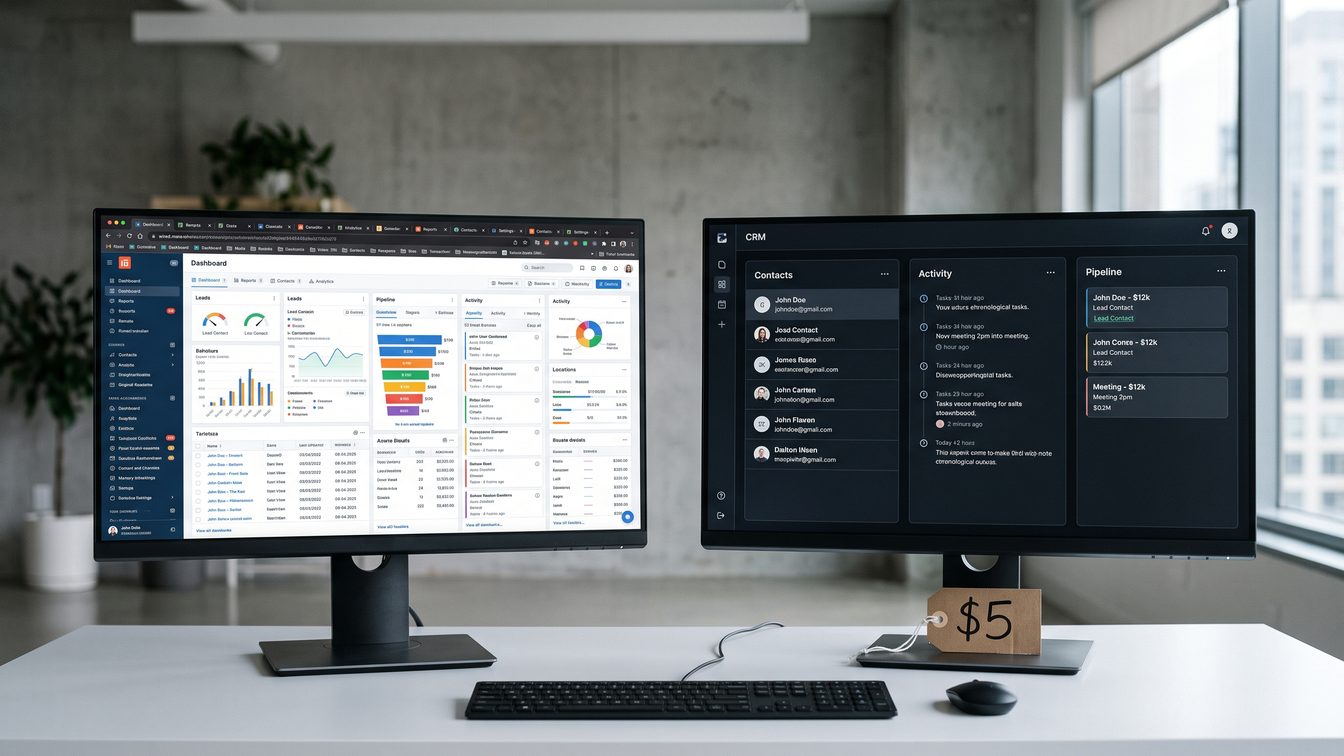
A CRM that costs $150 a month per seat and a CRM that costs $5 a month now do roughly the same job for a business under $5M in revenue. That gap is not a rounding error. It is a line on your P&L that a private equity buyer will find in due diligence, and it will lower your multiple if you don't find it first. This is the 90-Day Bottleneck Audit: a discipline for finding every dollar of software spend that survives on inertia instead of function.
I spent eleven years running engine rooms on a nuclear submarine. Every gauge, every valve, every system had a purpose and a cost. If a piece of equipment was still drawing power and nobody could tell me why, that was a casualty waiting to happen. Nobody signs off on a system they can't explain. Ships don't run on habit. Businesses shouldn't either.
That's the frame I bring to a $5 CRM story that most owner-operators will scroll past.
What Actually Happened
Saleoid launched a full-featured AI CRM in 2026 priced at $5 a month, billed over a two-year term (Entertainment Paper). Not a stripped starter tier. The base plan includes AI-powered lead scoring, built-in email and SMS outreach, appointment scheduling, custom dashboards with advanced filters, roles and permissions, a 360-degree customer view with full activity history, and five automations. Additional users cost $6 each. Additional features can be added a la carte at $1 per app, so a business pays only for what it uses instead of buying a bundle built for a company ten times its size.
Compare that to where the category has been living. HubSpot's Sales Hub Enterprise runs $150 per seat, per month, billed annually (HubSpot). Salesforce's Sales Cloud spans $25 to $550 per user, per month depending on tier, with Agentforce add-ons starting at $125 per user on top of that (Salesforce). A 20-person team on Salesforce Professional runs $3,300 to $6,600 a month before add-ons; the same headcount on a modular, AI-native platform can run a small fraction of that (monday.com).
I'm not telling you to rip out your CRM tomorrow. I'm telling you the pricing floor for CRM functionality just fell through the deck, and most operators haven't noticed because they've never looked at the invoice with fresh eyes.
Why This Matters More Than a Software Bill
Here's the doctrine point. When the tools you pay $150 a month for become available at $5 a month with comparable features, your tech stack stops being a differentiator. It becomes overhead. A moat is something a competitor can't easily replicate. A $150/seat CRM that a $5/seat competitor can match feature-for-feature is not a moat. It's a subscription you've been paying out of habit, the same way a submarine draws housekeeping power to a panel nobody's touched in years.
This is not just a software story. It's an exit story.
Private equity buyers and strategic acquirers run operational due diligence on every material software contract before they close. One audit of PE-backed technology reviews found that many mid-market firms have no central oversight of software spend at all, what advisors call "shadow IT," where finance doesn't even know how many active subscriptions exist (HedgeThink). A separate benchmarking firm found that 78% of target companies' enterprise software contracts are priced more than 20% above what a well-informed buyer would pay in a standalone negotiation, with the gap between "what you pay" and "market rate" running 20-40% on major contracts (VendorBenchmark). IT due diligence specialists report that over 60% of PE deals hit unexpected technology issues post-acquisition precisely because nobody looked closely enough before close (RJK).
Every dollar of unnecessary software spend does two things to your business. It reduces cash flow today. And when a buyer runs their Quality of Earnings review, it either gets challenged as an add-back you can't defend, or it gets left in as a recurring cost that drags on your Adjusted EBITDA. Either way, it's a lever the buyer pulls, not you.
Sellers who show up to a sale process with a clean, defensible cost structure consistently close 8-15% higher in enterprise value than sellers who don't, according to M&A advisory research on EBITDA normalization ($1.4M of value on a $3M EBITDA business at a 6x multiple, from documentation alone) (Glacier Lake Partners). That's not a hypothetical. That's the difference between an owner who ran a casualty drill on their own P&L and one who waited for the buyer's QoE team to run it for them.
The 90-Day Bottleneck Audit
I built the 90-Day Bottleneck Audit for exactly this problem: operators who are too close to their own systems to see where the waste has compounded. It's not a cost-cutting exercise. It's a doctrine review. Three questions, applied line by line to every software subscription on your P&L:
Which line items exist because you chose them, and which exist because you never looked? Pull every SaaS invoice from the last 90 days. For each one, ask who owns the decision to keep paying it. If nobody can answer in under ten seconds, that's the first casualty flag.
What does this tool actually do that you can't get for a tenth of the price? Not what it did five years ago when you signed the contract. What it does today, against what's available today. The CRM market moved. Has your contract moved with it? A modular, pay-per-feature pricing model, the kind Saleoid and a growing wave of AI-native tools are shipping, means you can now buy exactly the functions you use instead of a bundle designed to upsell you.
If a buyer audited this line item in six months, would it survive? This is the question that changes behavior. Owners who write this question into their monthly ops review stop treating software renewals as autopilot and start treating them as capital decisions.
Run this audit on your CRM, your project management tool, your accounting software, your marketing stack, and your communications platform. In my experience running this with owner-operators in the $500K-$5M range, the CRM and marketing stack are almost always where the fat lives, because those are the tools sales reps and marketers request without ever bringing to the owner for a second look.
An Anecdote from the Engine Room
On the boat, we ran casualty drills constantly, not because we expected a casualty every day, but because the drill was the only way to know, with certainty, which systems mattered and which ones were dead weight dressed up as redundancy. I remember a junior officer who wanted to keep a backup system running "just in case," even after we'd proven three times over that the primary covered the load. It felt safer to leave it running. It wasn't. It was drawing power, adding failure points, and giving the crew a false sense of security about a system nobody actually understood anymore.
That's what a bloated software stack looks like from the outside. It feels safer to keep paying for the enterprise CRM because you've always paid for it. But "always paid for it" is not the same as "needed." An acquirer will treat the difference as an advantage on their side of the table. You should treat it as an advantage on yours, six months before they ever see your books.
The Watchstander's Habit
On a submarine, watchstanding means someone is always accountable for a system, on a rotation, with a signature and a timestamp. Nobody drifts into "I think that gauge is fine." Somebody checks it, logs it, and owns the reading. Most small businesses run their software stack with no watchstander at all. The CRM was set up by an employee who left two years ago. The marketing automation tool was chosen by a contractor. The accounting software runs because the bookkeeper likes the interface. Nobody is standing watch on whether any of it still earns its keep.
Put a watchstander on your tech stack. It doesn't need to be complicated: one person, one spreadsheet, one line per subscription, reviewed on a fixed calendar cadence. The moment ownership is assigned, the casualties start showing up on their own. You'll find the $40-a-month tool nobody uses, the duplicate scheduling app two departments both pay for, the CRM tier you upgraded into during a growth spurt and never downgraded out of once growth slowed.
Sovereignty, Not Just Savings
The deeper doctrine here connects to what I call the Sovereignty Stack: the idea that an owner-operator should never be structurally dependent on a system, a vendor, or a person they can't replace on their own terms. Enterprise software vendors have built entire business models on making that dependency feel permanent. Land at a low price, expand into every workflow, then raise the price once switching costs more than staying (Cloud Secure Tech).
Commoditization breaks that model, but only for the operators who notice it. A $5 CRM doesn't automatically make you sovereign. It makes sovereignty affordable, if you do the audit and act on it. The businesses still paying $150 a seat for functionality available at $5 aren't loyal customers. They're the ones subsidizing everyone else's price war.
Doctrine Connection: The Owner's Exit Engine
Every dollar you save on commoditized software is a dollar that flows straight to your bottom line, and every dollar of EBITDA compounds at your exit multiple. That's the Owner's Exit Engine in miniature: operating discipline today converts directly into enterprise value at sale. A buyer doesn't pay you for what your business spent. They pay you for what your business earns, cleanly and repeatably, without them having to fix it first. Run the 90-Day Bottleneck Audit on your tech stack this quarter. It's the cheapest multiple expansion you'll ever execute.
FAQ
Q: Is a $5 CRM actually good enough to replace an enterprise platform? For most owner-operators under $5M in revenue, yes, for core functions: contact management, lead scoring, email and SMS outreach, and basic reporting. Enterprise platforms earn their price at scale, with complex sales organizations, deep customization needs, and dedicated administrators. Below that scale, you're often paying enterprise price for small-business use.
Q: How do I know if my current CRM spend is a bottleneck? Run the 90-Day Bottleneck Audit: pull every invoice, name an owner for each renewal decision, and compare current functionality against current market pricing, not the pricing you signed at. If a tool's price has stayed flat while the market's price for the same function dropped, you're overpaying.
Q: Will PE buyers really care about a few hundred dollars a month in CRM fees? They care about the pattern, not the single line item. A software stack full of unaudited, above-market contracts signals an operator who doesn't run financial discipline, and buyers price that risk into the multiple across the whole deal, not just the software line.
Q: What's the difference between cutting costs and building an exit-ready system? Cutting costs is reactive. Building an exit-ready system means every recurring expense has a documented owner, a documented reason, and a documented market comparison, refreshed on a schedule. That's a system a buyer can trust without re-auditing it themselves, and trust is what protects your multiple.
Q: Should I switch CRMs just because a cheaper option exists? Not automatically. Switching costs, data migration, and team retraining are real. The doctrine move is to quantify the gap between what you pay and what the market now charges for the same function, then decide deliberately, not out of inertia and not out of impulse.
*Jeff Barnes has no personal position in any company, platform, or tool named in this article. DEMG provides marketing systems and education, not investment advice.*