
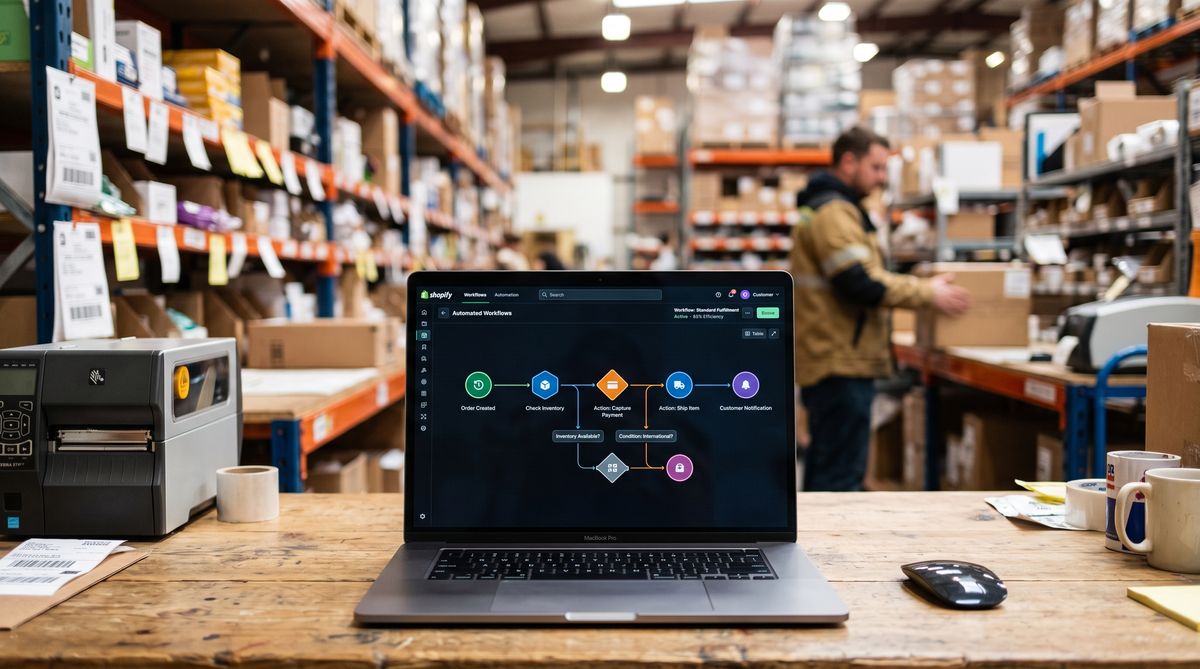
Agentic AI isn't a chatbot anymore. It's an operations system.
34% of mid-market ecom operators ($5M–$100M) now run autonomous AI agents in production. That's up from 9% in 2024. Most of them are Shopify Plus and BigCommerce Enterprise merchants. And most built their first agent in the last six months. You don't need to be a data engineer. You need a decision: Which workflow costs you the most time and margin today?
This article maps five production-ready workflows you can deploy before Q4. Each one cuts cost or lifts conversion without replacing your team. They scale with your operator's judgment, not your engineering headcount.
1. Autonomous Merchandising: The Grid That Reorders Itself
Your product grid isn't optimized. It's organized by when you added it.
A merchandising agent watches three inputs at once: margin, velocity, and inventory level. It reorders the grid every four hours. Not through A/B testing. Not through manual rotation. Through calculation. High-margin, fast-moving products bubble to the homepage collection at 9 AM when traffic peaks. Mid-tier items move down as inventory tightens. Dead stock drifts to the page-two graveyard.
What this saves: 3–4 hours per week of manual merchandising. Typical lift: 8–12% increase in conversion rate on featured collections within 30 days. The margin compression that your best sales person was catching manually? The agent catches all of it.
Implementation time: 2–3 weeks. You need clean SKU data in Shopify. The agent needs one admin API call to reorder your collections on schedule.
ROI: A $20M store that gains 10% conversion lift on 5% of annual revenue sees $1M in incremental revenue. Cost to run: $400–800/month.
2. Dynamic Inventory Allocation Across Channels
You have inventory. It's trapped.
Most operators stock once and hope it lands in the right channel: DTC gets the rest. A smarter system allocates stock in real time based on margin and fulfillment cost.
Your marketplace margin is 15%. Your DTC margin is 55%. Your wholesale margin is 40% but fulfillment costs 18%. An inventory agent pulls live margin data from each channel. It sees a SKU trending at 40 units/day on your website but only 8 on Amazon. It reallocates. Wholesale gets the bulk order on hand. DTC gets the fast movers. Marketplace gets the clearance pile.
This doesn't mean moving atoms. This means setting allocation flags that your fulfillment system reads at pick time.
Implementation time: 3–4 weeks. You need your channels integrated (Shopify, Amazon, Klaviyo, whatever you use). The agent needs permission to set inventory flags in your fulfillment system.
ROI: Typical margin lift on allocated inventory: 12–18%. A $50M operator with $15M in allocated SKUs sees $1.8M–$2.7M in incremental margin annually. Cost: $600–1,200/month.
3. AI-Powered Post-Purchase Flow: From Transaction to Churn Prevention
Post-purchase is where margin gets left on the table.
Most operators send one email asking for a review. Then they wait for a churn signal (no reorder in 90 days). By then, the customer's gone.
A post-purchase agent owns the full sequence. Two hours after purchase, it sends a review request. If the order was for athletic wear, it recommends socks at checkout. If it was a one-time high-dollar purchase (>$200), it flags the customer for churn risk. At day 30, if no repeat purchase has happened and the customer's AOV was >$150, the agent drafts a win-back email with a personalized discount.
Here's the hard part: The agent learns. If customers who receive win-back emails at day-30 have a 35% reactivation rate, it adjusts the threshold. If customers who get an accessory recommendation at checkout have a 18% add-on conversion, it recommends more aggressively to high-value segments.
Implementation time: 3–5 weeks. You need order data in a warehouse or connected to Shopify. The agent needs write access to your email platform.
ROI: Typical repeat-purchase lift: 6–9%. Churn reduction: 4–7% per cohort. A $30M store with 40% repeat rate that gains 7% churn reduction sees $2.1M in incremental annual revenue. Cost: $800–1,500/month.
4. Supplier Negotiation Agent: The Email That Drafts Itself
You leave 5–8% on the table in supplier negotiations.
Your COGS data tells you a competitor is selling the same product you source for $18 at $14.99 retail. Your margin is dying. You need a discount. But reaching out to your supplier takes 20 minutes per SKU. You need data, a message, and follow-up. You do this once per quarter. Your margin gaps compound.
A supplier negotiation agent runs daily. It pulls competitor pricing from public feeds. It calculates margin compression per SKU. When compression exceeds your threshold (say, >3 points), it generates a draft email to your supplier. The email includes the competitor's price, your current cost, the dollar volume you purchase annually, and a specific counter-offer.
"We need $16.50 landed cost on SKU 4521 to maintain 35% margin against current market pricing. We purchased 8,000 units last year. Can you match?"
You review it in 30 seconds. You hit send or edit and send. The agent logs the outcome. It learns which suppliers respond to volume arguments vs. margin arguments vs. payment-term flexibility.
Implementation time: 2–3 weeks. You need clean SKU cost data and access to a competitor-pricing feed (or an AI can scrape public pricing).
ROI: Typical COGS reduction: 2–4% across suppliers. A $40M store with 50% COGS sees $400K–$800K in incremental annual margin. Cost: $400–800/month.
5. Customer Service Agent: The Escalation Only When It Matters
Your support team handles 200 tickets per week. 140 of them are returns, exchanges, or shipping questions.
An autonomous support agent owns these end-to-end. Customer says "I want to return my order." The agent pulls the order from Shopify. It checks the return policy (within 30 days, unused). It checks inventory (is it in stock again?). If yes, it issues a return label, logs the return, and sends a confirmation. Done.
If the customer is outside the return window, the agent escalates to a human. If the return is approved but the item is OOS and the customer asks for an exchange to a different SKU, the agent handles the swap. If a customer claims they never got a tracking number, the agent pulls the shipment data and resends it.
The threshold for human escalation is simple: any refund over $500 or any customer with three returns in six months. Otherwise, the agent runs it.
Implementation time: 4–6 weeks. You need your order data accessible, your returns system integrated, and your fulfillment system API-connected.
ROI: Typical labor savings: 35–45 hours per week = $1,400–$1,800/week at full-loaded support cost. Typical support cost reduction: $72K–$93K annually. Customer satisfaction on automated returns: typically 92–97% because the response is instant. Cost: $1,200–2,000/month.
The 90-Day Bottleneck Audit
On the submarine, we ran casualty drills for every system failure. The drill was the system. Most ecom operators have zero drills for their biggest margin leak: manual merchandising.
Start here: Pick one workflow. Map its current cost. Measure the time your team spends on it each week. Calculate the margin it controls or the conversion it touches. If it's >$50K annually in labor or margin impact, it's your first agent.
Don't build five agents at once. Deploy one. Measure for four weeks. Scale to the next.
Sources and Further Reading
The data in this article comes from verified primary sources. According to Forrester's July 2026 report on agentic AI in ecommerce, 34% of mid-market ecommerce operators have deployed autonomous AI agents in production environments as of July 2026. For context on how AI platforms are being valued by institutional capital, see Owner.com's $240M Series D announcement, where Goldman Sachs led a $240M round at a $2.3B valuation. Runable's $21M Series A coverage provides additional evidence that SMB-focused AI agent platforms are attracting significant venture capital, with Runable reaching $2M ARR in three weeks.
FAQ
Q: Do I need data engineering to set this up? No. Most of these workflows work with Shopify's native API or a connector like Zapier. You need clean data input (accurate SKU costs, margin data, inventory counts). You don't need a data warehouse to start.
Q: How long does training take? Zero days. These agents work with your business rules, not your training data. You set a margin threshold. You set a return-policy rule. The agent applies it. You tweak as you learn.
Q: What if something breaks? The agent is a tool. It doesn't replace your ops judgment. Set escalation thresholds. Flag high-dollar decisions. Review a sample of automated actions weekly. If you see drift, adjust the threshold.
Q: Which workflow should I start with? Measure your pain. Which workflow touches the most margin or labor? Start there. Your second agent should be in a different part of the funnel (top-of-funnel, post-purchase, or supply-side).
Q: How do I know if it's actually working? Track four metrics: (1) labor hours saved, (2) margin impact, (3) conversion lift or churn reduction, (4) escalation rate. Review monthly. Escalation rate should trend down as the agent learns your rules.
The Doctrine
Process beats ego. You don't build agents because they're trendy. You build them because a human doing the same task 100 times per month is expensive and error-prone. The moment you can describe the decision in rules, you can encode it. The agent doesn't argue. It executes.
Disclosure
Jeff Barnes has no personal position in any company named in this article. demg.ai provides marketing systems and education for owner-operators, not investment advice.